
Case Study

Resilient Under Pressure. Operational After Attack
A strategic white paper detailing how to construct a Digital Jump Bag™ to establish a Minimum Viable Response Capability (MVRC) during destructive cyberattacks. It provides a blueprint for rapidly deploying an isolated clean room to investigate threats, avoid reinfection loops, and safely restore core business operations.
- Topic
- Security
- Published
- 9 Oct 2026
During destructive cyberattacks such as ransomware or wiper incidents, adversaries routinely evade endpoint detection (EDR/XDR) and target critical infrastructure-including identity services, communication channels, and physical access controls. When traditional security tools are isolated or rendered unreachable, response teams are left without the visibility or assets needed to investigate "patient zero" or eliminate attacker persistence.
The Digital Jump Bag™ framework resolves this vulnerability by serving as a protected, trusted repository of essential tooling, golden images, network configurations, playbooks, and emergency communication setups. Integrated within the Cohesity Clean Room solution, it enables organizations to rapidly establish a Minimum Viable Response Capability (MVRC). This structured approach allows Security Operations to safely investigate threats in an isolated environment while IT Operations rebuilds or cleans workloads-breaking the cycle of reinfection and ensuring a secure, predictable recovery.
Key Highlights:
Minimum Viable Response Capability (MVRC): Establishes the core set of essential tools, configurations, and workflows required to contain breaches and manage response without relying on compromised production infrastructure.
Overcoming EDR/XDR Evasion: Addresses the critical flaw where Ransomware-as-a-Service (RaaS) platforms evade endpoint controls or cut off investigation teams when infected networks are isolated.
Breaking the Reinfection "Doom Loop": Prevents organizations from repeatedly restoring compromised environments by conducting thorough root-cause forensics and threat eradication prior to production deployment.
Accounting for Secondary Outages: Prepares organizations for real-world attack conditions where VoIP, email servers, physical building access, and identity systems are disabled simultaneously.
4-Stage Clean Room Architecture: Maps incident response to a structured lifecycle-Prepare, Initiate, Investigate, and Mitigate-within an isolated clean room environment.
Clear SecOps & ITOps Ownership: Assigns SecOps ownership of the Investigation environment (forensics, threat hunting) and ITOps ownership of the Mitigation environment (rebuilding, patching, functional testing).
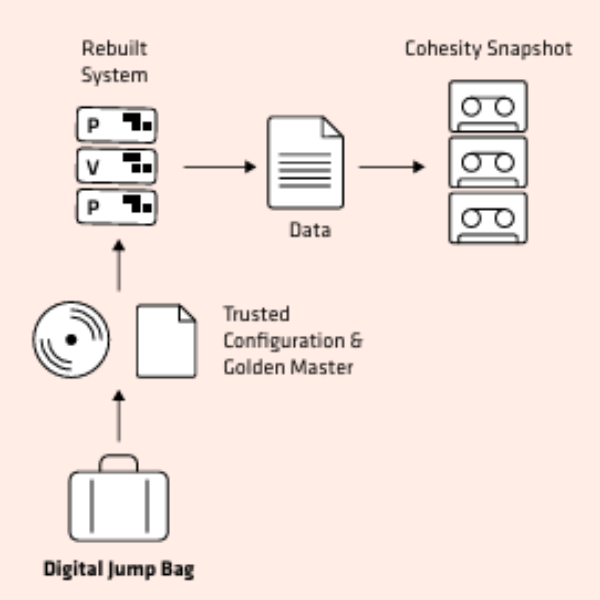
Dual Recovery Strategies: Delivers the flexibility to either "Recover and Clean" snapshots or "Rebuild to a Trusted State" using golden master images and automated scripts stored in the jump bag.
Comprehensive Jump Bag Contents: Outlines essential digital assets including license keys, firmware, Ansible/Terraform scripts, network diagrams, and emergency communication configurations.
Passive, Evasion-Proof Threat Hunting: Leverages native Cohesity file system forensics and data classification, which operate passively on secondary storage without alerting adversaries or triggering endpoint evasion.
Alignment with IR Frameworks: Fully aligns with established industry standards, including NIST SP800-61, SANS 6-Step IR Lifecycle, RE&CT Framework, and MITRE D3FEND.
Cohesity CERT Integration: Complements the digital jump bag with expert-led response through the Cohesity Cyber Event Response Team (CERT) for rapid, guided recovery.