
Case Study

How ABB Robotics AMRs Are Paving the Way to the Automotive "Dark Factory"
An executive report by ABB Robotics detailing how Autonomous Mobile Robots (AMRs) powered by Visual SLAM 3D vision accelerate the transition toward flexible, 24/7 automotive "dark factories". It outlines a phased roadmap to eliminate material flow friction, increase production capacity by up to 30%, and enhance plant resilience. Discover how ABB Robotics' Visual SLAM technology and integrated AMR ecosystem deliver 24/7 autonomous material flow, 30% higher capacity, and unmatched plant flexibility.
- Topic
- Hardware
- Published
- 27 Oct 2026
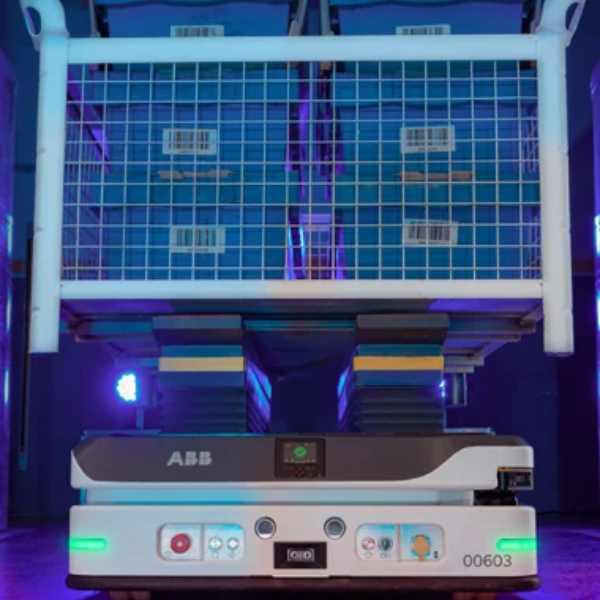
Automotive manufacturers face unprecedented operational friction from multi-powertrain assembly lines, acute material-handling labor shortages, and rising cost pressures. This ABB Robotics executive summary explores how Autonomous Mobile Robots (AMRs) serve as the connective tissue bridging traditional fixed automation and fully autonomous "dark factories". Utilizing AI-driven Visual SLAM technology for infrastructure-free 3D navigation, ABB’s unified robotics ecosystem connects material movement across the floor, driving up to 99.8% on-time delivery and enabling step-by-step scaling without plant disruption.
Key Highlights:
Defining the "Dark Factory": Envisions 24/7 fully autonomous operations managed by robotics, AI, and remote software, freeing human staff for high-value strategic roles.
Pressures on Legacy Manufacturing: Single-platform fixed lines struggle under multi-powertrain production (ICE, EV, Hybrid), labor shortages, and rising supply chain uncertainty.
AI-Powered Visual SLAM Navigation: Uses off-the-shelf 3D vision cameras to recognize natural landmarks (racks, structures, signs), eliminating the need for floor tape, wires, or QR codes.
Dynamic Fleet-Wide Mapping: Real-time environment mapping automatically updates and synchronizes changes across the entire robot fleet while distinguishing moving obstacles from fixed landmarks.
High Precision & Accuracy: Achieves positioning accuracy of up to ±5 mm across the entire AMR fleet for reliable machine-tending and assembly handover.
Quantifiable Productivity Gains: Delivers up to a 30% increase in production capacity, a 25% faster time to market, and 99.8% on-time delivery performance.
Proven Automotive Deployment: Validated at Ford’s Valencia Engine Plant with ~50 AMRs operating across >20 routes covering over 60,000 km annually.
Unified vs. Fragmented Ecosystem: Integrates mobile robots, fixed industrial arms, mobile manipulators, and orchestration software into a single unified control architecture.
Versatile AMR Fleet Portfolio: Covers diverse material handling needs including towing (T702), platform handling (P603/P604), and high-capacity forklift operations (F712).
Centralized Fleet Management: Managed via AMR Studio® software, bringing commissioning, setup, and fleet monitoring into one intuitive platform.
Phased Step-by-Step Scalability: Allows leaders to start with high-friction intralogistics bottlenecks and expand automation incrementally without full infrastructure overhauls.