
Case Study

Building a Real-Time Foundation for Observability
This eBook outlines how high-growth organizations use data streaming to transform fragmented telemetry into real-time operational intelligence. It provides a blueprint for eliminating data silos, controlling observability costs, and delivering fresh context for AI applications. How high-growth companies turn operational data into visibility, action, and AI-ready context.
- Topic
- Data Management and Analytics
- Published
- 5 Oct 2026
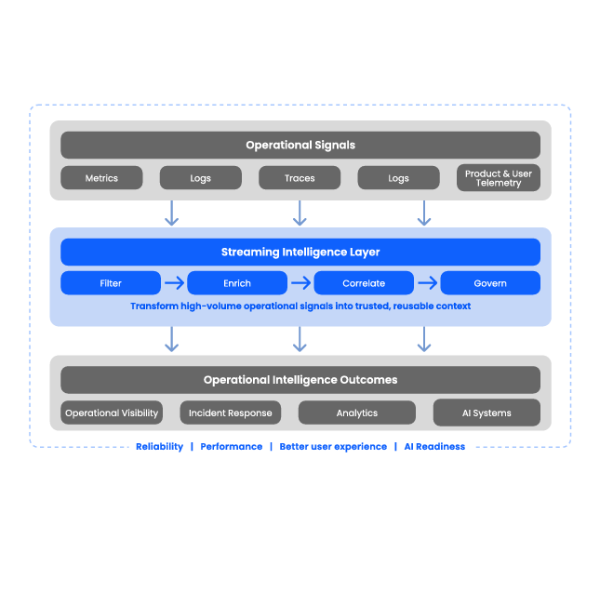
Modern distributed applications and cloud infrastructure produce vast streams of operational data, including logs, metrics, traces, and user telemetry. However, traditional batch jobs, point-to-point integrations, and isolated databases often trap this information in functional silos, delaying decision-making and escalating downstream processing costs.
High-growth enterprises address these visibility and AI-readiness challenges at the data pipeline level rather than relying solely on downstream monitoring platforms. By implementing a shared Data Streaming Platform (DSP), organizations filter, enrich, correlate, and govern telemetry in motion. This continuous streaming architecture establishes a vendor-neutral data layer that feeds observability platforms, analytics engines, and AI agents with trusted, real-time context.
Key Highlights:
Elimination of Data Silos: 93% of IT leaders report that data streaming platforms effectively break down data silos across enterprise systems.
Reusable Data Products: 86% of IT leaders state that packaged, governed data products enable more confident data sharing across business units.
Addressing Bottlenecks at the Source: Solves observability and AI readiness challenges by fixing data pipeline architecture rather than adding more monitoring tools.
Continuous Event-Driven Flow: Replaces fragile batch processes and point-to-point integrations with a shared, vendor-neutral streaming layer.
Shift-Left Cost Control: Filters and cleanses high-volume telemetry early in the flow, significantly reducing downstream compute, storage, and analytics costs.
AI-Ready Operational Context: Delivers real-time, enriched operational telemetry required by LLMs, intelligent automation, and agentic workflows to ensure accurate outputs.
Contextual Correlation: Correlates disparate signals (such as linking a latency spike directly to a recent deployment or service) before data reaches analytics platforms.
Accelerated Incident Response: Shrinks the latency between event detection and operational action, helping SRE and platform engineering teams resolve issues faster.
End-to-End Governance: Integrates lineage tracking, schema enforcement, and policy controls directly into the real-time streaming pipeline.
Enhanced Digital Experiences: Uses live product and user telemetry to deliver responsive, personalized experiences as customer activity occurs.
Strategic Operational Roadmap: Outlines a structured four-question framework (Map, Route, Enrich, Reuse/Govern) to guide organizations toward real-time operational maturity.