
Case Study

Agentic Security Lifecycle Management
This whitepaper details Agentic Lifecycle Management, explaining how to securely integrate AI agents into hybrid cloud operations. It demonstrates combining Infrastructure and Security Lifecycle Management (ILM + SLM) to enable risk-free Day 2+ Day-to-Day operations. Autonomous AI Workflows and Governed Guardrails for Modern Infrastructure
- Topic
- IT Management
- Published
- 11 Aug 2026
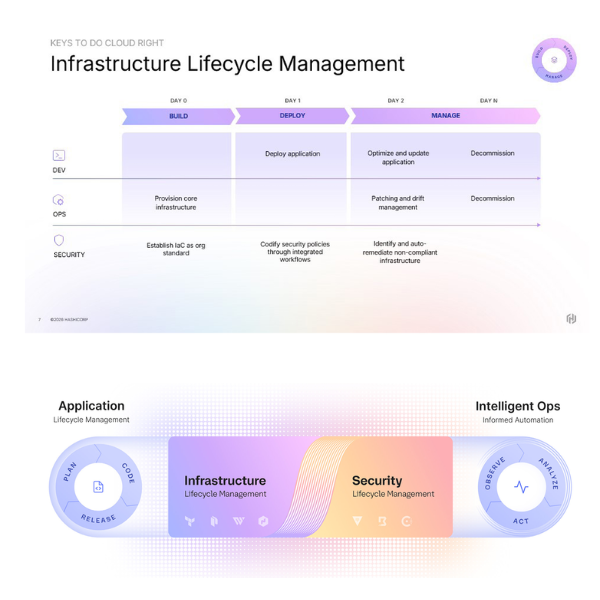
AI changes the interface to cloud operations, but it does not replace the underlying operational lifecycles. While Day 0 and Day 1 code generation can be easily accelerated with AI copilots, most enterprise effort and risk reside in ongoing Day 2+ operations. To safely execute tasks like drift remediation, patching, and incident response, AI agents require a unified context layer (such as an infrastructure graph) alongside strict policy-as-code guardrails and identity-based access controls. The paper provides a reference architecture and implementation roadmap for governed autonomy across hybrid environments.
Key Highlights:
Redefining Cloud Operations: AI changes the interface to operations, but does not replace underlying lifecycle management frameworks.
Day 2+ Focus: Enterprise value is concentrated in ongoing maintenance, patch management, drift remediation, and incident response.
The Day 2+ Context Gap: Foundation models fail in Day 2+ unless grounded in private, real-time system dependencies and state data.
Unified Lifecycle Integration: Infrastructure Lifecycle Management (ILM) and Security Lifecycle Management (SLM) must be orchestrated together.
Agentic Fabric Reference Architecture: Uses coordinated specialist agents (Orchestrator, Context, Terraform, Vault, Boundary) over single broad models.
Agents as Non-Human Identities (NHIs): Autonomous agents operate as identities requiring strict access controls, short-lived credentials, and continuous governance.
Policy-as-Code Guardrails: Machine-readable policies enforce compliance, least privilege, and blast-radius limitations before and after execution.
Automated Vulnerability Response: High-ROI workflow covering real-time impact assessment, patching, image updates, and verification.
Safe Secrets Rotation: Comprehensive lifecycle event management to reduce exposure during suspected pipeline compromises.
Three-Stage Maturity Model: Guides organizations from AI Copilots (Drafting) to Governance Partners (Proposing) and Autonomous Operators (Executing).
Pragmatic Implementation Roadmap: A phased 90-to-180-day execution plan to safely roll out an initial governed Day 2+ workflow.