
Case Study
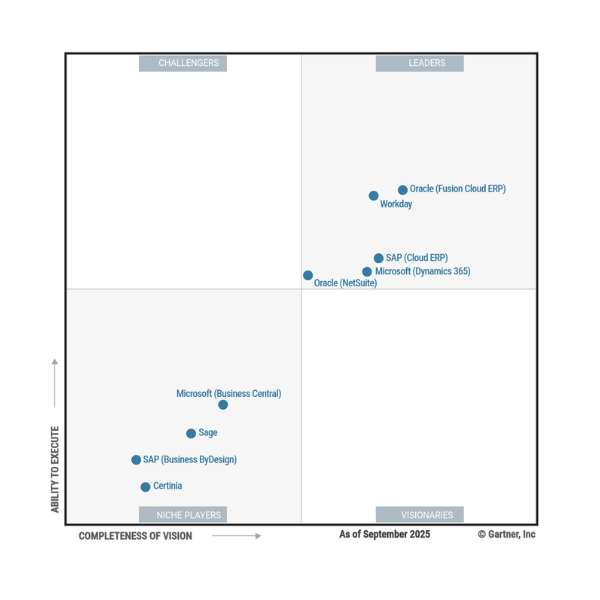
2025 Gartner Magic Quadrant for Cloud ERP for Service-Centric Enterprises
Access the complimentary Gartner® Magic Quadrant™ report to evaluate the critical capabilities, market strengths, and strategic directions of leading enterprise infrastructure vendors. Learn how technology executives are utilizing this objective research to de-risk long-term procurement and modernize core data estates. Navigate market complexity with objective, vendor-neutral research. Access the full report to compare top providers across execution, vision, and architectural stability.
- Topic
- Data Management and Analytics
- Published
- 29 Jun 2026
As corporate data portfolios scale across distributed environments, technology leaders face an essential operational mandate: selecting infrastructure platforms that balance high performance with absolute reliability, predictability, and security. Because data infrastructure represents a multi-year foundational investment, cutting through market noise to find the correct fit is critical to long-term business agility.
The latest Gartner® Magic Quadrant™ report provides a comprehensive, objective assessment of the global enterprise market. Utilizing a robust, standardized methodology, this research evaluates leading vendors based on their Completeness of Vision and Ability to Execute; giving you a clear, validated framework to inform your next capital investment cycle.
Key Highlights:
Objective Vendor Benchmarking: Categorizes global enterprise providers using Gartner’s independent methodology to map execution capability against long-term strategic vision.
Operational Execution Criteria: Evaluates product performance, sales delivery, pricing models, market responsiveness, and verified customer experience scores across complex multi-site environments.
Strategic Vision Mapping: Assesses each vendor’s ongoing research and development commitment, vertical sector orientation, geographic availability, and product roadmap viability.
Infrastructure Modernization Trends: Explores the market-wide shift from rigid legacy hardware configurations to highly agile, software-defined, and consumption-based data architectures.
Converging Storage and Resilience: Highlights how top-tier platforms are embedding core protection controls, such as immutable indexing and real-time behavioral monitoring, directly into the storage layer.
AI-Optimized Performance: Details the integration of machine learning and artificial intelligence engines to automate volume balancing, predictive capacity planning, and hardware health forecasting.
Ecosystem Compatibility: Examines how top vendors ensure seamless integration with hybrid/multicloud platforms, modern hypervisors, container frameworks, and DevOps pipelines.
Scalability without Compromise: Documents vendor efficiency in handling enterprise data growth while sustaining optimal latency metrics and high-throughput input/output operations.
Total Cost of Ownership (TCO) Optimization: Analyzes the economic impacts of advanced data reduction algorithms, energy-efficient footprints, and comprehensive upgrade lifecycles.
Data Security and Posture Management: Evaluates the embedded tools available to help organizations automatically discover, classify, and insulate sensitive assets from compliance vulnerabilities.
Defensive Procurement Framework: Serves as an essential executive playbook to streamline supplier evaluation cycles, align stakeholder expectations, and optimize capital expenditures.