
Article
Zero-Trust Architecture: Principles and Practical Implementation
This blog explains why traditional perimeter-based security has collapsed in the age of cloud, remote work, and machine identities, making zero-trust architecture a strategic necessity rather than an option. It outlines core principles: never trust, always verify; least privilege; assume breach; continuous verification- alongside a practical implementation framework, maturity model, and guidance for avoiding common pitfalls like tool sprawl and the all-or-nothing trap.
- Topic
- Cyber Security
- Published
- 21 May 2026

The Perimeter Has Collapsed
For decades, enterprise security operated on a simple binary: inside equals trusted, outside equals threat. That model worked when applications lived in data centers and employees worked from offices.
That world no longer exists.
Modern marketing infrastructure spans cloud platforms, distributed microservices, remote workforces, and AI-driven integrations. The traditional perimeter has dissolved into billions of daily trust decisions across fragmented infrastructure.
According to the 2026 Zero Trust Report, 82 percent of organizations view Zero Trust Network Access as essential to their security strategy, yet only 17 percent have fully implemented it. Organizations rate their current zero-trust effectiveness at just 6 out of 10.
Zero-trust architecture is not a security product. It is a systems design philosophy that recognizes a fundamental shift: from network-based trust to identity-based trust. Every request must be verified. The question is no longer "are you inside the network?" but "should you have access to this specific resource, right now, given your current context?"
Why Traditional Perimeter Security Fails
Cloud and Distributed Systems Erase Boundaries
Distributed systems communicate across networks. Data flows between platforms. Infrastructure is ephemeral. When your entire marketing stack is API-accessible from anywhere, there is no fixed boundary to defend.
Identity-Based Attacks Replace Network Breaches
Attackers no longer break in. They log in with compromised credentials and move laterally across systems undetected. The Verizon 2025 Data Breach Investigation Report shows 30 percent of incidents result from third-party compromise, doubled from the previous year.
Traditional models assume anything inside the network is safe. But internal threats are equally dangerous. The fatal flaw is implicit trust.
The Machine Identity Explosion
Modern networks now contain more non-human identities than human ones. APIs, bots, autonomous agents, and workloads access data at high velocity. Traditional perimeter security, designed to authenticate human logins, cannot manage machine-to-machine communication at scale.
Core Principles of Zero Trust
Never Trust, Always Verify
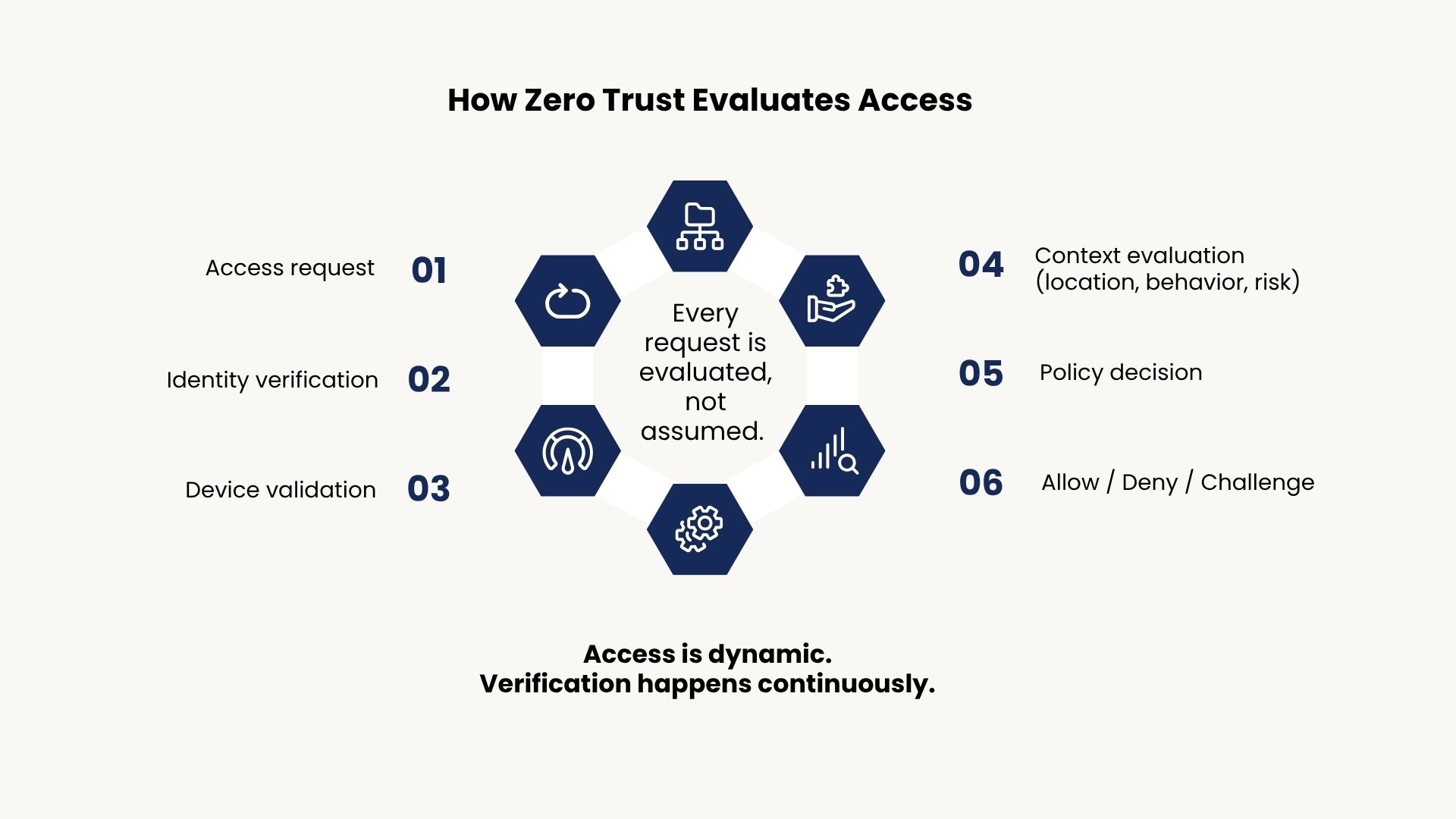
Every access request must be authenticated, authorized, and encrypted. No exceptions for internal traffic. The system evaluates contextual signals: who is requesting access, what device they are using, where they are located, and whether the request aligns with normal behavior.
This creates verification at the transaction level, not the session level. A campaign manager accessing performance dashboards from their corporate laptop experiences seamless access. The same user attempting to export the entire customer database from a new device triggers additional verification.
Least Privilege Access
Grant minimum required permissions for specific tasks, for minimum necessary duration. Access rights are defined at the resource level and granted just-in-time rather than permanently provisioned.
Attribute-based access control evaluates user attributes, resource characteristics, and environmental factors dynamically. The question shifts from "what role does this person have?" to "what is this person trying to do, with what data, and why?"
Fifty-six percent of organizations cite employee over-privilege as the leading contributor to unauthorized access.
Assume Breach
Design systems as if attackers are already inside. Micro-segmentation divides environments into granular zones with independent access controls. A breach in one segment cannot automatically spread to others.
If an attacker compromises contractor credentials to your email platform, they should not gain access to your data warehouse or CRM. Each system enforces its own access controls independently.
Continuous Verification
Access is never permanent. Every session is continuously evaluated as context changes. Real-time telemetry feeds dynamic policy decisions. If risk rises, access can be challenged, restricted, or revoked immediately.
Identity and Access Management: The Foundation Layer
Identity is the new perimeter. In zero-trust architecture, identity becomes the control plane of security.
Authentication and Authorization
Authentication verifies who or what is making the request. Modern implementations use multi-factor authentication as baseline, with step-up authentication for sensitive operations. Risk-based authentication adapts requirements based on contextual signals.
Authorization replaces network location with policy-based decisions. Attribute-based access control evaluates attributes of the user, resource, environment, and action before granting access.
Machine Identity Management
Service-to-service communication requires cryptographic identity binding. Technologies like SPIFFE issue cryptographically-bound workload identities. Every service mesh connection validates mTLS certificates. This replaces static API keys with short-lived credentials that rotate automatically.
Production implementations show SPIFFE-enabled service meshes cut lateral movement 94 percent during high-volume surges.
Implementing Zero Trust in Practice
Zero-trust architecture cannot be implemented overnight. Successful implementations follow incremental, risk-prioritized approaches.
Phase 1: Identity Foundation
Unify user and service identities across systems. Create visibility into access patterns and establish the control plane for subsequent phases.
Phase 2: Protect Crown Jewels First
Apply zero-trust principles to your most sensitive resources: customer data warehouses, PII-containing systems, high-value integration points. Start where risk concentrates.
Phase 3: Service-to-Service Authentication
Extend zero-trust principles to machine identities. Implement mutual TLS for all service-to-service communication. Replace permanent API keys with cryptographically-bound, short-lived credentials.
Phase 4: Policy-Based Access and Micro-Segmentation
Introduce attribute-based access control that evaluates context dynamically. Implement network segmentation to isolate systems and limit lateral movement.
The 2026 Zero Trust Report shows organizations take different starting paths: 30 percent start with access-first approaches, 26 percent adopt platform-first models, 17 percent lead with identity-first strategies. Each path addresses different friction points, but all converge on unified enforcement.
Common Pitfalls
Over-Complexity and Tool Sprawl
The single largest barrier to advancing zero trust is tool and vendor sprawl, cited by 26 percent of organizations. Seventy-eight percent manage secure access policy across more than two separate systems.
The solution is consolidation: converging identity, device, and network policy under a single adaptive framework. Sixty-three percent of organizations now favor single-vendor platform models.
Poor Developer Experience
Security that blocks productivity creates workarounds. Zero-trust implementations that treat developer workflows as an afterthought guarantee circumvention.
Well-designed zero-trust infrastructure improves developer experience through consistent authentication patterns, clear policy boundaries, and self-service access provisioning. Self-service portals cut shadow IT 87 percent while maintaining 92 percent policy compliance.
The All-or-Nothing Trap
Approaching zero trust as comprehensive transformation from day one leads to stalled initiatives. Organizations should start with high-value targets where strong identity controls deliver immediate risk reduction, then expand incrementally.
Zero-Trust Maturity Framework
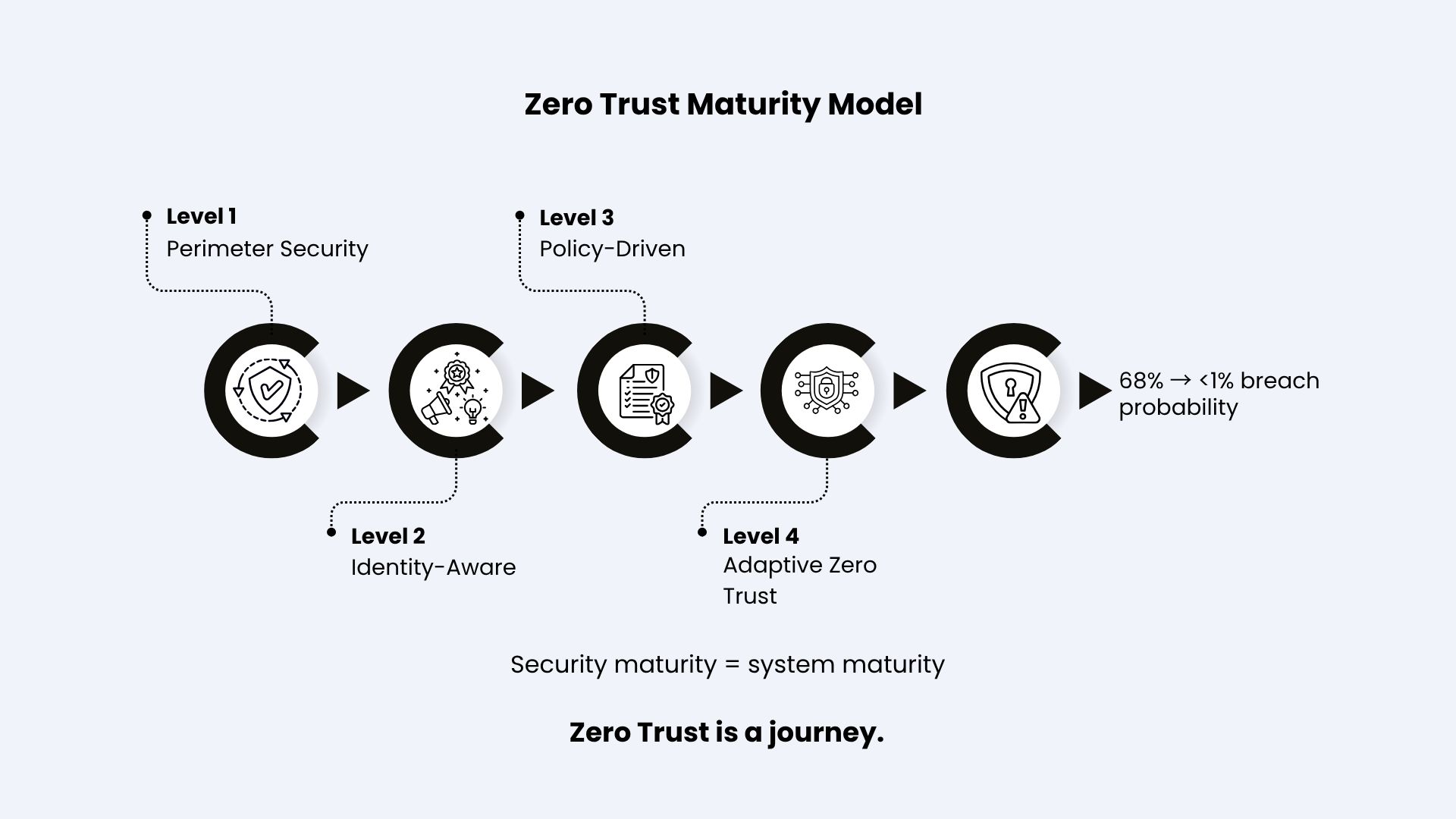
Organizations evolve through predictable stages:
Level 1: Perimeter-Based Security
Network-focused controls. Breach probability: 68 percent.
Level 2: Identity-Aware Security
Basic authentication, role-based access. Breach probability: 41 percent.
Level 3: Policy-Driven Systems
Context-aware decisions, dynamic access, attribute-based control. Breach probability: 12 percent.
Level 4: Adaptive Zero Trust
Continuous verification, automated responses, integrated across systems. Breach probability: less than 1 percent.
Most organizations operate at Level 2. Leaders operate at Level 3 and 4. The gap between levels represents not just security improvement but architectural sophistication enabling scale.
Strategic Implications
Zero-trust architecture reflects a shift from tools to infrastructure. Security becomes embedded in system design rather than added as a layer. The strategic advantage is not just protection but agility.
Organizations with mature zero-trust architectures onboard partners in hours instead of weeks. They grant contractors scoped access that expires automatically. They enable cross-functional collaboration without creating persistent vulnerabilities. They adopt new technologies faster because integration does not expand attack surface.
The shift is clear: from perimeter to identity, from static to dynamic, from tools to architecture. Organizations that implement zero trust effectively turn security into competitive advantage by enabling innovation safely at scale.
Conclusion
Zero trust has moved from aspiration to architecture. The challenge is no longer conviction but integration: unifying fragmented tools, policies, and signals into one adaptive security fabric.
The organizations that will lead are not those attempting all-or-nothing transformations, but those adopting zero trust incrementally, measuring progress honestly, and embedding security into workflows.
Because in 2026, your VPN is the weakest link. Your firewall is a facade. Your trusted internal network is where breaches actually happen. The question is not whether zero trust is necessary. The question is whether your organization will implement it deliberately or discover its absence when the next breach comes from inside the perimeter you thought was secure.