
Article
Workflow Orchestration Systems for Distributed Applications
This blog explains why workflow orchestration has become the defining infrastructure layer for modern marketing systems, where a single customer interaction can span predictive models, generative engines, CRMs, and compliance checks across systems never designed to coordinate. It covers the four forces making orchestration unavoidable, the core architectural patterns (stateful vs. stateless, DAG-based dependency modeling, centralized vs. choreographed control, retry and compensation logic), and a maturity model that shows why durable state and explicit workflow management separate teams that scale from those that plateau.
- Topic
- Technology
- Published
- 23 Jul 2026

The Strategic Shift From Tools to Intelligence
Marketing technology spent the last decade solving the wrong problem. Teams kept asking which tool to buy next: a CDP, an intent platform, a generative content engine, a new attribution model. Each purchase promised a capability gap closed. Few asked what would coordinate these tools once they were all running at once.
That gap has now become the defining constraint on growth. A single customer interaction can trigger a predictive scoring model, a generative offer engine, a CRM update, and a compliance check, all within seconds, across systems that were never designed to talk to each other directly. When one of those systems times out or returns a partial result, the failure does not stay contained. It propagates. The CRM believes one thing happened. The customer experienced another. That divergence compounds quietly until someone notices duplicate emails, double-charged accounts, or a campaign that simply never fired.
This is the orchestration gap, and it is now one of the most expensive hidden failure modes in modern marketing infrastructure. The shift underway is structural: organizations are moving from a tools era, where the goal was capability acquisition, through an infrastructure era built on data warehouses and CDPs, into an intelligence era where competitive advantage depends on how reliably autonomous systems coordinate with each other. Workflow orchestration is the architecture that makes that coordination possible.
Why Distributed Marketing Systems Break Without Orchestration
Modern marketing workflows are no longer linear scripts. A lead-routing journey spans enrichment, intent data, scoring, and sequencing. An onboarding program spans web behavior, product usage, support signals, and lifecycle messaging. Each of these is a graph of dependencies, not a chain of steps, and that graph grows more tangled as personalization deepens.
Four forces make orchestration unavoidable at this scale.
Workflow complexity is the most visible driver. When business logic is embedded directly in application code rather than expressed explicitly as a workflow, it becomes invisible to operations and nearly impossible to audit. Nobody can answer a simple question like which step failed without tracing logs across a dozen disconnected systems.
Long-running execution breaks traditional request-response thinking. A nurture sequence is not a single API call. It can span weeks, pause waiting on a customer action, and resume based on an external signal days later. Stateless systems have no memory of where they left off, so a crash mid-sequence means starting over or, worse, silently dropping the customer.
Cross-service coordination multiplies risk with every dependency added. When a real-time bid decision depends on a segmentation table that updated late, the downstream action executes on stale data and nobody is alerted. Each additional service in the chain is another point where partial failure can leave the system in an inconsistent state.
Failure is not the exception in distributed systems. It is the baseline condition. Services time out, networks partition, third-party APIs rate-limit at the worst possible moment. The question worth designing around is not whether failures happen but whether the system recovers without a human noticing first.
Core Architecture: The Patterns That Shape Reliable Execution
Building a coordination layer requires moving past chronological triggers like cron jobs and into stateful, dependency-aware execution models.
The first decision is state. Stateless workflows treat each operation as independent, which works for simple, short-lived tasks but collapses under retries, partial completion, and long-running processes. Stateful workflows persist execution history, so when a failure occurs mid-process, the system resumes from the last successful checkpoint instead of losing track entirely. For any workflow that spans more than a few seconds, durable state is not optional.
The second is dependency structure. Directed Acyclic Graph engines model tasks as nodes connected by explicit dependencies, which forces a useful discipline: every input must trace to a source, every output must have a defined consumer, and circular dependencies are structurally impossible. This is why DAG-based tools dominate data pipelines and increasingly govern the path from raw event data through feature engineering to audience activation.
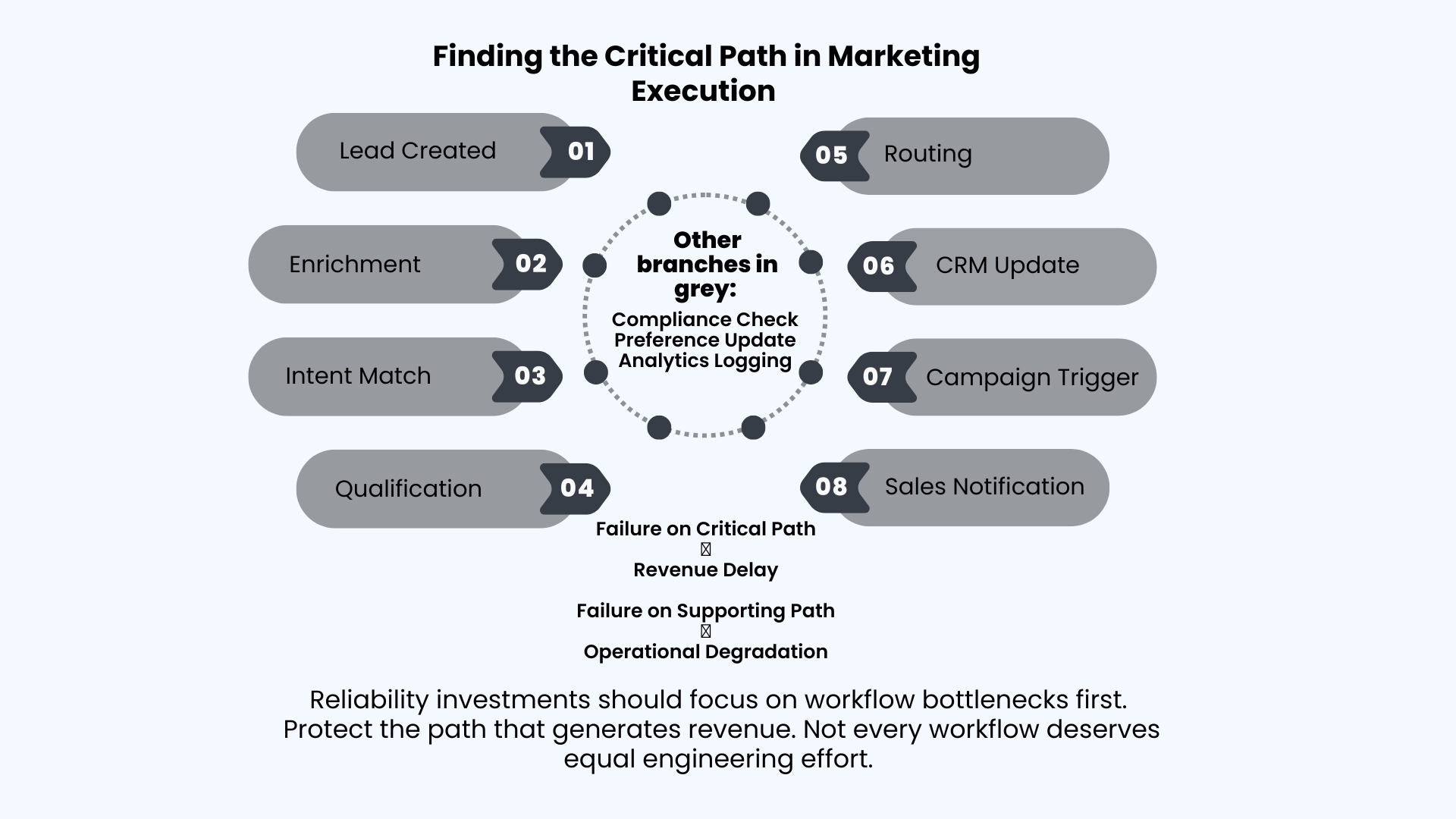
The third is control topology, and this is where the most consequential architectural choice sits. Centralized orchestration places one engine in command of sequencing, retries, and branching. It wins decisively on visibility: when something breaks, you can see exactly where and why. Choreography distributes coordination across services that react to shared events independently. It wins on loose coupling and lets teams ship without waiting on a central queue, but debugging a failure means reconstructing a story from scattered event logs. Neither pattern is universally correct. Mature organizations run centralized orchestration for revenue-critical workflows like onboarding and attribution, and choreography for high-volume event streams like clickstream processing, where speed and decoupling matter more than centralized visibility.
The fourth is failure handling itself, expressed through retry and compensation logic. Transient failures get automatic retries with exponential backoff. Business-level failures, such as a payment succeeding while provisioning fails, require compensation: the distributed equivalent of a rollback, undoing partial work so the system never sits in an inconsistent state. Idempotency underwrites all of this. If a retried task can execute twice without producing duplicate transactions or duplicate emails, the orchestration layer can fail safely. If it cannot, every retry becomes a new risk.
A Maturity Model for Orchestration Investment
Organizations tend to fall into one of four stages, and the stage they occupy says more about future scalability than the tools in their stack.
Stage one is tool-centric. Workflows live inside individual platforms, integrations are point-to-point, and failure handling is manual. Recovery means someone gets paged.
Stage two is integration-layer. A middleware tool connects systems and workflows become visible, but they are not durable. Recovery is semi-automated at best.
Stage three is orchestration-first. A dedicated workflow engine manages cross-tool coordination. State is externalized and persistent. Workflows are versioned and observable rather than implicit.
Stage four is the intelligence layer. Orchestration itself becomes AI-augmented: execution decisions adapt based on real-time signals, and the system learns from historical outcomes rather than following static rules.
Most enterprise marketing organizations sit between stage one and stage two. The competitive gap is opening between stage two and stage three, where durable state and explicit dependency management separate teams that scale from teams that plateau. Stage four is where the next generation of marketing systems is being built, and it is only reachable from a stage three foundation, because adaptive systems require workflow history that simply does not exist if state was never externalized in the first place.
Strategic Implications for Technology Leaders
Three decisions determine whether orchestration becomes a durable advantage or another layer of operational debt.
Treat orchestration as a product, not as background infrastructure. The teams that get the most value build internal tooling around it, create shared workflow primitives, and invest in observability that lets non-engineers inspect execution without filing a ticket. When visibility is self-service, velocity compounds instead of bottlenecking through a single team.
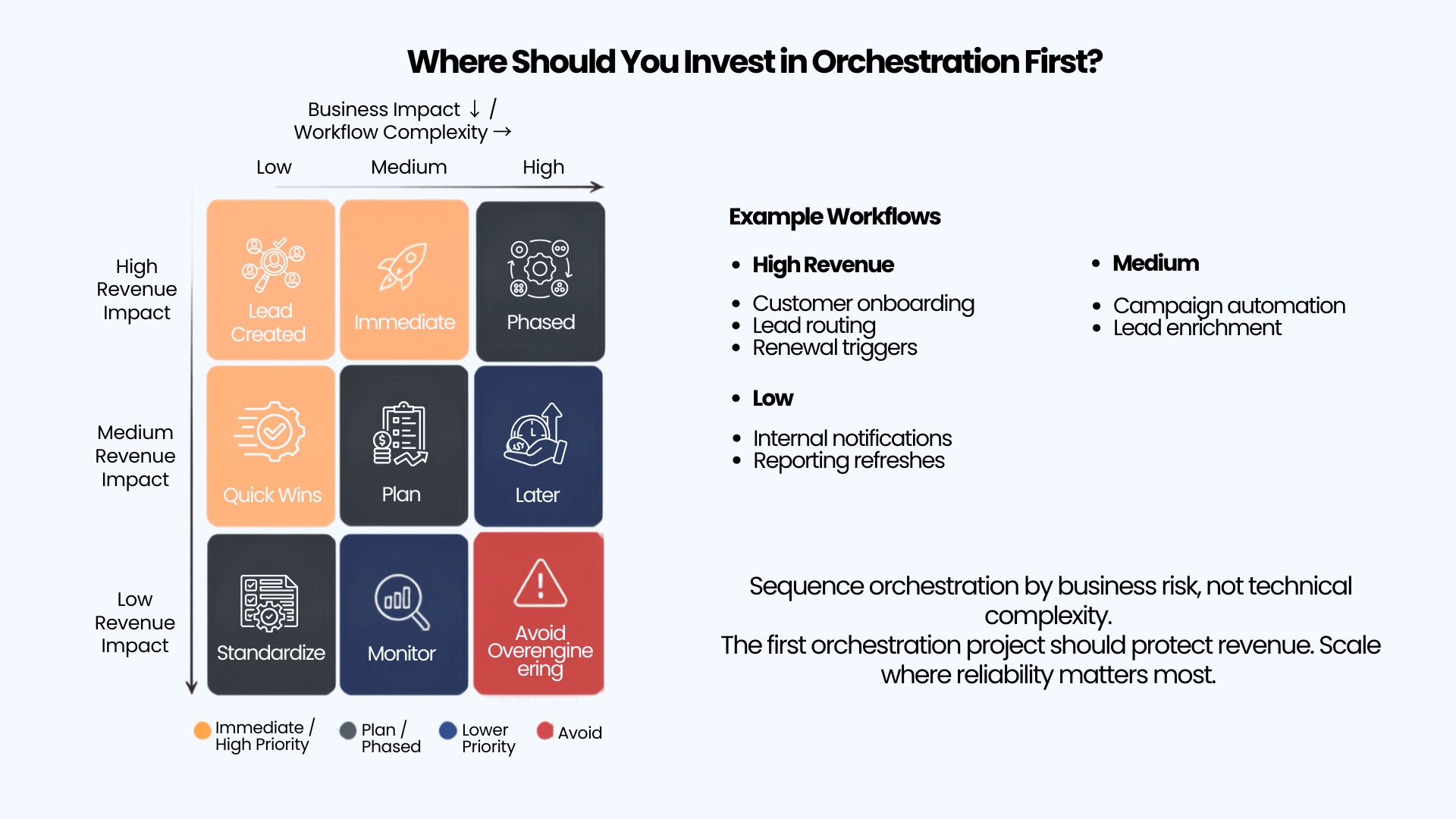
Sequence investment against business risk, not technical elegance. Target the workflows where failure has direct revenue consequences first: onboarding, renewal triggers, high-value account programs. Build reliability where it is felt before chasing architectural completeness elsewhere.
Externalize state now, even before you are ready to build adaptive systems on top of it. The path from orchestrated workflows to AI-augmented workflows requires historically logged, observable execution data. Organizations building on durable execution today are quietly assembling the data substrate that adaptive models will require tomorrow. Organizations that delay this will face a reconstruction project precisely when speed matters most.
Conclusion: Execution Stability as the Real Competitive Moat
The organizations that lead the next phase of marketing performance will not be the ones with the most sophisticated models or the largest data warehouses. They will be the ones that built the operational substrate underneath those capabilities: systems that coordinate reliably, recover automatically, and evolve without breaking what already works.
That work rarely shows up in a board deck. It does not generate a press release. But it is the layer that determines whether everything else, personalization, attribution, AI-driven decisioning, actually runs at scale instead of degrading quietly under its own complexity. Infrastructure decisions made now about how workflows hold state, recover from failure, and expose visibility will define which organizations compound their advantage over the next decade, and which ones spend that decade firefighting.