
Article
Transfer Learning in Applied Machine Learning: From Model Efficiency to Intelligence Infrastructure
This blog explores why transfer learning creates compounding returns through pre-trained representations, how it transforms compute economics from millions of dollars to hundreds, and the strategic shift from model-centric to system-centric AI that separates leaders from laggards.
- Topic
- Machine Learning
- Published
- 5 May 2026

The marketing technology landscape is fragmenting into two trajectories. One path follows the familiar pattern: acquire more data, train larger models, iterate endlessly. The other recognizes that intelligence, like infrastructure, can be borrowed, adapted, and redeployed at scale.
Transfer learning represents more than a technical optimization. It signals a fundamental shift in how organizations architect AI capabilities: not as isolated experiments, but as composable systems built on shared intelligence.
This matters because the traditional approach is collapsing under its own weight. Teams build custom models for every use case, each requiring massive datasets, specialized talent, and months of training time. Meanwhile, organizations that understand transfer learning deploy production-ready models in weeks, with a fraction of the data, by leveraging representations learned from billions of examples elsewhere.
The question is not whether your infrastructure will incorporate transfer learning. It is whether you will recognize the shift before competitors build an insurmountable velocity advantage.
Why Pre-Trained Representations Create Compounding Returns
Transfer learning works because knowledge representations are surprisingly transferable across domains. A model trained to understand language structure on billions of web pages has learned fundamental patterns about syntax, semantics, and context that apply equally to product descriptions, customer reviews, and support tickets. A computer vision model trained on ImageNet has not just memorized objects. It has learned hierarchical feature detection that transfers to brand logo recognition, packaging analysis, and visual quality control.
The efficiency gains are structural, not incremental. Consider a team building sentiment analysis for customer feedback. Training from scratch might require 100,000 labeled examples and weeks of compute time to achieve 85% accuracy. Using transfer learning from a pre-trained language model, that same team can fine-tune on 1,000 labeled examples and reach 90% accuracy in hours. The pre-trained model has already learned what language is. It only needs to learn what your customers care about.
This creates a compounding advantage. Every hour not spent collecting training data or debugging model architecture is redirected toward higher-order problems: refining business logic, improving data pipelines, or expanding to adjacent use cases. Teams operating with transfer learning move faster not because they work harder, but because they are solving fundamentally different problems than their competitors.
The compute economics are equally transformative. Training large models from scratch costs tens of thousands to millions of dollars in cloud infrastructure. Fine-tuning a pre-trained model costs hundreds. For organizations evaluating AI investments, this is not a marginal difference. It is the difference between AI as an executive pet project and AI as a scalable capability embedded across operations.
Three Architectural Patterns for Marketing Intelligence
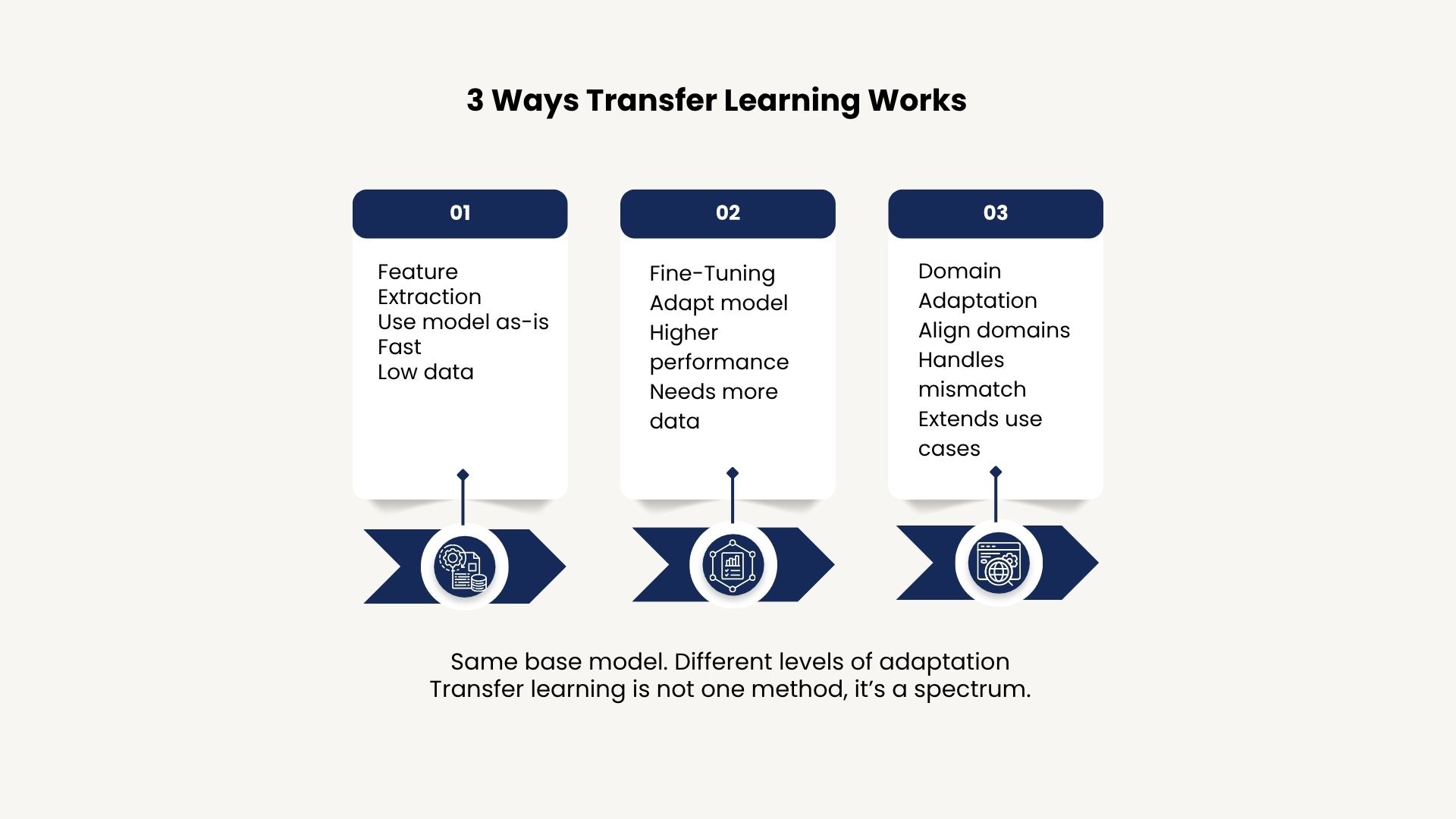
Transfer learning manifests through three distinct approaches, each with different risk profiles and strategic implications.
Feature extraction treats pre-trained models as fixed representation engines. The model's learned patterns remain frozen while only the final decision layer adapts to your specific task. A marketing team might use this for brand safety scoring, where a pre-trained image classifier extracts visual features and a lightweight classifier learns which features correlate with brand-appropriate content. This approach minimizes overfitting risk and works exceptionally well with small datasets, sometimes as few as 100 examples per category.
The strategic value lies in speed and reliability. Feature extraction enables rapid prototyping of AI capabilities without deep machine learning expertise. Teams can validate use cases, prove business value, and iterate on product requirements before committing to more complex approaches.
Fine-tuning unfreezes some or all of the pre-trained model's layers, allowing them to adapt more deeply to the target domain. This approach delivers higher performance ceilings but requires more data and careful tuning to avoid overfitting. A personalization engine might fine-tune a language model on your product catalog and customer interaction history, teaching it the specific vocabulary, preferences, and patterns unique to your business.
Fine-tuning is where transfer learning transitions from efficiency tool to strategic differentiator. The model learns representations that encode your specific market position, customer behaviors, and competitive context. This creates defensible advantage. Competitors can access the same pre-trained models, but they cannot replicate your proprietary fine-tuning data.
Domain adaptation addresses scenarios where source and target domains diverge significantly. A sentiment model trained on social media might fail on formal customer surveys because linguistic patterns differ. Domain adaptation techniques align these distributional shifts, often using unsupervised or semi-supervised methods to bridge the gap.
For marketing organizations, domain adaptation unlocks AI capabilities in specialized contexts: B2B versus B2C communication patterns, regional language variations, or niche industry verticals where pre-trained models perform poorly out of the box. It is the architectural pattern that extends transfer learning's reach into long-tail use cases.
Performance Risks and the Negative Transfer Problem
Transfer learning is powerful, but not without failure modes. Understanding them is critical for responsible deployment.
Negative transfer occurs when pre-trained knowledge actively hinders learning. A language model trained predominantly on English marketing copy might struggle with multilingual markets, importing assumptions about language structure that do not translate. The risk intensifies with fine-tuning: the model might double down on incorrect patterns rather than unlearning them.
The strategic implication: transfer learning requires explicit validation that source and target domains share fundamental structure. This is not a technical detail. It is an architectural decision about whether your use case maps onto the knowledge embedded in available pre-trained models.
Overfitting on small adaptation datasets represents a different failure mode. With limited fine-tuning data, models may memorize specific examples rather than learning generalizable patterns. A customer churn model fine-tuned on 500 examples might achieve perfect training accuracy while failing catastrophically on new customers.
This creates a paradox: transfer learning enables deployment with small datasets, but small datasets increase overfitting risk. The solution lies in evaluation discipline: holdout sets, cross-validation, and continuous monitoring for performance degradation as data distributions shift.
Domain mismatch blindness is perhaps the most insidious risk. Pre-trained models can produce confident predictions in domains where they have no meaningful knowledge. A sentiment model might confidently misclassify technical jargon or domain-specific terminology while appearing to perform well on surface metrics.
For marketing organizations, this manifests as AI systems that work perfectly in testing and fail subtly in production. The cost is not dramatic failure. It is systematic bias that slowly erodes customer trust or drives incorrect strategic decisions.
The Transfer Learning Maturity Model
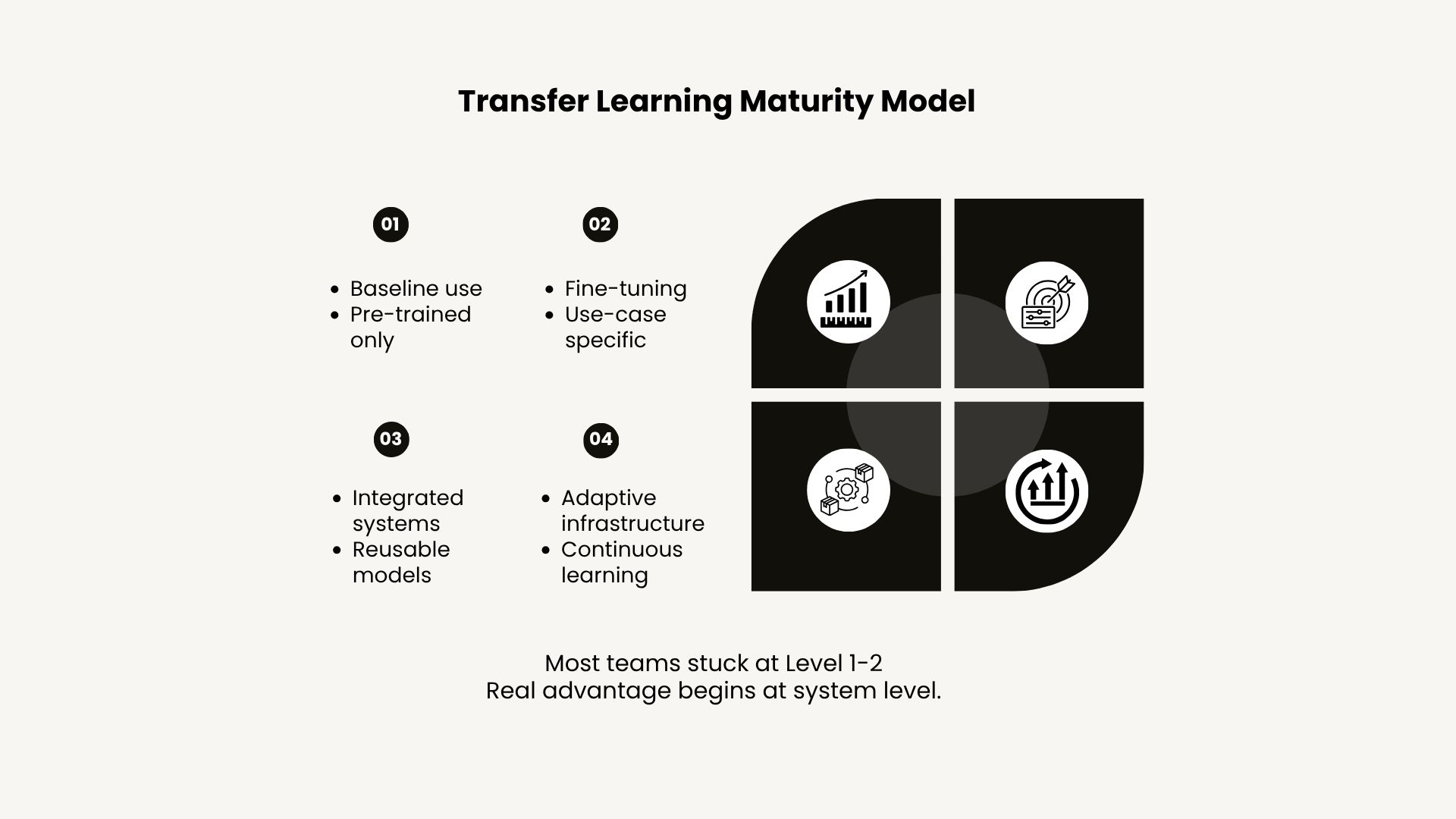
Successful transfer learning requires systematic decision-making across organizational capability levels.
Stage 1: Baseline Utilization Use pre-trained models as-is with minimal customization. This stage focuses on feature extraction for rapid prototyping and validation of AI use cases before deeper investment.
Stage 2: Guided Adaptation Fine-tune models for specific use cases and introduce domain data. Teams develop expertise in evaluation protocols and begin building proprietary fine-tuning datasets.
Stage 3: Integrated Systems Embed models into workflows and enable continuous learning. Organizations build versioned model repositories and automated fine-tuning pipelines. New use cases leverage existing fine-tuned models rather than starting from scratch.
Stage 4: Adaptive Intelligence Infrastructure Dynamic model updating and cross-domain learning become operational standards. Organizations systematically capture performance outcomes and feed them back into model refinement, creating compounding intelligence assets.
Most organizations operate at Stage 1 or 2. Leaders move toward Stage 3 and 4 by treating transfer learning not as a technique, but as infrastructure.
Strategic Implications: From Model-Centric to System-Centric AI
Transfer learning drives a broader shift in AI strategy that extends beyond individual models to how organizations architect intelligence itself.
The focus shifts from individual models to interconnected systems. Organizations no longer need massive proprietary datasets. They need the ability to adapt existing knowledge efficiently. Transfer learning enables faster experimentation, quicker deployment, and AI embedded in systems rather than standalone tools.
The deeper implication: build repositories of fine-tuned models that become organizational assets, reusable across use cases and compounding in value over time. When a new use case emerges, teams do not start from scratch. They search the model repository for relevant pre-trained or previously fine-tuned models, adapt them to the new context, and feed improvements back into the system.
This shifts the locus of competitive advantage from model architecture, which is increasingly commoditized, to data curation, evaluation discipline, and deployment velocity. Organizations win not by building better models than competitors, but by building systems that make model development faster, cheaper, and more reliable.
Conclusion: The Leverage Point
Transfer learning represents a fundamental leverage point in AI strategy. It transforms the constraint structure: data scarcity becomes manageable, compute costs compress, and deployment timelines shrink from months to weeks.
But the real opportunity is not efficiency. It is the second-order effects. When AI deployment becomes faster and cheaper, organizations can experiment more aggressively, validate use cases earlier, and compound learnings across initiatives. Transfer learning does not just make individual models better. It accelerates the entire learning loop through which organizations develop AI capabilities.
The strategic question facing leaders is not technical. It is organizational. Can you build systems that capture and reuse learned intelligence? Can you shift from treating AI as discrete projects to building composable infrastructure?
The technology already works. The question is whether your organization can work at the speed it enables.