
Article
Synthetic Data Generation for AI Training: From Collection to Creation
This blog explains why synthetic data generation is becoming essential as AI exhausts public high-quality data, how marketing and RevOps leaders can move from passive data collection to proactive data design, and the validation frameworks needed to ensure synthetic data drives real business outcomes.
- Topic
- Artificial Intelligence
- Published
- 28 Apr 2026

The AI industry has consumed virtually all available high-quality public data. Stack Overflow, Reddit, Wikipedia, news archives, every corner of the open web has been scraped and fed into foundation models. Projections suggest AI could exhaust the global supply of high-quality text data as early as 2026.
This scarcity marks a strategic inflection point. The organizations leading the next wave of AI innovation are not those with the largest existing datasets, but those mastering synthetic data generation, the creation of artificial data that mimics statistical properties of real data without exposing sensitive information or replicating its limitations.
For marketing and RevOps leaders building AI-native systems, this shift is foundational. The question is no longer who collects more data, but who engineers better training environments.
The Infrastructure Problem Real Data Cannot Solve
Marketing teams spent a decade solving for data volume. More tracking pixels, deeper integration layers, unified customer platforms. But volume never addressed the structural gaps limiting AI model performance.
Privacy constraints create operational blind spots. GDPR, CCPA, and emerging regulations have fundamentally altered what data can be collected and used for training. In 2026, GDPR fines reached $2.1 billion for PII misuse in personalization models. Even with consent frameworks, accessible training data often represents a biased subset, users who opt in behave differently than those who don't. Models learn from skewed samples, then make predictions about everyone.
Rare-event modeling exposes the long-tail problem. Enterprise deals might represent 2% of total conversions but 60% of revenue. Fraud occurs in 0.1% of transactions. Critical medical conditions appear in dozens of cases, not thousands. Traditional machine learning approaches drown high-value signals in noise from common events. The model optimizes for what it sees most often, not what matters most strategically.
Data imbalance compounds at scale. Most customer datasets follow power law distributions. A small percentage of segments generate disproportionate outcomes. When models train on imbalanced data, they excel at predicting the majority class and fail at identifying exceptions. For marketing systems, AI gets better at recognizing patterns you already understand and worse at catching opportunities you're missing.
Traditional solutions like oversampling, undersampling, class weighting are tactical adjustments. They don't change the fundamental constraint: you're limited by the shape and completeness of data you observed. Synthetic data generation breaks that constraint by treating data creation as an engineering problem rather than a collection problem.
From Rules to Intelligence: The Generation Spectrum
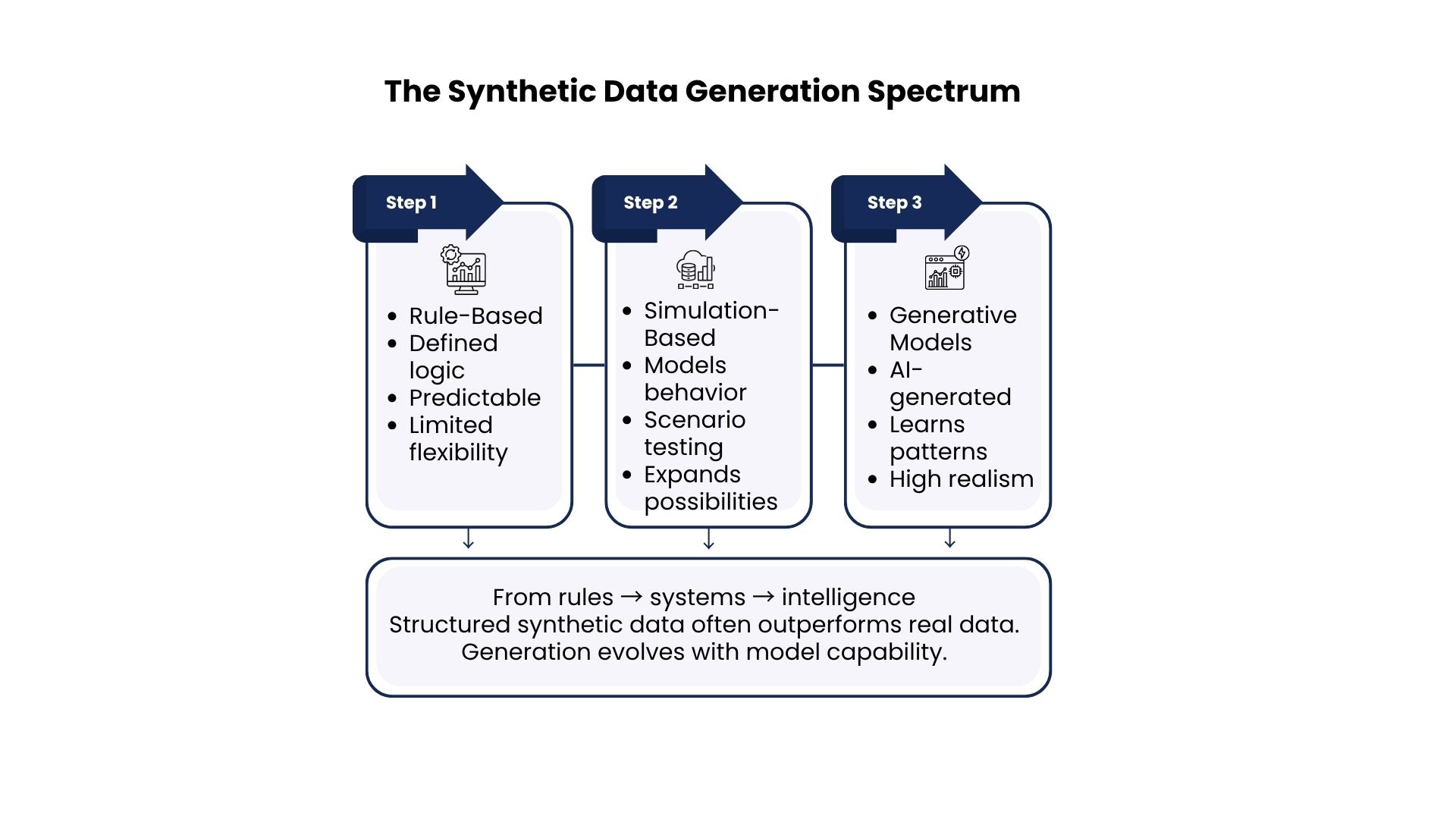
Synthetic data generation encompasses techniques ranging from deterministic rules to probabilistic modeling. The right approach depends on what you're teaching your models and what structural knowledge you already have.
Rule-based generation translates business logic into training examples. This approach encodes explicit domain knowledge: if a user exhibits behaviors X, Y, and Z within timeframe T, generate a synthetic example of likely outcome A. For teams with mature segmentation frameworks, rule-based synthesis creates training data reflecting strategic understanding rather than historical accident. The limitation is brittleness. Rules capture known patterns but can't extrapolate to novel combinations or emergent behaviors.
Simulation-driven generation models systems, not just outcomes. Instead of generating individual data points, you simulate underlying processes that create customer behavior. A simulation might model market conditions leading to customer awareness, consideration triggers, evaluation criteria, and conversion probability. By running thousands of simulated customer journeys with varied parameters, you generate training data spanning a wider behavioral space than historical datasets. This approach excels for scenario planning and edge case exploration.
Generative models learn latent structure and synthesize new instances. Generative Adversarial Networks (GANs) pit two neural networks against each other, a generator creating data and a discriminator evaluating its realism, iteratively improving until synthetic outputs are indistinguishable from real ones. Diffusion models, powering systems like DALL-E and Stable Diffusion, generate data by gradually denoising random signals into structured outputs, achieving state-of-the-art realism.
Recent research on pretraining data synthesis compared prompt design, generator model size, and source data across over one trillion generated tokens. The findings are counterintuitive: structured output formats like tables, math problems, and tutorials consistently outperform both curated web baselines and prior synthetic methods. Moreover, increasing generator model size beyond 1 billion parameters provides no additional benefit, a finding with significant implications for compute efficiency.
The frontier is conditional generation, teaching models to create synthetic data with specific properties. "Generate 10,000 examples of high-intent mobile users in financial services who abandoned during checkout." You're directing the model to fill exact gaps in your training data landscape.
Validation: From Statistical Parity to Strategic Utility
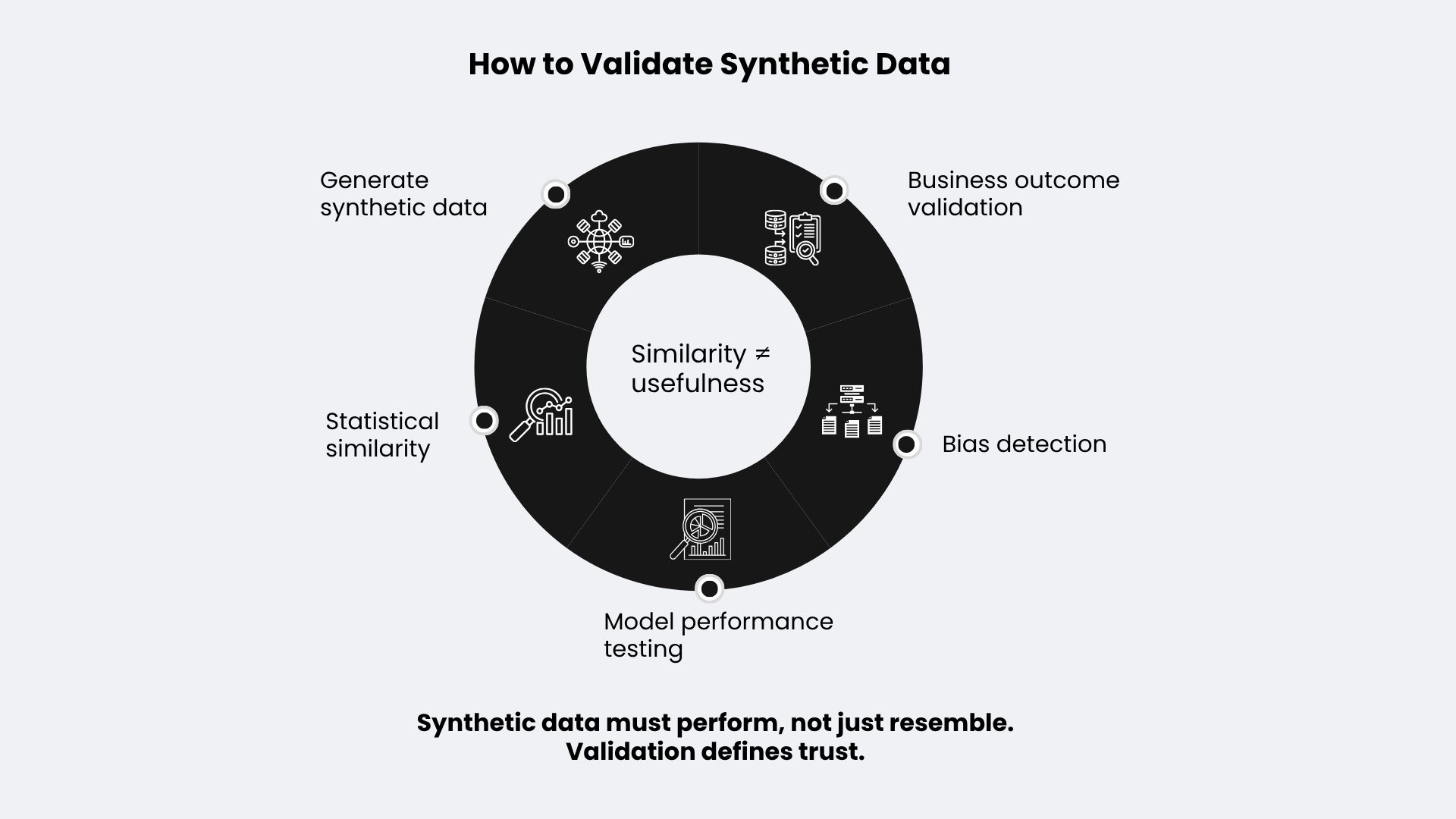
Generating synthetic data is straightforward. Generating useful synthetic data requires validation frameworks beyond superficial similarity checks.
Statistical similarity establishes baseline credibility. Distribution matching, correlation preservation, and dimensional analysis verify that synthetic data maintains structural properties of real data. But these are necessary, not sufficient. Two datasets can be statistically similar while being strategically different. The question isn't whether synthetic data looks like real data, it's whether models trained on it perform like models trained on real data.
Model performance impact is the practical test. The validation framework should compare models trained purely on real data, purely on synthetic data, and on hybrid datasets. For marketing applications, performance metrics should map to business outcomes, not just accuracy, but precision on high-value segments, recall on rare events, and calibration across customer lifetime value bands.
Research on synthetic mixed training demonstrates that combining synthetic question-answer pairs with synthetic documents enables log-linear improvements as both synthetic data volume and generator strength increase, outperforming traditional retrieval-augmented generation by 4.4% on long-document comprehension benchmarks.
Bias detection prevents synthetic amplification of existing problems. A 2025 study across 12 industry datasets found that synthetic data can amplify gender bias metrics by an average factor of 1.7x when generated without intervention. The same research demonstrated that targeted counterfactual resampling and reweighting strategies can reduce bias to levels below those in real data while degrading model performance by less than 1.5%.
Marketing teams must audit synthetic data for representation gaps and proxy discrimination—not just obvious demographic biases but structural ones. Does synthetic customer journey data underrepresent low-income segments because they're underrepresented in your CRM? Does it perpetuate engagement patterns favoring certain interaction styles? Bias detection requires examining what's absent as much as what's present.
Strategic Applications: Where Synthetic Data Changes Execution
Testing edge cases before they occur in production. Marketing AI systems fail most visibly at the boundaries, unusual customer behaviors, market condition shifts, product launch scenarios with no historical precedent. Synthetic data allows you to stress-test models against scenarios you haven't encountered. Before launching in a new geographic market, generate synthetic customer data reflecting regional behavioral patterns and validate model performance.
Data augmentation for imbalanced learning problems. Rather than replacing real data, synthetic generation extends it in strategically important directions. Your lead scoring model has 50 examples of enterprise conversions? Generate 5,000 synthetic examples that maintain statistical properties of those 50 while introducing controlled variation. The model learns robust patterns rather than memorizing sparse examples.
Privacy-preserving training for sensitive applications. For industries with strict data handling requirements like healthcare, financial services, regulated markets, synthetic data enables AI development without exposing protected information. Research on private event log synthesis combines differentially private autoregressive models and clustering algorithms to generate synthetic logs that retain statistical and behavioral characteristics while providing formal privacy guarantees.
The Maturity Framework: Four Levels of Synthetic Intelligence
Organizations adopt synthetic data along a maturity curve that determines strategic impact.
Level 1: Supplementary use. Synthetic data for basic testing and validation. Limited production impact. Most organizations remain here.
Level 2: Augmentation layer. Synthetic data combined with real data to improve model performance on specific use cases. Measurable but contained value.
Level 3: System integration. Synthetic data embedded into AI pipelines, supporting continuous learning and deployment cycles. Operational transformation begins.
Level 4: Data infrastructure. Synthetic data becomes a core architectural layer enabling scalable, privacy-safe systems that generate training environments on demand. Competitive differentiation.
The shift from Level 2 to Level 3 represents the critical transition from treating synthetic data as a workaround to recognizing it as foundational infrastructure.
Strategic Implications: From Data Dependency to Data Design
Synthetic data changes how organizations think about data itself. The traditional model assumed data collection as the primary constraint. The new model treats data creation as an engineering discipline.
From collection to creation. Instead of asking "how do we get more data," teams ask "what data do we need to design." This shifts data strategy from reactive acquisition to proactive architecture.
From static datasets to dynamic systems. Synthetic data enables continuous generation aligned with evolving business needs. Training environments adapt as strategies change.
From compliance risk to privacy advantage. Organizations can train models without exposing real data, transforming regulatory constraints into operational capabilities.
From tool-led AI to infrastructure-led AI. Synthetic data becomes part of core architecture, not an add-on. The competitive advantage shifts from who has more data to who can design better data systems.
Conclusion: Engineering Intelligence
Synthetic data is often misunderstood as artificial, secondary, or less reliable. But it addresses structural limitations of real-world data that volume alone cannot solve.
The organizations that will lead are not those generating the most synthetic data, but those generating the most trustworthy synthetic data. They validate rigorously, audit continuously, and mix strategically. They understand that synthetic data is not a replacement for real data but a complement that extends its reach.
In the coming years, the ability to generate high-fidelity, low-bias, privacy-preserving synthetic data will separate AI leaders from laggards. The techniques exist. The validation frameworks are emerging. The question is not whether to adopt synthetic data, but whether your organization will build the capabilities to generate it responsibly.
Because in modern AI-driven systems, data is no longer just collected. It is engineered. And those who master synthetic data generation will build more resilient, scalable, and intelligent systems.