
Article
Supply Chain Security in Modern Software Delivery
This blog explains why modern software delivery has become an assembly problem rather than a writing problem, where hundreds of transitive dependencies and AI models introduce inherited trust that attackers systematically exploit. It covers the four primary attack vectors (dependency poisoning, malicious package injection, compromised build environments, tampered artifacts), the SLSA framework for mapping exposure, and a three-stage maturity model that distinguishes organizations treating supply chain integrity as a compliance checklist from those embedding it as continuous, cryptographically verified infrastructure.
- Topic
- Cyber Security
- Published
- 30 Jul 2026
From Tool Adoption to Architectural Trust
A CI/CD pipeline can pass every scan, sign every build, and clear every review, and still ship a compromise. Somewhere between a public package registry and a production environment, a malicious dependency slips through trust that was never actually verified. This is the defining condition of modern software delivery: extraordinary velocity built on top of trust assumptions that attackers now treat as the primary entry point.
The shift matters most for organizations running AI driven marketing and revenue infrastructure. Customer data platforms, personalization engines, and real time data pipelines depend on thousands of shared third party libraries. According to JFrog's 2026 Software Supply Chain Security report, threat actors are now weaponizing the trusted models, registries, and agentic tools that power AI assisted development, not just the application code sitting on top of them. For technology leaders, the operative question has changed. It is no longer "is our application secure." It is "can we trust everything that contributed to building it."
This is not a scanning problem. It is an architecture problem. Treating supply chain integrity as infrastructure, rather than a checklist applied after release, is what separates resilient GTM stacks from fragile ones.
Why Software Supply Chains Have Become High Risk
Modern applications are not written. They are assembled. A typical enterprise application carries hundreds of direct dependencies, and each of those carries dozens more beneath it. If a team explicitly vets ten packages, the real attack surface may run into the hundreds once transitive dependencies are counted, most of which were never directly evaluated. Trust is inherited at every layer of indirection rather than established at any single one.
The scale is no longer marginal. JFrog found that 11.7 million new packages entered enterprise software supply chains in 2025, a 67 percent increase year over year, and malicious npm packages alone surged 451 percent. One campaign using just 25 malicious packages reached 2.5 million downloads before detection. Attackers have stopped attempting brute force entry into hardened systems. They go after the path of least resistance instead: a maintainer's compromised credentials, a typosquatted package name, or a dormant project quietly taken over years after its last legitimate update.
A newer, less governed frontier compounds the problem. JFrog researchers identified 495 malicious AI models on Hugging Face carrying payloads capable of credential theft and remote system compromise. Fifty three percent of organizations still self host models from sources where malicious payloads have previously been found, and 18 percent have no governance over IDE extensions or Model Context Protocol servers inside developer workflows. The supply chain no longer ends at the package registry. It now includes every model and agent touching the build.
Mapping the Modern Supply Chain
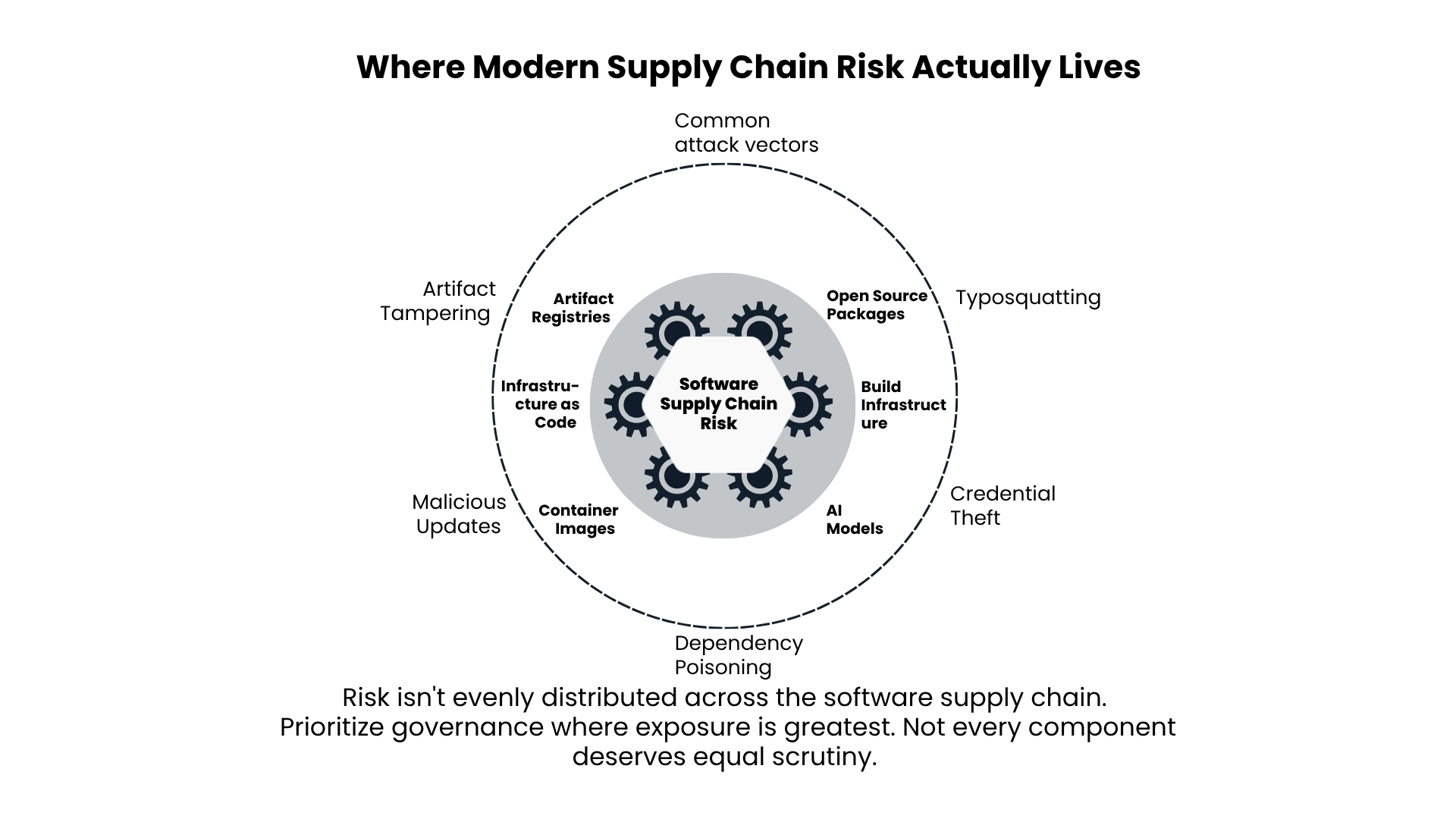
Effective governance starts with a clear model of where exposure actually lives. The Supply chain Levels for Software Artifacts (SLSA) framework offers a useful structure: sources are the human authored or reviewed starting point, builds transform sources and dependencies into outputs, dependencies are everything pulled in that is not source code, and packages are what gets published for others to consume. Each link is a distinct attack surface with its own risk profile.
Package repositories carry the broadest exposure simply because of scale. A package that was clean at integration can be compromised later through a malicious update or a subtle change buried in a minor version bump.
Build systems and CI/CD pipelines are the least scrutinized layer relative to their actual power. They hold elevated credentials and secrets, and a compromised build agent can inject code into an artifact without touching source control, leaving the reviewed code clean while the binary is not.
Container images and artifact registries form the distribution layer. A container is a composite of a base image, runtime dependencies, and application code, often sourced from entirely different origins. Organizations frequently lock down source repositories tightly while applying far weaker scrutiny to the base images everything else runs inside.
Infrastructure as code is the newest and least mature layer. Terraform modules, Helm charts, and cloud templates carry the same dependency risk as application code, but a single compromised module can reshape the security posture of an entire cloud environment at provisioning time rather than affecting one application.
How Attacks Actually Happen
Four vectors account for most real world incidents. Dependency poisoning injects malicious code into a package already in use, often through compromised maintainer credentials, and hits hardest where version pinning is loose enough to auto accept any patch release. Malicious package injection exploits registry namespaces directly through typosquatting and dependency confusion, tricking automated builds into pulling the wrong package by name alone. Compromised build environments are the most strategically dangerous vector because they operate with implicit trust from every downstream consumer; this is precisely what made the SolarWinds breach so hard to catch, since the source code was clean and the binary was not. Tampered deployment artifacts bypass every source level control by modifying an image or binary after the build completes, detectable only through cryptographic verification at deployment time.
Building Practices That Actually Hold
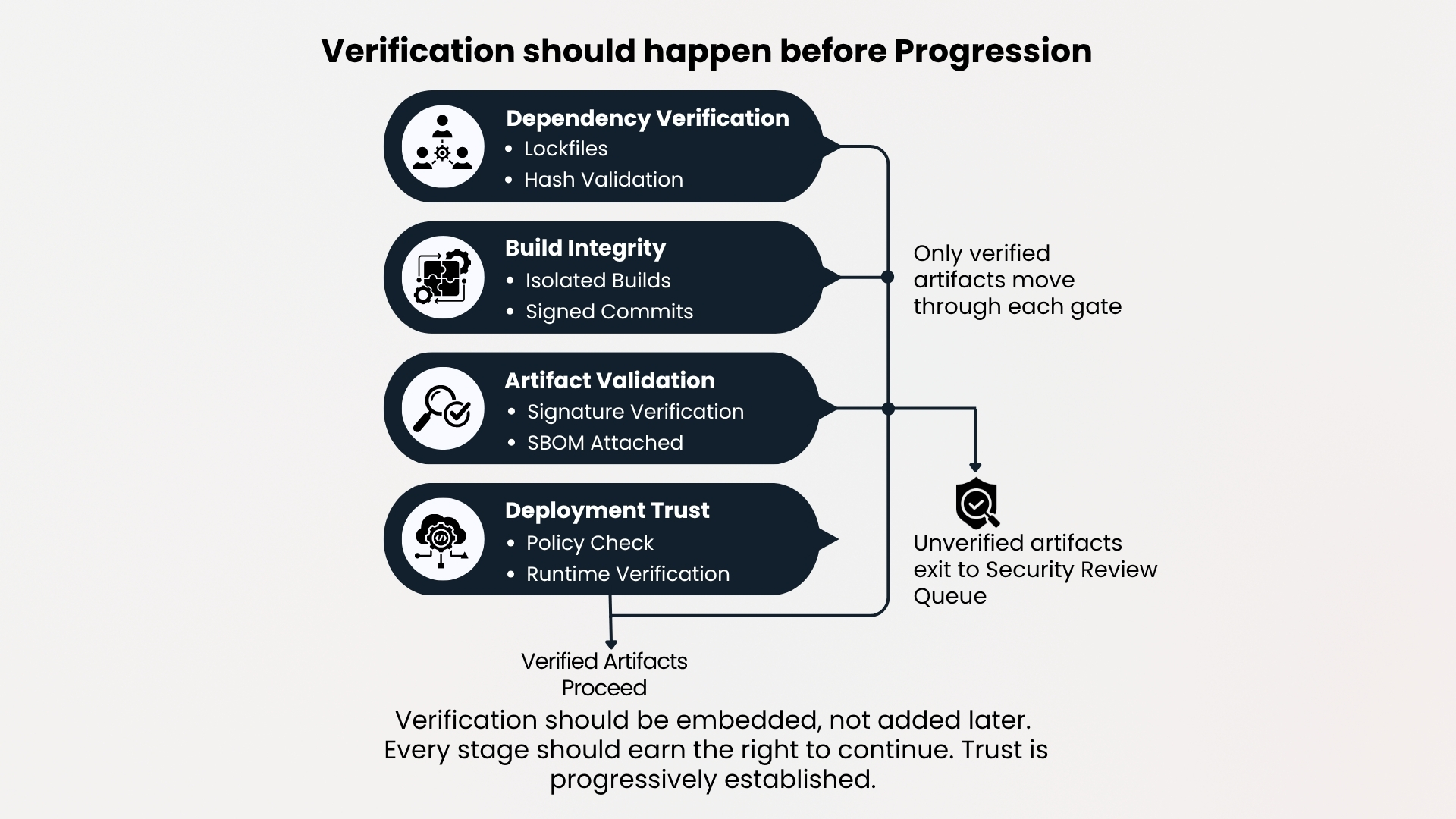
The industry response has converged on a few practices that function as a layered defense rather than isolated tools. Dependency verification through lockfiles, pinned commit SHAs, and cryptographic hash checking blocks version substitution attacks outright. Software Bills of Materials function as a machine readable ingredients list, turning vulnerability response from a manual server by server hunt into a single query against known inventory; this is now a procurement requirement under frameworks like US Executive Order 14028 and is spreading into enterprise contracts generally. Artifact signing, using tools such as Sigstore's Cosign, closes the gap between build and deployment by proving cryptographically that nothing changed after the pipeline finished its work. Isolated, ephemeral build environments limit dwell time for any attacker who gets in, since agents are provisioned fresh per build and destroyed right after.
A Maturity Model for Supply Chain Intelligence
Organizations tend to sit at one of three stages. Stage one is reactive visibility: no systematic dependency inventory, vulnerability response driven by ad hoc CVE alerts, build environments shared and broadly permissioned, trust assumed by default. Stage two is proactive verification: automated scanning embedded in CI/CD, SBOM generation automated for production artifacts, version pinning enforced by policy, build isolation taking hold. Stage three is continuous supply chain intelligence: trust verified cryptographically from source to deployment, SBOMs reconciled continuously against live vulnerability intelligence, and third party components evaluated against defined risk thresholds before introduction rather than after.
Most enterprises sit between stage one and stage two. The gap to stage three is not a tooling gap. The tooling already exists. It is an organizational gap: the ownership structures and workflows that make continuous verification sustainable at the speed software actually ships.
Strategic Implications
The progression across these stages mirrors a broader shift already underway across enterprise technology: from discrete tools, to integrated infrastructure, to intelligence driven operations. Organizations operating at stage three rarely talk about which scanner or signing utility they use. They talk about supply chain risk as a real time input into deployment decisions, the same way uptime or access control already function.
The velocity tension is real, but it resolves architecturally rather than procedurally. Controls that require manual review at every stage will always lose to release pace. Controls embedded directly into pipeline infrastructure, automated and exception driven rather than approval driven, scale with velocity instead of against it. The goal is not to slow developers down. It is to make the verified path the default path, so every dependency, model, or agent entering the system has already been inventoried, checked, and cleared before it reaches production.
Conclusion
The boundary between an organization's own software and the software it depends on has effectively dissolved. What remains is a continuous chain of custody running from open source maintainer to package registry to build pipeline to production, and from there into the AI models and agents now embedded in that same pipeline. Every link carries both capability and risk.
The organizations that navigate this with confidence will not be the ones with the largest security budgets. They will be the ones that treat supply chain integrity as a first class architectural property: embedded in delivery pipelines, governed through policy, and monitored continuously rather than assumed by default. The supply chain is no longer a dependency sitting underneath the system. It is the system. Building for that reality now is what separates scalable, trustworthy AI driven infrastructure from infrastructure that simply looks secure until it isn't.