
Article
How Stateful and Stateless Design Define Scalable Intelligence
This blog explains why state management is an invisible architectural decision that determines whether AI-driven systems scale and learn or collapse under complexity. It covers the trade-offs between stateless and stateful design, the CAP theorem as a daily constraint, the failover tax, hybrid state externalization, feature stores for AI, and a four-dimension framework for deciding where state should live.
- Topic
- Technology
- Published
- 29 Sept 2026

Introduction: The Invisible Decision That Shapes Everything
The most consequential architecture decisions never appear in a campaign brief or a product roadmap. They operate beneath dashboards, attribution models, and AI layers, quietly determining whether infrastructure compounds value over time or collapses under its own complexity.
That decision is state management: where does your system remember things, and who is responsible for that memory?
As AI-driven personalization, real-time decisioning, and autonomous agents become standard capabilities, the choice between stateful and stateless design has become a genuine strategic variable. Organizations that understand it build systems that scale and learn simultaneously. Those that do not find themselves perpetually re-platforming and chronically under-delivering.
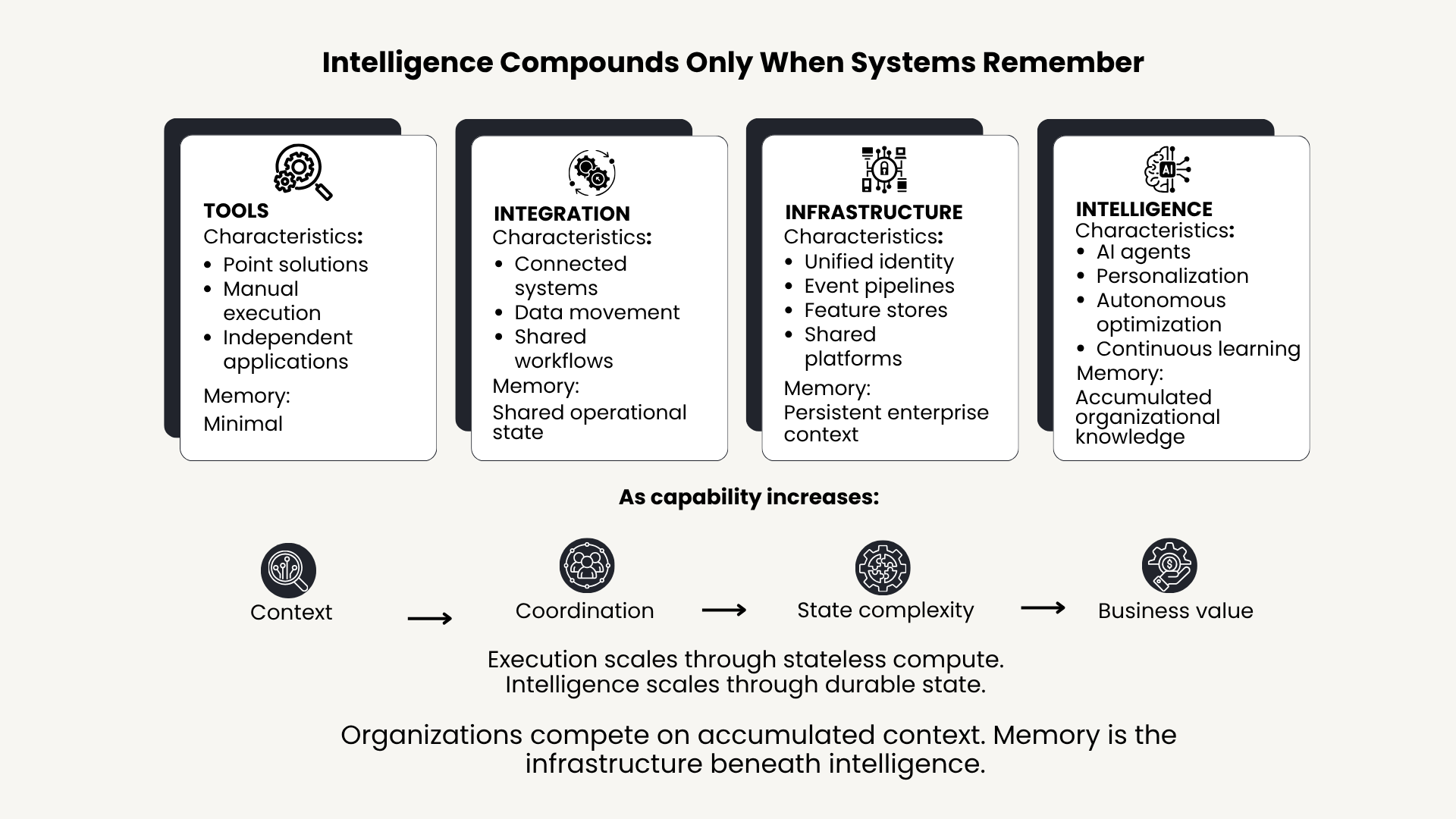
Enterprise systems are moving from isolated tools to integrated infrastructure to autonomous intelligence. State management is what makes that progression possible. If the state model is wrong, every layer above it becomes harder to scale.
Why State Management Shapes System Architecture
State is any information a system must retain to understand what happens next. In marketing and AI systems, it is everywhere: a user session, a campaign journey, an AI agent's memory, a consent record, a workflow checkpoint, a lifetime value score.
The architectural question is not whether state exists. Nearly every meaningful business system has state. The question is where that state lives, how long it persists, and who is responsible for keeping it consistent.
Scalability and the Coordination Problem
Stateless architectures scale horizontally because any healthy instance can process any request. Load balancers distribute traffic freely. New instances absorb demand spikes and retire cleanly when load drops. Failover is straightforward: failed instances are replaced and traffic routes elsewhere with no session data lost.
Stateful systems work differently. A session tied to a specific instance means adding capacity requires distributing, migrating, or replicating the state those servers hold. Uneven session intensity creates hotspots: some nodes become overloaded while adjacent ones sit idle.
Every capability added to a stack carries an invisible architectural cost. Deploying real-time personalization or AI-driven next-best-action is simultaneously a decision about infrastructure complexity. Few marketing organizations fully account for this in their planning.
The CAP Theorem as a Daily Constraint
Distributed stateful systems must confront the CAP theorem: a distributed data store can simultaneously guarantee only two of three properties: consistency, availability, and partition tolerance.
This trade-off is not theoretical. Strong consistency is required for transactional operations such as billing, consent records, and suppression state. Eventual consistency is acceptable for analytics aggregation or content recommendations where a brief sync delay does not degrade the experience. The correct choice follows business semantics: what is the actual cost of inconsistency in this specific context?
Stateless Architectures: The Scalability Default
Stateless design excels at high-throughput, low-context operations: serving landing pages, processing webhook events, validating API signatures, distributing email at scale. These are execution layers, not intelligence layers. They are fast, cost-efficient, and resilient by design.
When an instance fails, traffic moves to another without session recovery or data reconciliation. The application tier becomes disposable even though the business process is not.
The limitation emerges the moment execution requires context. A recommendation engine that starts fresh with every page view. A chatbot that cannot recall the previous message. An email sequence that cannot determine where a contact sits in a journey without querying an external system on every request. Stateless architectures are not wrong. They are incomplete as the sole model for systems that need to know their users.
Stateful Systems: Where Intelligence Lives, and Where Complexity Compounds
Stateful systems are essential when continuity is intrinsic to the workload. Databases, journey orchestration engines, AI agents, and customer data platforms must preserve context across interactions.
The Failover Tax
When a stateful instance fails, the system must determine where the latest valid state lives, transfer ownership, and resume incomplete operations without duplicating actions. For AI agents operating across multi-step workflows, restarting without durable state may cause repeated actions, skipped steps, or corrupted context.
This is the failover tax: the hidden cost of rich personalization is more complex recovery logic, more sophisticated data replication, and more rigorous operational discipline. Teams that underinvest here discover the cost during incidents, not during planning.
Data Synchronization as a Business Risk
Synchronization failures are not merely technical inconsistencies. They create business errors. An offer sent after a customer has already converted. A suppression rule that arrives too late. An AI agent acting on an outdated account status. The architecture must define how quickly updates must converge and what happens when they do not.
Hybrid Architecture: The Modern Synthesis
Most production systems at scale are neither entirely stateful nor entirely stateless. The dominant pattern in modern cloud-native infrastructure is state externalization: stateless application servers that delegate all memory to purpose-built external stores.
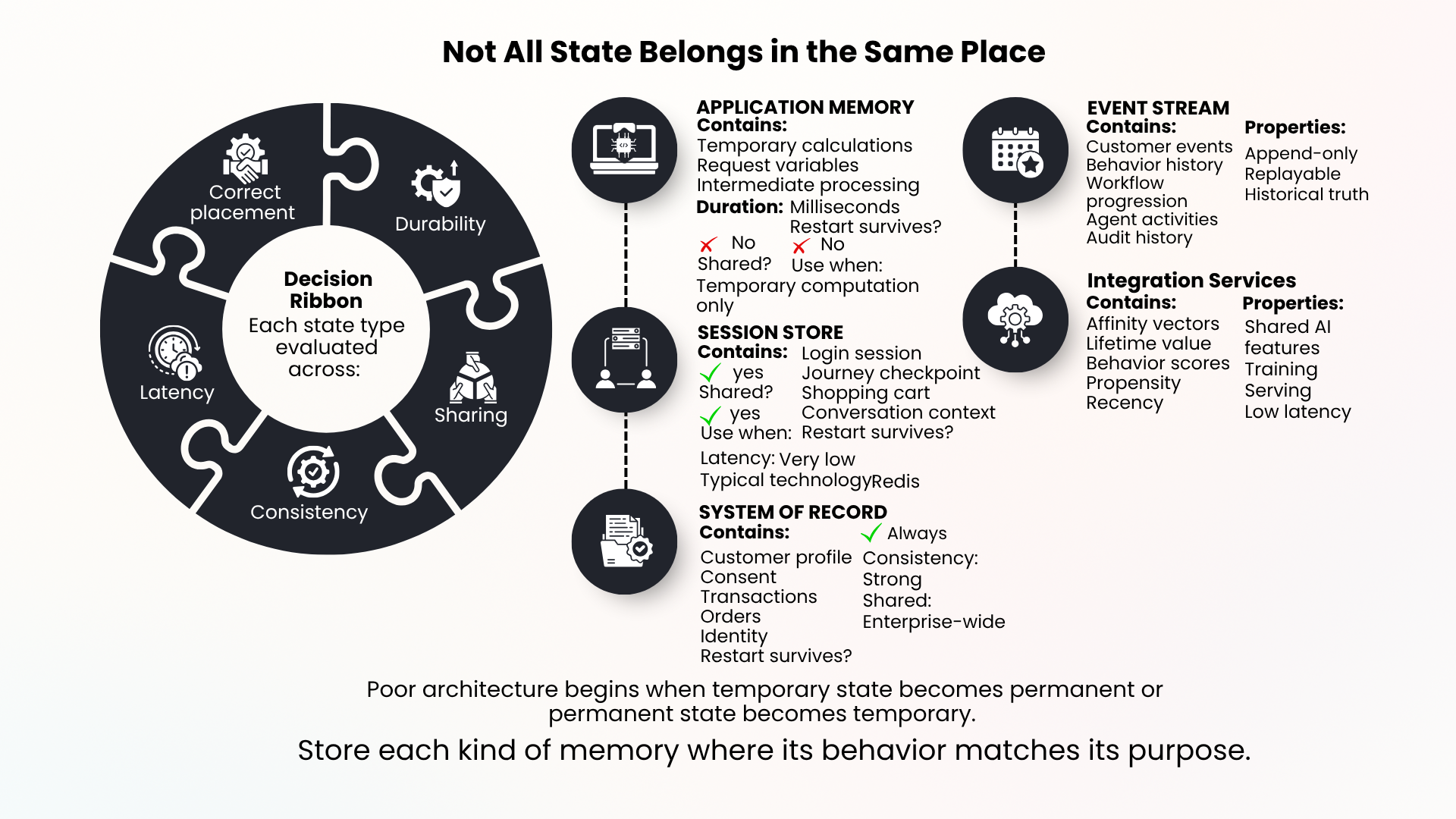
The compute tier handles request processing and remains horizontally scalable. The state tier handles persistence, replication, and consistency. In-memory caches such as Redis provide sub-millisecond access to session context and real-time feature vectors. Event streams serve as the immutable source of truth for behavioral history. Vector databases store interaction embeddings that stateless AI inference engines query dynamically on each prompt.
This architecture preserves horizontal scalability while enabling rich context. Compute capacity and state capacity become independent scaling problems. But externalization is not free: every external lookup adds latency and operational responsibility, and a cache failure can affect an otherwise healthy application. Externalization makes state visible; it does not make it simple.
Feature Stores and AI State Management
AI introduces a distinct category of stateful complexity. A recommendation model trained on user behavior is a compressed representation of historical signal. Keeping it current and serving it at low latency while updating it without disrupting live production systems is a coordination challenge most organizations underestimate.
The response is feature stores: shared, low-latency repositories of precomputed signals such as recency scores, affinity vectors, and lifetime value estimates, accessible to both training pipelines and serving systems. Feature stores are state management for AI and are rapidly becoming a core component of mature marketing data infrastructure.
A Framework for State Placement Decisions
Each state element in a distributed system should be evaluated across four dimensions:
Durability: Must this state survive a restart or disaster? If so, use durable storage with tested recovery, not an ephemeral cache.
Sharing: Must multiple services access this state? If so, externalize it from local process memory into a shared layer with defined access controls.
Consistency: How quickly must updates converge? Choose strong, session-level, or eventual consistency based on the business consequence of divergence, not infrastructure defaults.
Latency: Must access be near-immediate? Match the storage type to the access pattern: local memory for temporary computation, in-memory caches for session context, durable databases for records that must survive failure.
These four dimensions produce a practical decision hierarchy: local ephemeral state for temporary computation, external session state for personalization context, durable system-of-record state for consent and transactions, and event-sourced state for long-running workflows and autonomous agents. Choosing state placement based on convenience rather than these criteria is the most common design error in distributed marketing infrastructure.
Strategic Implications: Architecture as Competitive Advantage
The evolution of marketing technology follows a clear arc. The first era was about tools: acquiring capabilities and integrating point solutions. The second was about infrastructure: unifying data, resolving identity, and building the pipelines that connect systems. The era ahead will be defined by intelligence: systems that not only execute campaigns but learn, adapt, and optimize continuously.
That intelligence layer is inherently stateful. It accumulates signal, builds context, and compounds value over time. Leaders who treat this as a procurement decision will find themselves constrained by infrastructure not designed to carry intelligence at scale.
State ownership must become explicit. Every important state element should have a designated system of record, a consistency requirement, a retention policy, and a tested recovery strategy. This is not an IT concern. It is the foundation on which every AI-driven personalization and autonomous decisioning capability rests.
Conclusion
Stateless and stateful architectures are not competing philosophies. They are complementary layers in a well-designed system. Stateless services deliver horizontal scale and operational simplicity. Stateful infrastructure preserves the continuity, context, and accumulated intelligence that modern marketing and AI execution demand.
The organizations that will lead are not those that default to one model. They are those that understand where each belongs, invest deliberately in state management as a first-class capability, and treat architectural coherence as a strategic asset.
The algorithm is only as good as the infrastructure it runs on. Build accordingly.