
Article
Service Mesh Architecture: The Infrastructure Layer That Determines Whether AI-Driven Marketing Scales
This blog explains why the real constraint in AI-driven marketing systems is no longer what any single application can do but how reliably those applications communicate with each other across distributed service ecosystems. It covers what a service mesh actually does through sidecar proxies, the three core capabilities that affect business outcomes (traffic control and circuit breaking, mTLS and zero-trust enforcement, distributed tracing and observability), and a four-dimensional framework for determining when a mesh becomes a prerequisite rather than an option.
- Topic
- Technology
- Published
- 8 Sept 2026

The dominant story in marketing technology for the past decade was about acquiring better tools. Better AI. Better personalization engines. Better analytics. The implicit assumption was that capability lived in the applications themselves.
That assumption is now the bottleneck.
As enterprise marketing and AI stacks have evolved into interconnected service ecosystems, the real constraint is no longer what any single application can do. It is how reliably those applications communicate with each other. The competitive advantage has shifted from tools to the infrastructure layer beneath them.
Service mesh architecture is the response to that shift. Understanding it is no longer a concern for infrastructure engineers alone. It is a strategic requirement for anyone building AI-powered systems at scale.
The Hidden Cost of Distributed Marketing Systems
A decade ago, a marketing stack was a set of loosely coupled silos connected by scheduled data transfers. Latency was tolerated. Failures were contained. The architecture was simple because the ambitions were simple.
That world ended when real-time became the standard.
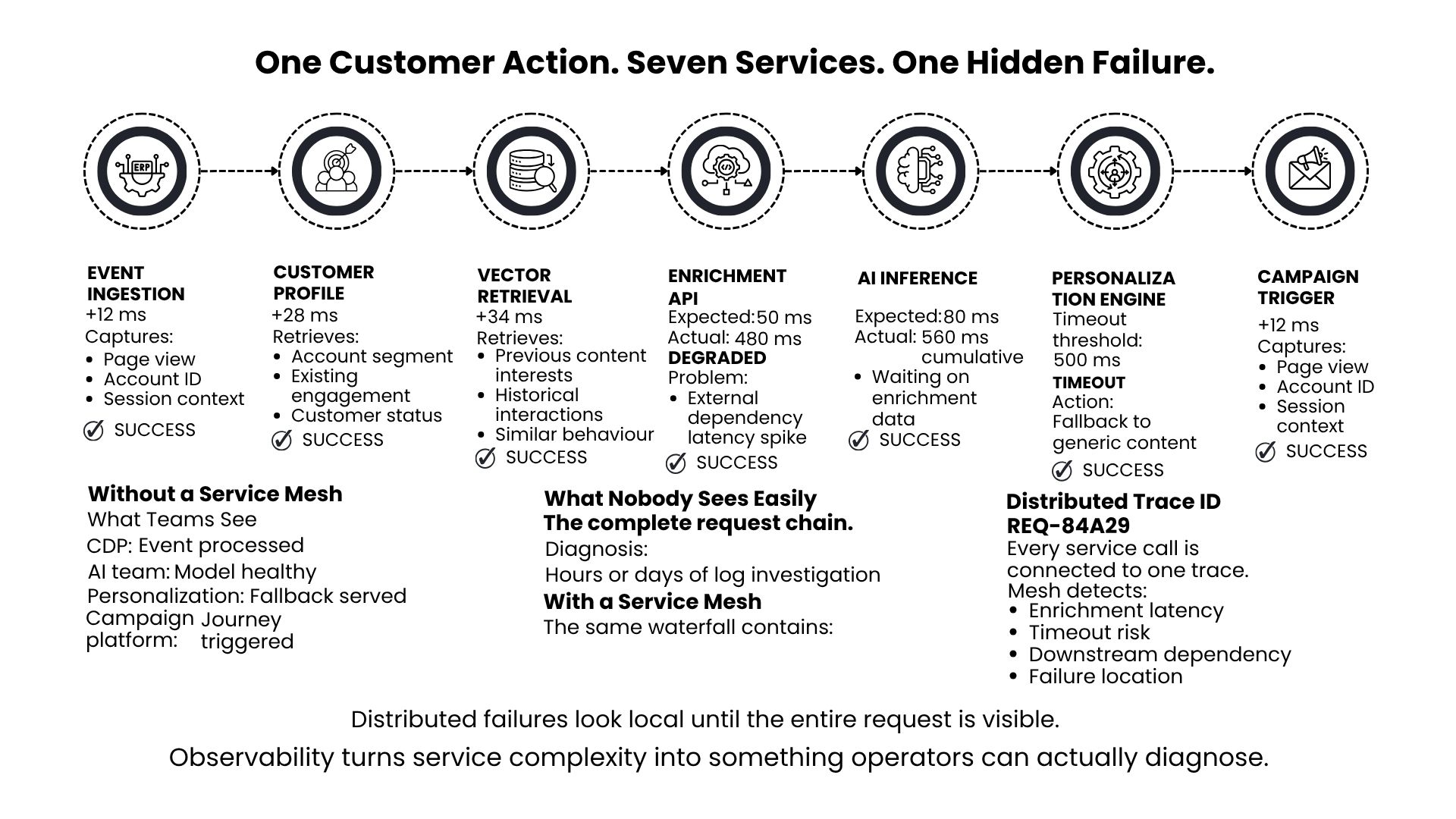
In a modern enterprise stack, a single customer action can trigger dozens of internal service calls: a customer data platform extracting behavioral traits, a vector database retrieving historical engagement, an AI inference engine predicting the next best action, and a personalization service assembling a dynamic offer. Each is a separate microservice, communicating with others in real time.
This internal traffic between services is called east-west communication. Unlike north-south traffic, which flows between external users and the application boundary and is typically governed by API gateways, east-west traffic operates inside your environment without consistent oversight. The result is three compounding problems.
First, failures cascade invisibly. A fifty-millisecond delay in one enrichment API propagates through the pipeline and causes a real-time personalization engine to time out, defaulting every user to generic content. Because no single team owns the full request chain, the failure is hard to locate and harder to explain.
Second, observability becomes a black hole. When an automated campaign fails to trigger, teams cannot easily determine whether the failure originated at event ingestion, the decision engine, or a downstream webhook. No natural layer exists to capture what happened.
Third, security compliance deteriorates. Unencrypted internal transfers expose sensitive customer data to lateral movement risks, violating zero-trust mandates like GDPR and CCPA. Perimeter firewalls do not address threats that originate inside the network.
These are not engineering inconveniences. They are structural conditions that limit how far any AI investment can go.
What a Service Mesh Actually Does
A service mesh is an infrastructure layer that manages how services communicate without requiring each service to implement that logic itself.
The mechanism is the sidecar proxy. Instead of embedding network concerns such as retries, encryption, load balancing, and observability directly into each service, a mesh deploys a lightweight proxy alongside every service instance. All traffic entering and leaving that service passes through the proxy. The proxy handles the communication logic while the service handles business logic.
This separation matters for a fundamental reason: it moves communication from a distributed problem to a managed one.
When each service team owns its own retry strategies, timeout configurations, and certificate management, the organization accumulates inconsistency. One team retries aggressively and amplifies load on degraded dependencies. Another under-retries and drops requests silently. These inconsistencies surface as unpredictable latency, unexplained campaign drops, and compliance gaps that only appear during audits.
A service mesh replaces that fragmentation with a consistent control layer. Platform teams configure how traffic is routed, secured, and observed. Those policies apply automatically across every service, regardless of which team built it or which language it uses. Development teams build product logic. The mesh handles the network.
Core Capabilities That Affect Business Outcomes
Three mesh capabilities directly determine the performance of marketing and AI systems at scale.
Traffic control and circuit breaking address the cascade failure problem. When an external dependency such as an ad network API or LLM endpoint begins degrading, a service mesh can detect the error rate in real time and automatically stop routing traffic to that service for a defined period. The system returns a graceful fallback rather than hanging indefinitely. This is the difference between a degraded experience and a full outage during peak demand. The same capability supports canary deployments, where new model versions or service updates receive a controlled percentage of traffic before broader rollout, allowing staged releases without application code changes.
Mutual TLS and zero-trust enforcement address the east-west security problem. A service mesh enforces mutual authentication between every pair of communicating services. Both sides present cryptographic certificates before data is transmitted. All traffic is encrypted in transit. This is not perimeter security applied to internal traffic. It is identity-based security that operates at the service layer, which is the only model that holds in multi-cloud and multi-team environments where the network perimeter is effectively meaningless.
Distributed tracing and observability address the black hole problem. Because all traffic flows through sidecar proxies, the mesh can attach a unique trace identifier to every incoming request and follow it across every internal service call. Operations teams can view a single waterfall chart showing exactly which service consumed the majority of processing time, when it happened, and what the downstream effects were. Diagnosing a delayed campaign or an incorrect recommendation shifts from days of log archaeology to minutes of trace analysis. The system becomes legible in a way it cannot be without a standardized telemetry layer.
A Framework for Adoption Decisions
Service mesh is not the right answer for every organization, and adopting it prematurely creates overhead without proportional return. A structured evaluation across four dimensions clarifies when it makes sense.
Communication complexity is the first dimension. Count how many internal services communicate regularly and how quickly that dependency graph is growing. A platform with ten stable services and predictable traffic patterns rarely justifies a mesh. An environment with dozens of services exchanging data across multiple teams, languages, and clusters presents a stronger case.
Policy consistency is the second dimension. Assess whether different teams are independently solving the same networking problems. If authentication logic, retry configurations, and observability instrumentation differ across services, centralizing those concerns through a mesh will reduce both maintenance burden and operational risk.
Risk sensitivity is the third dimension. Financial services, healthcare, and any platform handling regulated customer data have compliance requirements that benefit from automated mTLS enforcement and auditable policy management. The stricter the compliance surface, the earlier a mesh justifies its cost.
Operational readiness is the fourth dimension. A service mesh requires platform engineering capability to operate: certificate lifecycle management, traffic policy configuration, proxy health monitoring, and control plane maintenance all need dedicated expertise. Without that foundation, the mesh is more likely to create instability than reduce it.
The principle tying these dimensions together: adopt a service mesh when the cost of unmanaged service communication exceeds the cost of operating the mesh. That calculation depends on your scale, risk profile, and team capacity, not on the sophistication of the technology itself.
Strategic Implications for AI-Driven Organizations
AI investment in marketing is frequently misdiagnosed when it underperforms. The default assumption is that the model needs improvement. The actual cause is often that the infrastructure carrying the model's inputs and outputs is fragile or opaque.
A recommendation engine receiving stale data produces stale recommendations. A personalization layer that fails silently defaults every user to generic content. An autonomous agent framework without secure, rate-limited communication between sub-agents cannot operate deterministically at scale. The AI system performs exactly as well as its infrastructure allows, and the infrastructure is the constraint.
Service mesh architecture addresses this by making the communication layer a first-class concern rather than an afterthought embedded in application code. Organizations that win in AI-powered marketing will not simply have the most sophisticated models. They will have the infrastructure to run those models reliably in production, under the conditions that matter most. A service mesh is not the destination. It is the foundation without which the destination remains unreachable.
Conclusion
Service mesh architecture is a disciplined response to a specific problem: communication complexity that has grown beyond what individual teams can manage consistently.
It abstracts traffic management, security, and observability into a shared infrastructure layer. The benefits are real: consistent policy enforcement, automatic mTLS, circuit breaking, and distributed tracing. So are the costs: latency overhead, resource consumption, and the operational complexity of managing the mesh itself.
The decision is not about whether the technology is mature. It is about whether your organization has reached the scale where unmanaged service communication actively limits what your systems can do. For small, stable environments, simpler networking remains the better design. For large, multi-team, AI-driven platforms, the mesh becomes less of an option and more of a prerequisite.
Infrastructure is not the long game. It is the only game that compounds.