
Article
Security Observability: Detecting Threats in Real Time
This blog explores how security observability goes beyond traditional monitoring to detect threats in real time by correlating authentication, network, and API signals; turning noise into actionable insight. It explains why marketing technology leaders must adopt this proactive approach to protect customer trust, reduce response times from weeks to minutes, and turn security into a competitive advantage.
- Topic
- Cyber Security
- Published
- 7 Apr 2026

Today's marketing organizations process an unprecedented amount of sensitive data related to their customers as well as behavioral signals, analytics specific to their campaigns and sales revenues. This vast amount of data processed by marketing technology stacks makes them prime targets for cybercriminals to exploit. The average annual cost of a cyberattack to a company is approximately $3.7 million, and companies are dealing with an average of 11,000 security alerts per day.
Recent breaches of major telecommunications providers in the United States by Chinese hackers demonstrate that while the companies had access to visibility, monitoring capabilities, and the ability to maintain a log of events taken against them, the attackers were able to operate undetected for 18 months. Visibility alone is therefore insufficient to protect a company from a cybercriminal.
Security observability is a new approach that considers what has happened in the past to help answer the questions of what it means currently and how we act on it to prevent future harm. This difference in perspective is critical for marketing technology leaders who are responsible for maintaining customer confidence and stability to help fuel their enterprise's growth. Security and observability of an organization's assets is a business driver having a direct impact on its ability to generate revenues, retain and build its brand reputation, and be resilient in the marketplace.
Limitations of Traditional Security Monitoring
Traditional tools look at logs and known threat patterns, but they simply can’t keep up with how quickly today’s attacks change.
Volume and noise
As our digital environments continuously evolve, they generate enormous amounts of data: authentication logs, API requests, network traffic, and application events. Security teams are flooded with thousands of alerts every day, a large percentage of which turn out to be false positives. Research indicates that as many as 53 percent of security alerts can be false positives. This kind of alert overload results in security personnel overlooking the signals and the response times getting prolonged.
Based on the 2024 Devo SOC Performance Report, 70 percent of Security Operations Centers find it challenging to deal with alert volume efficiently. If security technologies are left to work in silos and lack contextual awareness, they will inevitably mistake the most legitimate of activities for threats, thus leading to an unnecessary waste of both time and resources in pursuing investigation dead ends.
For marketing organizations operating global campaigns and digital platforms around the clock, the risk is clear: critical threats hide in plain sight among routine activity.
Delayed detection
Traditional tools often identify breaches only after damage has occurred. Many companies only find out about breaches after weeks or even months following the first compromise. For instance, the Microsoft Midnight Blizzard attack was not detected for about two months, during which time the attackers were able to move laterally and steal highly sensitive data.
Since conventional signature-based detection depends on patterns of known attacks, it is almost completely ineffective in the case of zero-day vulnerabilities and new types of attacks. Research has shown that exploits currently get weaponized within days, quite often even within hours, after they are disclosed. Hence, companies need detection solutions that can keep up with the velocity of threats.
When breach detection is late, the costs of remediation and damage to the company's reputation become higher. According to several studies, if attackers are not detected for a longer period, the aftermath will be more serious. In the scenario of environments where there is direct interaction with a customer, the delay means that the loss of trust and regulatory risks are the consequences that follow.
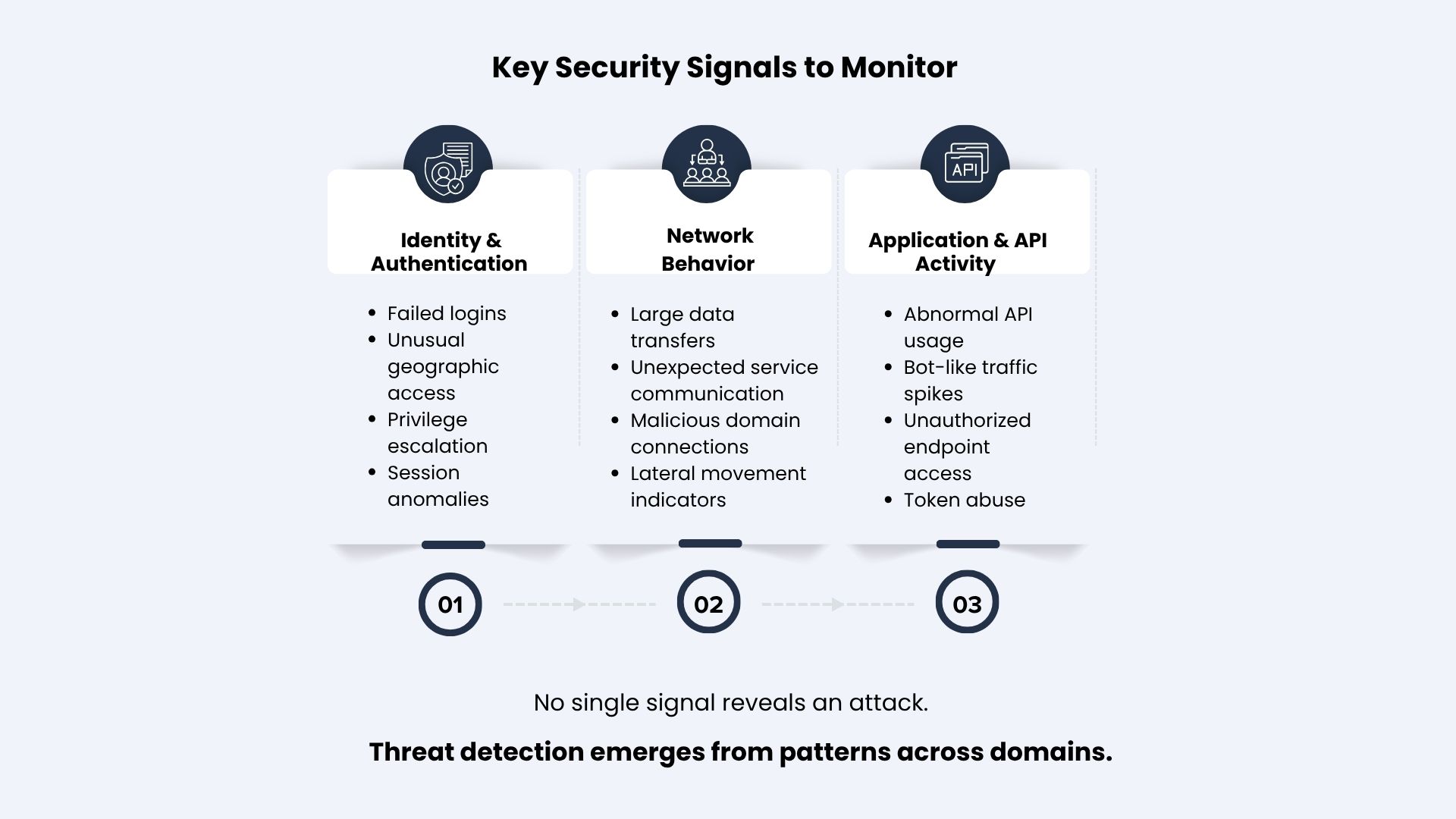
Key Security Signals to Monitor
Security observability shifts focus from isolated alerts to meaningful patterns across three critical categories.
Authentication anomalies
Attacks that target user identities have quickly become one of the most common ways hackers get in. Over half of incidents now involve MFA bypass or account takeover, frequently via adversary-in-the-middle attacks harvesting session tokens.
Observability platforms don’t monitor user behavior only at login, they monitor user behavior throughout entire sessions. They establish normal behavior patterns and detect any changes instantly. Key signals include:
Repeated failed login attempts from the same source, Logins from unusual geographic locations, Impossible travel scenarios like simultaneous logins from distant regions, Sudden privilege escalations and User velocity anomalies: a login from Sydney followed by activity from New York five minutes later.
Organizations that use behavior analytics have found 67 percent more possible insider threats than rule-based systems. Gartner states that by 2025, half of large enterprises will have advanced behavioral analytics as part of their identity management systems, which is a drastic increase from less than 5 percent in 2021.
Network behavior patterns
Not all attacks comprise getting direct access to the system. Most of them start from minor changes in the network behavior. State-of-the-art security solutions monitor:
Points of large data transfers that could signify data theft, Unexpected interactions between services that hint at a potential lateral movement, Communication with domains known to be malicious, Unusual pod-to-pod interactions in Kubernetes setups and Privilege escalation attempts at the kernel level.
eBPF-based solutions such as Tetragon bring great observability features at a very low performance cost. Hence, they can trace process execution, file access, and network activity all happening at the kernel level. Such a high level of granularity allows the security team to spot smuggled threats, which are disguised as normal operations.
Application and API signals
The modern marketing teams depend on APIs to integrate their CRM, analytics, marketing automation tools, and customer platforms. Attack indicators are:
Unusual API usage pattern not matching the normal baseline, Too many requests coming from one source that may suggest a bot attack, Access to endpoints that are not part of the usual behavior, Abuse of Service Account tokens in cloud environments. It is critically important to keep an eye on these signals to secure customer data and campaign infrastructure.
Correlating Events Across Systems
Atypical logins may seem harmless in isolation, but when correlated with abnormal data access and network patterns, they form a high‑confidence indication of a security incident.
Contextual analysis
Security observability platforms combine signals across various sources to offer context. Take a normal attack scenario for example: an adversary phishing an employee for credentials, the same employee having their session token stolen, and the adversary using it to get into the highly protected systems. Conventional supervision can produce a variety of alerts which may include one for a login that looks suspicious, another for a file access that is not usual and one more for the connection to the external IP. These appear as disconnected events.
Observability correlates these signals into a single story. It ties the session ID across activities, recognizes that the "user" accessing files at 3 AM exhibits none of their normal behavioral patterns, and escalates risk in real time. For example:
Login from new geography, Access to sensitive customer database and Large outbound data transfer. Individually, each event may seem routine. Together, they reveal a potential breach. Context turns noise into insight.
Reducing false positives
Correlation also limits the overload of alerts. Instead of distracting themselves with single unusual events, teams focus on real risks by recognizing patterns. Enterprises adopting contextual correlations are witnessing a drop in false positives by more than 60 percent while at the same time spotting advanced attacks better.
AI-driven tools cut down on false positives by as much as 80 percent through the creation of detailed baselines considering role-based behavior, time patterns, and environmental context. Such precision is crucial for organizations with customer-facing digital platforms to maintain user trust and ensure continuous availability.
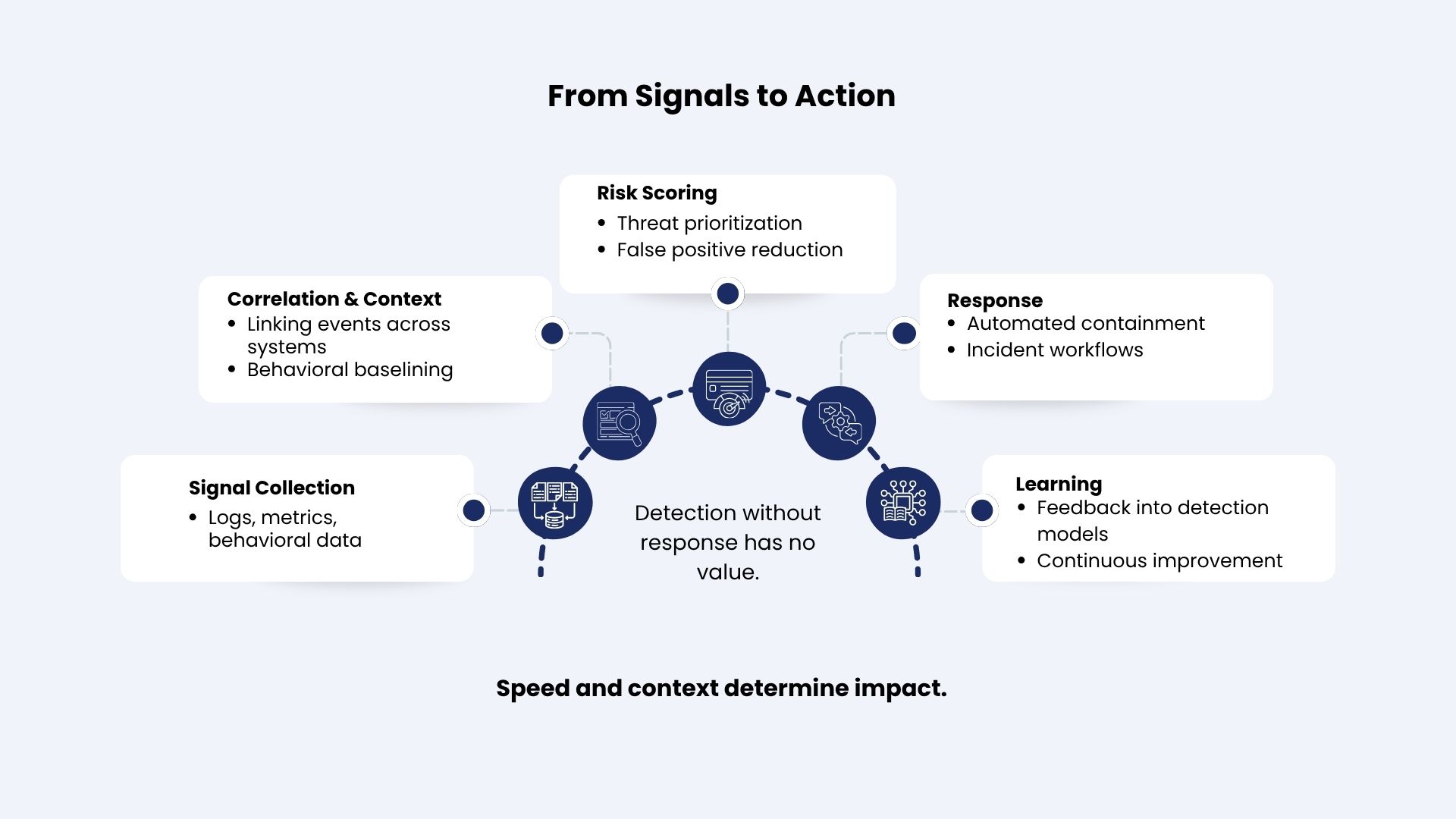
Incident Detection and Response
Detection delivers value only when it is followed by rapid, effective action.
Alert triage
Effective incident response starts with prioritization. Security observability platforms employ risk scoring systems prioritizing alerts based on:
Criticality of assets as well as level of business impact; Attack sophistication & Threat Intelligence correlation; High impact Threats against Sensitive Systems; Suspicious behavior from Privileged Accounts; Indicators of Data Exfiltration.
Machine Learning Models are always learning from the decisions of analysts. Over time this will help to improve the prioritization of incidents. Teams which utilize AI-powered triage have achieved a 75% reduction in the number of investigations and consequently have a higher degree of success at handling additional incidents using the same number of staff members.
Automated response
Speed is crucial during an active threat. It is estimated that the Security Orchestration, Automation, and Response (SOAR) sector will reach $4.42 billion in value by 2030 while growing at a Compound Annual Growth Rate (CAGR) of 18.82%. This growth in demand demonstrates that malicious attackers are expanding their ability to attack, and it is widely acknowledged across the industry that it is not feasible for manual response methods to respond to today’s types of attacks. Automation executes immediate containment actions:
Disable compromised accounts; Block malicious IP addresses; Isolate affected systems; Trigger incident workflows and Suspend access for high-risk users. Studies have shown that automated context, aware responses can reduce Mean Time to Respond (MTTR) to under 10 seconds in cases of privilege escalation, lateral movement, and data exfiltration. SOAR deployments result in a reduction of investigation cycles by up to 75 percent and drive a reduction of 82 percent in unplanned downtime. Automation of containment steps can, in many cases, hinder the escalation of incident into a full breach.
For marketing enterprises that are continuously running real-time campaigns, automated interventions serve as the customer experience safeguards and thus avoid disruptions to revenue operations.
Measuring Security Effectiveness
Security observability must demonstrate its value through measurable, data‑driven results.
Mean Time to Detect (MTTD)
MTTD refers to a metric that shows how soon threats are recognized. Quickly detecting threats lessens the extent of damage, the cost of recovery, and the disruption to the business. An IBM report, Cost of Data Breach 2025 reveals that, on average, companies with MTTD under 200 days save $1. 1 million per incident compared to those with longer detection times.
Those businesses which have advanced observability capabilities are able to identify issues more typically in a matter of minutes than after several days. The best teams have an MTTD time range of 30 minutes to four hours.
Mean Time to Respond (MTTR)
Mean time to recover (MTTR) is a metric that shows how fast a team confines and fixes the main causes of a security breach. The shorter the response time, the less time the operation is down, and the less impact on the customers and the regulatory exposure. Teams striving for top performance should be able to give answers to all severities within a time frame of two to four hours, and one hour should be the maximum reaction time to a critical incident.
MTTR is inversely proportional to the level of risk exposure. The faster an organization manages to contain a threat, the lesser will be their losses in terms of data compromise, system unavailability, and negative publicity.
Business impact
Security effectiveness should also be evaluated in terms of customer trust preservation, compliance adherence, and continuity of digital operations. For marketing-driven organizations, protecting data integrity and platform reliability directly supports revenue growth.
With 66 percent of companies reporting financial losses from downtime exceeding $150,000 per hour, every minute of undetected or unresponded threat activity translates directly to bottom-line impact.
Building Security as a Business Capability
Security is not just a concern of IT department anymore. It has become a priority for business. Marketing technology ecosystems are now being connected with customer data platforms, personalization engines, analytics tools, and automation systems. A compromise in any component will propagate throughout the entire customer journey.
Security observability gets you the visibility that you require to safeguard these interconnected systems without hindering the pace of innovation. Well-known breaches can result in loss of customer trust and lowering the stock price. Over one million individuals, including many government officials, suffered from the telecom breaches that went undetected for a period of 18 months. If there had been any kind of observability, these breaches would have been discovered anywhere from weeks to months sooner than they did.
Having comprehensive observability gives you situational awareness and allows you time to prepare yourself for proactively defending against threats instead of reactively responding to them. This transition involves integrating multiple sources of data, performing behavioral analytics on that data, automating repetitive tasks, and developing outcome measurements based on the results of those actions.
The threat environment develops at such a pace that it outstrips traditional defenses which are the mainstay of the past. Organizations that depend purely on passive/reactive monitoring will perpetually be in a situation of chasing incidents that have already happened. Those who adopt security observability take a step closer to proactive protection, i.e. early anomaly detection, quick response, and winning/customer trust retention.
For the top executives at the crossroad of marketing, technology, and data, the directive is unmistakable: real, time threat detection is not merely a security function. It's a competitive advantage. In a digital economy where trust drives growth, the ability to see threats as they emerge may be as important as the ability to see customers.