
Article
Security Misconfiguration Management in Cloud Infrastructure: Why Architecture Is the Answer
This blog explains why cloud security misconfigurations are a systemic architecture problem rather than individual error, driven by deployment velocity, diffuse ownership, and inconsistent baselines. It maps where risk concentrates, outlines the shift from periodic audits to continuous configuration intelligence through policy as code and drift detection, and presents a four-layer governance framework that makes secure configuration a competitive infrastructure capability.
- Topic
- Cyber Security
- Published
- 16 Sept 2026

The most dangerous shift in cloud security is not the rise of sophisticated attackers. It is the quiet accumulation of misconfigured infrastructure deployed at speed, across distributed teams, with no one clearly responsible for the result.
Gartner estimates that through 2027, over 99% of cloud security failures will be the customer's fault. IBM puts the average breach cost at $4.44 million, with misconfigurations taking more than 240 days to identify and contain. The 2024 Snowflake breach, which compromised over 100 million customer records, did not begin with a zero-day exploit. It began with databases that lacked enforced multi-factor authentication.
The prevailing explanation locates the failure in an individual: a developer who missed a setting, an engineer who granted excessive permissions. That framing is accurate but incomplete. The actual fracture point is systemic. Organizations cannot audit their way to cloud security. They must architect it.
Why Misconfigurations Persist Despite Mature Security Tooling
Cloud environments are fundamentally different from traditional data centers. A mid-sized enterprise may run workloads across multiple hyperscalers, hundreds of services, thousands of microservices, and millions of configuration parameters. In organizations with continuous deployment pipelines, infrastructure state changes not weekly but hourly. Every autoscaling event, automated patch cycle, and developer-initiated deployment is an opportunity for configuration to drift from its intended secure baseline.
The security team reviewing configurations at the end of a sprint is, structurally, always reviewing the past.
Human error in this context is not the root cause. It is the symptom of a system that expects human attention to operate faster and more consistently than it can. Three structural forces sustain the problem.
Velocity outpaces governance. When teams push updates multiple times a day through CI/CD pipelines, debug configurations and default permissions quietly enter production. Speed is optimized; policy enforcement is not.
Responsibility becomes diffuse. Platform teams manage foundational environments. Application teams configure workloads. Data and AI teams deploy endpoints. MarTech teams integrate third-party platforms. Without explicit ownership maps, each team assumes someone else is responsible. Misconfiguration becomes a coordination failure as much as a technical one.
Inconsistent baselines multiply risk. Without automated guardrails, different business units operate under different security standards, creating asymmetries that no single audit cycle can close.
Where Misconfiguration Risk Actually Concentrates
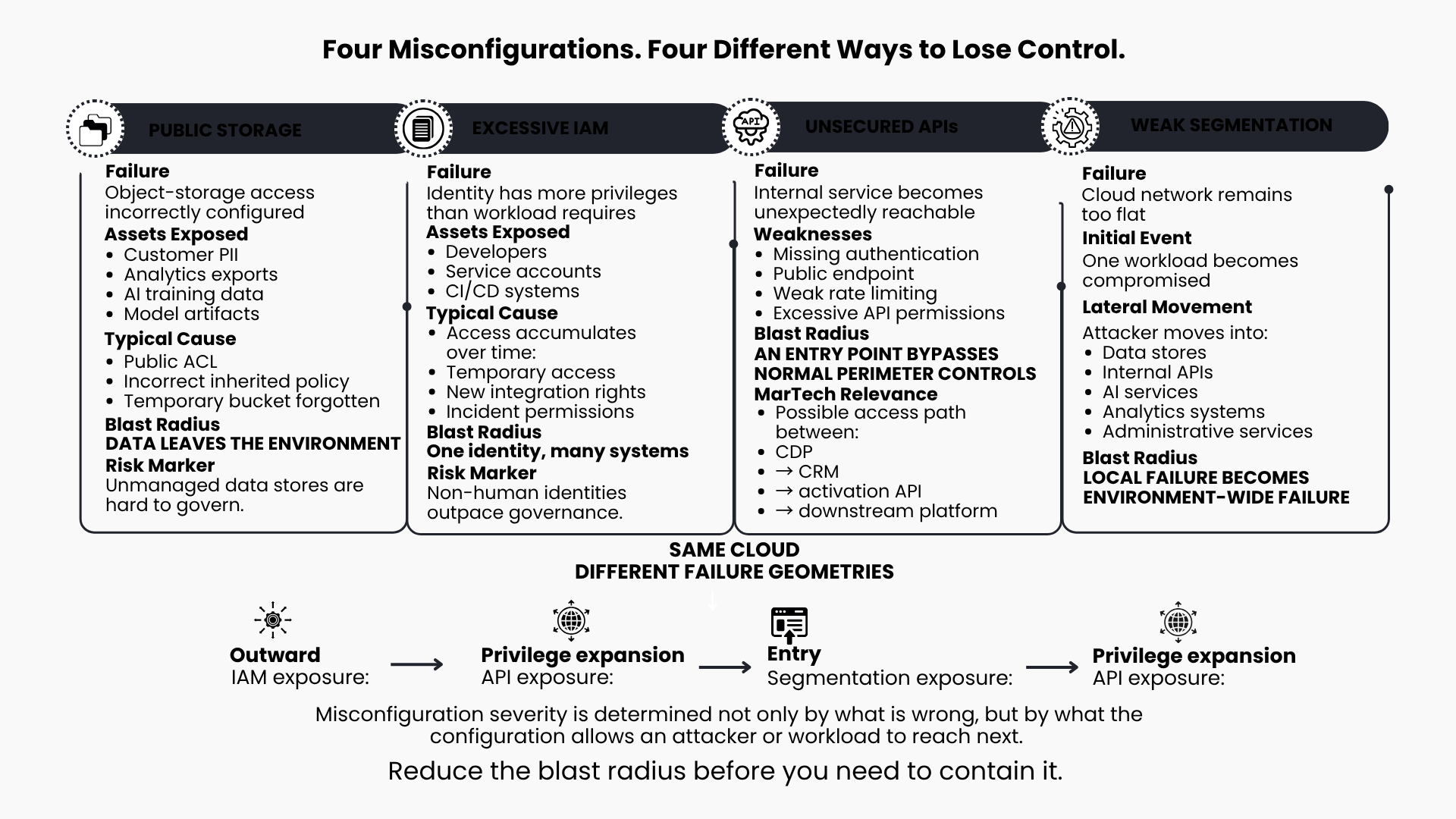
The attack surface is not uniformly distributed. Risk clusters around four structural failure modes.
Publicly exposed storage is the most visible and avoidable. Object storage services hosting customer PII, AI training datasets, analytics exports, or model artifacts can become publicly accessible through a single incorrect access control setting. The risk extends beyond production databases. IBM's research found that 35 percent of studied breaches involved data stored in unmanaged sources, highlighting how staging environments, temporary buckets, and analytical exports regularly fall outside established governance.
Excessive IAM permissions carry the largest blast radius. Permissions grow incrementally: a developer receives additional access to resolve an incident, a service account gains rights for a new integration, a project requires temporary administrative privileges. Over time, access expands well beyond what any workload requires. This problem intensifies as non-human identities multiply. Applications, automation agents, CI/CD systems, and AI services now outnumber human users in many cloud environments, making manual permission governance structurally impractical.
Unsecured APIs and services create invisible entry points. As development teams expose internal services for inter-component communication, misconfigured authentication, missing rate limits, and inadvertently public endpoints bypass perimeter controls entirely. In MarTech environments, where customer data platforms, CRM systems, and activation APIs exchange data continuously, every unintended public interface is a potential extraction vector.
Weak network segmentation amplifies every other failure. Flat cloud topologies without east-west traffic controls mean that a single compromised workload can become a pivot point for lateral movement across an entire environment. Segmentation reduces blast radius, but it must become part of automated deployment rather than a separate post-deployment activity to remain effective at scale.
From Periodic Audits to Continuous Configuration Intelligence
The shift from point-in-time audits to continuous configuration intelligence is one of the most consequential architectural transitions available to security and infrastructure teams. It is not merely a speed improvement; it is a categorical change in the type of risk that can be surfaced.
Continuous posture scanning compares infrastructure state against defined policy baselines in near real time. Configurations that drift into non-compliance for 48 hours between audit cycles represent a fundamentally different risk profile from those detected within minutes. Findings must be prioritized by exposure and business impact, not presented as one undifferentiated backlog.
Policy as code elevates security governance from documentation to executable infrastructure. By encoding requirements in version-controlled, machine-readable definitions using frameworks such as Open Policy Agent or cloud-native policy engines, organizations make their security intent legible to automated systems. Proposed configurations are evaluated against guardrails before deployment; non-compliant code fails the build before it reaches production.
Drift detection operationalizes the principle that any deviation from declared infrastructure state is, by definition, a signal. When a running resource diverges from its defined baseline, through a manual change or an automated script, drift detection surfaces the variance before it becomes exploitable.
Automated compliance validation closes the loop between intent and execution. Organizations with mature configuration intelligence generate continuous evidence of compliance posture across GDPR, SOC 2, PCI DSS, and HIPAA without the labor-intensive data gathering that typically precedes certification cycles.
A Framework for Sustained Configuration Governance
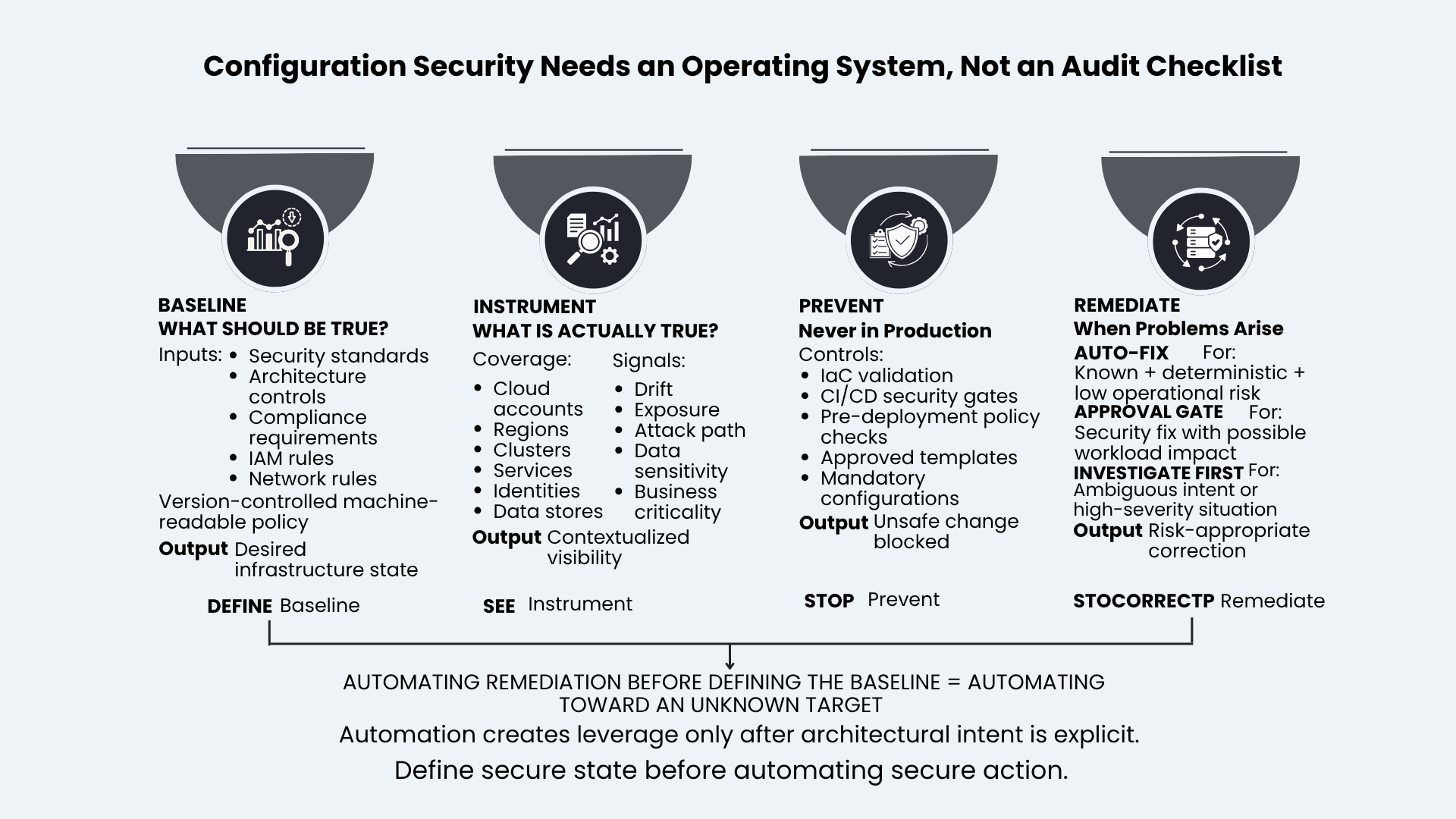
Strategic leaders benefit from a model that integrates these capabilities into a coherent governance architecture. Four layers build on each other sequentially.
Baseline defines desired state as machine-readable policy. Every security standard, compliance requirement, and architectural control is expressed in version-controlled code, not documentation. Without a clear baseline, detection and prevention have nothing to measure against.
Instrument deploys continuous scanning and drift detection across all cloud accounts, regions, and services. Visibility is the prerequisite for everything that follows. Findings must be contextualized by data sensitivity, business criticality, and attack path before teams can act on them effectively.
Prevent integrates policy enforcement directly into deployment pipelines. When Infrastructure as Code validation gates and pre-deployment policy checks are built into the CI/CD workflow, misconfigurations that cannot be deployed cannot become incidents. This shift moves security from reactive remediation to proactive enforcement.
Remediate automates corrective action for known, low-risk deviations while reserving human judgment for high-severity or ambiguous conditions. Not every misconfiguration warrants the same response. Auto-fix handles deterministic, low-risk corrections. Approval gates cover changes with potential workload impact. Investigate-first applies to findings where intent is unclear. Automation should reduce repetitive work without turning the security system into a source of operational instability.
This stack enforces architectural discipline before operational efficiency. Organizations that invest in remediation automation before codifying desired state are automating against an undefined target.
Strategic Implications for AI and Marketing Infrastructure
The urgency of this architectural shift grows as marketing, analytics, and AI workloads become more deeply embedded in cloud infrastructure.
Modern MarTech ecosystems contain customer data platforms, analytics warehouses, activation APIs, identity systems, and external SaaS integrations. AI environments add model endpoints, vector databases, training datasets, agent credentials, and machine-to-machine identities operating at speeds no human review process can match. A misconfigured pipeline does not merely expose data. It corrupts the decision systems that revenue, campaign, and personalization strategies depend on.
IBM's 2025 research found that 63 percent of studied organizations lacked AI governance policies, and that organizations with high levels of shadow AI experienced an additional $670,000 in average breach cost. As AI agents gain the ability to act autonomously, infrastructure mistakes in their permission boundaries can propagate at machine speed. Security architecture has to evolve before autonomy does.
The organizational implication is equally significant. Security cannot remain the exclusive responsibility of a centralized SecOps team. Engineering, data, marketing, and operations leads must share ownership of the systems they manage. When security ownership maps to infrastructure ownership, audit readiness becomes a continuous capability. This has strategic value beyond security: it accelerates enterprise procurement cycles, simplifies regulatory engagement, and reduces due diligence costs in merger and acquisition contexts.
Conclusion: Configuration Governance as Competitive Infrastructure
The configuration crisis in cloud infrastructure will not be resolved by more vigilant individuals. It will be resolved by organizations that redesign the systems within which individuals operate.
The organizations that lead will not be those that prevent every misconfiguration. They will be those that have engineered detection, prevention, and remediation directly into the systems through which infrastructure is created, changed, and governed. They will treat configuration governance not as a compliance burden but as the structural capability that makes scalable, trustworthy growth possible.
The question for decision-makers is not whether this architectural transition is necessary. The evidence on that point is unambiguous. The question is whether your organization will build this capability intentionally, or reactively, after the breach that makes the investment case impossible to ignore.