
Article
Security Considerations in Distributed Systems: Architecting Trust at Scale
This blog argues that traditional perimeter-based security fails in modern distributed systems, where the attack surface spans services, APIs, and identities. It outlines a zero-trust approach, covering authentication, data protection, and threat detection—and provides a maturity model to help organizations balance security with performance and agility.
- Topic
- Technology
- Published
- 14 May 2026

The perimeter is dead. The castle-and-moat model that defined enterprise security for decades has become obsolete in architectures where workloads span cloud providers, regions, and trust boundaries. Modern marketing technology stacks now manage 91 cloud services on average, with each integration point, API handshake, and data sync becoming a potential vulnerability.
This is not a tools problem. It is a systems problem. The shift from monolithic applications to distributed microservices has fundamentally changed the attack surface, and security must evolve with it. NIST's Zero Trust Architecture guidance makes this explicit: security should focus on protecting resources, services, and workflows rather than assuming trust based on network location. For marketing leaders and tech decision-makers, security can no longer be a feature added at the end of a project. It must be an architectural foundation.
The Expanding Attack Surface in Distributed Architectures
Distributed systems introduce security challenges that monolithic architectures never faced. The attack surface expands across three critical dimensions that compound as organizations scale.
Service-to-service communication replaces in-process method calls with network requests. Every inter-service interaction becomes a potential attack vector. In a typical marketing workflow, a prospect fills a form, an enrichment service appends firmographic data, a lead scoring engine evaluates, routing logic assigns, the CRM creates a record, and an activation platform triggers an email sequence. Six services, five handoffs, each requiring authentication and data transfer. A compromised frontend service can attempt to exploit a backend database service. A misconfigured service mesh can allow unauthorized access between namespaces. Trust boundaries are no longer at the application edge. They exist between every pair of communicating services.
API exposure multiplies the attack surface exponentially. Each microservice exposes its own API, often with distinct authentication and authorization models. The 2023 Verizon DBIR found that APIs were involved in 23% of breaches, with marketing and customer data systems disproportionately targeted because they sit at the intersection of valuable data and rapid iteration cycles. OWASP's API Security Top 10 for 2023 highlights broken object-level authorization and broken authentication as leading risks, noting that APIs expose endpoints that handle identifiers and create large attack surfaces if access controls are weak or inconsistent.
Identity sprawl compounds the problem. Where a monolith manages a single identity context, distributed systems manage dozens or hundreds of service identities. Each service account, each API key, each JWT represents a potential compromise vector. Marketing operations teams often maintain 15 to 20 different logins, each with varying password policies and access controls. The real risk is not inconvenience. It is that provisioning and deprovisioning becomes distributed across systems, creating orphaned access that persists long after employees leave or change roles.
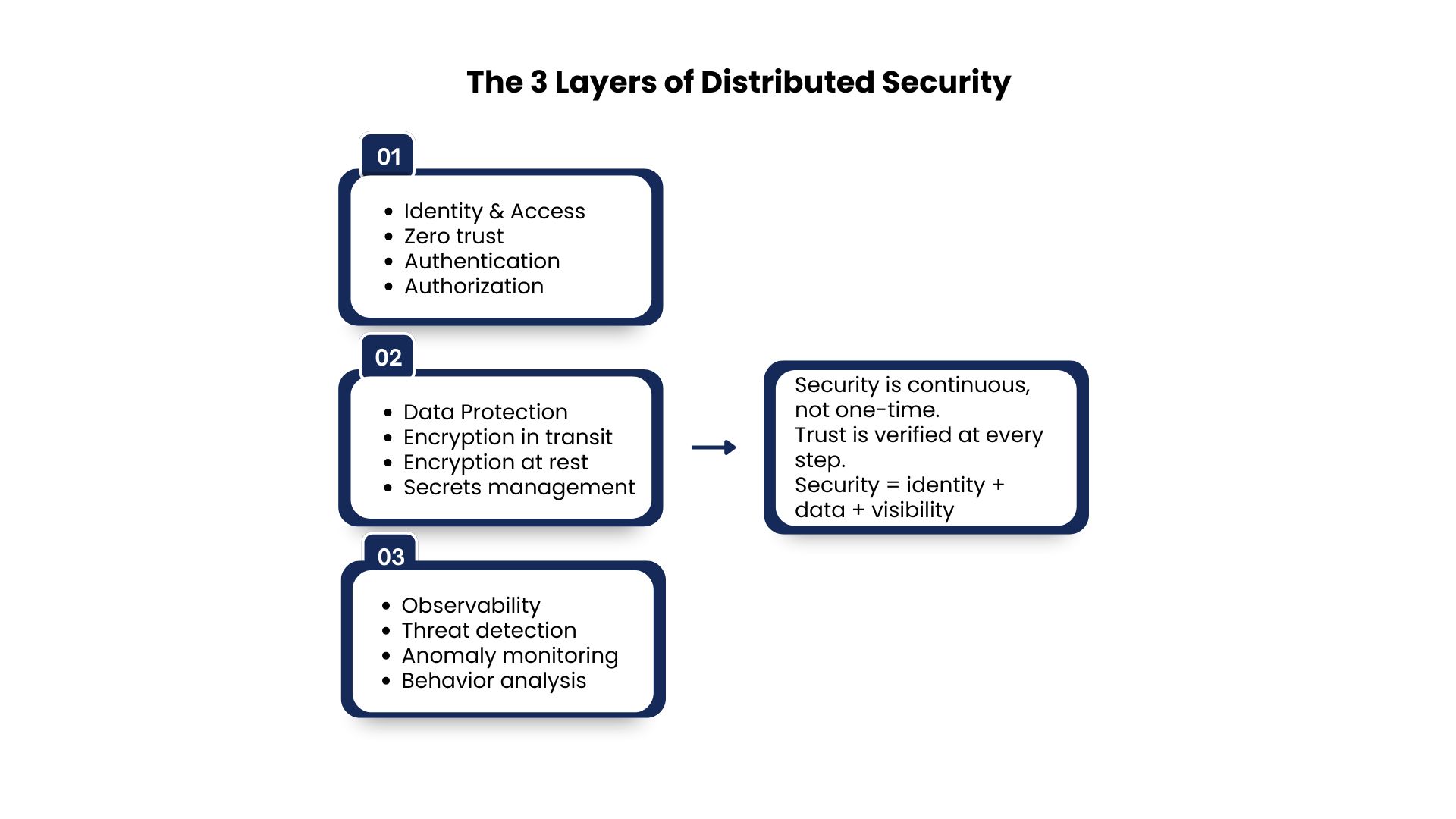
Authentication and Authorization: The Zero-Trust Mandate
The debate between centralized and distributed authentication models reflects fundamental trade-offs that security architects must navigate.
Centralized models consolidate authentication through a single Identity Provider and API gateway. This approach simplifies policy enforcement and provides a single control plane for access management. However, it creates a potential single point of failure and a high-value attack target. A 2025 empirical study comparing centralized and distributed authentication in zero-trust microservices environments found that centralized architectures exhibit predictable performance under load but can become bottlenecks under extreme traffic.
Distributed authentication delegates authentication to each microservice, enforcing mutual TLS and local JWT validation. This approach better reflects zero-trust principles by eliminating implicit trust between services. The same study demonstrated that distributed models provide stronger defense-in-depth, effectively blocking lateral movement and identity spoofing attempts through per-service validation and cryptographic identities. However, they introduce significant operational complexity in managing certificates and keys across the service fleet.
The strategic choice extends beyond authentication to authorization models. Traditional role-based access control assumes relatively static permissions. Modern distributed systems require attribute-based access control that evaluates contextual attributes: user department, data sensitivity classification, request origin, time of access, and data residency requirements. An ABAC system might grant a demand generation manager access to European prospect data only when working from approved locations during business hours, automatically applying appropriate data masking.
Google's Workload Identity Federation guidance and GKE workload identity documentation stress using federated identities instead of long-lived service account keys, signaling that machine identity management has become a primary security design concern in cloud-native systems.
Protecting Data in Motion and at Rest
Distributed architectures multiply the points where data requires protection, both as it moves between services and as it persists across storage systems.
Data in motion requires TLS for all service-to-service communication. In zero-trust implementations, mutual TLS provides mutual authentication, ensuring both client and server verify each other's identities before any data exchange. Service meshes enable workload identity and mTLS at scale, ensuring encrypted communication and workload authenticity without application-level changes. Studies show mTLS adds less than 1 millisecond to p95 latency across thousands of service mesh connections, making security overhead negligible.
Data at rest requires encryption that accounts for distributed storage patterns. The emergence of confidential computing technologies including Intel TDX and AMD SEV-SNP enables encryption of data even during processing, protecting against compromised hypervisors or host operating systems.
Distributed key management represents one of the most operationally complex security challenges. Recent innovations include threshold cryptography approaches where no single party ever holds a complete key. Envelope encryption architectures encrypt data with data encryption keys, which are themselves encrypted with key encryption keys managed by dedicated key management services. This allows for key rotation without re-encrypting all data and enables granular access control at the encryption layer itself.
Secrets management requires centralized storage with fine-grained access controls, automated rotation without application downtime, audit logging of all secrets access, and encryption in transit and at rest. OWASP's Secrets Management Cheat Sheet emphasizes that shared secrets across services make root-cause identification harder after compromise. Modern implementations using HashiCorp Vault or AWS Secrets Manager can rotate thousands of service tokens daily with zero standing credentials, dramatically reducing attack windows.
Observability and Threat Detection: Security as a Data Problem
Security observability in distributed systems requires capabilities beyond traditional monitoring. One of the hardest parts of securing distributed systems is not prevention. It is visibility.
Real-time threat detection demands ingestion and correlation of billions of telemetry events. Citrix's implementation using Apache Druid ingests 3 billion events per day with sub-minute latency, enabling proactive risk scoring for behaviors including impossible travel logins, data exfiltration attempts, and excessive failed authentications. The volume of events in a distributed MarTech stack makes manual monitoring impossible. A mid-sized marketing operation might generate millions of log events daily across their ecosystem.
Anomaly detection must account for distributed context. Behavioral baselines provide the foundation. Instead of rule-based alerting, systems establish normal patterns and flag deviations. If a marketing analyst who typically accesses 50 to 100 prospect records daily suddenly queries 10,000, that deviation triggers review not because it violates a static rule, but because it deviates from established behavior.
Emerging approaches using eBPF technology enable unified, kernel-level collection of application-layer network flows and system call sequences, eliminating the need for resource-intensive sidecar patterns while providing context-rich feature data for anomaly detection models. Studies show eBPF-based detection combined with service mesh telemetry can reduce mean time to resolution from hours to under one minute.
Balancing Security With Performance and Productivity
Security cannot come at the cost of system usability or developer productivity. Every security control adds latency. Token validation, encryption and decryption, authorization checks all take time. In marketing systems where real-time personalization requires sub-100 millisecond response times, security overhead becomes a strategic constraint.
Advanced organizations recognize security and performance as interdependent requirements demanding architectural sophistication. Edge-based security moves validation closer to where decisions happen, reducing round-trip latency. Caching authorization decisions appropriately can reduce overhead while maintaining security posture. Asynchronous security validation allows certain non-blocking checks to happen after the primary workflow completes.
Developer productivity requires security that enables, not blocks. Overly restrictive policies lead to workarounds. Complex certificate management leads to operational shortcuts. The most secure system is one that developers actually use. When identity is infrastructure, provisioning new team members or systems happens in minutes rather than days. When authorization is attribute-based and dynamic, new use cases do not require architectural changes.
A Maturity Model for Distributed System Security
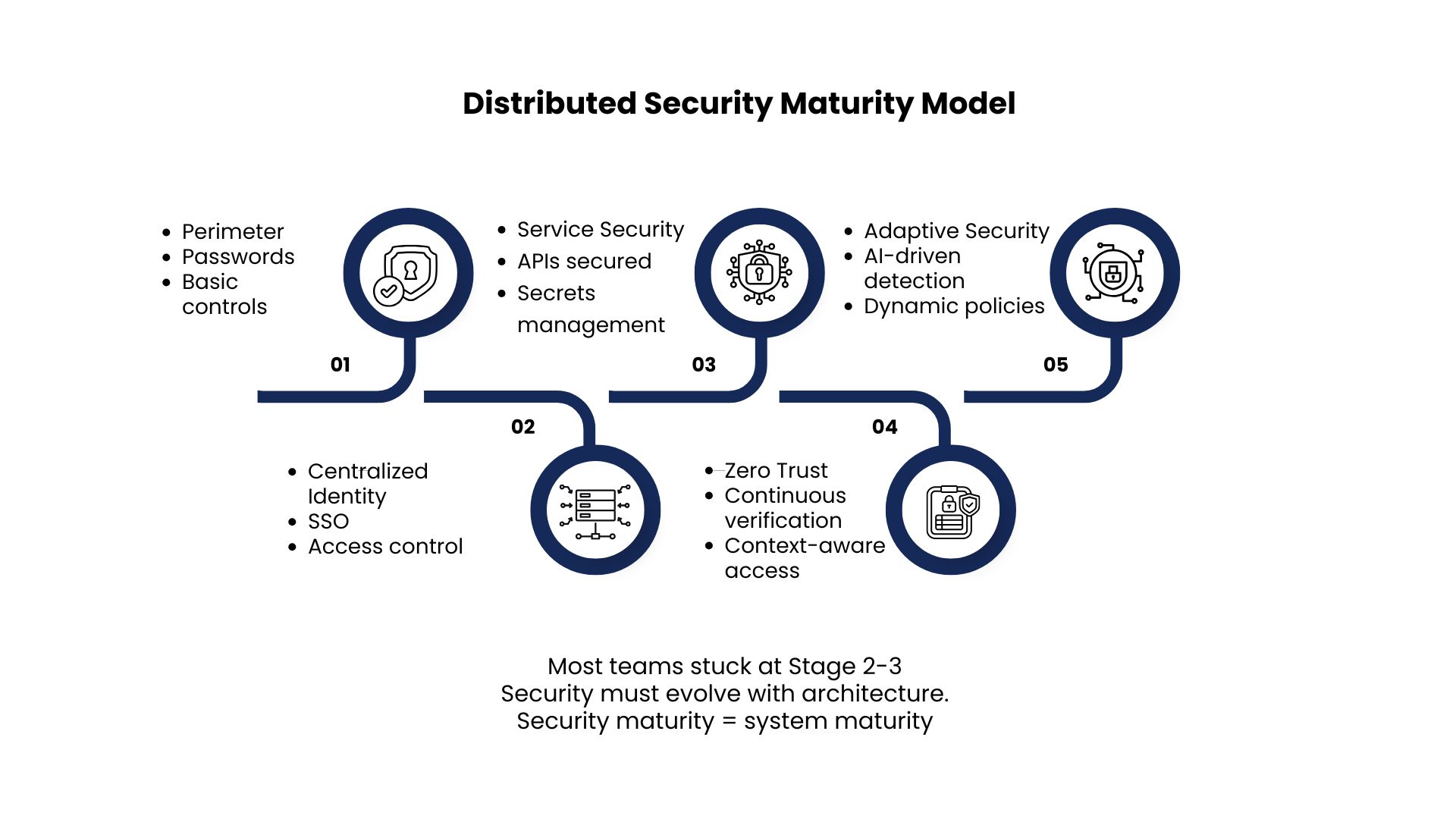
Organizations progress through identifiable stages as their security infrastructure matures:
Stage 1: Perimeter Protection. Security focused on platform-level access. Individual tools have passwords and permissions. Integration security is ad hoc.
Stage 2: Centralized Identity. Single sign-on implemented across platforms. Identity provisioning becomes systematic rather than manual.
Stage 3: Service Mesh Security. Service-to-service authentication established. APIs secured with modern protocols. Secrets management centralized.
Stage 4: Zero Trust Architecture. Continuous verification replaces perimeter trust. Authorization becomes context-aware and dynamic. Security becomes infrastructure rather than overlay.
Stage 5: Adaptive Security. Machine learning identifies anomalies. Security policies adjust based on risk signals. Security enables velocity rather than constraining it.
Most marketing organizations operate between stages 2 and 3. The leap to stage 4 requires treating security as architectural, embedded in how systems are designed rather than added afterward.
Strategic Implications: Security as an Enabling Layer
The organizations gaining advantage are not choosing between security and velocity. They are recognizing that modern security architecture enables both.
Security infrastructure has become a prerequisite for marketing agility. Organizations that continue treating it as overhead will find themselves constrained by their own technical debt, unable to adopt new capabilities because their security foundations cannot support them. McKinsey research shows that organizations with mature security practices deploy new capabilities 30% faster than peers while maintaining lower breach probability.
The competitive moat is not the sophistication of your algorithms. It is the infrastructure that lets you move quickly while maintaining trust. In B2B contexts, security architecture has become a marketing asset. Being able to prove data resilience and privacy-first engineering is often the deciding factor in enterprise deal shortlists.
Conclusion: Engineering Trust in Distributed Architectures
Security in distributed systems is not a product to install. It is an architecture to design. The shift from monolithic to distributed architectures demands a corresponding shift in security thinking: from perimeter defense to identity-based controls, from static policies to continuous verification, from batch log analysis to real-time threat detection.
The organizations that succeed will treat security as a core architectural requirement, not an add-on. They will accept that distributed systems require distributed security models, with the operational complexity that entails. And they will balance security with performance, knowing that a system too locked down to use is a system that will be bypassed.
The question is not whether your distributed architecture is secure. The question is whether your security architecture is distributed enough to protect it.