
Article
Security Challenges in Distributed and Cloud-Native Systems
This blog explains why distributed and cloud-native systems multiply attack surface exponentially; through APIs, misconfigured services, and non-human identity sprawl, while traditional perimeter-based security catches only a fraction of incidents. It covers the three primary threat vectors, the shift to identity as the new perimeter, the monitoring paradox in cloud environments, and a four-dimensional maturity framework that transforms security from reactive tooling into architectural infrastructure for AI-driven systems.
- Topic
- Cyber Security
- Published
- 25 Jun 2026

The Strategic Shift Nobody Fully Prepared For
Enterprise marketing architecture has passed through two distinct eras. The first was tools: a CRM here, an email platform there, a few SaaS applications loosely connected by manual processes. The second was infrastructure: centralized data lakes, cloud data warehouses, unified platforms designed for scale.
We are now in a third era: intelligence. Modern marketing engines compete on how dynamically their distributed systems and AI models process data to drive automated customer experiences. But this shift carries a security cost that most organizations have not fully reckoned with.
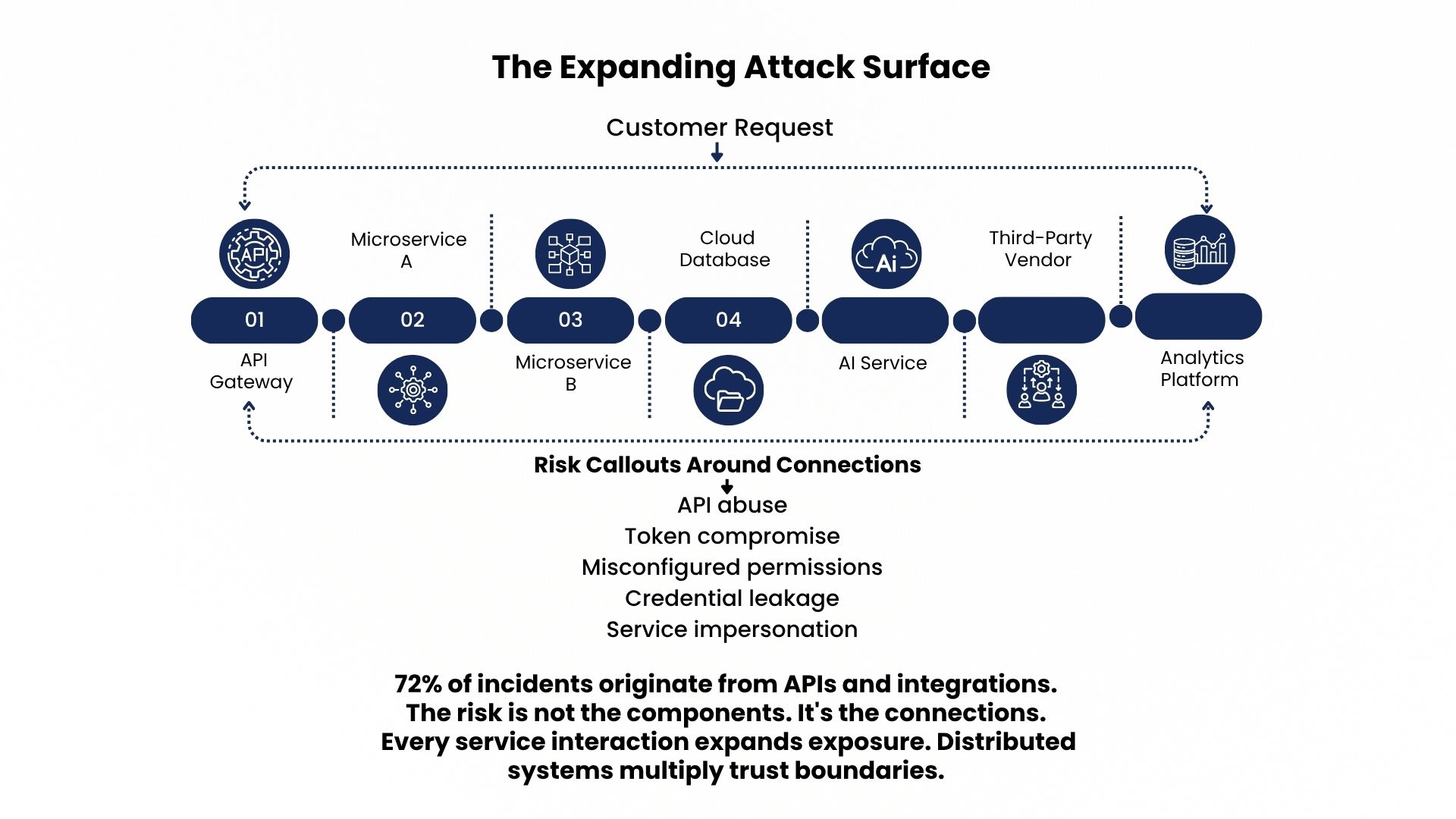
The old security model was a perimeter problem. You built a firewall, placed everything inside it, and assumed internal traffic was safe. That assumption no longer holds. Today, a single user request may traverse an API gateway, multiple microservices, a cloud data warehouse, and a third-party AI endpoint before producing a result. Each hop crosses a trust boundary. A 2025 benchmark of cloud-native stacks found that only 29% of security incidents were detected at the perimeter. The rest were discovered through internal telemetry, anomaly detection, or customer reports.
For technology and marketing leaders, this is a systems-thinking problem, not a security operations nuance. The organizations that will scale AI-driven infrastructure safely treat security as a layer embedded in architecture, identity, and observability, not a control bolted on at deployment.
Why Distributed Systems Expand Risk Exponentially
The shift from monolithic to microservices architecture does not increase attack surface linearly. It multiplies it. A system with ten microservices generates potentially hundreds of exposure points when you account for service-to-service communication, shared data stores, event queues, and external APIs. A 2024 breach analysis found that 72% of incidents in cloud-native stacks originated from APIs or integrations, not from the traditional entry points security teams were watching.
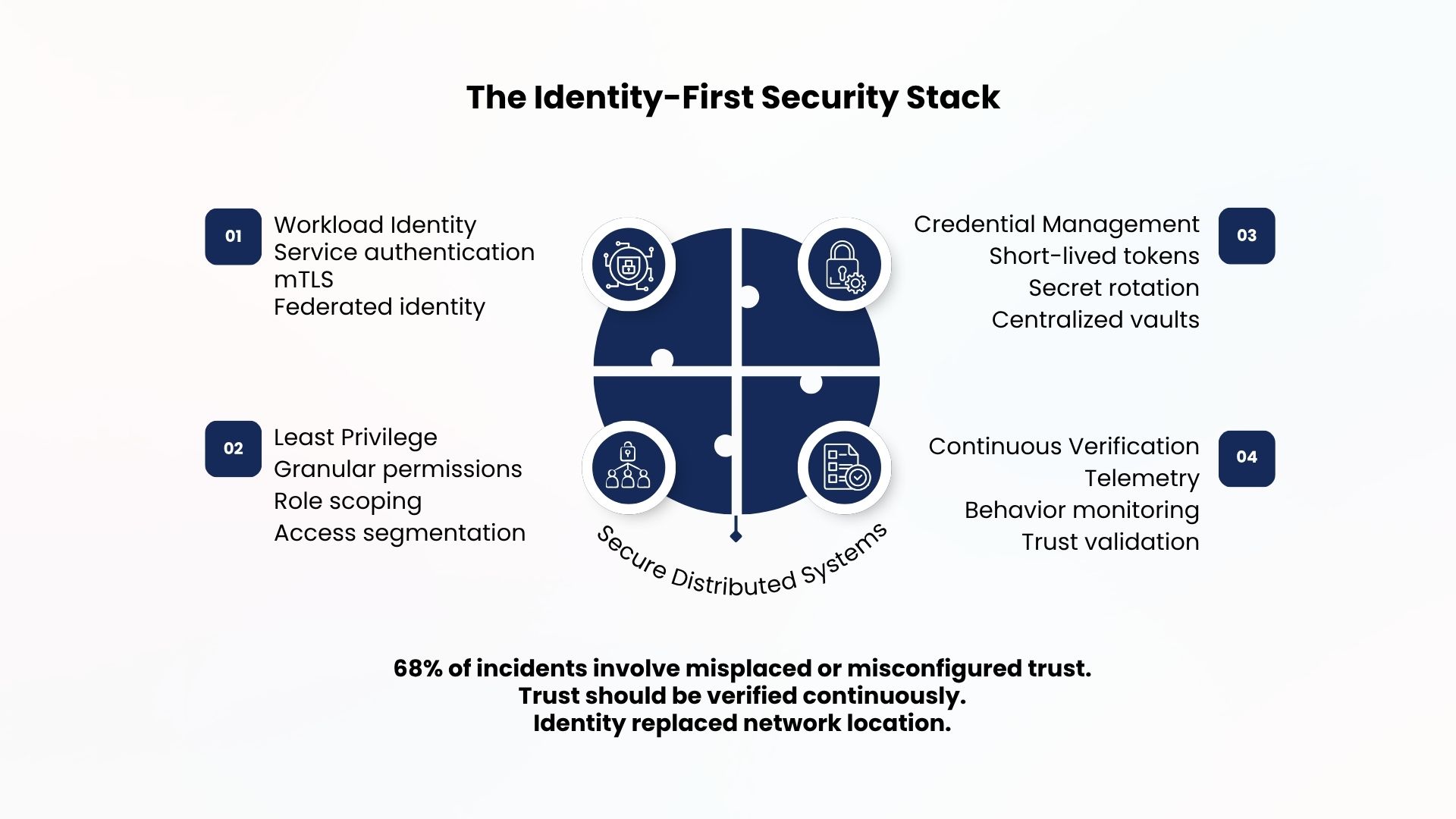
The structural problem is trust. Monolithic systems operate within a single trusted runtime. Distributed systems require dozens of trust decisions simultaneously: service to service, workload to database, container to cluster, automation tool to production system. A 2025 benchmark found that 68% of incidents in distributed stacks involved misplaced or misconfigured trust, including over-privileged service accounts, misconfigured cross-account roles, and absent authentication between services.
One breach documented in 2025 illustrates the downstream impact. An attacker exploited an OAuth token tied to a third-party integration rather than targeting the core platform directly. The token granted programmatic API access, enabling quiet data exfiltration that monitoring dashboards never flagged. The breach looked, throughout, like legitimate traffic.
The Three Threat Vectors That Actually Matter
API Abuse: The Open Door
APIs are the connective tissue of modern marketing infrastructure. They bind CRMs to CDPs, analytics layers to AI personalization engines, and automation workflows to customer data. They are also the most frequently exploited attack surface in cloud-native environments.
What makes API abuse dangerous is that it often looks like normal traffic. There is no brute force signature, no malware pattern. A user authenticated with a valid token changes an object ID in a request and accesses another customer's record. An attacker with a compromised enrichment API key queries customer data at scale, builds detailed account profiles, and launches downstream social engineering campaigns. The requests are technically valid. The authorization logic is broken.
In AI-driven marketing systems, this risk compounds. APIs increasingly connect customer data, campaign workflows, and machine learning models in tightly coupled flows. A single misconfigured endpoint can expose PII, enable unauthorized transactions, or corrupt personalization logic at scale.
Misconfigured Services: The Silent Multiplier
Cloud misconfiguration is not primarily a human error problem. It is an architecture problem. When infrastructure is provisioned through code, deployed at speed, and managed by distributed teams, configuration drift is the predictable output of moving faster than governance processes allow. An S3 bucket left public, an overly permissive IAM role, a Kubernetes cluster with an exposed dashboard: these are ordinary outcomes in organizations where the wrong configuration is the path of least resistance.
A 2025 case study found that 42% of incidents in cloud-native stacks were entirely due to misconfiguration, not code vulnerabilities. In one instance, a CDP storage bucket was configured with open read access, contained sensitive firmographic data, and had no logging to detect large-volume downloads. Attackers discovered and exfiltrated over 2.4 million records. The incident was detected months later by a third-party monitoring service.
Non-Human Identity Sprawl: The Invisible Majority
In distributed systems, humans represent a small fraction of the entities that need to authenticate. Services authenticate to other services. Pipelines authenticate to data stores. AI models authenticate to APIs. Analysts estimate non-human identities now outnumber human users in cloud environments by as much as 50 to 1.
These machine identities are managed inconsistently at best. API keys get committed to code repositories. Service accounts accumulate admin-level permissions that were never scoped down. Tokens never expire and are never rotated. Over time, organizations have no reliable inventory of what credentials exist, where they are stored, or what access they grant. Compromised credentials remain one of the most expensive initial attack vectors in cloud breaches, with average breach costs approaching $5 million per incident.
Identity as the New Perimeter
In distributed systems, identity replaces network location as the primary security control. This is not a tool upgrade. It is a mental model shift.
The goal is no longer to verify users at the edge. It is to verify every workload, service, and integration at every interaction. Short-lived credentials, workload identity federation, and centralized secrets management treat credential lifecycle as a first-class engineering concern rather than an operational afterthought. Architectures that implement mutual TLS across service-to-service communication, combined with automatic certificate rotation tied to workload identity, eliminate static secret sprawl at the infrastructure level.
Least privilege must apply at service granularity, not just at the user level. A database access service should not have permission to delete storage buckets. An analytics service should not have admin access to the orchestration layer. Fine-grained role-based access control at the pod level, combined with intent-based permissioning, prevents any single compromise from becoming a system-wide breach.
The Monitoring Paradox
Cloud-native systems generate enormous volumes of telemetry and still create profound visibility gaps. Logs from microservices are isolated. Traces span multiple systems with different schemas. Security events from third-party SaaS tools sit in vendor dashboards. Correlating an anomalous API call at 2am with a misconfigured IAM role and an unusual data export three days earlier requires infrastructure that most organizations have not built.
Alert fatigue compounds the problem. When every automated scan and anomaly model fires independently, security teams process thousands of low-fidelity notifications daily. A 2024 benchmark found that only 28% of alerts in cloud-native stacks were confirmed security incidents, while 47% were suppressed as too noisy. Critical signals get buried. Human attention, the scarcest resource in any security program, gets depleted.
The solution is not more sensors. It is better signal processing. Organizations that focus alerting on high-signal, business-context-aware events, such as pipeline-table writes by non-standard services or enrichment API latency spikes coinciding with data anomalies, improve detection rates while reducing alert volume. In one documented case, this approach reduced alert volume by 43% while improving incident detection by 31%.
A Framework for Security Maturity
Rather than treating security as a checklist, leading organizations assess capability across four dimensions:
Architecture and Perimeter Maturity asks whether services and APIs are explicitly designed with security boundaries, whether ingress and egress points are controlled, and whether the attack surface is deliberately shaped rather than an emergent byproduct of fast development.
Identity and Access Maturity asks whether service and human identities are explicitly defined, whether privileges are scoped to least privilege, and whether credentials are managed centrally and rotated automatically.
Monitoring and Detection Maturity asks whether telemetry is collected consistently across services, whether alerts are correlated and business-context-aware, and whether incident response playbooks are practiced regularly.
Governance and Culture Maturity asks whether security ownership is shared across technology, marketing, and security teams, and whether security is treated as an architectural constraint from the start.
Organizations that reach high maturity across all four dimensions reduce incident rates substantially and improve mean time to resolution, shifting security from reactive posture to operational capability.
Strategic Implications for AI-Driven Systems
The next chapter of distributed systems security will be shaped by two converging forces: increasingly sophisticated AI-powered attack tooling and increasingly available AI-powered defense capability. Organizations that treat security as infrastructure will be positioned to leverage defensive AI effectively. Those in a reactive, tool-acquisition posture will face an adversarial environment where the offense has structural advantage.
For technology leaders, this means making security a first-order architectural constraint alongside performance and reliability. For marketing leaders, who often operate some of the most complex and data-sensitive systems in the enterprise, it means understanding that every new integration is a trust decision and every new data flow is a boundary to govern. The velocity advantage of cloud-native marketing infrastructure is only durable if the security architecture can support it.
The shift from tools to infrastructure to intelligence is the defining arc of modern enterprise systems. Security must make the same journey. Buying a security tool solves a point problem. Building security infrastructure creates organizational capability. Developing security intelligence, the ability to understand and respond to risk in the specific context of your systems and business, creates durable competitive advantage.
In an environment where data breaches carry reputational consequences that no marketing campaign can repair, that is not just a security outcome. It is a strategic one.