
Article
Securing APIs in Modern Application Architectures: The Infrastructure Behind Intelligent Scale
This blog explains why APIs have become prime attack targets as the connective tissue of modern digital business; connecting MarTech, AI services, and partner ecosystems, while most organizations fail to distinguish between authentication and authorization. It covers common API vulnerabilities, layered security controls (rate limiting, input validation, service mesh enforcement), and the governance and observability required to turn API security from an afterthought into scalable infrastructure.
- Topic
- Cyber Security
- Published
- 9 Jun 2026

APIs Are Now Business Infrastructure
Modern applications are no longer built as isolated systems. They are assembled through APIs.
This shift has made APIs the operating layer of digital business. They connect customer-facing applications, MarTech platforms, payment systems, analytics tools, AI services, and partner ecosystems. But this connectivity has also made them prime attack targets.
The risk is structural. APIs expose business logic, data access, and workflow actions directly to other systems. According to the largest published analysis of API security failures, based on 1.4 million test executions across 2,616 organizations, 34% of all API test failures have a direct security implication. More concerning: 38% of all security failures are authentication and authorization issues, with only 29% of test suites verifying that access is correctly enforced across users and permissions.
For technology decision-makers and marketing leaders, API security is no longer just an engineering concern. If APIs connect customer data, campaign platforms, AI systems, and revenue workflows, then API weaknesses directly affect trust, compliance, and operational continuity.
The shift is clear: from APIs as integrations to APIs as critical infrastructure.
Why APIs Are Prime Attack Targets
APIs sit at the intersection of access, data, and business logic. Unlike traditional web pages, they are designed for machine-to-machine interaction and often expose direct operations such as retrieving customer records, updating account status, triggering workflows, and sending data to third-party platforms.
This creates a fundamental tension. Business agility and real-time execution require highly accessible, deeply integrated APIs. But this open connectivity exponentially expands the attack surface.
The threat landscape is evolving rapidly. APIs are increasingly operated by agentic workflows: autonomous systems that discover endpoints, chain API calls, and act at machine speed. This changes the risk profile entirely. Authorization gaps, unsafe integrations, and inventory blind spots that once required deliberate manual effort can now be uncovered and exploited continuously.
New endpoints carry disproportionate risk. Analysis shows that endpoints deployed within the last 90 days carry a 3.1x higher authorization failure rate than endpoints older than 90 days. Security testing is least rigorous where it needs to be most rigorous.
Business logic vulnerabilities are particularly dangerous because they cannot be detected by standard security scanners. OWASP identifies broken object level authorization as the top API security risk, noting that APIs often expose endpoints that handle object identifiers and create a broad attack surface for access-control failures. An attacker can manipulate object IDs in paths, query strings, headers, or payloads to access data they should not see. The system is working. The authorization model is not.
Authentication and Authorization: The Critical Distinction
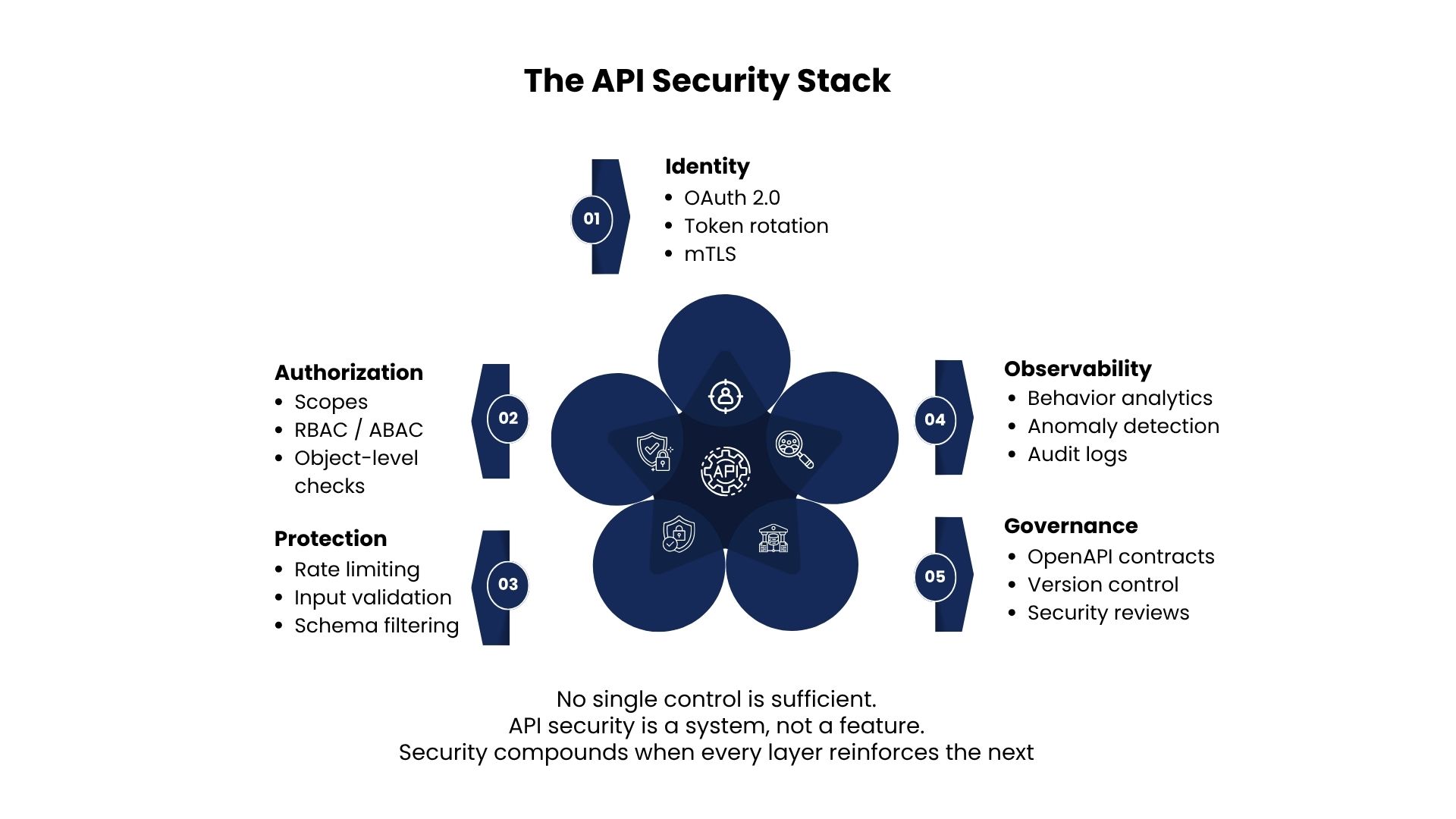
Strong API security begins with a clear separation: authentication verifies identity, authorization verifies permission. Both are required. One without the other is incomplete.
Modern APIs commonly use token-based access models such as OAuth. This matters because API keys and static credentials are often overused. Google's API key best practices warn that exposed API keys can lead to unauthorized access or unexpected charges. Token-based authentication offers greater security, with encrypted tokens sent with each call rather than static credentials. OAuth also enables Single Sign-On, allowing credentials to be leveraged across services.
For modern architectures, the priority should be short-lived tokens, scoped permissions, secure storage, and rotation and revocation capabilities.
But authentication alone does not prevent misuse. An API should not only ask "Who is calling?" It must also ask "What is this caller allowed to do?"
That requires scope and role enforcement at the API level. Several models exist:
Scope-based authorization limits API access by defining permissions for an access token. The client requests specific scopes, and the API grants or denies them. This is ideal for partner integrations.
Role-Based Access Control (RBAC) assigns permissions based on predefined roles like admin, editor, or viewer. This simplifies management and enforces least privilege.
Attribute-Based Access Control (ABAC) grants access based on attributes of user, resource, and environment, supporting fine-grained control for complex scenarios.
This is especially important in AI and MarTech architectures where agents, automation tools, and integrations may act across systems. Over-permissioned APIs can turn one compromised token into a broad operational risk.
Protecting Against Common API Attacks
API security requires layered controls. No single mechanism is enough.
Rate limiting is the first line of defense against automated abuse. When agentic workflows operate at machine speed, resource abuse is no longer accidental. Effective rate limiting requires per-IP and per-endpoint limits because different endpoints have different risk profiles. A login API, payment API, and public content API should not have the same tolerance for traffic spikes.
Microsoft's Azure API Management best practices specifically recommend focusing on quotas, rate limits, retry policies, circuit breakers, load balancing, and exception handling as part of resilient API design. Rate limit headers should include X-RateLimit-Limit, X-RateLimit-Remaining, and X-RateLimit-Reset in responses so clients can self-throttle.
APIs must also validate inputs as aggressively as web applications. Common risks include injection attacks, mass assignment, parameter tampering, and excessive data exposure. OWASP highlights broken object property level authorization, where APIs expose object properties that authenticated users should not access. This is especially relevant in APIs returning rich user, account, or customer objects.
A secure API should return only what the caller needs, not the entire object.
In microservices-based systems, security controls must be consistent across services. NIST SP 800-204A explains that service mesh components can provide a robust security infrastructure for microservices-based applications, including service-to-service communication support, throttling, load balancing, circuit breaking, and monitoring. API gateways and service meshes help centralize authentication, authorization enforcement, traffic control, logging, and policy enforcement.
But they do not remove the need for secure application-level logic. Authorization must still be enforced where sensitive data access occurs.
Observability and Monitoring: Detecting What Tools Miss
APIs fail quietly when monitoring focuses only on uptime. A healthy API may still be abused.
Effective API observability should track unusual access patterns, failed authentication attempts, repeated authorization failures, spikes in 4xx and 5xx errors, abnormal data retrieval volumes, and unusual endpoint sequences.
AI-powered anomaly detection has become essential for modern API security. Production systems now use platforms that ingest billions of events and detect anomalies in real-time, identifying impossible travel patterns, enumeration attacks, and composite health metrics combining latency, error rates, and request patterns.
API abuse often appears as behavior change rather than obvious malware. Example: a token that normally retrieves 100 customer records per day suddenly retrieves 50,000. The requests may be authenticated. The behavior is abnormal.
Security teams should monitor call frequency, endpoint combinations, request geographies, data volume accessed, and privilege usage. API logs should capture enough context to support investigation: caller identity, token scope, endpoint, request metadata, response status, latency, and correlation ID. Without correlation IDs and identity-aware logs, debugging distributed API incidents becomes slow and incomplete.
Governance and Lifecycle Management
API security is not only about runtime controls. It is also about lifecycle governance.
APIs evolve. New versions are released. Old versions remain active for compatibility. That creates risk. Older APIs may lack modern authorization controls, expose excessive data, use weaker authentication models, or remain undocumented. A secure API program should define version ownership, deprecation timelines, backward compatibility rules, and sunset communication. Security debt grows when old APIs remain alive indefinitely.
Spec-driven development is the foundation of scalable governance. API contracts like OpenAPI become the single source of truth, enabling automated linting for naming conventions, validation for syntactic correctness, and security enforcement requiring authentication schemes across all endpoints.
When APIs are developed according to specifications, security enforcement begins with the contract. Specifications can explicitly require OAuth 2.0, API keys, JWT, or mutual TLS. By including these declarations directly in the contract, platform teams can enforce rules preventing developers from mistakenly exposing unprotected services.
Every new API should go through structured review: authentication model, authorization logic, data exposure, rate limits, logging requirements, abuse cases, and error handling. This matters because API vulnerabilities are often design flaws, not implementation bugs. Once an API is public and integrated into partner or customer workflows, fixing design-level security issues becomes significantly harder.
Strategic Implications for MarTech, AI, and Modern Systems
APIs now sit behind many high-value business capabilities: real-time personalization, account intelligence, customer data activation, campaign automation, and AI agents and workflow orchestration.
As systems become more intelligent, APIs become more consequential. An AI agent with API access can retrieve data, trigger actions, update systems, and automate workflows. That creates speed, but also raises the cost of weak API controls.
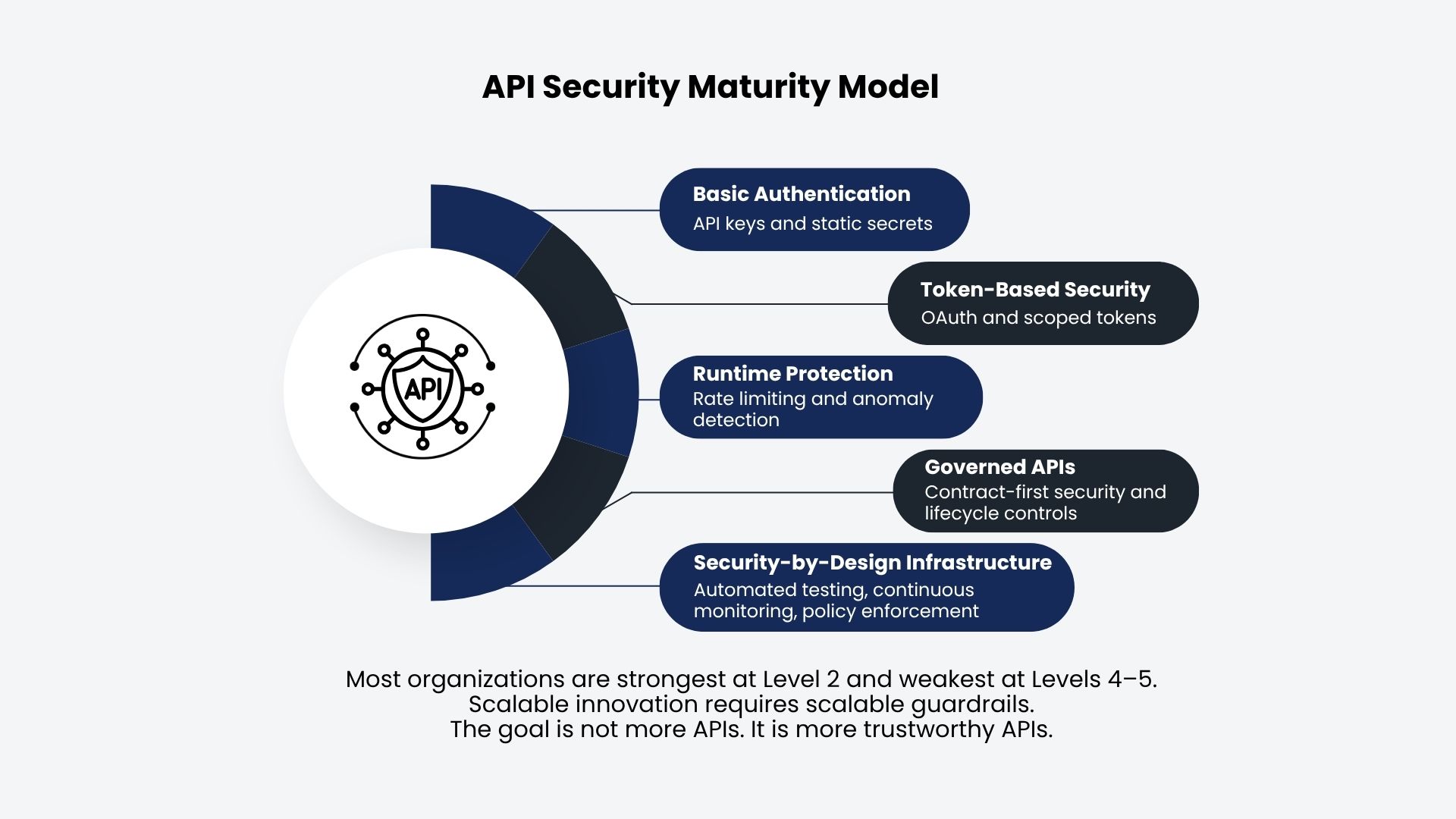
The strategic implication is simple: API security must scale before automation scales. Otherwise, every new integration increases exposure.
Organizations that treat API security as an afterthought will accumulate hidden risk across integrations, partners, automation, and AI systems. Organizations that treat APIs as governed infrastructure will build systems that are scalable, observable, resilient, and trustworthy.
Conclusion: Secure APIs Enable Scalable Digital Systems
APIs are no longer technical plumbing. They are the connective tissue of modern application architecture. That makes API security a strategic capability.
The future of digital architecture will not be defined by how many APIs a company exposes. It will be defined by how safely those APIs allow systems to connect, decide, and act. Authentication without proper authorization is insufficient. Rate limiting without anomaly detection is incomplete. Manual governance without automation cannot scale.
The organizations that will lead are not those that deploy the most APIs, but those that secure them systematically. Modern API security should not slow innovation. It should enable teams to integrate faster because access patterns, controls, and monitoring are already designed. The future belongs to enterprises that build open, highly connected systems, supported by uncompromising architectural guardrails.