
Article
Secrets Management in Distributed Systems: The Infrastructure Layer That Determines Everything Else
This blog explains why credential sprawl has become a systems architecture problem rather than a developer hygiene issue, as non-human identities now outnumber human users 50 to 1 in modern distributed environments. It covers the four credential categories (API keys, database credentials, encryption keys, service accounts), common failure patterns, the architectural shift from static credential storage to identity-native security, a four-stage maturity model, and the governance layer required to unify secrets management across multi-cloud environments.
- Topic
- Cyber Security
- Published
- 14 Jul 2026

Modern enterprises are in the middle of a third architectural shift. The first moved teams from isolated SaaS tools to integrated infrastructure: CDPs, data lakes, and cloud platforms. The second built intelligence on top of that foundation, running ML models, real-time personalization engines, and autonomous AI agents across distributed cloud environments.
The third shift is the one most leadership teams have not fully absorbed. In the intelligence era, the vast majority of system interactions are machine-to-machine. Enrichment services call identity-resolution APIs. AI scoring engines call intent platforms. Orchestration engines call CRMs, marketing platforms, and cloud data warehouses. Every leg of that journey requires a machine identity and a credential. That credential is a potential entry point for attackers.
This is not a developer hygiene problem. It is a systems architecture problem. Organizations that treat it as the former will keep patching the same leak at different points in the pipe.
Why Credential Sprawl Is a Systems Risk, Not a Storage Problem
In a traditional stack, user authentication was straightforward: a human logged in with a password. In a modern cloud-native architecture, non-human identities outnumber human users by a factor of 50 to 1. Each identity carries secrets: API keys, database credentials, encryption keys, and service account tokens.
Credential sprawl emerges almost inevitably from this complexity. Secrets get duplicated across development, staging, and production environments. They get embedded in CI/CD pipelines, configuration repositories, and container images. Developers under deadline pressure hardcode them into source code, not out of negligence, but because the secure path is rarely the frictionless one. A significant proportion of these credentials remain valid months after initial exposure, sitting dormant until discovered or exploited.
The attack surface this creates is qualitatively different from traditional perimeter threats. Compromised secrets do not announce themselves. A leaked database credential does not trigger a firewall alert. In distributed architectures, where a single credential can grant access to cascading layers of downstream services, the blast radius of one exposure can be catastrophic.
The Four Credential Categories Modern Systems Depend On
Modern distributed stacks rely on four classes of secrets, each with a different risk profile and governance requirement.
API keys and tokens connect systems to payment processors, enrichment providers, analytics engines, and AI inference APIs. Because they often carry high privileges and are prolifically generated, they are the most frequently leaked class of credential and the least consistently rotated.
Database credentials provide direct access to the core of data integrity: customer records, behavioral analytics, and financial information. Shared credentials across teams and services are common, representing a single point of failure with maximum exposure potential.
Encryption keys protect data at rest and in transit. Their compromise does not just expose current data. It can retroactively undermine the integrity of everything previously encrypted. Storing keys in plain text or sharing them across environments is a consistently underweighted risk.
Service account identities are the machine-level personas that allow automated systems and cloud services to interact. In cloud-native environments, these accounts are frequently over-provisioned, granted broad access to accelerate development, and never scoped back down. A compromised over-privileged service account can result in cascading damage: in documented cases, write-delete permissions that were never removed led to the deletion of millions of records.
How Failures Happen
Secrets management failures occur through the same recurring patterns. Understanding them is the prerequisite to architectural intervention.
Shared credentials collapse the accountability model. When ten services authenticate with the same database username and password, there is no meaningful audit trail. When that credential is compromised, attribution is impossible and remediation requires touching every connected system simultaneously.
Manual rotation creates predictable gaps. Security policy may specify quarterly rotation cycles. Operational reality, with rotating teams, undocumented dependencies, and no automated enforcement, means rotation slips. Stacks relying on manual processes experience significantly more credential-related incidents than those using automation, and roughly half of manual rotation tasks are never completed.
Secrets exposure through CI/CD pipelines is the attack vector that scales with automation. Build logs, environment variables echoed during pipeline runs, error messages containing connection strings: these patterns are endemic in organizations that have adopted DevOps velocity without matching security architecture. In one documented supply chain incident, attackers compromised an integration layer, used stolen OAuth tokens to pivot through connected environments, and caused cascading damage across customer-facing systems without triggering a single access alert.
The Architectural Shift: From Credential Storage to Identity-Native Security
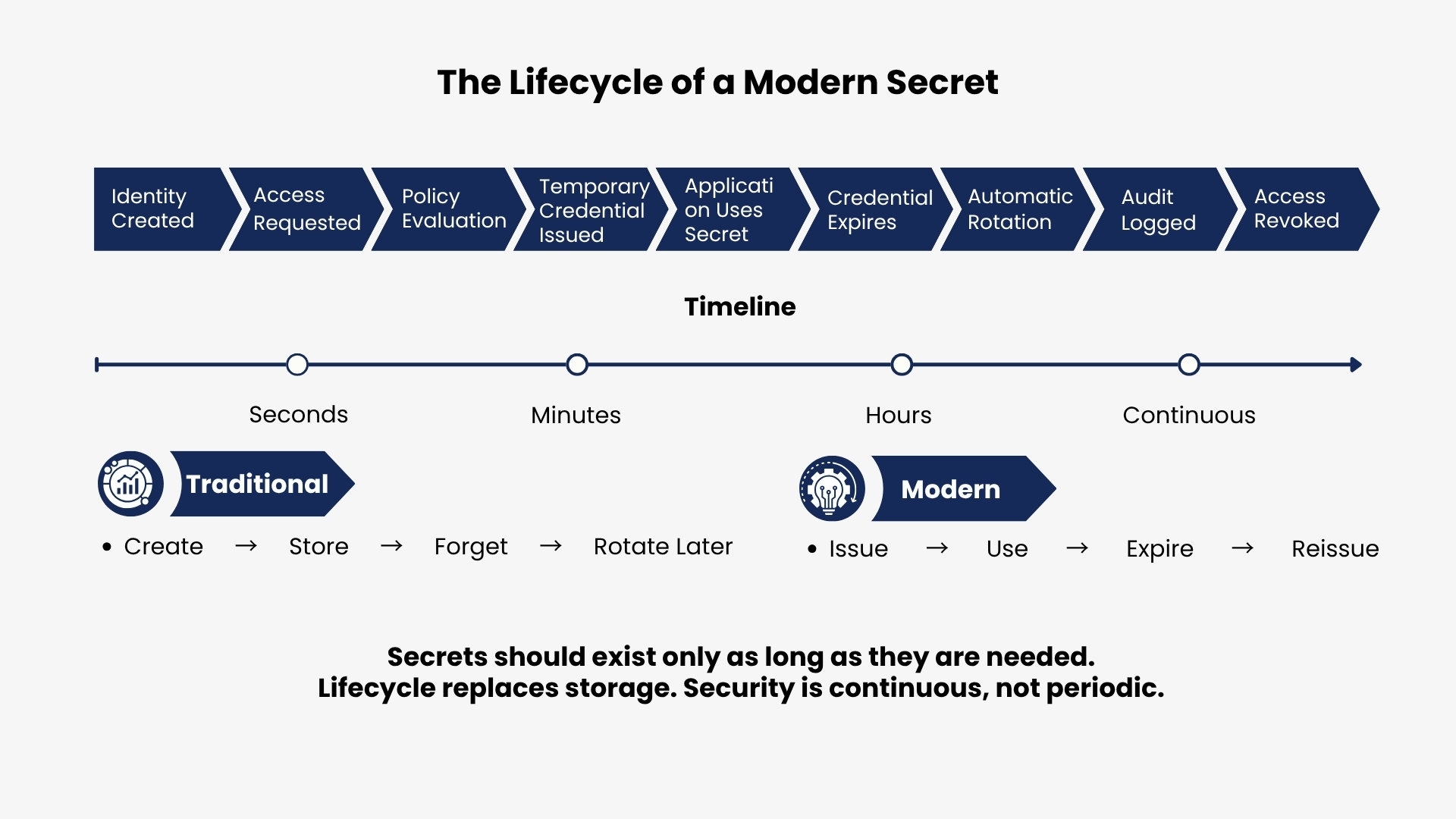
The most significant structural change available to organizations securing distributed systems is moving from static credential distribution to identity-based access.
In a static credential model, a secret is created, distributed to the services that need it, and persists until someone rotates it. The central question is: who holds this secret?
In an identity-native model, services authenticate based on what they are, verified through their runtime identity, whether a Kubernetes service account, an AWS IAM role, or a GCP workload identity, and receive a short-lived, scoped credential in response. The secret never persists. There is nothing to steal. The question becomes: is this identity authorized to request this access right now?
This shift, from secret-as-artifact to secret-as-ephemeral-grant, eliminates the core vulnerability of the traditional model. Dynamic credentials generated on demand and expiring within minutes limit attacker opportunity even when exposure occurs. Identity-based issuance also eliminates the manual rotation overhead that makes human-dependent processes fail at scale.
A Maturity Model for Secrets Governance
Stage 1 is reactive: secrets are hardcoded, shared across services, and manually rotated. No centralized visibility exists. High exposure, poor accountability.
Stage 2 is centralized: a secrets vault is in place, access is controlled, and audit logs exist. Rotation is still largely manual, and governance is inconsistent across environments.
Stage 3 is dynamic: secrets are short-lived by design. Credentials are generated on demand and expire after a defined window. Service accounts authenticate through identity-based mechanisms. Rotation is automated and continuous.
Stage 4 is intelligence-driven: access is continuously monitored, anomaly detection surfaces unusual patterns, and policy-as-code enforces least privilege automatically across multi-cloud environments.
Most organizations sit between Stages 1 and 2. Regulatory pressure from SOC 2, ISO 27001, and emerging AI governance frameworks is pushing the acceptable baseline toward Stage 3.
The Governance Layer That Unifies Multi-Cloud Environments
The governance dimension of secrets management becomes substantially harder in multi-cloud architectures, which now describe the majority of enterprise environments. AWS, Azure, GCP, and on-premises infrastructure each carry native secrets management capabilities with different APIs, different access control models, and different audit log formats.
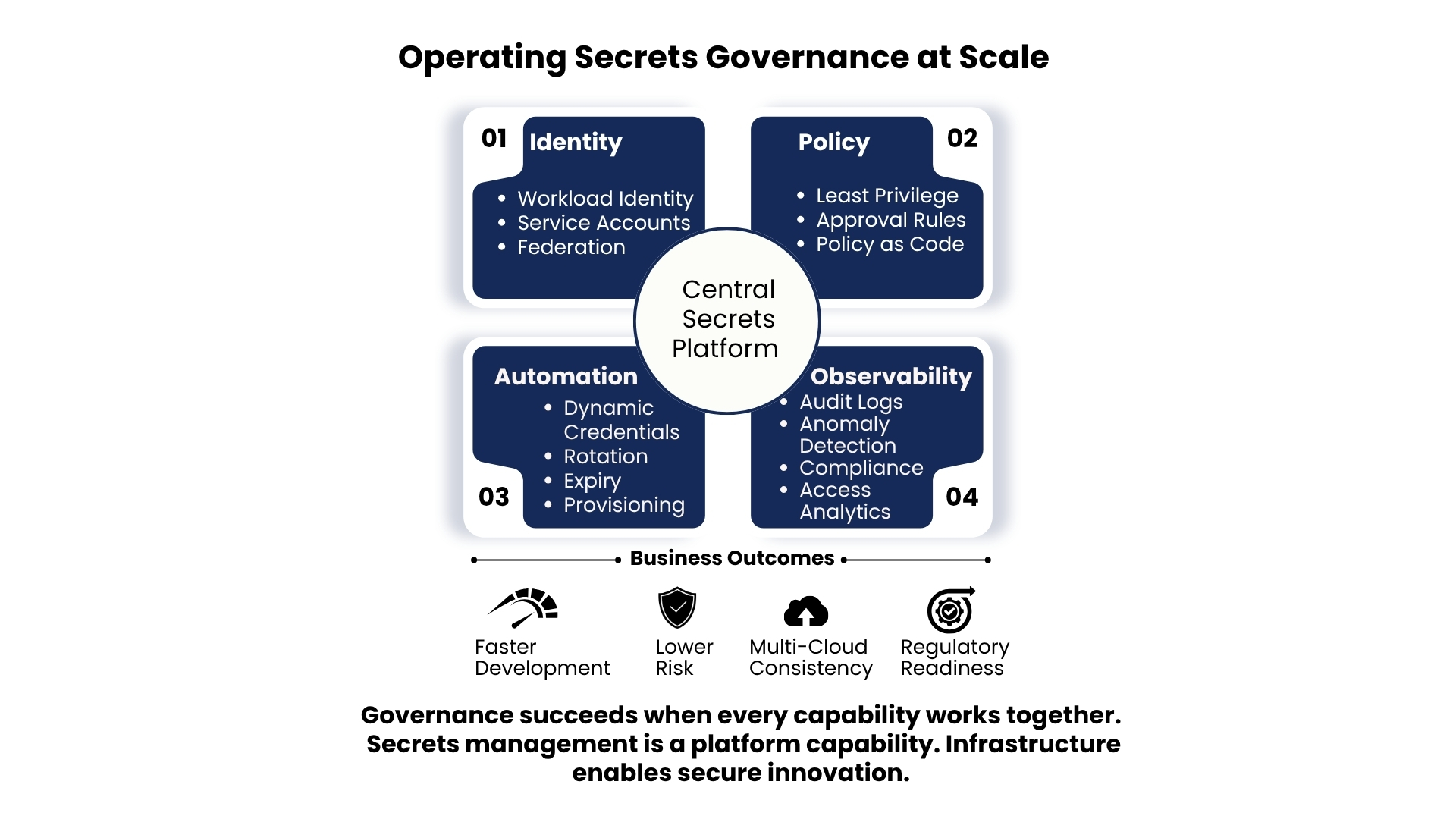
The naive approach is to manage each environment natively, producing siloed visibility and inconsistent policy enforcement. The architectural response is a vendor-agnostic governance plane that sits above individual cloud providers, enforces consistent policy, and aggregates audit telemetry into a unified view. This is an infrastructure strategy decision, with long-term implications for compliance posture, incident response capability, and the ability to onboard new environments without rebuilding governance from scratch.
The developer experience dimension is equally critical and frequently underweighted. Secrets management infrastructure that creates significant friction will be circumvented. Organizations that succeed at this balance, providing secure and seamless secrets access as a platform capability rather than a security checkpoint, are the ones where adoption is high and exceptions are low. The secure path must be the easiest path.
Strategic Implications for Technology Leaders
Three shifts define the leadership position. First, move from reactive rotation to proactive automated expiry. Static credentials are a legacy pattern. Second, move from tool-by-tool secrets management to a unified governance layer spanning all environments rather than adding another vault to manage. Third, move from treating secrets security as a developer responsibility to embedding it as platform infrastructure that developers consume without friction.
The cost of inaction is not abstract. Credential-based attacks account for a growing proportion of cloud breaches. As AI systems proliferate, each requiring their own service identities and API credentials, the attack surface is not stabilizing. Every new AI agent, every new enrichment integration, every new orchestration layer adds machine identities that must be issued, scoped, monitored, and eventually revoked. The organizations that will lead are those that build governance and automation to manage non-human identities at scale before the scale makes the problem unmanageable.
Conclusion
Distributed and cloud-native systems depend on secrets. Unmanaged secrets represent one of the most serious and underappreciated security risks in modern architecture. They spread across environments, persist in codebases, hide inside pipelines, and quietly grant access to critical systems.
Strong secrets management requires lifecycle governance: centralized vaults, short-lived credentials, automated rotation, least privilege access, identity-based controls, and continuous auditability. Organizations that build this foundation now are the ones whose infrastructure will scale with their ambition. Those that do not will face the compounding costs of credential sprawl, orphaned access, and breaches that begin, as they increasingly do, with a forgotten API key in a pipeline log.
In modern cloud-native architecture, trust is not assumed. It is issued, scoped, monitored, rotated, and revoked.