
Article
Runtime Security in Containerized Environments: From Deployment to Intelligence
This blog explains why static scanning leaves containerized environments exposed, since deployment is the starting gun, not the finish line. It covers the four runtime threat vectors, the four-layer capability stack (prevention, observation, detection, response), a four-stage maturity model, and the operational trade-offs that separate organizations capable of defending systems at production speed from those stuck in periodic artifact inspection.
- Topic
- Cyber Security
- Published
- 6 Oct 2026
Introduction: Deployment Is Not the Finish Line
Enterprise security strategy spent the last decade racing toward the left. Scan the image. Validate the configuration. Lock down the pipeline. The logic was sound, and the tooling matured. Then cloud-native adoption exposed a structural flaw in that model: deployment is not the finish line. It is the starting gun.
In containerized environments, the attack surface does not sit still. Workloads spin up and tear down in seconds. Microservices communicate laterally across mesh networks. Third-party dependencies execute code that no static scanner ever evaluated in context. The environment your security team signed off on at build time is not the environment your application inhabits sixty seconds later.
This gap is the runtime security problem. According to Sysdig's 2025 Cloud-Native Security and Usage Report, 60% of observed containers lived for one minute or less. Attackers now weaponize newly disclosed vulnerabilities within hours. In environments where containers exist for minutes or seconds, traditional triage fails. Runtime security is the visibility and control layer that determines whether organizations can understand and contain threats while distributed systems are actually operating.
Why Static Security Leaves the Production Floor Exposed
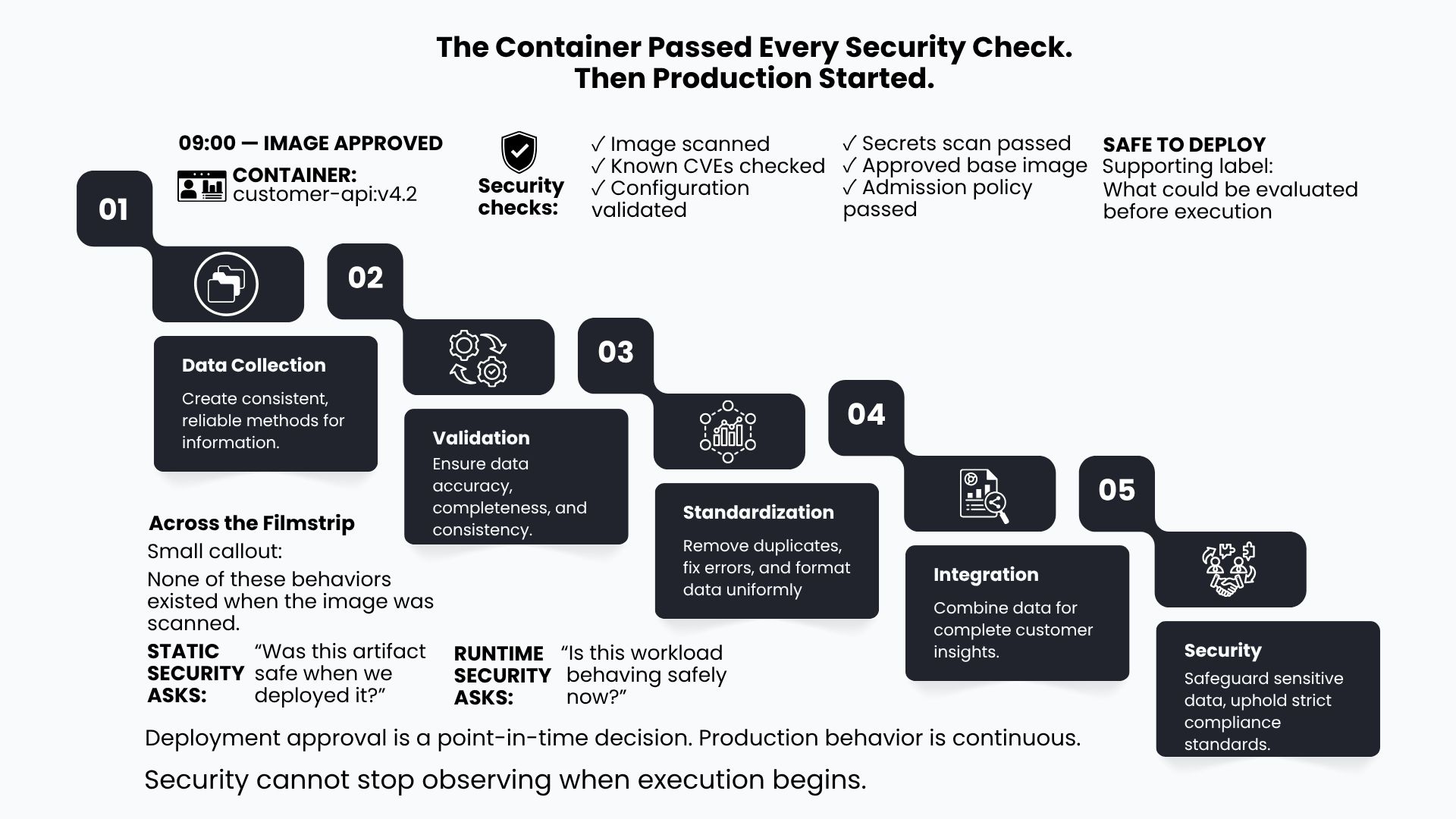
Static scanning answers a precise question: is this artifact safe as built? Runtime security answers a different one: is this system behaving safely as it runs? These are sequentially necessary questions, and most organizations only ask the first.
A container certified clean at 9 a.m. may, by 9:15, be executing a shell script injected through a compromised volume mount, communicating with a command-and-control server, and exfiltrating credentials while your monitoring dashboard shows green. Static scanners cannot see this because the behavior has not happened yet. Signature-based detection catches known issues in known packages. It cannot catch a legitimate binary launching an unexpected child process, a valid credential used in an unauthorized context, or a zero-day exploit activated only after deployment.
Ephemeral workloads compound the forensic challenge. When a container is deleted, its local state disappears with it. If runtime events are not captured and exported continuously, evidence expires before any investigation can begin. This is a paradigm gap, not a tooling gap. Security must shift from periodic artifact inspection to continuous behavioral observation.
Build-time security describes potential risk. Runtime security observes operational risk.
The Four Threat Vectors That Exploit the Runtime Gap
Four dominant threat categories define the runtime attack surface in containerized environments.
Privilege escalation occurs when a process acquires capabilities beyond its intended permissions through misconfigured RBAC policies, exposed host namespaces, or exploited kernel vulnerabilities. Host-level access collapses the isolation model containerization is built upon.
Container escape attacks represent the highest-severity vector. Containers share the host kernel, and when an attacker moves from a container to the underlying host, every workload on that node becomes exposed. Recurring vulnerabilities in container runtimes have confirmed this is not a theoretical edge case.
Unauthorized process execution is frequently the earliest observable signal of compromise. A container designed to run a Node.js API that suddenly spawns a bash shell or initiates an outbound scan has deviated from its behavioral baseline. That deviation is detectable, but only if a baseline exists and the environment is continuously instrumented.
Lateral movement between workloads exploits the flat network architectures many organizations inadvertently create during Kubernetes migration. Without enforced network policies and service mesh observability, a compromised workload can traverse internal service boundaries with minimal friction, escalating a contained breach into a systemic incident.
Core Architecture: From Telemetry to Intelligence
A mature runtime security architecture is a capability stack built across four connected layers.
The prevention layer reduces unnecessary runtime capability before execution begins. Read-only root filesystems, non-root execution, dropped Linux capabilities, and workload-specific seccomp profiles restrict what containers are permitted to do at the kernel level.
The observation layer captures process, syscall, file, network, and orchestration telemetry continuously while workloads run. Technologies like Extended Berkeley Packet Filter (eBPF) enable deep kernel-level telemetry without modifying application source code, keeping CPU overhead below 2%. Tools like Falco intercept system calls and Kubernetes audit events in real time. Because containers disappear quickly, telemetry must be exported to durable systems immediately.
The detection layer applies behavioral baselines and anomaly analysis to identify meaningful deviations. ML models trained on expected container behavior flag statistical deviation from normal execution patterns without requiring a pre-existing signature. Without a behavioral baseline, every alert is noise. With one, signal becomes actionable.
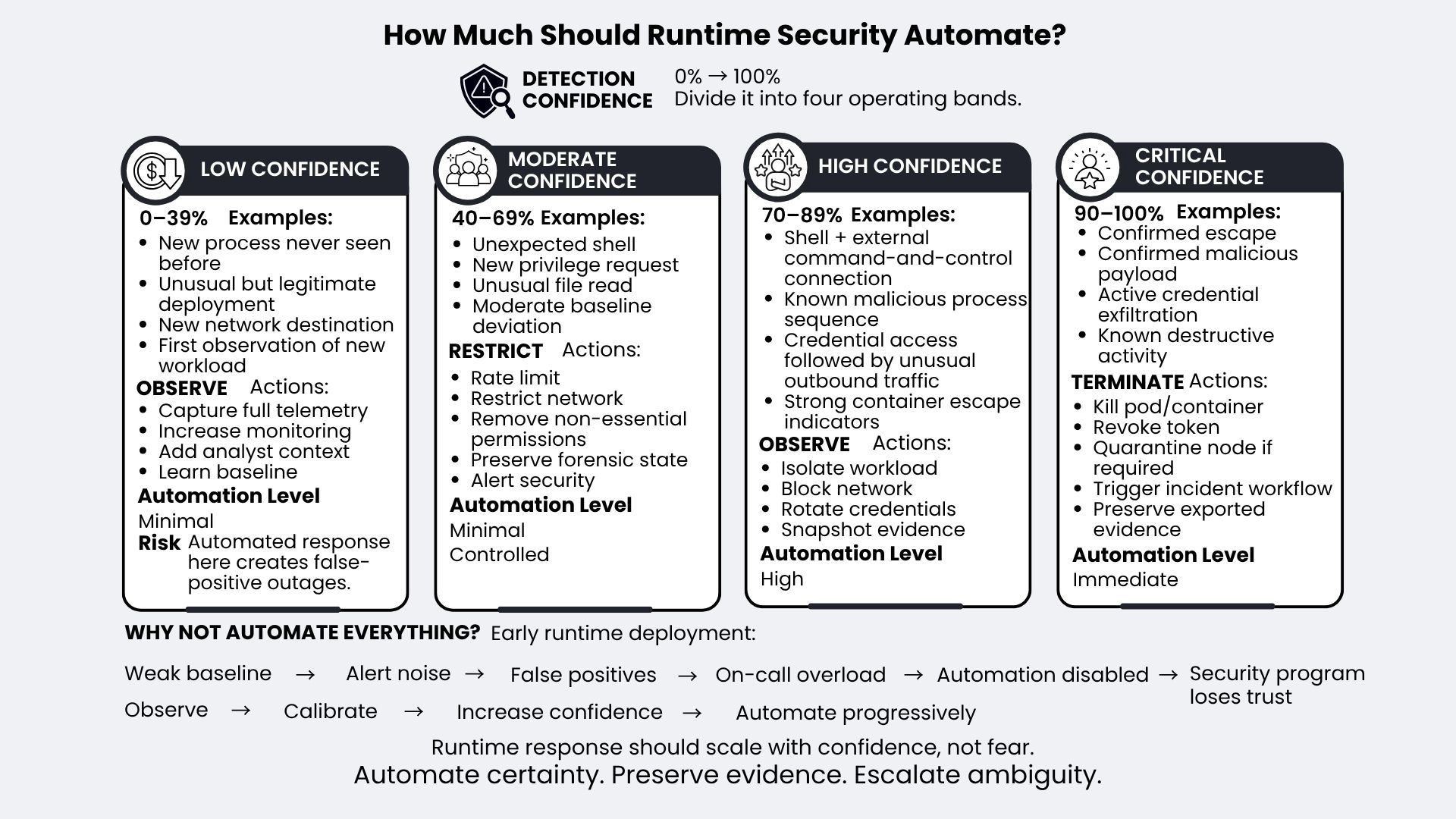
The response layer closes the loop between detection and control. Network policy automation, pod deletion triggered by security events, and automatic credential rotation transform detection from a reporting function into an active defensive posture. Staged response, restricting access and preserving forensic data before termination, reduces the risk of destroying evidence or causing unintended outages.
The Runtime Security Maturity Model
Organizations can assess their posture against a four-stage maturity framework that maps directly to infrastructure investment horizons.
Stage 1, Reactive: Basic logging is enabled. Events are reviewed after incidents. Detection is entirely signature-dependent with no behavioral visibility.
Stage 2, Proactive Observation: Syscall monitoring is deployed. Behavioral baselines are established per workload class. Alerts are generated but response remains manual, creating high alert volume and delayed mean time to respond.
Stage 3, Automated Response: High-confidence detections trigger containment automatically. Policy-as-code is enforced at admission. Forensic data is preserved by default across ephemeral workloads.
Stage 4, Intelligence-Driven Defense: ML-powered anomaly detection is continuously calibrated against evolving baselines. Runtime signals feed upstream into pipeline security gates. Security posture becomes measurable, auditable, and self-improving.
Most enterprise organizations operating containerized workloads at scale currently sit between Stage 1 and Stage 2. The strategic goal is not to reach Stage 4 immediately. It is to architect a path there that does not require rearchitecting the platform at each stage transition.
Operational Trade-offs That Budget Proposals Overlook
Rigorous runtime security is not free, and the costs that matter most rarely appear in procurement proposals.
Performance overhead from syscall interception and network inspection is real. eBPF-based instrumentation adds approximately 1 to 3% CPU overhead in production workloads, acceptable in most contexts but material in latency-sensitive applications. The performance budget must be explicitly modeled, not assumed.
False positive management is the operational tax on immature behavioral baselines. Early-stage deployments commonly generate alert volumes that exhaust on-call capacity. The solution is better baseline modeling and a deliberate calibration period before automated response is enabled. Scaling compounds this problem: a platform that functions well at fifty nodes may produce incoherent telemetry at five hundred. Streaming data pipelines and distributed forensic storage must be designed into the monitoring architecture from the start.
DevSecOps integration determines whether runtime security becomes a sustained capability or a compliance exercise. When runtime policy is co-owned by platform engineering and security, encoded as code, and reviewed alongside application changes, it becomes a durable organizational asset. When deployed in isolation by a separate security team, it generates friction and workarounds.
Strategic Implications: From Gatekeeper to Intelligence Layer
The shift from perimeter security to runtime intelligence is not a product category transition. It is a conceptual reorientation in where organizations define their security boundary.
For AI and MarTech infrastructure, this reorientation is particularly consequential. A modern customer intelligence system may contain APIs, event processors, identity services, model endpoints, and agentic workflows running across containerized infrastructure. Static scanning can verify what software was deployed. Runtime intelligence is required to understand what that software is actually doing, including how AI agents behave differently depending on their input, retrieved context, or tool permissions.
Three implications follow. Runtime security must be funded as infrastructure, not tooling, with recurring investments in compute, forensic storage, and policy calibration. The security organization's role shifts from gatekeeper to signal provider, where the most valuable function is generating behavioral intelligence that informs platform design and risk quantification, not blocking deployments. And runtime security posture becomes a competitive differentiator: organizations that can produce behavioral audit trails, policy enforcement logs, and incident response telemetry gain a material advantage in regulated verticals and high-trust sales cycles.
Conclusion: Security That Operates at Production Speed
The next phase of cloud-native maturity will not be won by organizations with the most secure pipelines. It will be won by those that build systems capable of defending themselves at the speed at which they operate.
Images can be scanned. Configurations can be checked. Access policies can be defined. But production behavior remains dynamic. Processes execute. Credentials are used. Network relationships change. Attackers exploit opportunities that did not exist when the container image was originally inspected.
Runtime security closes this gap by making execution observable, bounded, and recoverable, not by replacing static security practices but by extending the security boundary into execution, where modern threats live and where static tools cannot follow.
The security posture that matters most is not the one documented at deployment. It is the one the workload demonstrates at runtime.