
Article
Query Optimization Is the Hidden Foundation of AI-Driven Marketing Intelligence
This blog explains why most data strategies fail at the execution layer rather than the collection layer, where query performance degrades faster than data grows due to complex joins, concurrency pressure, and the hidden gap between result size and computational cost. It covers a four-layer optimization framework (scan efficiency, transformation efficiency, reuse efficiency, resource efficiency), the economics of cost per useful analytical outcome, and why continuous monitoring and regression detection turn query performance from a backend chore into the foundation for real-time marketing intelligence.
- Topic
- Data Engineering and Analytics
- Published
- 10 Sept 2026

Most data strategies fail not at the collection layer, but at the execution layer. Organizations invest heavily in ingesting customer events, building machine learning models, and deploying personalization engines, only to find that the analytics infrastructure underneath cannot keep pace. Dashboards stall. Attribution models run overnight. Audience segmentation queries lock shared compute pools at the worst possible moment.
This is not a data quality problem. It is a query performance problem, and at scale, it becomes a strategic one.
The competitive divide in modern marketing technology is no longer about who has access to data. It is about who can act on it within the time frames decisions require. Query optimization, long treated as a backend chore, is now the discipline that separates organizations capable of real-time intelligence from those perpetually catching up.
Why Query Performance Degrades Exponentially
Performance does not decline in proportion to data growth. It declines faster, for compounding reasons.
As tables grow from millions to billions of rows, full scans become prohibitively expensive. But scale is not only about volume. It is about the interaction between volume, query complexity, storage layout, and concurrent workload pressure.
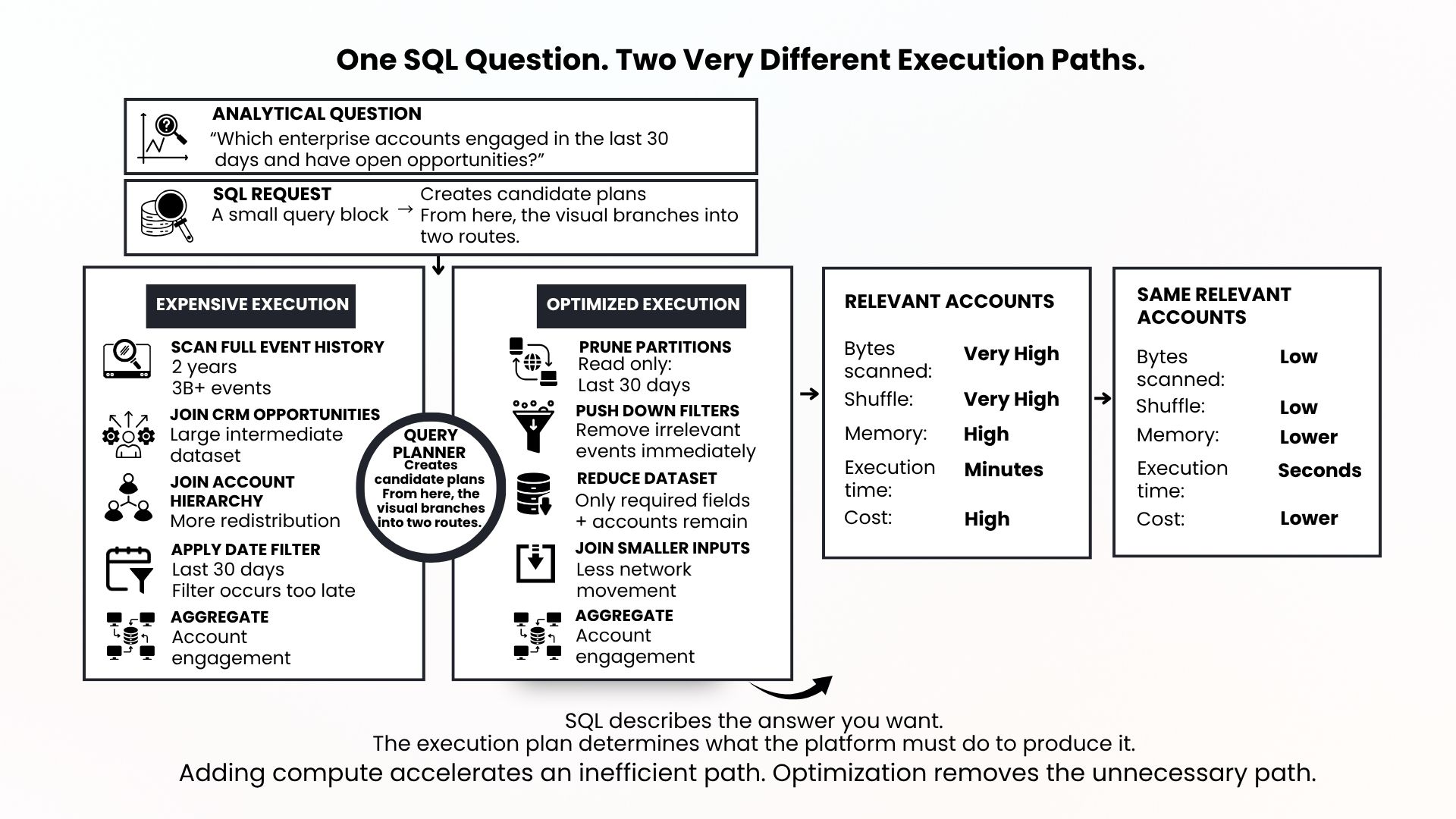
Complex joins drive the largest costs. Consider a marketing intelligence workflow connecting billions of web events, CRM records, campaign data, account hierarchies, and product usage signals. The issue is not the number of tables. It is where the relevant rows live. When distributed workers must shuffle large intermediate datasets across the network to align join keys, execution time rises sharply and cost follows.
Concurrency amplifies the problem in ways teams rarely anticipate. A query that runs in 15 seconds at 7 a.m. may take minutes during peak business hours. The SQL has not changed. The workload has. Interactive dashboards, analyst notebooks, AI feature-generation jobs, and automated reporting compete for the same compute pool. Query performance at scale is partly a scheduling problem, and organizations that ignore this optimize individual queries while leaving systemic inefficiency intact.
Perhaps the least intuitive insight: result size is a poor indicator of computational cost. A query returning 200 rows may still scan billions of records and shuffle terabytes of intermediate data to produce that result. This gap between output size and processing footprint is where most analytics cost is hidden.
The Execution Layer: Where Data Strategy Meets Reality
Understanding how queries execute, not just how they are written, is prerequisite to meaningful optimization.
Modern distributed query engines transform SQL through several stages. A planner generates candidate execution strategies. A cost-based optimizer evaluates those options using statistical models of the underlying data. The chosen plan then runs across distributed workers. The visible SQL is only the starting point. A concise query can trigger a full table scan. A complex query can execute efficiently if the optimizer eliminates redundant operations.
Query execution is not a fixed cost. It is a design surface. The same analytical question can be answered with dramatically different resource requirements depending on how the query is written, how the underlying data is organized, and what pre-computation has been done in advance. Adding compute addresses the symptom. Redesigning the execution path addresses the cause.
A Four-Layer Framework for Systematic Optimization
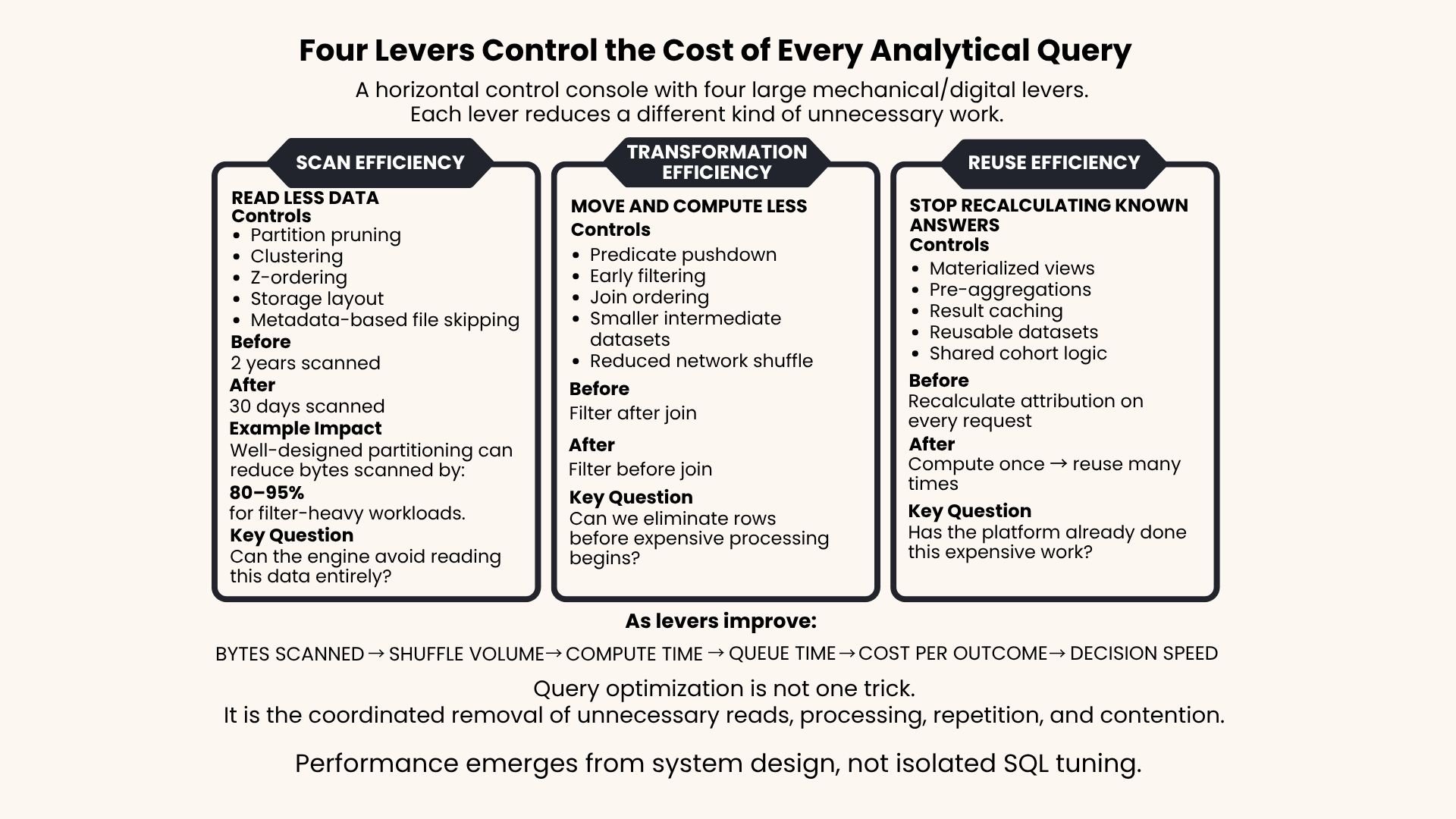
Rather than treating query performance as a collection of isolated SQL problems, high-performing analytics organizations work through four structural layers. Each layer targets a distinct source of cost.
Layer 1: Scan Efficiency
The most impactful optimizations happen before a query executes. The fastest large-scale query is the one that avoids reading unnecessary data in the first place.
Partition pruning is the primary mechanism. When tables are partitioned by event date, region, or another high-value access key, queries that filter on that key can skip entire data segments. A campaign performance query covering the last 30 days should never scan two years of history, but without partitioning aligned to actual query patterns, it will. Well-designed partitioning can reduce bytes scanned by 80 to 95 percent on filter-heavy analytical workloads.
Micro-clustering and Z-ordering extend this logic within partitions. By co-locating related attributes within compact storage blocks, the optimizer skips irrelevant files based on metadata bounds rather than reading them to check. The critical constraint: storage design must reflect actual workload patterns, not theoretical data structure.
Layer 2: Transformation Efficiency
Scan efficiency limits unnecessary reads. Transformation efficiency limits unnecessary computation during execution.
Predicate pushdown moves filtering logic as close to the physical storage layer as possible, before joins or aggregations run. Filters applied at the scan stage minimize the data shuffled across the network in subsequent stages. Many BI pipelines inadvertently disable this mechanism through poorly structured SQL, causing costly data movement at scale.
Join strategy matters equally. Snowflake's AI Engineering team demonstrated that altering predicate evaluation order in AI-powered query pipelines, treating model inference cost as a first-class optimization objective, delivered two to eight times more performant execution plans than standard approaches. The principle generalizes: filter early and aggressively, and structure joins to minimize intermediate data before expensive operations run.
Layer 3: Reuse Efficiency
Many analytics environments repeatedly calculate the same expensive aggregations. Executive dashboards request monthly revenue. Attribution models recalculate the same funnel daily. Audience segments query identical cohort logic across campaigns.
Materialized views address this by pre-computing and storing the results of complex joins and aggregations. Instead of recalculating a full attribution model from raw events on every dashboard load, the model runs once and all subsequent queries read the result. The tradeoff is storage overhead and refresh latency, but for stable, high-volume queries, the reduction in read-time compute typically outweighs the cost.
Result caching complements this at a different layer. When multiple users load the same dashboard view within a short window, serving results from memory requires almost no CPU. Caching is most effective when query patterns are stable, a condition common in production dashboarding environments.
Layer 4: Resource Efficiency
The final layer governs how compute is allocated across the workload as a whole.
Interactive exploration, production dashboards, ML pipelines, and batch transformations have different latency requirements and different business value. Running them under identical resource policies means high-stakes workloads compete with low-stakes ones at exactly the moments when prioritization matters most.
Workload isolation queues, auto-scaling rules, query timeouts, and cost alerts prevent runaway queries from degrading system-wide performance. Governance at this layer turns query performance from individual developer responsibility into platform-level control.
The Economics of Optimization
Every performance improvement has an economic dimension that strategy leaders must evaluate explicitly.
The strategic metric should not be query latency alone. It should be cost per useful analytical outcome. Reducing a dashboard from three seconds to one second has little business value if infrastructure cost triples to achieve it. Reducing a customer segmentation workflow from two hours to ten minutes may materially improve campaign responsiveness and downstream revenue.
A query powering real-time personalization at the point of conversion has different latency requirements, and different cost justification, than one feeding a weekly executive report. Treating them identically, which is what happens without explicit workload classification, means over-investing in low-stakes queries and under-resourcing high-stakes ones.
Research on ML-driven optimization frameworks has demonstrated that predictive modeling with adaptive reinforcement learning can reduce average query latency by 42 percent and costs by 25 percent compared to baseline configurations. This reflects how much headroom exists in environments where optimization has been left to individual query writers rather than designed into the platform.
Monitoring as a Continuous Discipline
Data changes. Usage patterns shift. New dashboards appear. AI workloads introduce new concurrency pressure. Previously efficient queries regress as tables grow. Optimization cannot remain a periodic engineering exercise.
Effective observability tracks patterns rather than isolated slow queries. Useful signals include total bytes scanned, p95 and p99 query latency, queue time, shuffle volume, spill volume, and cost by workload class. These reveal whether the problem is a specific SQL statement or a systemic pattern requiring architectural intervention.
Regression detection is the discipline most commonly overlooked. Query performance can degrade silently as data grows, schemas change, or pipeline modifications ripple downstream. Without automated benchmarks and alerting, teams discover regressions only when users complain, typically after performance has already affected business outcomes.
Strategic Implications: From Infrastructure to Intelligence
The evolution of analytics architecture follows a predictable arc. Organizations first build tools that answer questions. Then they build infrastructure capable of answering those questions at scale. Eventually, they need optimization systems that continuously determine how those questions should be executed efficiently.
An audience query that requires hours constrains real-time segmentation. A slow customer feature pipeline delays model updates. An attribution model run less frequently because of cost reduces decision freshness. These are not technical limitations. They are commercial constraints that compound over time.
Query optimization is the infrastructure for intelligence. It is not the end goal, but the necessary foundation for marketing systems and AI models that must be fast, scalable, and cost-effective simultaneously. The organizations that sustain analytical advantage will be those who treat query performance as a product, with owners, service-level agreements, and continuous improvement cycles, not as plumbing.
The query layer is the execution surface of your entire data strategy. Design it accordingly.