
Article
Protecting Data: In Transit and At Rest
This blog explores the critical role of encryption in protecting B2B data assets from multi-million dollar breaches. It provides a technical roadmap for securing data in transit and at rest to ensure regulatory compliance and maintain enterprise buyer trust.
- Topic
- Cyber Security
- Published
- 17 Mar 2026

Your CRM holds customer relationships worth millions. Your marketing platform handles thousands of prospect interactions every day. Your content system stores the assets your team depends on. Then you get the notification: sensitive data was intercepted during transmission or stolen from storage.
The damage goes beyond money. Customer trust evaporates overnight. Regulators start asking questions you don't want to answer. Your competitive edge disappears while competitors circle.
The reality is that in 2025, data breaches of the average size resulted in U.S. companies incurring losses of $10.22 million. Globally, this figure is only $4.44 million. Even more unfavorably, 53% of the breaches revealed the personal information of customers. Just reconsider the bonds your demand generation teams and CMOs have been developing for years. One breach, and all the efforts are gone.
Why Modern B2B Organizations Must Prioritize Encryption
Three factors make encryption and data protection mandatory for B2B organizations today.
First, regulators aren't playing around. GDPR demands appropriate technical measures, including encryption, for personal data. HIPAA's 2025 changes require encryption of all electronic protected health information, both at rest and in transit. CCPA expects reasonable security procedures to be in place. SOC 2 compliance requirements include having documented encryption policies. A breach of these rules can result in severe penalties: the GDPR violations led to €1.2 billion in fines during 2024, and individual penalties amounted to as much as €310 million.
Second, trust drives business decisions now. Security became a deal-breaker in B2B buying. Enterprise buyers check your security certifications before they'll even talk to sales. Data protection shows up in RFP requirements. Prospects grill you about security architecture before discussing price. Research shows 70% of B2B buyers weigh security heavily in purchase decisions. Companies that get breached lose 30% of their customers.
Third, threats keep multiplying. External attackers cause 67% of breaches. Insider threats cost the most at $4.92 million per incident in 2025. Cloud misconfigurations expose data constantly. Supply chain and third-party breaches made up 35.5% of all incidents in 2024. Ransomware attacks averaged $5.08 million in costs last year. Stolen credentials enable 60-68% of breaches, with attackers moving from initial access to data theft in 62 minutes or less.
Understanding Data States
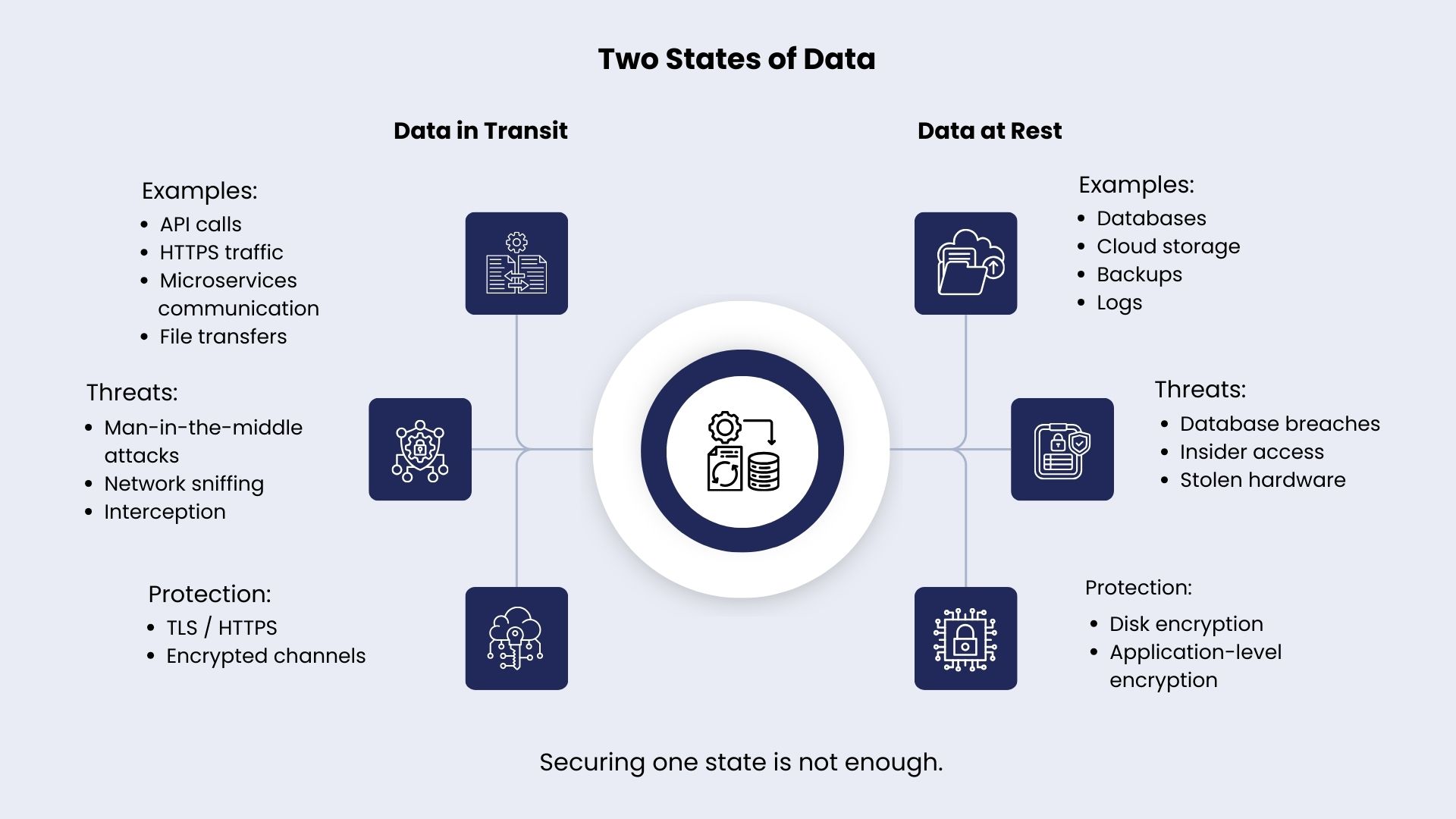
Data lives in two states, and each needs different protection.
Data in transit is data that travels over networks. API calls between microservices. HTTPS traffic from customer browsers. Database replication across data centers. File transfers to cloud storage via email communications. When data is in motion, you no longer have direct control over it, and it is at risk of being intercepted. Man-in-the-middle attacks capture the traffic that is not encrypted.
Network sniffing tools easily read plaintext data. Data at rest sits in storage, production databases, object storage buckets, backup repositories, local disk volumes, and archived logs. Storage brings different dangers. Someone steals physical media and gets direct access to your files. Database compromises expose entire record sets. Old hardware gets decommissioned but still holds data fragments.
Here's the trap: securing only one state gives you false confidence. Your team encrypts databases but sends queries and results over unencrypted connections. Attackers intercept the unencrypted traffic and bypass your storage encryption completely. Real breaches exploit whichever link breaks easiest.
Locking Down Data in Transit
Transport Layer Security keeps network communication secure in 2025. TLS builds encrypted tunnels between systems. A client connects to a server, and TLS runs a handshake. Systems agree on encryption protocols. The server proves its identity with a certificate. They swap keys for symmetric encryption. Everything after flows through the encrypted tunnel. Attackers who intercept network traffic see only encrypted garbage without decryption keys.
Best practice today would be TLS 1.3. This iteration gets rid of the less secure, older cipher suites and conceptually reworks the handshake. TLS 1.2 is still compatible with proper configuration, but you must immediately stop using TLS 1.0 and 1.1.
HTTPS is basically HTTP on top of TLS, enabling the encryption of web traffic. All external apps, API endpoints, and customer portals should be using HTTPS. Absolutely no exception by any means.
HTTP transmits everything in plaintext: login credentials, session tokens, and customer data. Browsers nowadays tag HTTP websites as "Not Secure," which can deter your customers even before they come into contact with your content.
Don't forget internal traffic. Many companies encrypt customer-facing traffic but leave internal service-to-service communication wide open. Microservices should talk over TLS. Database connections need encrypted channels. API gateways should enforce encryption everywhere.
Automating Certificate Management
Managing certificates becomes complicated very quickly. TLS certificates are essentially server identity proofs during connection establishments. Certificates, however, have a validity period and will expire.
The traditional certificate lifespan was 398 days. That will reduce to 200 days in March 2026. By March 2029, certificates will only last 47 days. Companies managing 50 certificates will have to handle more than 400 certificate renewal events every year by 2029.
Services go down when certificates expire. Automation is a must. The Automated Certificate Management Environment protocol enables devices to request, verify, install, and renew certificates without human intervention.
Fortifying Data at Rest
Storage-level encryption protects data on physical media and cloud volumes. Full disk encryption turns entire storage volumes into ciphertext. Cloud providers offer transparent encryption. You flip it on in configuration, and encryption happens automatically with barely any performance hit. Storage-level encryption rolls out easily and needs no application changes.
The catch is access control. Storage encryption stops attackers who lack system access. Once an authorized user or application gets in, storage automatically decrypts data. Storage encryption won't save you from SQL injection, compromised admin accounts, or malicious insiders with legitimate access.
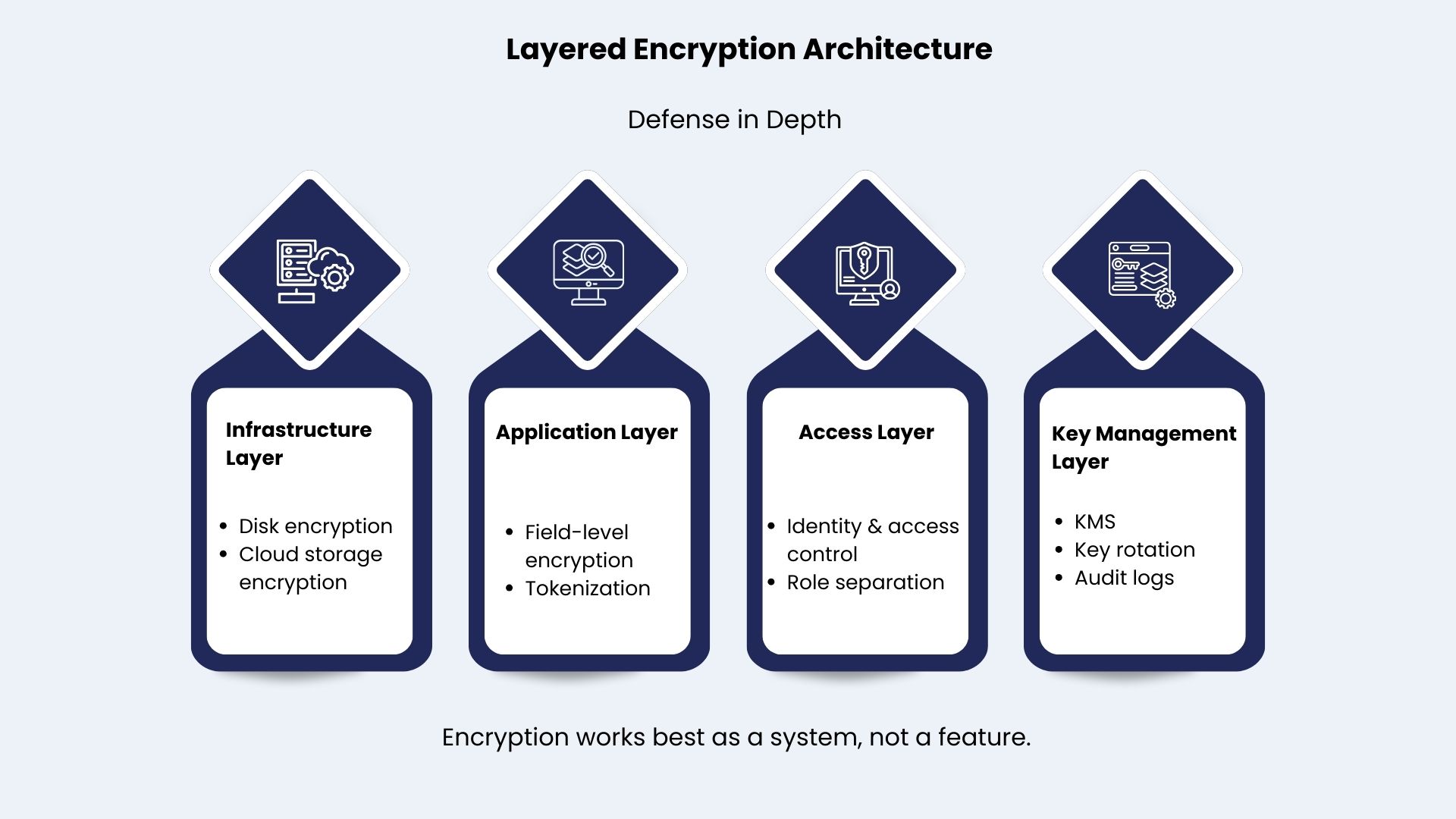
Application-level encryption is there to cover this gap by encrypting particular fields before they get saved to storage. Your application code is doing the encryption of sensitive fields like Social Security numbers, credit card numbers, and authentication tokens. You are handling encryption keys independently of storage. Not even database administrators with full access can see anything other than encrypted values.
Smart teams layer both approaches. Use storage-level encryption as baseline protection for everything. Add application-level encryption for the sensitive stuff: personally identifiable information, financial data, credentials, medical records, and intellectual property. Match your encryption depth to data sensitivity.
The Key Management Challenge
Encryption only works if you protect the keys. Perfect encryption algorithms mean nothing with sloppy key management.
Common mistakes kill security. Hard-coded keys in source code. Shared secrets in configuration files. Encryption keys are saved in the same database as encrypted data. Keys that never rotate. Any of these choices breaks your encryption.
Key rotation contains damage. Static keys create permanent vulnerability. A compromised key unlocks data forever. Regular rotation means compromised keys work for limited time only. Industry experts recommend rotating encryption keys every 90 days for sensitive data.
Access control needs least-privilege thinking. Split roles between key administrators and key users. Key administrators create, rotate, and destroy keys but can't use them for encryption. Applications and services use keys for encryption but can't change key policies or access control. Role-based access control ties permissions to job functions.
Centralized Key Management Services (KMS) take care of all the major tasks. AWS KMS, Azure Key Vault, and Google Cloud KMS offer managed infrastructure with features such as high availability, automatic backups, audit logging, and seamless cloud integration. These services ease the running of a business and bring top-notch security to the enterprise level without the hardware worries.
Building Competitive Advantage Through Protection
Strong data protection builds trust at scale. Enterprise customers check your security capabilities before buying. Security certifications open new market segments. Encryption compliance gets you into regulated industries.
Companies with mature data protection stand out in competitive evaluations. The long-term cost of ignoring data protection dwarfs what you'd spend on prevention. Protecting data in transit and at rest lets your business grow while keeping risk under control.