
Article
Model Drift in Production ML Systems: Why Intelligence Infrastructure Requires Continuous Maintenance
This blog explains why machine learning models fail not by crashing, but by degrading invisibly as the world changes around them; a problem of infrastructure, not data science. It covers the three forms of drift (data, concept, and prediction), detection architectures, business consequences, and mitigation strategies, arguing that competitive advantage comes not from building sophisticated models but from maintaining their reliability over time.
- Topic
- Machine Learning
- Published
- 28 May 2026

The most dangerous failures in enterprise AI are not the ones that crash spectacularly. They are the ones that degrade invisibly. Marketing leaders invest millions in predictive analytics and personalization engines, then watch performance quietly erode over time without understanding why. The culprit is model drift: machine learning systems gradually losing their ability to make accurate predictions as the world around them changes.
A recommendation engine delivering 18% conversion lift in Q1 might drop to 14% in Q2, then 11% in Q3. Teams attribute this to market conditions or campaign fatigue. But the real issue is architectural. Production systems operate on learned patterns from a world that no longer exists. Unlike traditional software that only breaks when someone changes the code, ML models break precisely because nothing in the code changed while the environment did.
This is not a data science problem. It is an infrastructure problem with strategic consequences. The organizations winning with AI in production are not those deploying the most sophisticated models today. They are building systems that maintain intelligence tomorrow, next quarter, and beyond as markets evolve and competitive landscapes transform.
Why Drift Is Fundamentally a Production Problem
Offline validation creates a dangerous illusion. A model achieving 94% accuracy on historical test data can deteriorate to 76% within months of deployment, not because the model changed, but because reality did. Validation happens in static environments. Deployment happens in dynamic ones.
Training datasets represent frozen snapshots. An attribution model trained on 2023 data learned that email engagement peaks Tuesday mornings and certain demographics respond to specific creative formats. Deploy it in 2024, and iOS privacy changes alter tracking signals, TikTok emerges as a discovery channel, and economic uncertainty shifts purchase timelines. The model's learned relationships, statistically sound when trained, no longer map to reality.
What makes drift insidious is its invisibility. Unlike a broken API throwing errors, a drifting model continues operating and returning predictions. Traditional monitoring will not detect it because the system technically works. It is just making progressively worse decisions. Reports show AI-driven execution, but the intelligence underneath is becoming noise.
User behavior continuously shifts the input distribution. Data sources evolve through schema changes, field deprecations, and new data types. Environmental effects introduce systematic shifts. The most dangerous aspect is how easily it goes unnoticed. Teams interpret underperformance as market variability rather than model degradation, especially in marketing and revenue systems where symptoms look like ordinary pipeline fluctuation.
The Three Forms of Degradation
Production ML teams must distinguish between three distinct drift types, each requiring different detection and mitigation strategies.
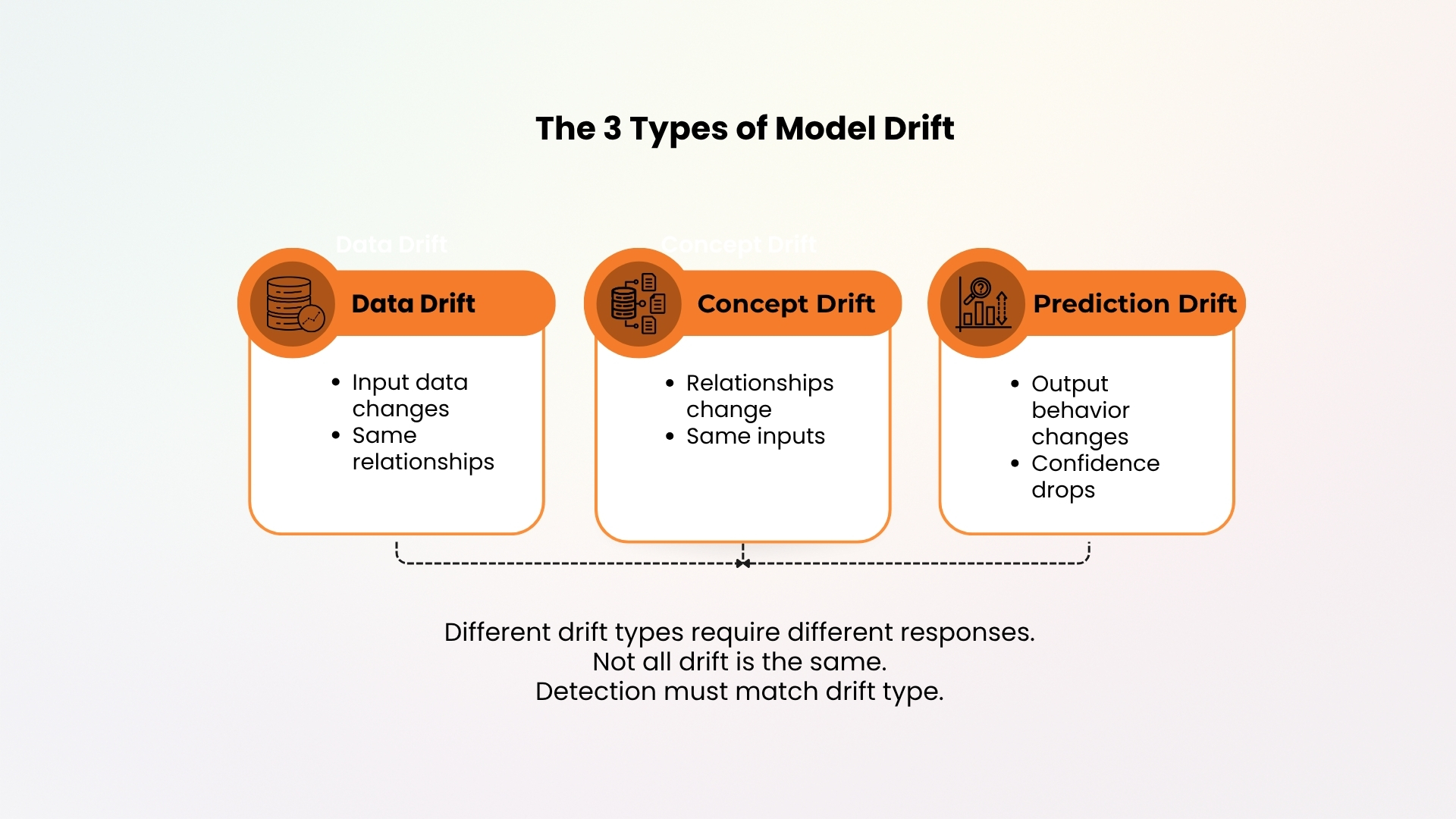
Data drift occurs when input feature distributions change over time while the relationship between inputs and outputs remains stable. A lead scoring model expects certain feature ranges for session duration, engagement rates, and interaction patterns. As behavior evolves, these distributions shift. New traffic sources bring different segments. Platform changes alter interactions. The model receives valid inputs, but they no longer represent the same underlying reality.
Concept drift is more fundamental. The actual relationship between inputs and outcomes changes. What historically predicted conversion no longer does. A B2B scoring system might have learned that downloading a whitepaper plus attending a webinar plus viewing pricing strongly predicts pipeline progression. If prospects become more sophisticated and research extensively before sales contact, those signals lose predictive power. The features have not changed. Their meaning has.
When fraudsters adapt their behaviors to evade detection models, the decision boundary shifts. When economic conditions change, the factors influencing loan approvals evolve. Concept drift represents a shift in the conditional probability distribution between time steps. In marketing systems, this appears when the same engagement pattern no longer predicts conversion, or when historically strong buying signals weaken after market or product changes.
Prediction drift manifests as changes in output distributions and declining confidence. Even when relationships remain stable, production environments introduce variations training did not capture. In many enterprise systems, labels arrive late. Revenue closes months later, churn is observed over quarters. Prediction drift and confidence changes become important early warning indicators before outcomes can be measured.
Building Detection Architecture Into Systems
Organizations managing drift successfully architect systems with awareness built in from the start. This requires fundamentally different infrastructure than traditional ML deployments.
Statistical distribution monitoring compares incoming data distributions to training baselines using Kolmogorov-Smirnov tests, Wasserstein distance, and Jensen-Shannon divergence. These metrics detect when input distributions have shifted beyond acceptable thresholds. Population Stability Index provides another measure, with values above 0.25 typically triggering investigation.
But statistical methods miss business impact. A feature can shift dramatically without affecting predictions if it carries little model weight. Conversely, subtle shifts in critical features destroy performance. Architecture must bridge statistical drift and business outcomes.
Performance-based detection monitors model outputs directly. For classification models, accuracy drift measures the drop in estimated accuracy compared to training-time performance. Confidence monitoring tracks not just accuracy but confidence levels. A model averaging 85% confidence now at 68% signals it is operating outside its learned knowledge, often preceding measurable accuracy loss.
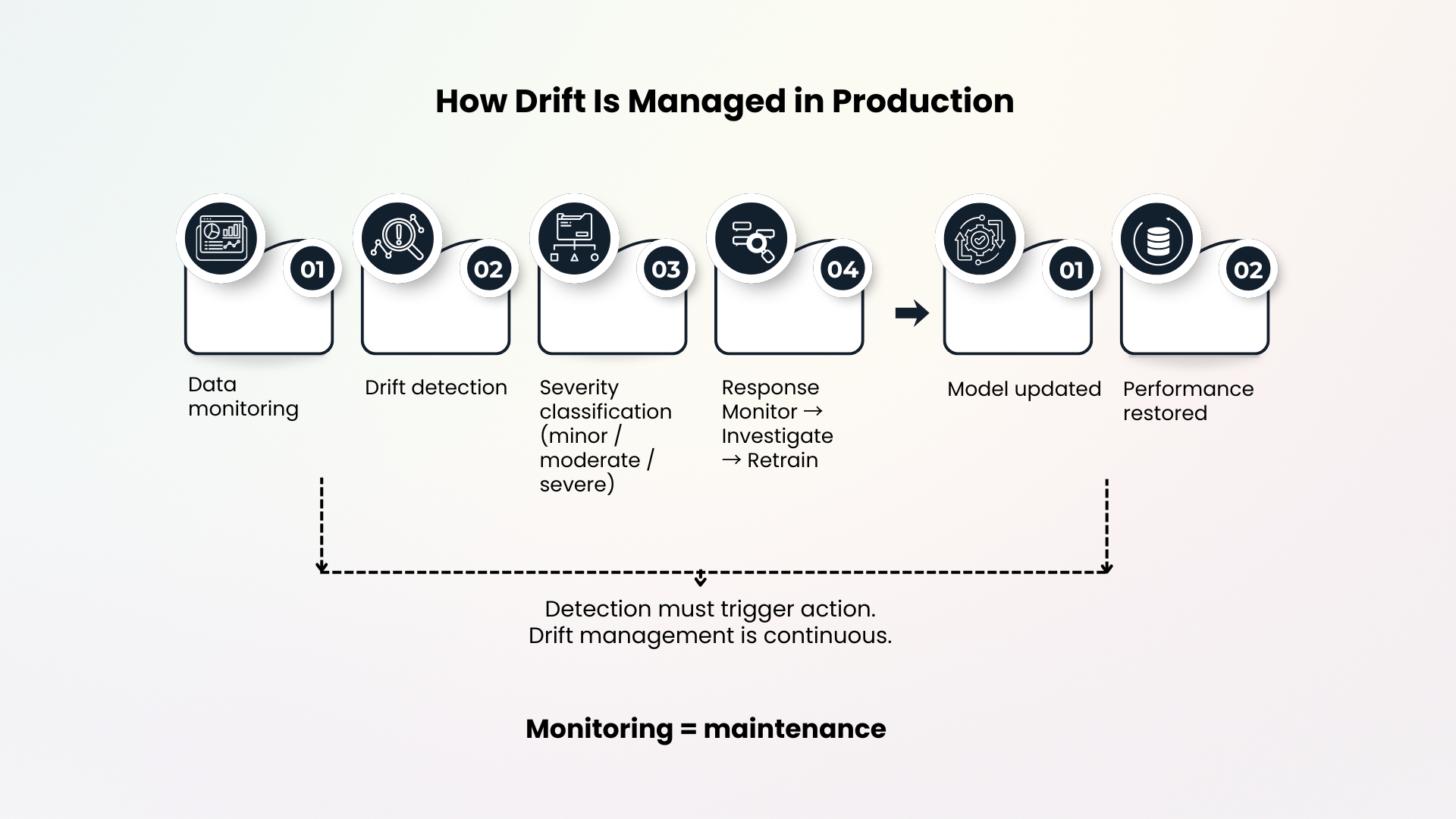
Severity-aware detection distinguishes between minor, moderate, and severe drift, triggering proportionate responses. Organizations solving this implement graduated response systems. Minor drift triggers enhanced monitoring. Moderate drift initiates investigation. Severe drift automatically triggers retraining or falls back to simpler heuristics.
Real-time monitoring architectures can now detect drift with every prediction. Feature-level monitoring using statistical analysis compares incoming data distributions to training baselines, with configurable thresholds typically alerting when distributions diverge significantly.
The Cascade of Business Consequences
The translation from model drift to business outcomes is rarely linear, making it particularly dangerous. A 10% accuracy decline might produce nothing detectable or cascade into catastrophic failure.
Declining accuracy directly impacts decision quality. When models score leads and automation platforms route them, thousands of marginally incorrect decisions happen silently. High-value leads get deprioritized. Low-probability prospects receive expensive outreach. The aggregate appears as declining conversion rates or creeping customer acquisition costs, symptoms attributed to market conditions rather than infrastructure decay.
Operational inefficiencies emerge as inaccurate outputs force manual intervention. When fulfillment or routing models drift during peak demand, teams resort to manual overrides and rework, turning minor prediction errors into costly operational disruptions.
Trust erosion might be the most significant long-term impact. When marketing teams see AI-driven decisions performing worse than human judgment, they route around the system. Shadow processes emerge. Manual overrides become standard. Infrastructure built for scale becomes an obstacle. Once stakeholders lose confidence in model outputs, they revert to intuition or override systems entirely, negating the value of ML investment. Rebuilding that trust is far more expensive than preventing its loss.
Strategic Mitigation Through Layered Approaches
Leading organizations address drift through layered strategies rather than single solutions.
Severity-aware adaptation balances stability and adaptability. Recent frameworks combine multiple statistical measures to quantify distributional changes, then apply tiered adaptation policies. Minor drift is monitored but ignored. Moderate triggers incremental model updates. Severe initiates full retraining.
Retraining architecture forms the foundation. Not scheduled monthly retrains, but infrastructure that retrains continuously, validates rigorously, and deploys safely. The leading approach uses continuous monitoring that detects drift and triggers evaluation, automated retraining pipelines that execute without manual intervention, and gradual rollout systems that validate new models against production before full deployment.
Online learning approaches update models incrementally as new data arrives, reducing lag between drift detection and response. Methods like Subset Extended Kalman Filter update only the neural network parameters with highest impact on loss magnitude, significantly reducing computational cost while introducing stability by leaving most parameters unchanged. However, online learning introduces risks. Models can drift toward local patterns, forget historical learnings, or get poisoned by bad data. The solution is hybrid architectures combining online adaptation for recent patterns with periodic full retrains for long-term stability.
Governance and ownership ensure drift detection is operationalized, not theoretical. Every model must have a designated owner responsible for monitoring drift metrics, setting alert thresholds, and initiating retraining when necessary. Without governance, drift remains detectable but unmanaged.
The Infrastructure Imperative
Model drift exposes a larger truth about enterprise AI. Production systems are not static assets. They are living systems operating inside changing environments. The competitive moat is no longer the model you built yesterday, but your ability to detect and mitigate its decay today.
Regulatory expectations increasingly mandate this capability. Compliance frameworks in financial services and healthcare require demonstrable model governance, including documented drift monitoring and retraining protocols. NIST's AI Risk Management Framework explicitly treats reliability, validity, and ongoing monitoring as lifecycle concerns rather than one-time predeployment checks.
The path forward requires investment in monitoring infrastructure, severity-aware adaptation mechanisms, and clear ownership models. The question is not whether your models will drift. It is whether you will detect it before your business does. Organizations that understand this distinction are building resilient, self-aware systems. Those that do not accumulate technical debt that compounds silently until it manifests as competitive disadvantage.
In the intelligence era, drift management precedes intelligence sovereignty. Competitive advantages emerge not from deploying sophisticated models but from building the infrastructure to keep them reliable over time. Drift detection is not a one-time validation. It is a continuous operational discipline.