
Article
ML Pipelines: From Experimentation to Production
This blog explains why most organizations fail to operationalize machine learning—not because they can’t build models, but due to structural gaps in infrastructure and workflows. It outlines a four-layer production pipeline and maturity model to help teams move from ad-hoc experimentation to scalable, reliable ML deployment.
- Topic
- Machine Learning
- Published
- 12 May 2026

Most organizations don't struggle to build machine learning models. They struggle to operationalize them.
The data reveals a stark reality: despite $7 trillion in planned compute investment by 2030, only 22% of AI initiatives successfully deploy; down from 32% in 2023. The CNCF's 2025 Annual Survey exposes the velocity crisis beneath these failures: only 7% of organizations deploy AI models daily, while 93% treat deployment as an exception rather than routine operation.
This isn't a modeling problem. It's a systems problem. The gap between experimentation and production is structural, and it's widening.
The Execution Gap: Why Research Metrics Don't Translate to Revenue
Marketing ML projects fail at the production stage because they're designed like campaigns rather than systems. A data scientist proves that a recommendation engine can increase click-through rates by 35% using historical data. Leadership approves the project. Six months later, the model still isn't live; caught in an endless loop of integration questions, data pipeline failures, and cross-functional dependencies no one mapped upfront.
Three structural patterns drive this failure:
Research and engineering optimize for different outcomes. Data scientists maximize model accuracy on static datasets. Engineers optimize for system reliability under dynamic conditions. Google Cloud's MLOps documentation identifies the core mismatch: traditional software relies on unit tests and integration tests, while ML models require statistical validation through performance on holdout datasets. These are not the same objective. Models frequently fail in production when data distribution shifts or environment dynamics change.
Manual workflows kill velocity. The typical workflow involves data pulled manually, models trained locally, and results shared via dashboards. This creates no repeatability and no automation. The 2024 DORA Report found that organizations increasing AI usage by 25% experienced a 1.5% reduction in throughput and a 7.2% decline in system stability. CI/CD pipelines optimized for stateless applications break under the weight of model serving.
Reproducibility becomes impossible without systems thinking. Teams cannot answer which dataset was used, which model version performed best, or what parameters were applied. Without this traceability, collaboration breaks down and production deployment becomes guesswork. A reproducible experiment means the same combination of data, code, and parameters produces the same result. Without it, debugging becomes impossible and trust in models declines.
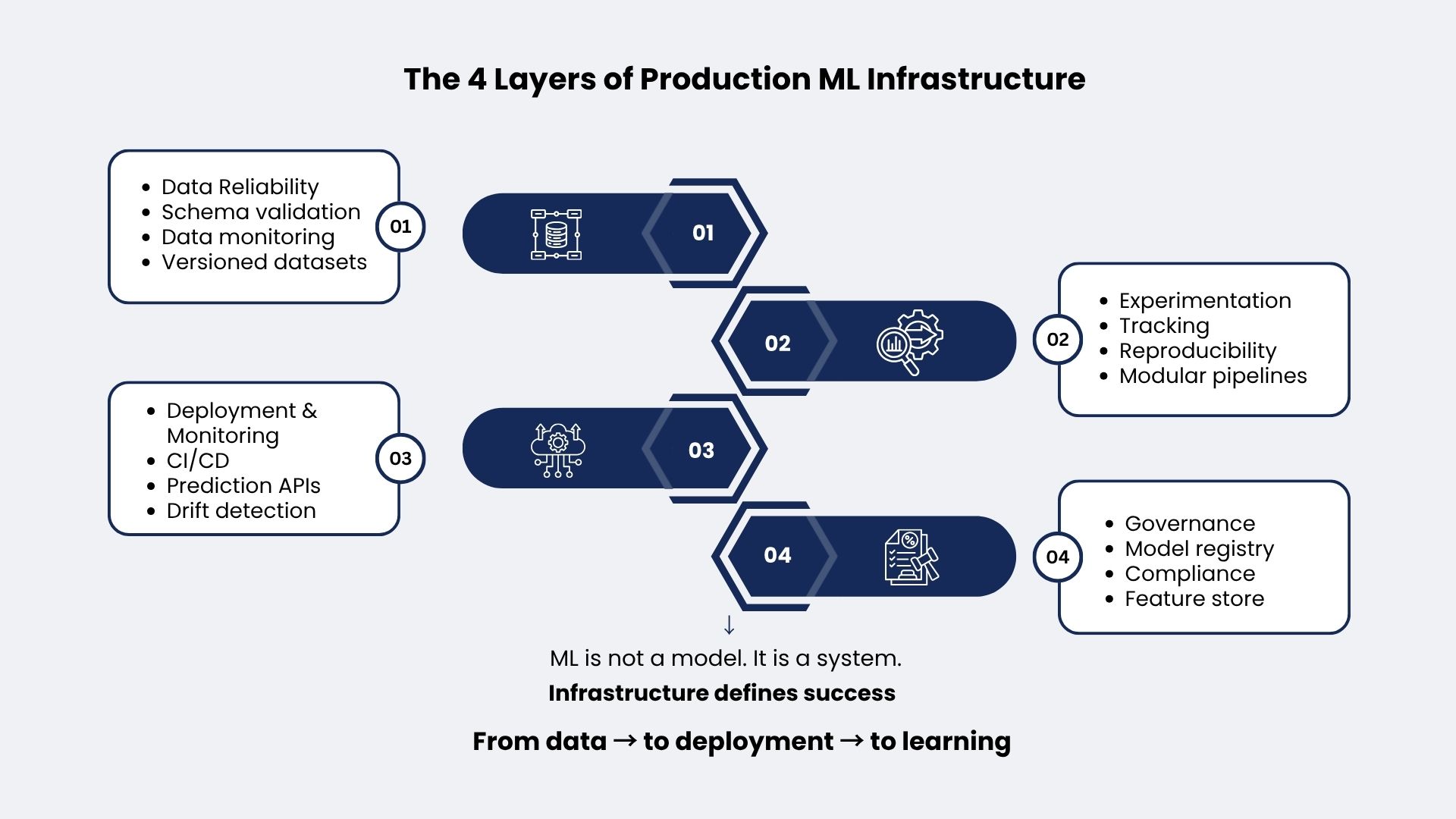
Building Production ML Infrastructure: The Four Critical Layers
Organizations that successfully operationalize marketing ML build layered infrastructure that treats ML as a continuous process rather than a project milestone.
Layer 1: Data Reliability Architecture
Production ML starts with treating data as a product with quality guarantees. This requires schema validation before any model touches production data. If the CRM export suddenly changes how it encodes campaign source attribution, the pipeline fails loudly rather than silently degrading model performance over weeks. Version-controlled datasets with lineage tracking ensure every model training run knows exactly which data snapshot it used, how that data was transformed, and when it was extracted. Automated data quality monitoring provides real-time alerts when data distributions shift materially from training conditions.
Layer 2: Experimentation Velocity Through Standardization
Speed of iteration matters more than perfection of any single model. Experiment tracking as a first-class workflow means every model version, hyperparameter configuration, and performance metric gets logged automatically with full reproducibility metadata. Modular pipeline components with defined interfaces ensure data preprocessing, feature engineering, model training, and deployment are separable, reusable pieces. A/B testing infrastructure built into deployment allows new models to run in parallel with automated traffic splitting and performance monitoring, enabling automatic rollback if performance degrades.
Layer 3: Continuous Deployment and Monitoring
Marketing AI that requires manual updates for every campaign launch doesn't scale. Automated retraining triggers ensure models automatically retrain when sufficient new data accumulates or when performance metrics degrade below thresholds. Prediction APIs with SLA guarantees deliver model predictions in milliseconds with fallback logic when the ML service is unavailable. Observable performance at every layer extends beyond model accuracy to include data freshness, prediction latency, resource utilization, and business metric impact.
Layer 4: Governance and Collaboration Frameworks
Model registries serve as the source of truth for every production model, documenting ownership, approval history, business purpose, and success metrics. Shared feature stores eliminate duplicated work when multiple teams need the same calculations, customer lifetime value gets computed once and reused everywhere. Automated compliance and bias testing verify models comply with privacy requirements and don't encode discriminatory patterns before reaching production.
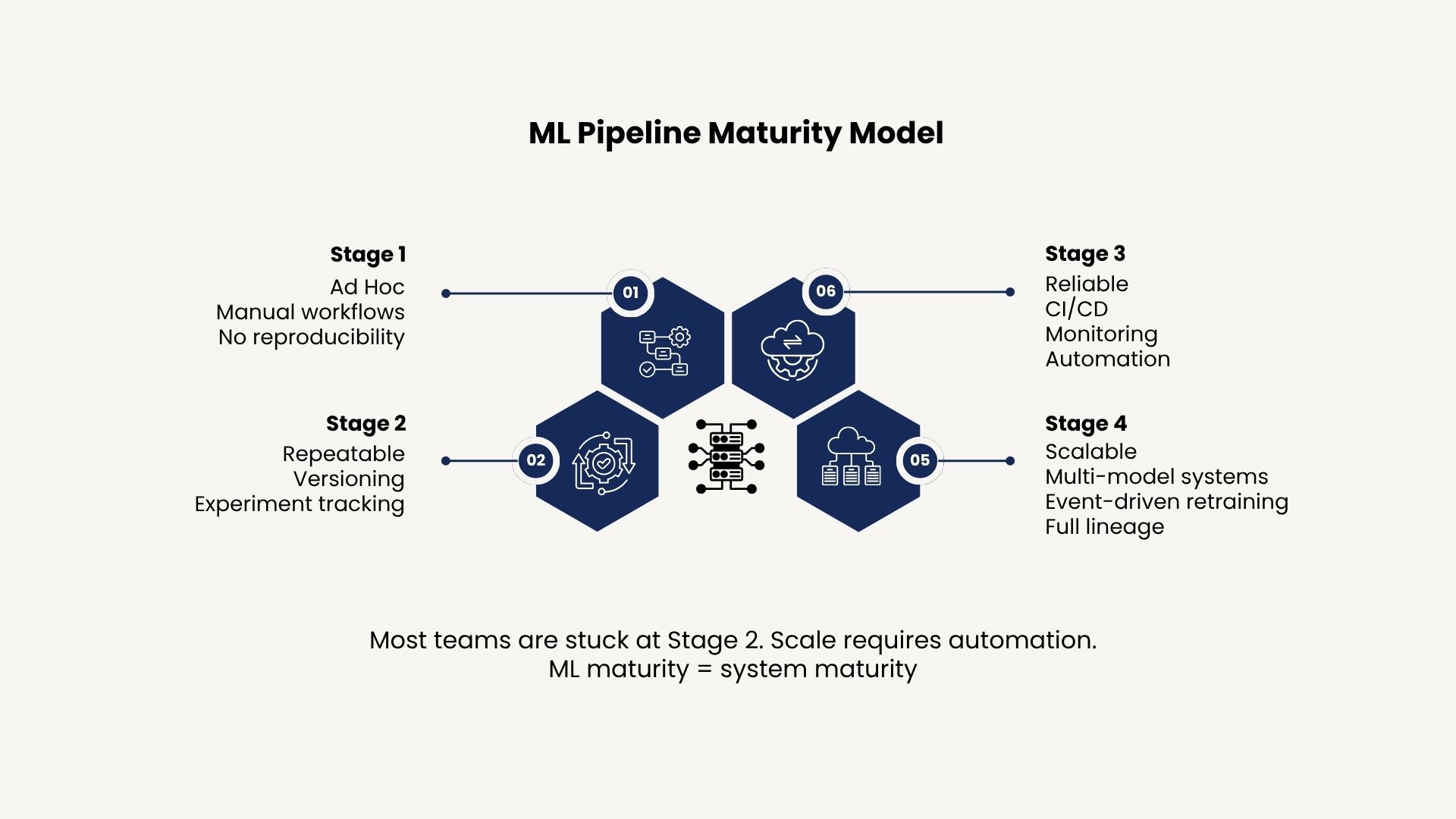
The ML Pipeline Maturity Model
Organizations evolve through predictable stages from experimentation to production:
Stage 1: Ad Hoc (87% of teams) Jupyter notebooks, manual training, email handoffs. No reproducibility, no versioning, no automation. Quarterly releases with 47% production success rate.
Stage 2: Repeatable Versioned code and data, experiment tracking, documented pipelines. Monthly releases with 73% success rate. Manual deployment and limited monitoring remain gaps.
Stage 3: Reliable (Production-Ready) Automated CI/CD, model registry, canary deployments, drift monitoring. Weekly iteration with 94% success rate. Cross-team coordination and governance still require attention.
Stage 4: Scalable Multi-model management, policy-as-code, event-driven retraining, full lineage. Daily adaptation with 98% reliability. Self-optimizing systems.
Most organizations operate at the Repeatable level. They have versioning and experiment tracking but lack the automation and governance required for scale. Progression strategy: prove it with one model, generalize the flow, scale in iterations, and manage the fleet.
Strategic Implications: Infrastructure as Competitive Advantage
The return on infrastructure investment is measurable. McKinsey profiled a large bank in Brazil that reduced ML time-to-impact from 20 weeks to 14 weeks, a 30% reduction, by adopting MLOps and data engineering best practices. The 2024 DORA Report found that elite performers deploying multiple times per day with sub-hour recovery times are twice as likely to exceed their profitability targets.
The competitive moat isn't the sophistication of your algorithms. It's the infrastructure that lets you run hundreds of experiments while competitors are still manually deploying their first model to production. Speed of learning becomes the sustainable advantage.
Each marketing campaign generates data that automatically feeds back into model improvement. Customer response patterns inform content optimization, which generates new engagement data, which trains better segmentation models, which enables more precise targeting. This flywheel only works when infrastructure seamlessly connects execution to learning to iteration without manual intervention.
Organizations building reliable deployment infrastructure now establish operational advantages that compound over time. Each deployment teaches the system something new. Each failure caught early prevents a production incident. Each automated workflow reduces the cognitive load on the next team.
From Models to Infrastructure
Building models is no longer the hard part. Scaling them is.
The shift required is clear: from experimentation to production, from models to pipelines, from tools to infrastructure. Marketing's next competitive frontier isn't which teams have AI. It's which teams have AI that actually runs in production, improves continuously, and scales across use cases without exponential complexity.
The question is not whether your organization can build a great model. The question is whether you can deploy it and keep it deployed at scale. Because in modern AI-driven organizations, ML success is not defined by what you build. It is defined by what runs reliably in production.