
Article
Metadata Management: The Intelligence Layer Your Data Platform Can't Scale Without
This blog explains why metadata has become the strategic bottleneck in modern data platforms, where the challenge has shifted from data volume to data comprehension across fragmented systems. It covers a business-risk-aligned taxonomy (technical, business, operational, lineage), the architectural distinction between catalogs and metadata layers, a three-stage maturity model (visibility, impact analysis, automated intelligence), and common failure modes including metadata drift, incomplete lineage, and unclear ownership that prevent organizations from scaling trustworthy AI and analytics.
- Topic
- Data Engineering and Analytics
- Published
- 9 Jul 2026

For most of the last decade, enterprise data strategy centered on volume: how much data organizations could collect, store, and process. The result is a familiar irony. Companies now hold more data than ever and trust it less than ever.
The bottleneck has shifted from data availability to data comprehension. A 2025 RevOps benchmark of 58 GTM-driven data platforms found that only 29% of organizations had a centralized metadata layer. The rest relied on spreadsheets, tribal knowledge, and ad-hoc documentation. The consequence was predictable: low discoverability, fragile governance, and costly debugging when pipelines broke or dashboards diverged.
This is the metadata crisis of scale. It is no longer a back-office engineering problem. It is a strategic liability for every organization building AI-driven marketing, autonomous decision systems, and self-serve analytics at enterprise scale. Metadata is the connective tissue that makes the transition from raw infrastructure to intelligent infrastructure possible.
Why Metadata Becomes Critical at Scale
When an organization runs a handful of dashboards from a single warehouse, metadata is a minor concern. But modern data platforms span CDPs, CRMs, enrichment providers, event-streaming systems, AI feature stores, and BI tools. Each generates its own schemas, lineage assumptions, and access patterns.
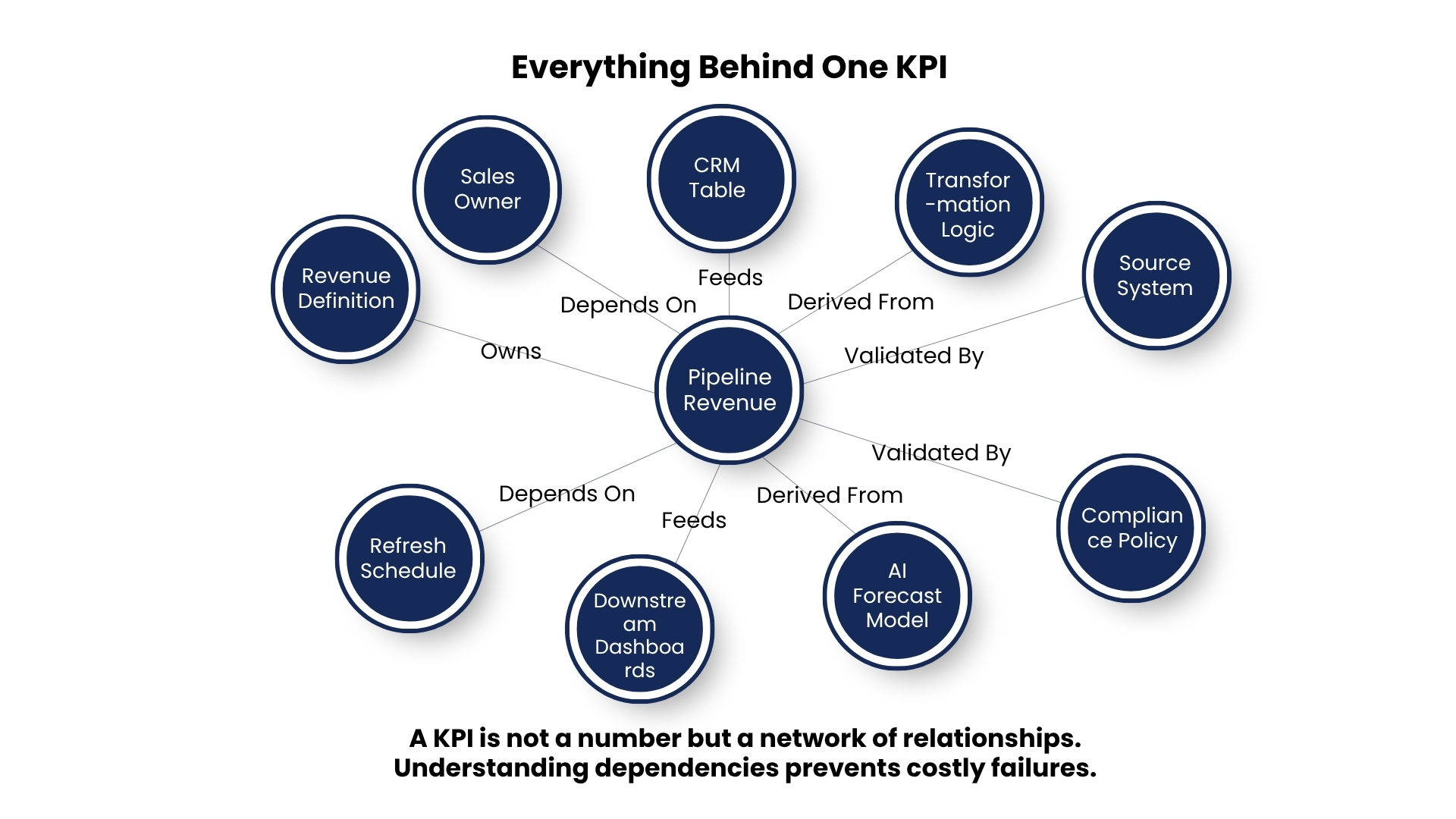
At this scale, the real problem is not data fragmentation. It is visibility fragmentation. Teams cannot answer basic questions: Where did this metric come from? Who owns this dataset? Which dashboards break if this schema changes?
These are not merely analytical questions. They are operational ones. A campaign suppression list built on stale segmentation logic, a revenue attribution model pulling from an unvalidated source, or a personalization engine referencing deprecated features each represents a failure point that metadata governance could have prevented. As organizations automate more decision-making through AI and ML, the stakes of poor metadata hygiene rise proportionally. A flawed model continues making flawed decisions until someone catches it, which requires precisely the kind of lineage visibility that metadata provides.
Cross-team environments amplify the risk. Marketing defines "qualified lead" differently from sales. Finance calculates revenue attribution differently from RevOps. Without a shared metadata layer, organizations accumulate semantic inconsistency that erodes analytics trust and slows every decision that depends on shared data.
A Taxonomy That Maps to Business Risk
Most metadata frameworks collapse in practice because they are built for documentation, not operations. A useful taxonomy maps directly to business risk and execution velocity.
Technical metadata covers schemas, data types, and storage locations. It answers the question: what does this data look like, and where does it live? This layer is the most commonly automated, but it is only the foundation.
Business metadata captures semantic context: what a field means, how a KPI is calculated, which team owns a dataset. This is the layer most often managed informally in wikis, and the first to degrade at scale. Organizations that mapped technical fields to business definitions reduced metric-definition conflicts by 48% and increased GTM-team confidence in dashboards by 33%.
Operational metadata tracks runtime behavior: execution timestamps, row counts, latency distributions, error rates. This is what moves metadata from passive documentation to active infrastructure. It enables teams to answer "is this data healthy right now?" rather than just "what is this data?"
Lineage and dependency metadata maps the full ancestry and downstream impact of any given data asset. This is the most strategically valuable layer and, paradoxically, the least mature in most organizations. Incomplete lineage systems caused 37% of post-change incidents in a 2025 tracking benchmark, while strong lineage systems reduced impact-analysis time by 49%.
The organizations building durable data intelligence treat these four layers not as separate concerns but as an integrated graph: queryable, continuously updated, and surfaced to both technical and business stakeholders in context.
Architecture Before Tools
The instinct in most organizations is to buy a data catalog and call the problem solved. A catalog is a product. A metadata layer is an architectural commitment.
Data catalogs provide the foundation: searchable inventories of data assets with attached business context. But their value is proportional to the completeness and freshness of the metadata they index. That is a pipeline problem, not a UI problem.
Schema registries enforce contract-level consistency as data moves between producers and consumers. In environments where event schemas evolve frequently, a schema registry is the difference between controlled versioning and silent data corruption.
Automated metadata extraction is the investment that separates organizations with living metadata from those with documentation that was accurate six months ago. Tools like dbt for transformation lineage, OpenLineage for cross-platform lineage events, and continuous quality monitoring systems form the operational backbone of a mature metadata layer.
The hardest problem is not technical. It is semantic. When the paid media team's definition of "conversion" differs from the product team's, no catalog will reconcile them automatically. Metadata management at scale requires governance process as much as tooling: clear ownership models, definition arbitration workflows, and business glossaries maintained with the same rigor as production code.
A Three-Stage Maturity Model
Metadata infrastructure matures in stages. Organizations that skip stages create the conditions for the failures they were trying to prevent.
Stage 1 is Visibility. Teams can find, understand, and trust data assets. Catalog adoption is high. Business glossaries are maintained. Basic lineage is captured. The primary value is reducing time-to-insight and eliminating duplicated dataset creation.
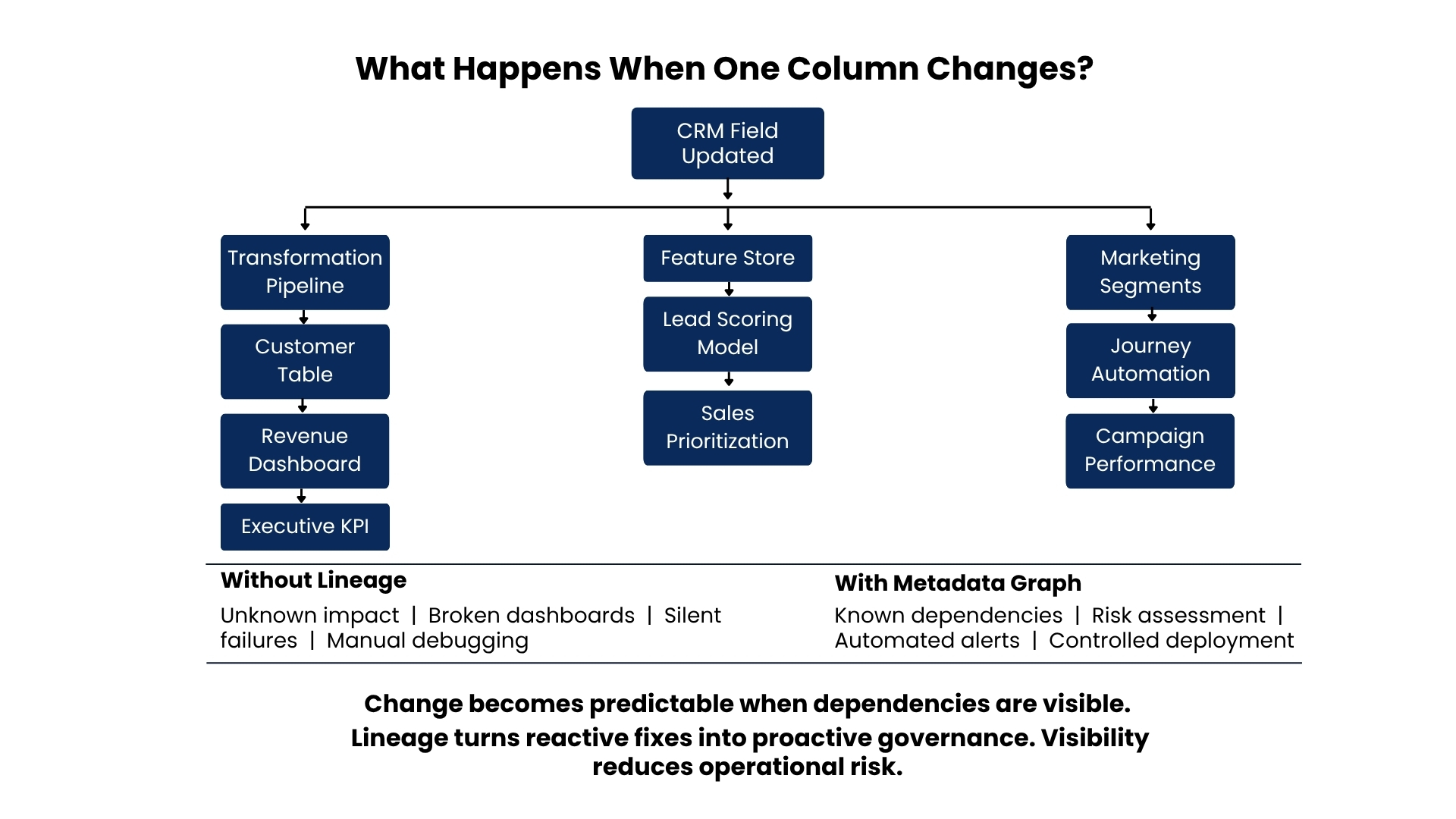
Stage 2 is Impact Analysis. Before modifying an upstream data source, engineers can query the metadata graph to understand all downstream dependencies: dashboards, models, pipelines, and automated decisions that will be affected. Change management in data systems becomes governed rather than speculative. Teams using metadata-driven impact analysis reduced post-deploy incidents by 39% and cut deployment time by 28%.
Stage 3 is Automated Intelligence. Metadata drives automated governance, compliance checking, and anomaly alerting. When a pipeline emits a signal such as a column nullability rate crossing a threshold or an unexpected schema change, the metadata layer contextualizes it: identifying which downstream consumers are at risk, who to notify, and what the probable business impact is. At this stage, metadata is the intelligence layer, not a support function.
Organizations pursuing self-serve analytics at scale cannot reach Stage 3 without deliberately building through Stages 1 and 2. Metadata infrastructure has to precede the democratization of data access, or self-serve becomes a vector for data misuse rather than a productivity multiplier.
What Fails in Practice
Even well-designed metadata systems degrade without deliberate maintenance.
Metadata drift is the most common failure mode. Schema changes propagate without triggering catalog updates. Business definitions evolve informally. A 2024 governance audit found that 48% of GTM-driven metadata layers suffered from significant drift within 12 months. The only durable solution is treating metadata updates as a first-class part of the data development lifecycle, with lineage captured at pipeline execution time, not documentation time.
Incomplete lineage is the second major failure. Most lineage tools work well within a single platform. Cross-platform lineage, tracking data from a source system through a transformation layer into a feature store and into a model endpoint, remains unsolved in most organizations. OpenLineage is emerging as the open standard for cross-platform lineage events, but adoption requires instrumentation across every system in the stack.
Organizational ownership is the most under-discussed challenge. In many organizations, accountability for metadata quality falls between engineering and analytics, with no one owning the semantic layer in between. Organizations that defined clear metadata ownership models reduced drift by 42% and increased cross-team consistency by 36%.
Strategic Implications
The organizations that will lead the next wave of AI-driven marketing and analytics are not simply those with the most data or the most models. They are those with the most trustworthy, discoverable, and well-governed data infrastructure.
For technology decision-makers, the priority sequence is clear: invest in lineage capture before catalog tooling; invest in governance process before governance automation; and treat metadata infrastructure as a platform investment with a multi-year horizon.
For marketing leaders, the implication is equally direct. The quality of AI-driven personalization, attribution, and audience intelligence your organization can achieve is bounded by the quality of your metadata layer. The gap between organizations that have built this infrastructure and those that have not is not a gap in AI capability. It is a gap in data readiness that AI amplifies, not closes.
Metadata is not documentation. It is the control plane for data operations. And in modern enterprise architecture, it is what makes distributed systems understandable, governable, and safe to evolve at scale.