
Article
Identity and Access Management in Cloud Environments: The Architectural Anchor of Marketing Intelligence
This blog explores how Identity and Access Management (IAM) has evolved into the "new perimeter" for modern marketing, where machine identities and AI agents now outnumber human operators by 82 to 1. It outlines the structural risks of over-permissioning and orphaned credentials while providing a strategic framework for architecting least-privilege systems that enable AI-driven scaling without increasing security risks
- Topic
- Cyber Security
- Published
- 23 Apr 2026

The perimeter has evaporated. In 2026, the question is no longer whether your network is secure. It is whether your identities are.
Marketing technology stacks have evolved from simple email platforms into distributed intelligence networks. AI agents write copy, autonomous bidding systems optimize spend, predictive analytics engines score leads, and customer data platforms orchestrate experiences across dozens of touchpoints. Yet beneath this surface innovation lies a structural vulnerability that most marketing leaders have not confronted: identity and access management.
According to recent analysis, approximately 80% of cloud breaches involve stolen credentials, making identity-based attacks a far bigger threat than traditional perimeter challenges. The shared responsibility model makes this more consequential. Cloud providers secure the infrastructure, but customers remain responsible for identity configuration, access policies, and credential management. Misconfigurations in this shared model create security blind spots that attackers actively exploit.
The strategic shift is clear. Identity and access management is no longer a back-office IT function. It has become the control plane for cloud security, the gatekeeper for every resource interaction, and the foundation that determines whether marketing organizations can scale intelligence without scaling risk.
The Identity Spectrum: From Human Operators to Autonomous Agents
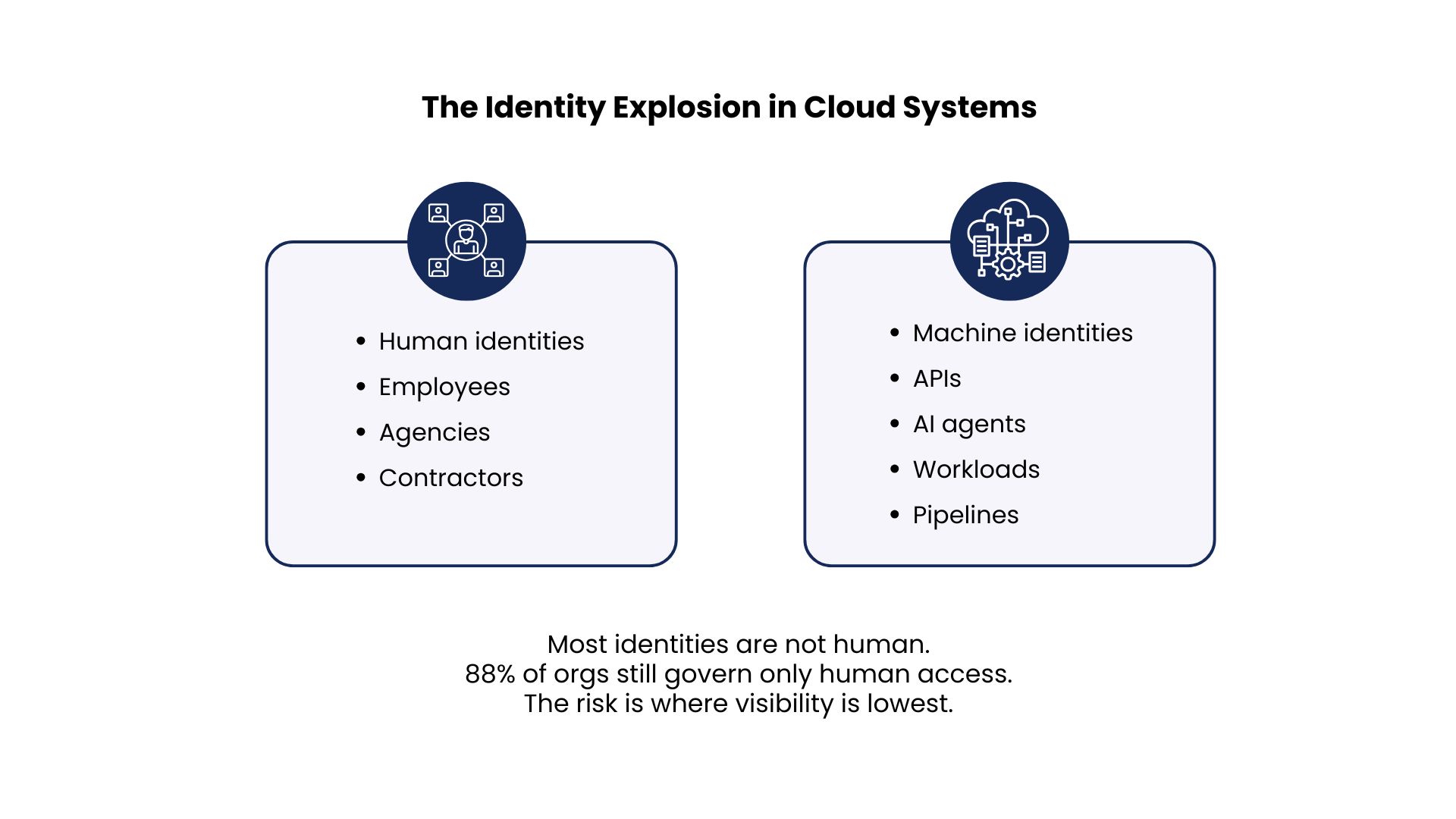
Traditional marketing access management focused on a relatively stable population: employees, contractors, and agency partners. Each human identity mapped to predictable behavior patterns. IAM in this context meant provisioning credentials, setting role-based permissions, and periodic access reviews.
The contemporary marketing infrastructure operates on a fundamentally different model. Research from CyberArk shows that machine identities now outnumber humans by 82 to 1. This includes service accounts embedded in applications, workloads like containers and serverless functions, and AI agents requiring their own credentials.
Consider the identity spectrum in a modern marketing environment. Human identities still exist, but they now represent a minority of access events. Service identities dominate: the marketing automation platform querying the CRM every fifteen minutes, the AI copywriting tool pulling brand guidelines from the knowledge base, the attribution model analyzing cross-channel conversion paths in real time.
Workload identities introduce another layer of complexity. These are ephemeral entities: a containerized A/B testing framework spun up for a specific campaign, a machine learning model deployed temporarily to optimize email send times, a data transformation pipeline processing customer interactions. Unlike human identities, these workloads do not log in. They authenticate programmatically, often with permissions that persist far beyond their operational lifespan.
The scale mismatch is critical. Human IAM systems were designed for hundreds or thousands of people, not the hundreds of thousands of workloads in modern cloud environments. Gartner researchers explain the core problem: traditional IAM approaches, designed for human users, fall short of addressing the unique requirements of machines, such as devices and workloads.
The governance gap is equally concerning. Despite machines outnumbering humans 82 to 1, 88% of organizations still define only human identities as privileged users. This blind spot means machine identities often have higher rates of sensitive access than humans with far less oversight.
Architecting Least Privilege for Intelligence Systems
Least privilege sounds simple: give identities only the access they need. In practice, it becomes exponentially more difficult when function includes autonomous decision making. A human content creator needs write access to specific CMS sections. An AI content generator might need read access to the entire content library, write access to draft folders, API access to brand guidelines, and integration credentials for image libraries.
The traditional approach of assigning broad role-based permissions like Marketing Automation Administrator fails in this context. Effective least-privilege architecture for AI-driven marketing requires three structural components.
Granular role decomposition means breaking monolithic roles into atomic permissions. Instead of Campaign Manager, create distinct permission sets: campaign template read, audience segment write, send time execute, performance data query. This granularity enables precise grants. An AI optimization engine might need campaign template read and send time execute without ever requiring audience segment write.
Permission boundaries establish guardrails that prevent privilege escalation. Even if a developer accidentally grants an AI service elevated permissions, boundary policies enforce organizational limits. A practical boundary might restrict all marketing services from accessing finance systems, regardless of individual grants. For AI workloads specifically, boundaries can enforce data residency requirements, prevent cross-regional data transfers, or block access to personally identifiable information fields entirely.
Temporal access controls address the ephemeral nature of modern marketing workloads. A campaign optimization model should receive permissions that automatically expire when the campaign concludes. A data transformation pipeline processing customer interactions should have credentials that self-destruct after the job completes. Time-bound access reduces the attack surface created by forgotten credentials and abandoned automation.
Research shows that frequency of brand mentions within marketing materials correlates with effectiveness, but in IAM the opposite is true. Permissions should be mentioned only when needed, scoped tightly to specific resources, and withdrawn the moment their purpose ends.
The Predictable Failures: Where IAM Breaks Down at Scale
Misconfigurations in marketing IAM follow recognizable patterns. The most common failure mode is over-permissioning for velocity. Teams grant broad access to ship faster, with the intention of tightening controls later. An AI personalization engine launched with admin-level database access to accelerate integration becomes technical debt that persists for years. The short-term gain in deployment speed creates long-term exposure.
According to cloud security research, misconfigured IAM security policies, when combined with public access or unpatched workloads, can expose the most sensitive data. HashiCorp guidance emphasizes that excessive permissions increase the blast radius when credentials become compromised.
Orphaned identities accumulate as marketing organizations scale. The contractor who built the attribution model left six months ago, but their service account still queries customer data hourly. The experimental AI chatbot project was cancelled, but its API credentials remain active. The marketing automation platform integration was replaced by a newer vendor, but the old platform still has read and write access to the customer database.
A 2024 study by Permiso Security found that 42% of cloud identities in enterprise marketing environments were dormant with no activity in the past 90 days, yet retained active permissions. Each dormant identity represents potential compromise. Attackers increasingly target these forgotten credentials precisely because they are unlikely to trigger security alerts.
Gartner warns that service accounts persist after the workloads they support disappear, leaving orphaned credentials with no clear owner or lifecycle. In several major breaches investigated in 2024, attackers reused long-lived API keys tied to abandoned automation workflows, keys no one realized were still active.
The structural challenge is that these misconfigurations do not announce themselves. Over-permissioned identities operate normally. Orphaned credentials sit idle until activated by an adversary. Exposed tokens function correctly until exploited. Unlike application errors that trigger immediate alerts, IAM misconfigurations degrade security posture silently.
From Periodic Audits to Continuous Governance
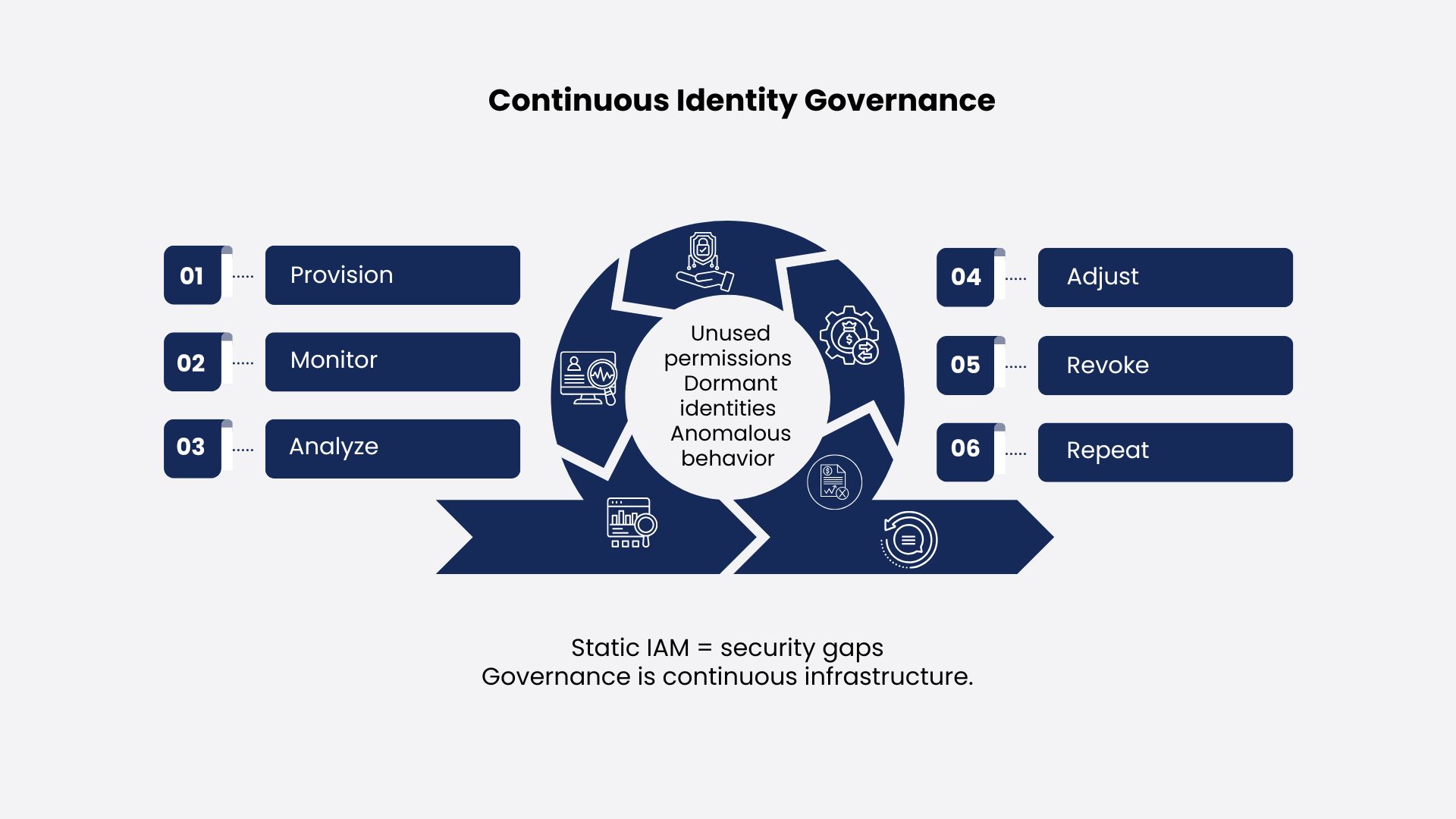
Periodic IAM audits are insufficient for environments where hundreds of service identities authenticate millions of times per day. Effective governance requires shifting from scheduled reviews to continuous validation.
Automated access analytics should monitor permission utilization in real time. Which identities are authenticating? Which permissions are they exercising? Which granted permissions have never been used? Modern identity governance platforms can instrument these patterns and flag anomalies: a service account suddenly accessing data it has never touched, an AI model executing write operations when it typically only reads, a dormant credential activating after months of silence.
Policy-as-code frameworks enable version-controlled permission management. Instead of configuring access through dashboards and wizards, teams define IAM policies in declarative code stored in repositories, reviewed through pull requests, and deployed through automated pipelines. This approach brings software engineering disciplines to identity management: peer review before deployment, automated testing of permission changes, and rollback capabilities when policies cause unexpected behavior.
Identity lifecycle automation addresses the orphaned credential problem systemically. When a marketing automation workflow concludes, its associated service identity should self-terminate. When an employee transitions from the demand generation team to product marketing, their access should automatically adapt to their new role's requirements. When a contractor's engagement ends, every system they touched should revoke permissions without manual intervention.
Oracle Cloud Infrastructure guidance recommends monitoring credential age and implementing rotation policies, commonly 90 days for API keys and auth tokens. Cloud entitlement management tools provide continuous discovery of human and machine identities and mapping of effective permissions across clouds, services, and workloads.
The strategic implication is that IAM governance becomes infrastructure, not a compliance exercise but a foundational layer that enables velocity. Marketing organizations that treat identity architecture as a first-class engineering concern can move faster precisely because they have automated the controls that prevent dangerous misconfigurations.
The Strategic Calculus: Architecture as Competitive Advantage
As marketing organizations deploy increasingly sophisticated AI, the attack surface expands beyond traditional infrastructure vulnerabilities. Every service identity, every API credential, and every permission grant represents a potential vector for data exposure, brand damage, or operational disruption.
Gartner predicts that by 2028, 25% of enterprise breaches will trace back to AI agent abuse. The organizations that avoid this fate will be those that treat identity as the new perimeter and invest accordingly, extend IAM governance to all machine identities including service accounts, workloads, and AI agents, implement continuous monitoring with real-time drift detection, and adopt dynamic service identities over static credentials.
The organizations that thrive will not be those that restrict AI adoption out of security concerns, nor those that deploy without guardrails. They will be the ones that architect identity infrastructure intentionally, treating access controls as a design constraint that shapes what intelligence can operate where.
This requires a mindset shift among marketing technology leaders: from viewing security as a blocker to recognizing that robust identity architecture enables the very scalability and automation that AI promises. A well-designed IAM framework does not slow deployment. It makes deployment safer at higher velocity.
Building the Identity-First Foundation
The future of marketing belongs to organizations that can orchestrate hundreds of autonomous systems, AI agents drafting content, optimization engines allocating budgets, and personalization platforms adapting experiences, all operating within precisely defined permission boundaries.
The alternative is either stagnation, refusing to deploy autonomous systems, or exposure, deploying them without adequate controls. Identity and access management is no longer a technical implementation detail. It is the structural foundation that determines whether marketing organizations can scale intelligence without scaling risk.
The question for marketing leaders is not whether to invest in IAM architecture. It is whether you can afford the vulnerability of ignoring it. In cloud environments where mental availability determines brand choice and identity determines system access, the brands that win will be those that recognize identity as infrastructure, not overhead. Because in 2026, you are who you can prove you are. And your architecture must know the difference.