
Article
Human-in-the-Loop Systems: Building AI Infrastructure That Earns Trust at Scale
This blog explains why the organizations seeing sustained AI performance aren't the ones automating fastest; they're the ones building sophisticated systems for knowing when not to automate. It covers HITL as strategic infrastructure, intervention design, feedback loops, and a maturity model that transforms human oversight from a cost center into a compounding learning system that earns trust at scale.
- Topic
- Artificial Intelligence
- Published
- 26 May 2026

The enterprise AI conversation has shifted. Three years into generative AI deployment, the organizations seeing sustained performance aren't the ones automating fastest. They're the ones who've built the most sophisticated systems for knowing when not to automate.
This marks a fundamental evolution in how we architect intelligent systems. The question is no longer "Can AI do this?" but rather "What's the failure mode if it gets this wrong, and who catches it?" According to recent analysis, approximately 50% of enterprises are experimenting with agentic AI systems, yet only 11% have achieved full-scale deployment. That gap is driven primarily by reliability concerns that expose a deeper truth: models are capable enough to automate, but not reliable enough to trust without human oversight.
Human-in-the-Loop (HITL) represents more than a safety mechanism. It's a strategic architecture that treats automation and human judgment as complementary forces in a unified system. Organizations building HITL as infrastructure rather than afterthought are creating systems that compound in value rather than accumulate technical debt.
Why Full Automation Hits a Reliability Ceiling
The limitations of autonomous AI systems become visible not in average performance, but in distributional edge cases. A content generation system might produce acceptable outputs 95% of the time, but the remaining 5% could include factual errors that damage credibility, compliance violations, or tone-deaf messaging during sensitive contexts. In enterprise environments where reputation compounds over years, these tail risks carry asymmetric consequences.
Edge cases expose architectural assumptions. Training data reflects historical patterns, which means AI systems inherit blindspots from the past. A demand generation model trained on pre-pandemic conversion data will miss structural shifts in buyer behavior. These aren't bugs. They're architectural limitations that emerge when statistical correlation meets real-world complexity.
Ethical ambiguity requires human judgment architecture. Marketing AI increasingly makes decisions with ethical dimensions: which audiences see which messages, how user data informs personalization, when promotional content borders on manipulation. These questions don't have objective answers. They require value judgments that reflect organizational principles and cultural context. Delegating these decisions entirely to algorithms means encoding ethics implicitly through training data rather than defining them explicitly through design choices.
High-stakes decisions demand interpretable governance. When systems influence revenue forecasting, budget allocation, or brand positioning, the cost of unexplained errors escalates. Regulatory frameworks reinforce this reality. GDPR requires human review for automated decisions affecting EU citizens. The EU AI Act mandates human oversight for high-risk applications. Organizations without documented HITL processes face compliance exposure.
Designing HITL as Strategic Infrastructure
Human-in-the-loop isn't a stopgap for immature AI. It's a distinct architectural pattern for building systems that remain reliable as they scale. The design challenge is determining where human judgment adds disproportionate value versus where it creates bottlenecks.
Intervention points should map to failure consequences, not failure probability. A spelling error in an automated social post might be likely but low-impact. A compliance violation in healthcare marketing might be rare but catastrophic. Effective HITL design routes edge cases by blast radius, not by frequency. This requires classifying outputs along multiple dimensions: regulatory risk, brand sensitivity, financial exposure, and reversibility.
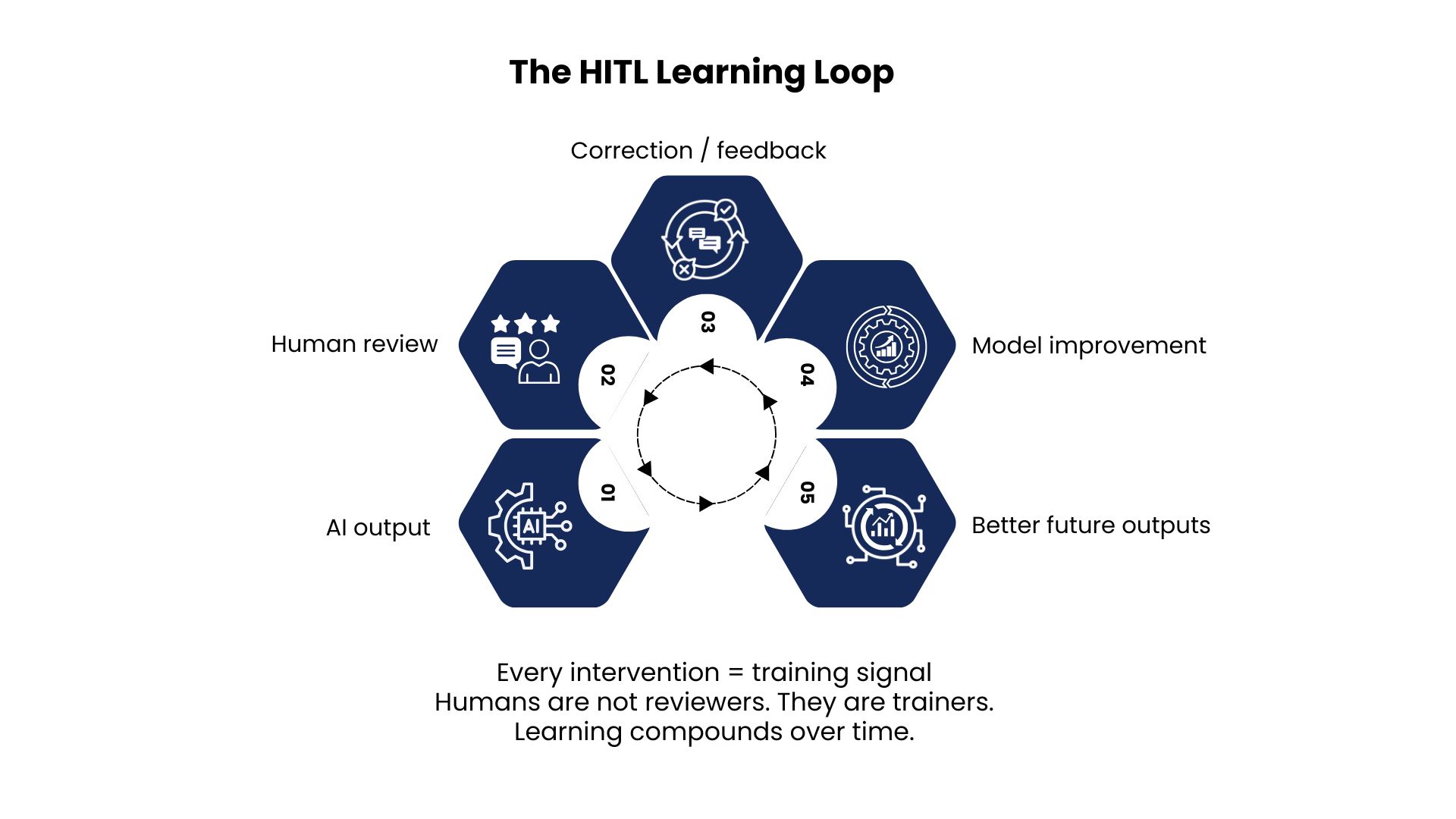
Feedback mechanisms should close the learning loop, not just catch errors. When humans intervene, the system should capture why they intervened and what that reveals about the model's blindspots. Every human correction is training data. A marketer who rewrites AI-generated email subject lines is providing labeled signal about tone, urgency, and audience understanding. Without systematic feedback capture, every intervention is a lost learning opportunity.
Escalation logic should enable graduated autonomy. Rather than binary approve/reject workflows, mature HITL systems use confidence scoring and conditional routing. High-confidence outputs proceed automatically. Medium-confidence outputs get human review. Low-confidence outputs trigger deeper analysis or specialist escalation. This creates a learning scaffold where the system gradually expands its autonomous zone as reliability improves.
Where HITL Creates Competitive Advantage
Three domains consistently demonstrate where structured human oversight becomes strategic infrastructure rather than operational overhead.
Content moderation demonstrates the feedback loop imperative. Platforms running trust and safety operations at scale can't manually review every decision, but they also can't afford automated systems that miss emerging patterns or cultural context. Effective moderation infrastructure uses AI for initial classification, human review for boundary cases, and systematic feedback loops that retrain models based on reviewer decisions. The humans aren't just preventing errors. They're continuously teaching the system about evolving norms.
Healthcare and life sciences expose regulatory risk architecture. Medical AI systems must balance diagnostic accuracy with clinical judgment. A model might correctly identify a condition but miss critical context that a physician would recognize. Research on HITL in healthcare emphasizes that regulatory requirements and patient safety concerns make autonomous systems unacceptable for high-stakes decisions. The human layer represents domain expertise embedded in the execution path.
Finance and compliance reveal interpretability requirements. Marketing systems that influence credit offers, investment recommendations, or financial product positioning face regulatory scrutiny around algorithmic decision-making. HITL infrastructure here serves dual purposes: catching errors before they reach customers, and generating audit trails that demonstrate governance.
Scaling Human Oversight: From Cost to Learning System
The fundamental tension in HITL design is economic: human review has linear cost scaling while automated systems have logarithmic cost curves. Sustainable HITL infrastructure requires deliberately designing for leverage.
Sampling strategies should optimize for learning, not coverage. Rather than reviewing a fixed percentage of all outputs, sophisticated systems use stratified sampling that overweights novel patterns, edge cases, and high-stakes decisions. If 90% of outputs fall into established templates with known performance profiles, reviewing a random 10% sample provides minimal learning. Sampling systems that operate in unfamiliar contexts generates more valuable feedback per hour of human time.
Reviewer tooling should amplify judgment, not just facilitate approval. Showing reviewers just the output and asking approve/reject creates low-information workflows. Surfacing the AI's reasoning, confidence scores, similar past decisions, and potential alternatives transforms review into a higher-leverage activity where humans can pattern-match across edge cases and provide richer feedback.
LLM-as-Judge for intelligent triage. Modern HITL architectures use secondary AI systems to pre-screen outputs, routing only uncertain cases to humans. A well-calibrated judge can triage 80-90% of routine outputs, reducing human review volume by an order of magnitude while concentrating expert attention where it matters most.
The HITL Maturity Model
Organizations evolve through predictable stages in how they architect human oversight:
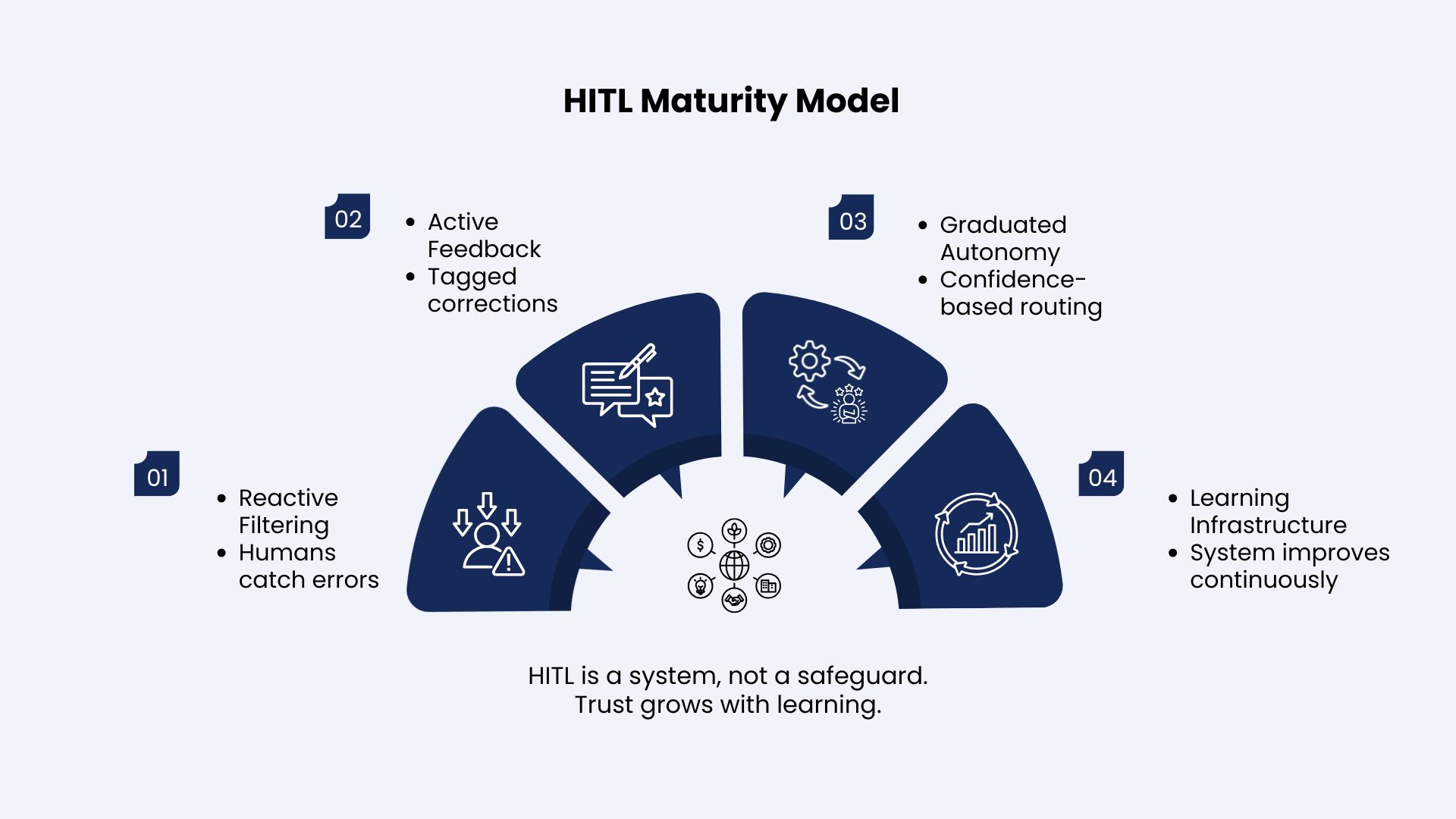
Stage 1: Reactive Filtering. Humans review AI outputs before they ship, catching obvious errors but generating minimal learning signal. The system doesn't improve. It just doesn't get worse.
Stage 2: Active Feedback. Human reviewers tag errors with structured reasons, creating training data that improves model performance over time. The system learns from mistakes but remains dependent on continuous oversight.
Stage 3: Graduated Autonomy. The system develops confidence scoring and routes only uncertain cases to humans. High-confidence outputs run autonomously while review resources concentrate on genuine edge cases. Automation zones expand as reliability improves.
Stage 4: Learning Infrastructure. Human judgment becomes a sensor layer that detects concept drift, emerging patterns, and blindspots before they become widespread failures. Reviews inform not just training data but architectural evolution. When systematic review patterns emerge, they trigger investigation into whether the model needs new features, different training data, or conceptual redesign.
Most organizations remain stuck between Stage 1 and Stage 2, treating HITL as a safety mechanism rather than a learning system. The leap to Stage 3 requires rethinking AI infrastructure as scaffolding that supports graduated autonomy rather than binary automation.
Strategic Implications: Trust as Infrastructure
The long-term competitive advantage of HITL systems isn't in their current performance. It's in their capacity to earn expanding trust over time. Organizations that architect for reliability build systems where:
- Autonomy expands systematically rather than through risky deployments
- Failure modes surface early in controlled contexts rather than at customer-facing endpoints
- Domain expertise embeds into systems rather than remaining siloed in expert reviewers
- Audit trails compound into organizational memory about edge cases and evolving standards
This creates compounding returns. A system with two years of structured HITL feedback has learned not just from its own outputs but from thousands of hours of expert human judgment. That embedded knowledge becomes architectural moat. It's not easily replicated by competitors adopting the same base models.
The Rolls-Royce example illustrates this principle. The company has used intelligent systems in manufacturing for nearly 20 years, but enterprise-wide AI for project management and business decisions required humans involved at every stage, from training data selection to defining acceptable recommendations. After showcasing the prototype and explaining the data strategy and design choices, trust emerged not from the AI technology itself, but from meeting expectations and aligning with contextual knowledge.
Conclusion
The future of enterprise AI isn't full automation. It's intelligent collaboration where systems and humans occupy distinct, high-leverage roles. HITL systems enable automation where reliable, escalate where uncertain, and capture the highest-quality training signal where humans add value.
The organizations that will lead are not those pursuing full autonomy, but those that architect HITL systems that learn from human expertise to reduce intervention needs while maintaining quality standards. They treat human oversight not as a failure of automation, but as the feedback loop that makes automation possible at scale.
The question is not whether your AI system needs human oversight. The question is whether you will design that oversight intentionally as infrastructure that compounds value over time, or discover its absence when the first edge case fails in production.