
Article
How Retrieval-Augmented Generation (RAG) Improves Enterprise AI Accuracy
This blog post explains how Retrieval-Augmented Generation (RAG) addresses the critical issue of AI hallucinations in enterprise settings by grounding large language model responses in retrieved, up-to-date source material. It details RAG’s system architecture, key components, and proven impact on accuracy across customer support, legal, and policy use cases, while acknowledging practical deployment challenges.
- Topic
- Artificial Intelligence
- Published
- 9 Apr 2026

Your company deploys an AI assistant throughout its operation, and it sees you making a mistake in telling customers their return policy, misquoting regulations that have been updated in the last two years or explaining provisions that don’t even exist in any contract. That happens every day in companies that hurriedly use large language models while ignoring their fundamental problem: hallucination.
Hallucination is the tendency of LLMs to generate plausible-sounding but factually incorrect outputs. This is not a bug waiting to be patched. It is an architectural reality rooted in how these models are trained. For enterprises operating in regulated industries, managing sensitive data, or serving customers at scale, hallucination represents direct business risk.
RAG stands out as the most practical approach to addressing the above issue. While conventional methods ask the model to recall information from the training data set, RAG asks it to search for relevant, up-to-date, and credible information before formulating the answer. With RAG, the AI doesn’t just look correct; it is correct.
Why Accuracy Breaks Down in LLM-Based Systems
LLMs learn by processing enormous volumes of text and developing probabilistic relationships between words and concepts. This makes them remarkable at language but fundamentally limited in factual reliability. When an LLM generates a response, it is not retrieving a stored fact. It is statistically predicting what text should come next based on patterns seen during training.
This distinction matters in enterprise contexts. A model trained with knowledge cut-off will be unaware of any regulation changes from last quarter, product updates from last month, or policy changes from last week. For facts that were available during the training phase, even if they exist, models will make up facts, particularly for narrow queries that are under-represented within the training data.
The problem with fluency vs. accuracy is extremely problematic because it is imperceptible. A model that is unaware of something will never admit to being unaware of the facts. It produces a confident, well-structured response anyway. According to McKinsey's latest survey, 71% of organizations now report regular use of generative AI in at least one business function, yet only 17% attribute meaningful EBIT impact to those deployments. The adoption-value gap typically originates from unfounded and misleading outputs.
Inquiries specific to the field further exacerbate this issue. Legal, medical, finance, and operational inquiries necessitate nuanced and relevant information. The general-purpose LLM cannot provide this type of information. Without grounding, enterprise AI applications become costly white elephants masquerading as intelligent agents.
Research indicates that traditional chatbots produce false information within the range of 30% to 40% for inquiries specific to the field. In the business world, this is far from a small problem. False information provided by customer service systems, compliance procedures, or internal intelligence systems causes significant operational problems.
How RAG Works at a System Level
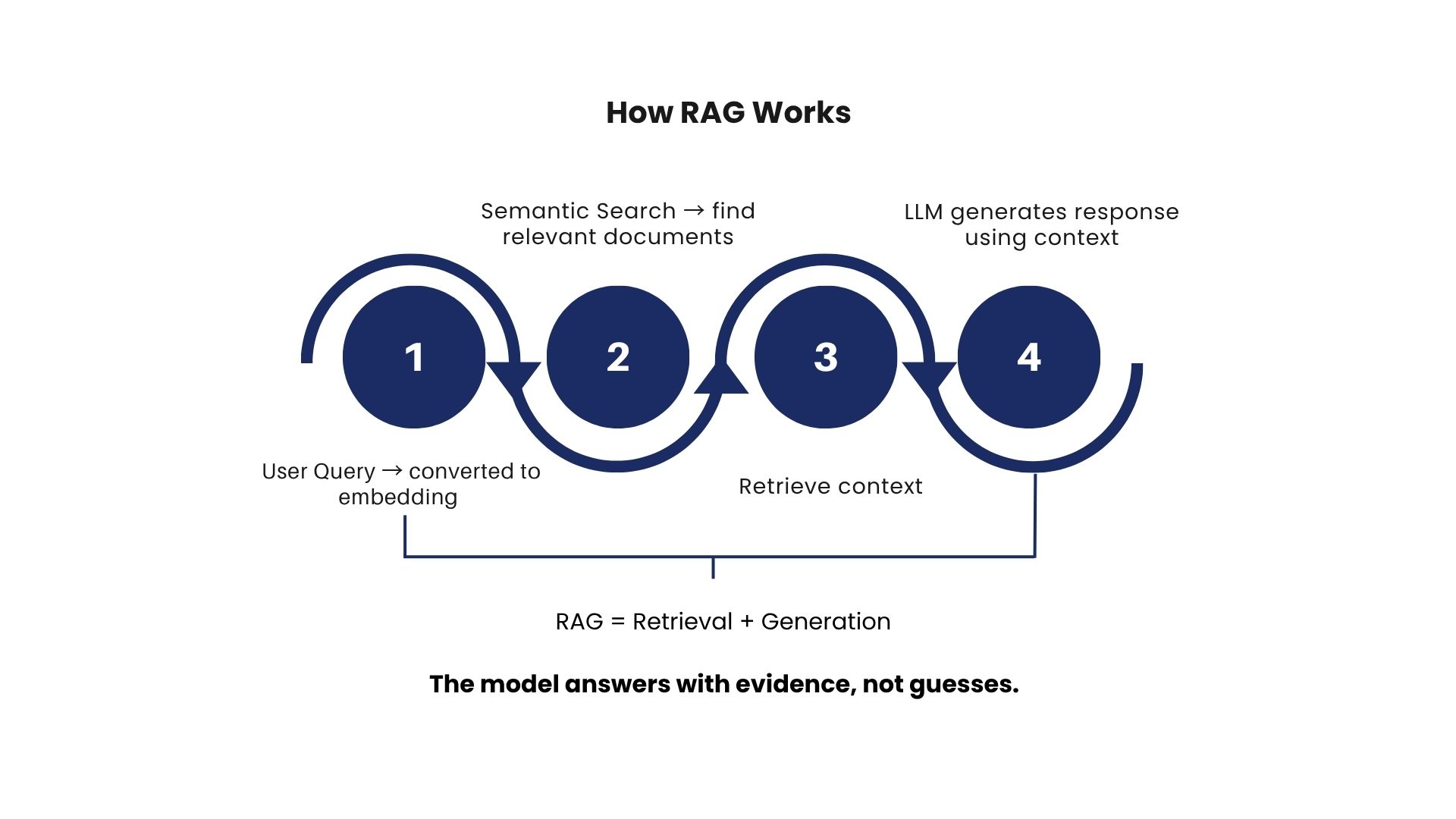
RAG can be considered an example of “open-book” AI. In this approach, rather than using the internal memory of the model, relevant documents from a credible knowledge repository are fetched and used as context for the model.
The overall process takes place in three steps:
Embedding Query: The user’s query is mapped into a numerical vector format with the help of an embedding model.
Semantic Search: The vector is then searched within an existing knowledge repository in which all possible documents have been indexed beforehand.
Grounded Response: The retrieved information is then used as context within the LLM prompt, and the model responds based on the given information.
Unlike fine-tuning, RAG is not a fine-tuning approach. Fine-tuning involves modifying the parameters of the model, which requires computing power and labeling of datasets.
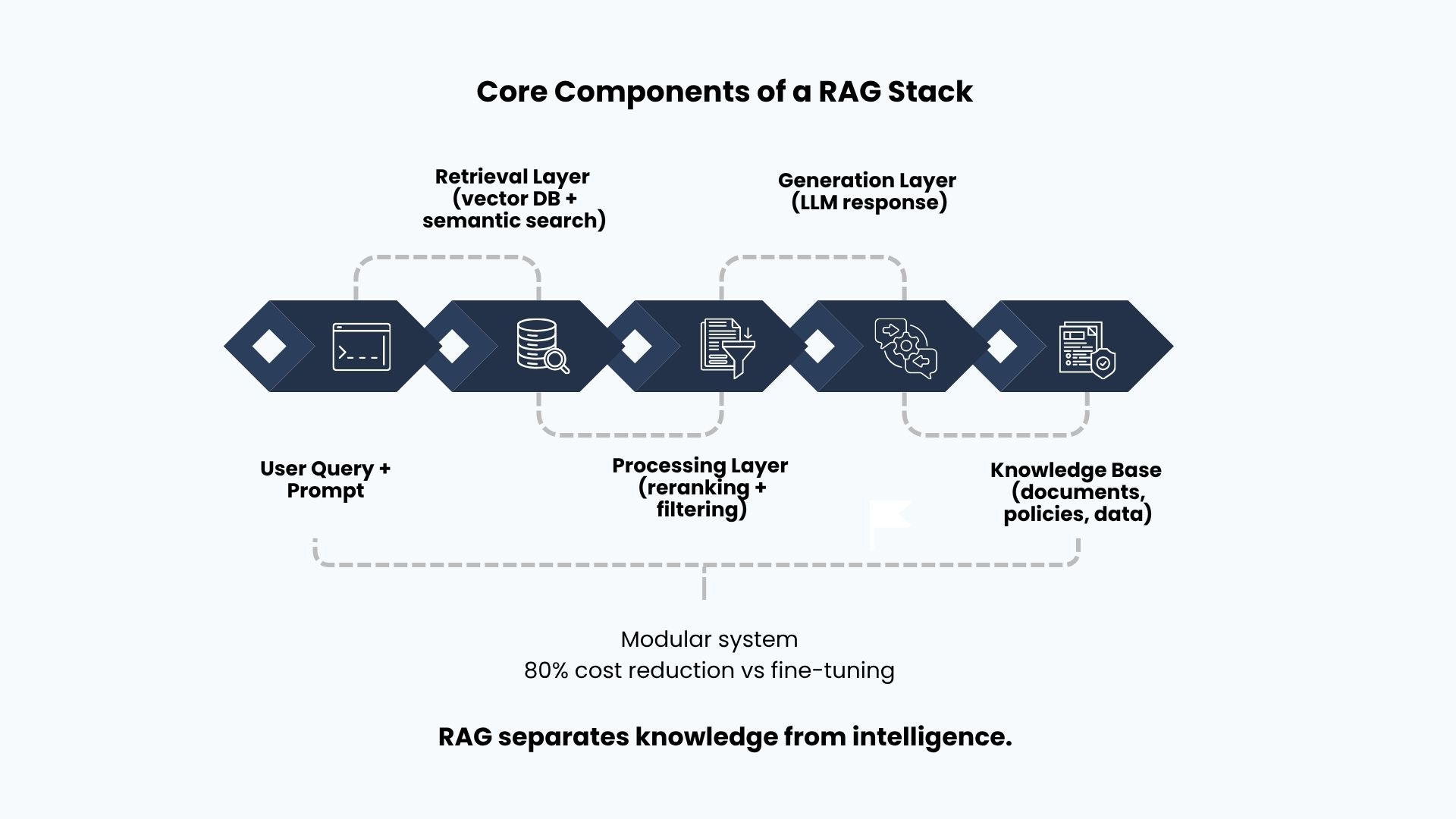
RAG leaves the model intact. Only the retrieval layer is updated when your knowledge base evolves. This makes RAG dramatically more cost-effective and agile for enterprise deployments. Research indicates that implementing RAG reduces the cost of fine-tuning LLMs for domain-specific tasks by up to 80%.
This separation of retrieval and generation responsibilities enables modularity. You swap embedding models, upgrade your LLM, or expand your knowledge base without rebuilding the entire system. This is a meaningful operational advantage in fast-moving enterprise environments.
Core Components of a RAG Stack
Understanding the architecture of a RAG system is essential for enterprise teams evaluating build-vs-buy decisions or assessing vendor capabilities. A production-grade RAG stack consists of four interconnected layers.
Vector Databases and Embedding Models
For example, vector databases include Pinecone, Milvus, and Weaviate; all are optimized for fast similarity searches on embeddings. The quality of the semantic embedding depends on the embedding model; whether it is an OpenAI model or another one like Cohere or BERT models (open-source). Selecting an appropriate embedding model for your specific language is an essential part of the architectural design. Domain-oriented enterprises such as law, medicine, or engineering will profit from domain-oriented embedding models.
Document Chunking and Indexing Strategies
How documents are split and indexed profoundly affects retrieval quality. Chunks that are too large dilute relevance. Small chunks lack context. Granularity-aware retrieval techniques such as hierarchical chunking, sliding windows, and sentence-level chunking are commonly used in production RAG systems. According to research, semantic chunking is accurate 60% of the time compared to the 25% achieved by fixed-size chunking techniques.
Retrieval Ranking and Relevance Filtering
Initial retrieval is often followed by reranking, a secondary relevance scoring process that filters out irrelevant passages before they consume precious context window space. Hybrid search approaches combining dense vector search with sparse methods like BM25 have shown a 12% boost in retrieval relevance compared to dense-only methods. This is a meaningful accuracy improvement at scale. Advanced production systems add metadata filtering for date ranges, document types, and access permissions to narrow the search space before vector comparison.
Prompt Templates and Context Windows
The final layer governs how retrieved content is structured and injected into the model prompt. Well-designed prompt templates include retrieved passages, citation markers, and clear instructions for grounded answering, reducing the model's reliance on parametric memory. As LLMs have expanded to support longer contexts, the volume of retrievable evidence has increased proportionally, enabling more nuanced and accurate generation.
Where RAG Performs Best
RAG delivers the greatest impact in environments where accuracy, freshness, and traceability matter most. Enterprises are choosing RAG for 30 to 60% of their AI use cases, particularly where the cost of error is high.
Knowledge-Heavy Internal Systems
HR policy assistants, IT runbook search, legal contract analysis, and internal knowledge bases represent ideal RAG use cases. Employees get accurate, cited answers drawn from current internal documentation, not general-purpose AI conjecture. Workday's adoption of RAG for employee policy Q&A illustrates how enterprises personalize AI assistants while keeping answers fully traceable. Research shows RAG reduces hallucinations from 30-40% to under 6% in these scenarios.
Customer-Facing Support Assistants
Enterprise adoption of RAG for customer support has grown 150% annually due to improvements in answer accuracy and lower rate of escalation. As a result of using a support chatbot that bases its answers on real-time documentation, return policy, and personal data, client satisfaction goes up, while support expenses go down. Morgan Stanley's wealth management assistant retrieves from 100,000 research reports, cutting response time by 90%.
Policy, Documentation, and Research Use Cases
RAG technology helps legal practitioners, compliance officers, and research analysts extract citations and research data related to their work. A 2024 study shows that diagnostic tools developed using RAG technology have a 15% lower error rate than traditional AI-based tools. This data point resonates across any high-stakes knowledge domain. Stanford research found even RAG systems hallucinate 17-33% in legal contexts, yet this remains dramatically better than base models.
Scenarios Requiring Up-to-Date Information
Any use case where the knowledge landscape shifts frequently benefits from RAG's ability to retrieve from continuously updated sources. Regulatory changes, market intelligence, product catalogs, competitive positioning all require current data. RAG models maintain a 25% higher accuracy on time-sensitive queries compared to models with a static training cutoff. By 2030, the RAG market is projected to hit $11 billion, driven by accuracy improvements of 42-68% over vanilla LLMs.
Practical Challenges in Production RAG
RAG is effective, yet deploying it at enterprise scale introduces engineering and operational challenges that demand deliberate attention. Leaders evaluating RAG investments should anticipate the following.
Latency from Retrieval Layers
Adding retrieval to the inference pipeline introduces latency. This is mitigated through caching frequently accessed embeddings, optimizing vector index configurations, and employing adaptive retrieval strategies that skip retrieval for simple queries, saving up to 30% on compute overhead. Each query requires embedding generation, vector search, optional reranking, context assembly, and LLM generation. Similarity search alone takes hundreds of milliseconds for large indexes. Production teams must target sub-2-second enterprise SLAs through careful infrastructure scaling.
Context Overload and Irrelevant Retrieval
Generation quality is degraded by retrieving the incorrect document (or too many), which is due to either irrelevant context providing conflicting data (confusing the model) or providing too much confusion to the model by placing irrelevant context in the way of useful context.
Retrieval filtering, contextual reranking, and relevance threshold scoring are critical safeguards for production quality generation processes. Additionally, teams should develop fallback mechanisms for low confidence in document retrieval. Advanced systems employ self-reflective RAG approaches that validate retrieval quality before generation.
Data Freshness and Access Control
Enterprise RAG systems must be connected to live, governed data sources. Stale data in the retrieval layer is nearly as dangerous as no retrieval at all. Production pipelines require incremental sync and change data capture to detect updates with sub-minute latency. Additionally, access control at the retrieval layer, ensuring that users only receive documents they are authorized to access, is a non-negotiable requirement in most enterprise and regulated environments. A junior employee should not retrieve executive salary data just because it exists in the database.
Measuring Accuracy Beyond Human Judgment
Proprietary, domain-specific data in RAG systems is not well evaluated with current standards of evaluating LLMs as there are not sufficiently good ways of testing these systems in this type of data. As an example of this there are new evaluation frameworks designed specifically for RAG systems which include RAGAS and human-in-the-loop evaluations that both measure retrieval precision (where the right documents found?) and generation accuracy (whether the model used them appropriately?). The development of tools for the production environment such as TruLens also remains challenging but do allow for some visibility into RAG production systems.
The Bottom Line: Grounded AI is Not Optional
The enterprise AI conversation has matured. The question is no longer "should we use LLMs?" It is "how do we make them reliable enough to build our business on?" RAG represents the most practical, scalable, and cost-effective answer available today.
With 80% of enterprise software developers citing RAG as the most effective method for grounding LLMs in factual data, and 72% of software companies listing it as their top AI priority, the signal is clear. RAG is no longer an architectural experiment. It is the infrastructure layer that separates enterprise-grade AI from expensive guesswork.
For CMOs designing AI-powered customer experiences, CFOs evaluating AI ROI, and DevOps leaders architecting scalable AI infrastructure, RAG offers a rare combination of reliability, flexibility, and measurable accuracy improvement. Fortune 500 companies deploying RAG report hallucinations reduced by 95%, with accuracy rates climbing to 96-99%. The enterprises that move from experimental GenAI to production-grade, grounded AI now will be the ones that turn capability into competitive advantage.
RAG transforms LLMs from fluent generalists into verifiable enterprise tools. By grounding responses in retrieved source material, it dramatically reduces hallucinations, enables citations, and keeps knowledge current without retraining. The organizations that succeed treat RAG as a systems engineering problem, not just a model selection problem.