
Article
Handling Imbalanced Datasets in Machine Learning
This article explores the financial and operational risks of imbalanced datasets in B2B machine learning, where critical events like fraud, churn, and qualified leads are naturally rare. It outlines how to move beyond deceptive accuracy scores by implementing resampling techniques like SMOTE and utilizing business-aligned metrics such as Precision-Recall curves.
- Topic
- Machine Learning
- Published
- 10 Mar 2026

Your fraud detection model has an accuracy of 99%. Your lead scoring algorithm is working wonderfully in the test environment. Then comes the production environment, where your fraud model fails to detect all the fraudulent transactions, your lead scorer doesn’t consider your best leads, and your churn predictor doesn’t detect your at-risk customers.
The issue is not your model architecture or hyperparameters. The issue is data imbalance, and it is costing B2B companies millions of dollars in lost business.
Why Data Imbalance Is Common
Imbalanced datasets are not edge cases. They are the norm in most business-critical machine learning applications.
Rare events produce natural imbalances. Fraudulent transactions are less than 0.1% of all transactions. High intent buyer signals are 2-5% of website visitor behavior. These aren’t data collection issues. They represent the natural scarcity of the events you are trying to predict.
Imbalanced data collection accentuates the pre-existing imbalance. When you create a model for customer churn, you have thousands of customers retained and hundreds of customers who have churned. Your data set will obviously favor the common outcome because it is common.
Business-driven imbalance is an issue that arises from operational realities. A B2B business may receive 10,000 inquiries from small businesses and 50 inquiries from enterprise businesses every quarter. The minority class holds more business significance, but the majority class is more prominent in your dataset.
Risks of Ignoring Imbalance
Using models trained on imbalanced data without mitigation leads to predictable failures.
Deceptive accuracy scores cover up for systematic errors. A model always predicting "not fraud" for all transactions will score 99.9% accuracy when fraud accounts for 0.1% of all transactions. A churn model always predicting "retained" will score 95% accuracy when only 5% of customers churn. Such scores are impressive on a slide but provide no business value.
Poor performance on the minority class ruins business value. If your lead scoring model has 95% accuracy but can detect only 15% of the qualified leads, you are missing 85% of the business opportunities. The minority class usually has the highest business value.
Biased outcomes lead to risks of compliance and reputation. The models developed using biased data tend to favor the majority class, which might introduce discriminatory patterns. In regulated sectors, biased model outputs are prone to regulatory actions and lawsuits.
Techniques to Address Imbalance
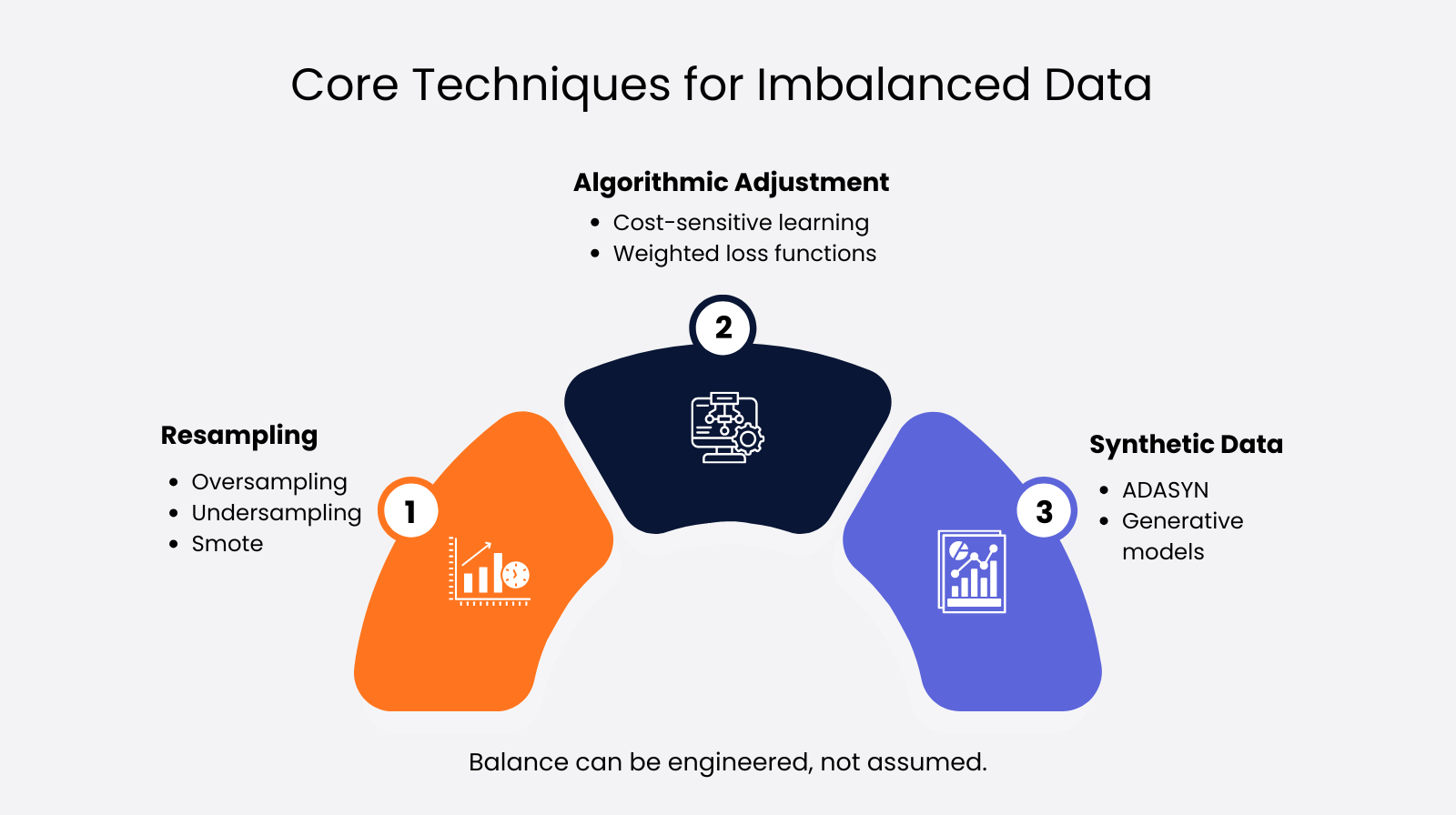
Resampling techniques change the composition of the training set to equalize class representation. Undersampling decreases the majority class instances, which accelerates the training process but may lose valuable information. Oversampling amplifies the minority class instances.
SMOTE (Synthetic Minority Over-sampling Technique) creates new samples through interpolation among existing samples of the minority class. The method finds k-nearest neighbors for each sample of the minority class and constructs new samples on the line connecting the neighbors. Experiments using SMOTE on churn prediction data sets reported improvement in model performance from 61% to 79%.
Cost-sensitive learning adjusts algorithms to assign greater costs to the misclassification of the minority class. Rather than treating all errors the same, you want to assign greater costs to false negatives. In the case of fraud detection, the cost of misclassifying a fraudulent transaction could be 100 times the cost of misclassifying a legitimate transaction.
The generation of synthetic data through advanced techniques leads to the production of realistic data instances of the minority class. Techniques such as ADASYN synthesize data adaptively based on local density, producing more instances in areas where the minority class is less dense.
Choosing the Right Evaluation Metrics
The usual accuracy measures do not work well for imbalanced datasets.
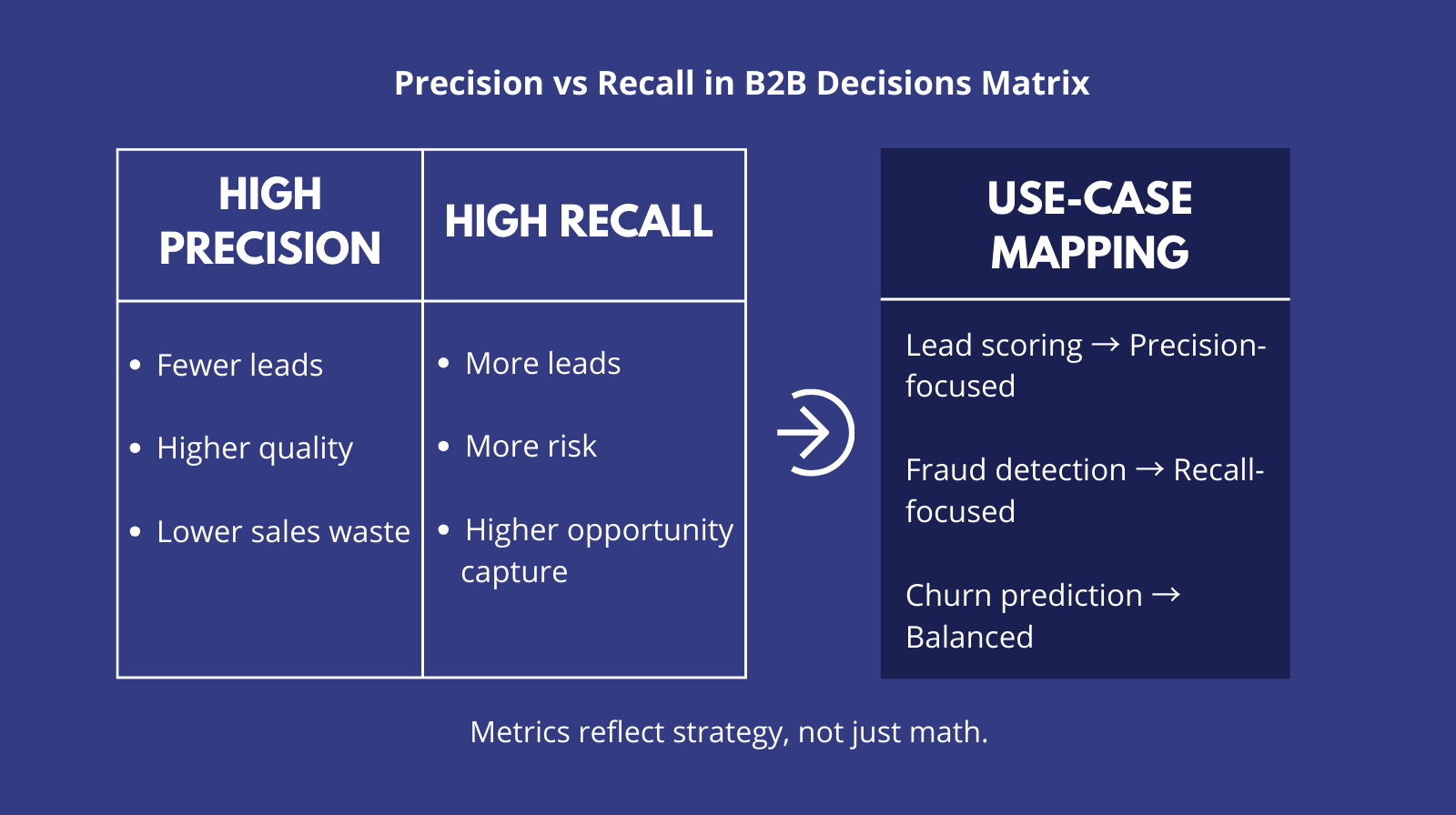
Precision is the ratio of true positive predictions to the total number of positive predictions made. Recall is the ratio of actual positive instances retrieved to the total number of actual positive instances. The F1 measure is a combination of precision and recall and is shown to be a better metric than accuracy for class-imbalanced problems.
In B2B scenarios, the precision-recall curve corresponds directly to business choices. Lead scoring models may choose to emphasize precision to prevent wasting sales efforts. Fraud detection models may choose to emphasize recall to prevent wasting financial resources.
ROC curves are plots of the true positive rate against the false positive rate, as the decision threshold varies. Although ROC-AUC is appropriate for use with balanced datasets, Precision-Recall (PR) curves are more appropriate for imbalanced datasets, as they are concerned only with the minority class.
Metrics that are business-aligned enable the translation of model performance into economic impact. The expected revenue generated from correctly identified leads, cost savings from detected fraud, or customer lifetime value preserved from churn prevention can be calculated.
Production Considerations
The change in the distribution of classes in the production setting impacts the behavior of the model unpredictably. The lead scoring model, which was trained on the assumption that enterprise leads comprised 5% of the inquiries, will deteriorate if this percentage falls to 2% or increases to 10%.
Keep track of data distributions and model performance. Class proportion changes, target distribution drift, and prediction distribution changes are monitored. Automated notifications alert teams when class distributions vary from training baselines.
Monitor minority class metrics separately from overall accuracy. Track precision and recall for your target class on a daily or weekly basis. Establish thresholds based on business impact: if lead scoring recall falls below 60%, then opportunities to generate revenue are being lost at an unacceptable rate.
The triggers for retraining determine when the models should be updated. The best practices for triggers include performance-based triggers when the performance metrics are below certain thresholds, drift-based triggers when there are significant changes in the data distribution, and time-based triggers for periodic updates.
Imbalanced datasets are a reality in high-stakes machine learning. The most valuable predictions are, by definition, rare events: fraud, churn, and qualified leads. Companies that treat imbalance as a core machine learning problem are building more robust systems. The first step is to challenge accuracy metrics and then apply the right balancing methods.