
Article
Fine-Tuning vs Prompt Engineering: The Strategic Choice
This article explains the strategic trade-offs between prompt engineering and fine-tuning when applying AI in B2B environments, highlighting differences in cost, scalability, accuracy, and use cases. It argues that prompt engineering offers speed and flexibility for exploratory tasks, while fine-tuning delivers higher accuracy and consistency for specialized, high-risk applications. The recommended approach is a hybrid strategy using fine-tuning for core decision systems and prompt engineering for adaptable, creative workflows to maximize business impact.
- Topic
- Artificial Intelligence
- Published
- 6 Feb 2026

Every head of demand generation faces this problem: you've invested in AI, but your SDR automation is clumsy, your content tool is producing generic copy, and your chatbot is misunderstanding industry speak. The question isn't whether AI is viable. It's how to apply AI to your company environment.
There are two approaches: fine-tuning and prompt engineering. Both improve the functionality of AI. They yield different results, have different prices, and operate on different paradigms. For B2B executives, making the wrong choice means investing money in unnecessary infrastructure or coping with different results that erode customer confidence.
What Prompt Engineering Solves
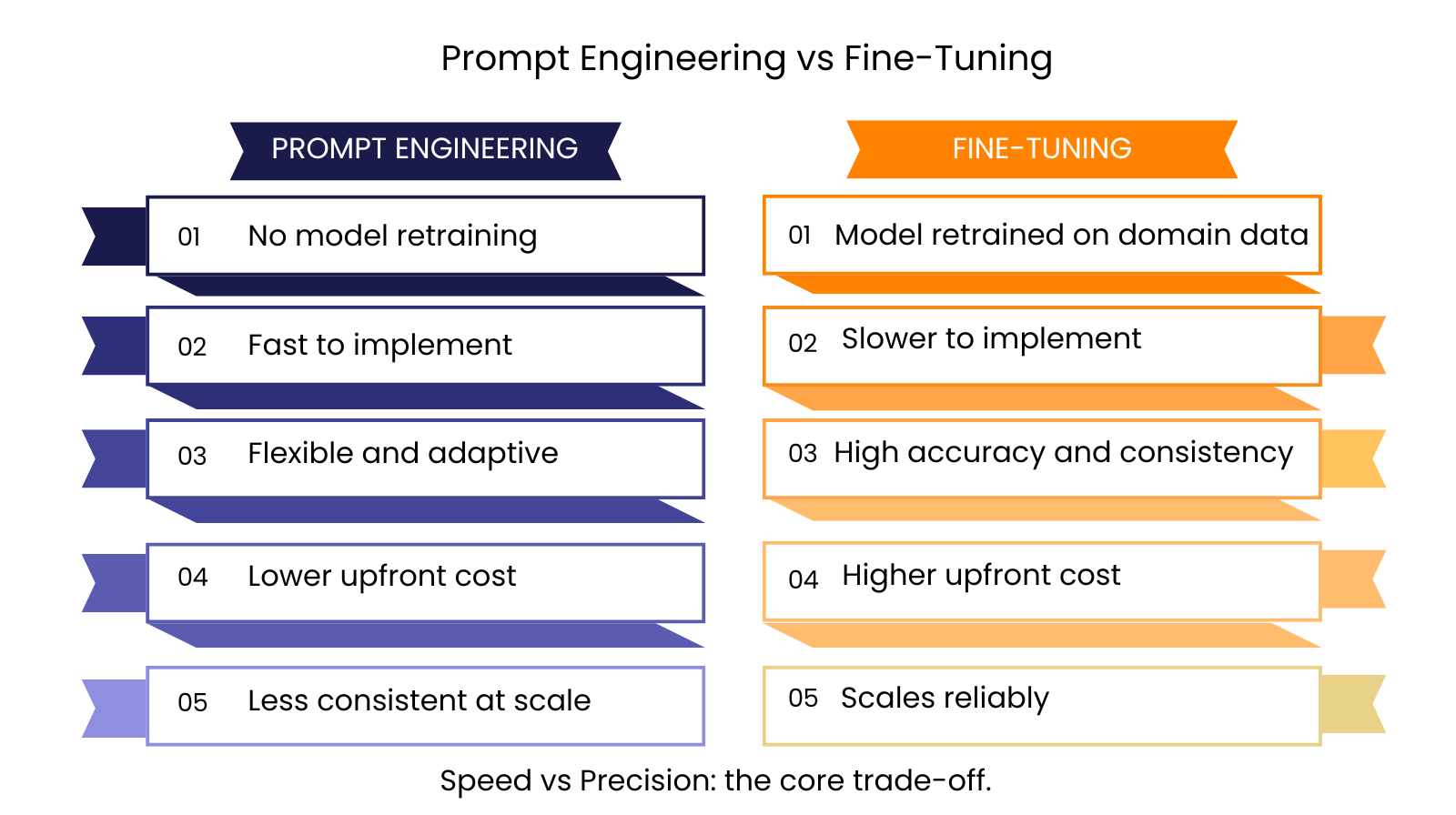
Without modifying the model, prompt engineering develops the input that guides the pre-trained models towards the desired results. Rather than training an expert from scratch, you are giving them specific directions.
The capability comes from being fast. Well-crafted prompts yield results within a few hours, whether your sales team requires tailored outreach templates or your marketing team requires product descriptions in a specific tone. State-of-the-art prompting methods are similar to the capability of fine-tuned models for general-purpose tasks, as per a study comparing prompt engineering with fine-tuning.
Few-shot learning works well in this case. In the context of the prompt itself, you provide two to three examples of what the results should look like. There is an understanding of format and style requirements. Role-based prompting is helpful in B2B scenarios. Ask the model to assume the role of a compliance officer or a technical sales engineer. The domain becomes more relevant.
The limitations are real. Consistency at scale is a challenge for prompt engineering. Small variations in the input can cause unexpected outputs when handling thousands of client requests daily. Hundreds of tokens are employed for handling complex prompts. The cost escalation is rapid when handling millions of requests monthly.
The phrasing of things has an influence on the outcome. It is advisable to encourage sharing of logic pieces among teams. It becomes difficult to ensure uniformity at scale. Prompt sprawl leads to an operational problem as businesses grow.
What Fine-Tuning Changes
Domain-specific data is used, and fine-tuning involves adjusting model weights. You build an expert who has absorbed your vocabulary, patterns, and knowledge.
The model is trained to update its weights when it is fine-tuned. The way it processes and generates words is based on these mathematical considerations. The model does not follow the rules of your domain. It has a better understanding of it. Medical terms are not always defined in the input when a healthcare organization is fine-tuning an LLM on medical data. This knowledge is absorbed by the model.
There is a substantial boost in performance. Fine-tuned models achieve 15–30% higher accuracy than prompt-only baselines for specialized domains. Accuracy is critical in regulated domains such as healthcare, law, and finance. Fine-tuning ensures reliability that cannot be guaranteed by rapid engineering for B2B use cases requiring deterministic results (contract analysis, regulatory checks, technical writing).
However, there are some trade-offs. The model achieves specialization through catastrophic forgetting. This means that the model might forget its general-purpose skills. When it comes to regular corporate communication, the model that has been fine-tuned for legal texts might not perform well. The technique requires a lot of quality training data. Thousands of samples are required for most fine-tuning attempts.
Any information that goes into fine-tuning is magnified. Inadequate labeling, bias, or noise results in poor performance. Teams tend to underestimate the complexity of evaluation, cost of annotation, and preparation of data.
Cost and Scale Realities
The cost of fine-tuning a moderately sized model using the best GPUs ranges from $10,000 to $30,000 per training cycle. This is brought down to $500-$3,000 using parameter-efficient methods such as LoRA, making fine-tuning accessible to mid-market companies.
Typically, 20-40% of the total fine-tuning budget is spent on data preparation. You will require engineers for training pipeline development, data scientists for data preparation, and domain experts for result verification. Retraining cycles will lead to increased recurring costs.
Prompt engineering provides another cost structure. The startup cost is actually low. With your existing API access, you can start experimenting with prompts immediately. The accumulation of inference costs is not fixed. For every request, tokens are spent on the complex prompt. Prompt engineering is more expensive than fine-tuning for large-scale applications that process millions of queries monthly.
The volume defines the scalability equation. The pay-as-you-go pricing model of prompt engineering is economical for low to moderate usage or rapidly changing requirements. By reducing the cost per query and improving the performance, the upfront cost of fine-tuning provides a better return on investment for high volume and stable usage.
When to Choose Which
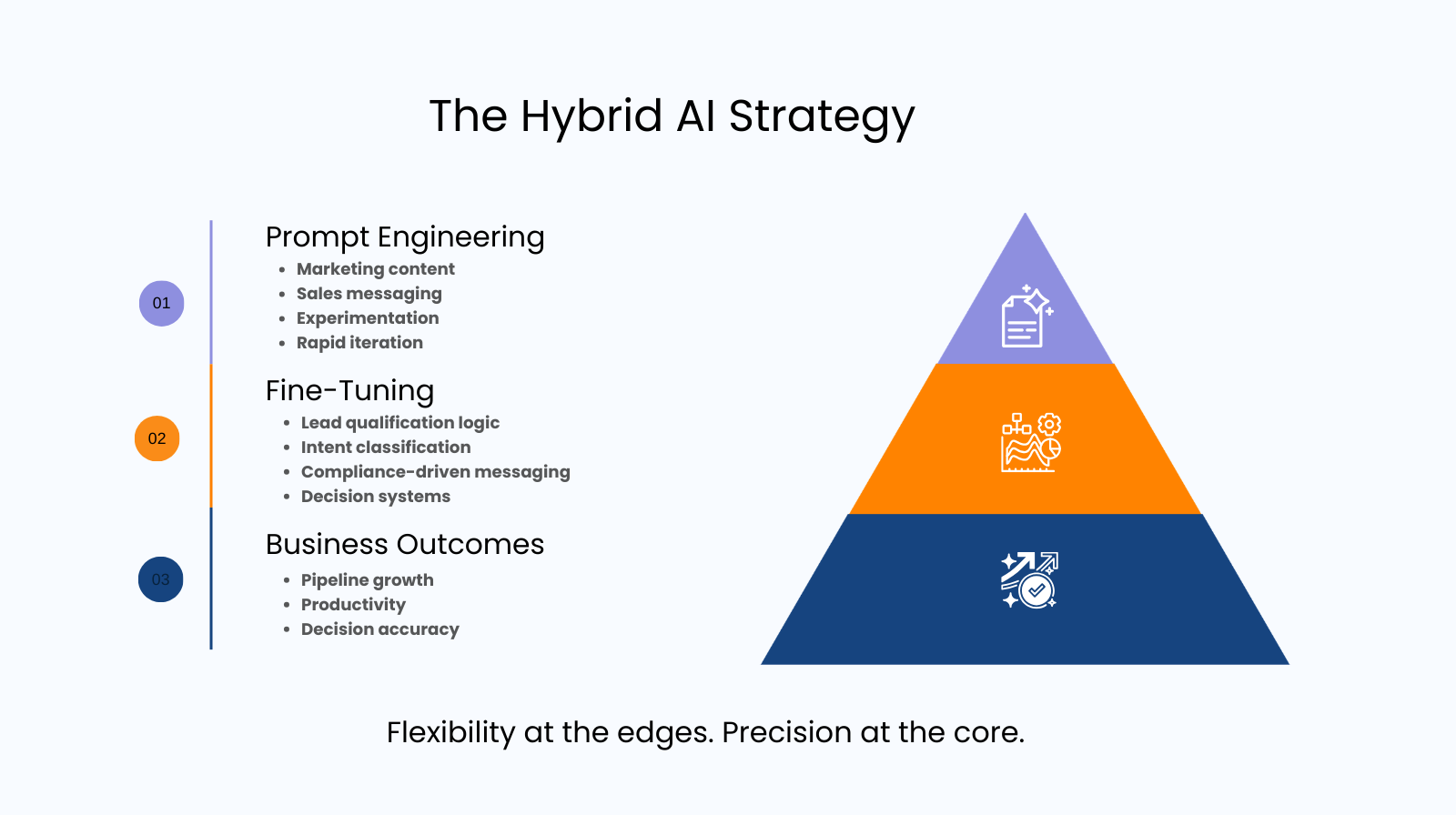
When the output is exploratory or creative, the requirements keep fluctuating, human evaluation is involved in the process, and speed is given more importance than accuracy, then prompt engineering is effective. It can be applied in the generation of marketing content, sales enablement, campaign ideas, and account research summaries.
When there are few activities and they are repetitive, errors are costly, consistency is key, and definitions are fixed, fine-tuning is appropriate. This would include lead qualification logic, intent signal categorization, data extraction, and messaging that is compliance-driven.
Good teams leverage both. Fine-tuning for the core decision layers. Prompt engineering for flexibility at the edges. This is a hybrid approach that finds a middle ground between adaptability and reliability.
Ask yourself these questions: What is the cost of incorrect output? How stable is this use case? Who is reviewing the results? How often will the requirements change? The greater the risk, the greater the need for fine-tuning.
Avoiding Common Mistakes
The models become brittle because of overfitting during fine-tuning. The ability to generalize is affected by training on small or imbalanced data. The models perform outstandingly on the training data but poorly on data from the real world. The problem can be solved by incorporating early stopping techniques or using data augmentation to increase the diversity of training data.
Without governance, the prompts will diverge. The results will begin to differ. The institutional knowledge will be lost. Ownership and libraries of prompts are necessary. Set up templates for the prompts, develop libraries for sharing, and establish a review system.
Most teams have subjective assessments of AI results. It is impossible to tell whether there is improvement or degradation without having accurate standards. Thorough assessment involves setting up specific metrics, testing in various conditions, setting up automated testing processes, and monitoring in the production environment.
Both methods have unseen costs: immediate maintenance, retraining loops, model drift, and technical debt. Disregarding these will result in disappointment down the line.
Making the Strategic Choice
Begin with prompts. Deliver value. Fine-tune where it counts. The best choice is less about technical prowess and more about clear purpose. For B2B executives, the objective isn’t to create the most sophisticated AI model. It’s to create one that consistently drives better pipeline, productivity, and decision-making outcomes.