
Article
Feature Stores in Production ML Systems
This blog explains why most AI initiatives fail not from weak models but from fragmented feature engineering; where the same logic is rebuilt across teams, training-serving skew degrades performance, and duplicate implementations erode trust in AI. It covers how a feature store solves these problems through centralized governance, unified online and offline access, and point-in-time correctness, along with a maturity framework for determining when adoption becomes a strategic necessity.
- Topic
- Machine Learning
- Published
- 16 Jun 2026

The Architecture Gap That Models Cannot Fix
Most AI initiatives in marketing and revenue operations do not fail because of weak models. They fail because the infrastructure surrounding those models cannot keep pace with organizational scale.
By 2026, machine learning sits behind audience segmentation, intent-based sequencing, dynamic personalization, real-time bid optimization, and predictive forecasting. AI is no longer a feature inside a vendor platform. It is operational infrastructure that drives entire go-to-market workflows.
This shift has exposed a structural problem: feature engineering at scale. A 2025 benchmark of 48 AI-driven MarTech environments found that 73% of data science teams were spending 30-50% of their time rewriting, reconciling, or debugging feature logic rather than building or improving models. The same intent-based "account score" was often implemented differently across marketing, sales, and RevOps, each team applying its own logic, thresholds, and data assumptions.
The result is not just engineering inefficiency. It is fragmented customer intelligence, unreliable model behavior, and AI systems that degrade silently after deployment.
The organizations that will scale AI-driven marketing successfully are not those with the most sophisticated algorithms. They are the ones that treat features as shared infrastructure rather than one-off calculations.
Why Feature Engineering Breaks in Production
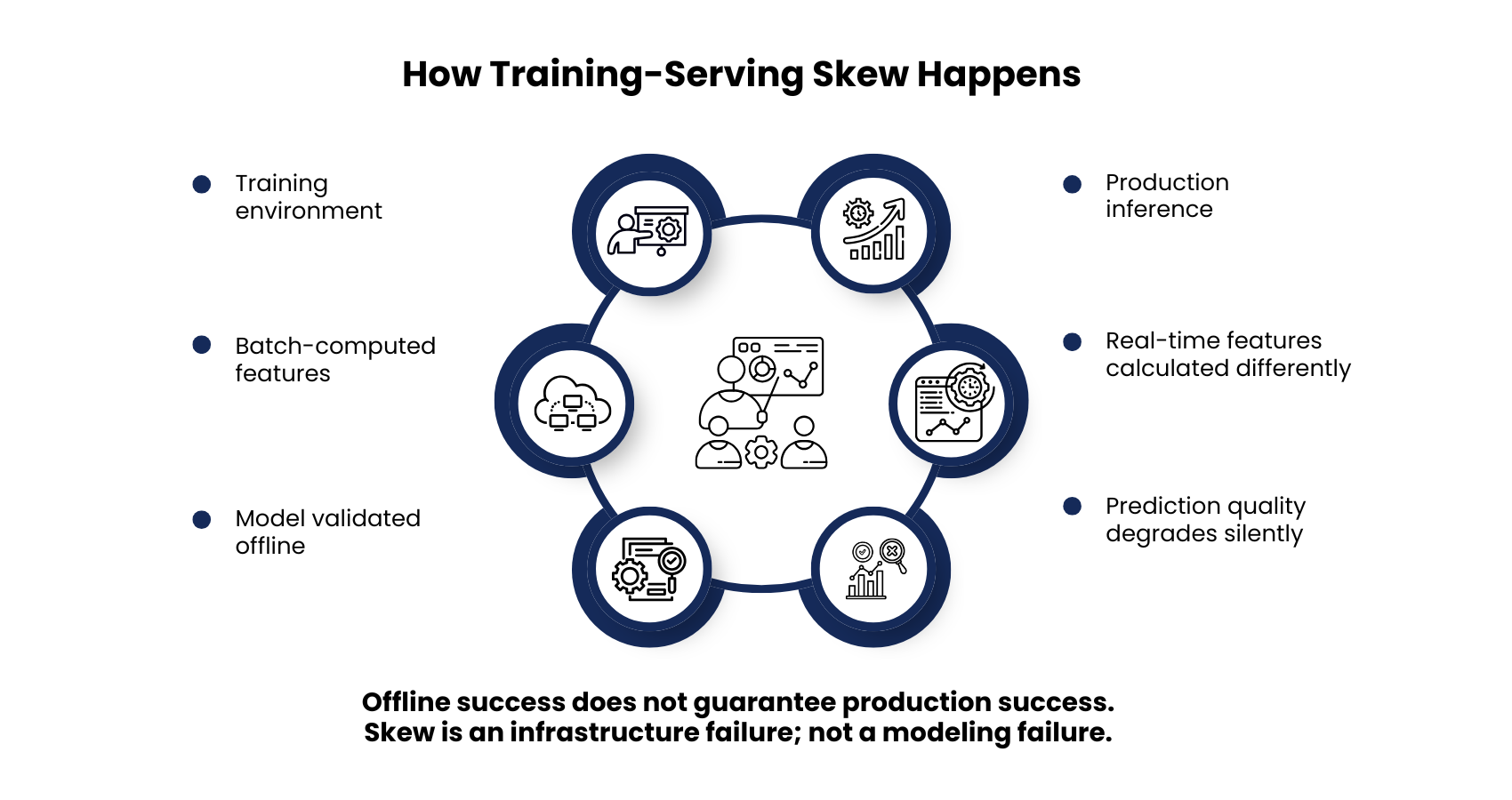
Training-Serving Skew Is an Architectural Failure
The most expensive and hardest-to-detect problem in production ML is training-serving skew. It occurs when the features used to train a model are computed differently from the features used during live inference.
Consider a churn model trained on batch-aggregated engagement data calculated nightly from a data warehouse. In production, the same engagement features are computed from a real-time streaming window with different timestamp handling and null-value defaults. The model continues running without throwing an error. Predictions degrade silently. Offline metrics look excellent. Real-world performance collapses.
A 2025 RevOps benchmark found that 64% of AI-driven teams without a feature store reported training-serving skew significant enough to reduce real-world pipeline lift by 18-33% compared to offline experiments. This is not a modeling problem. It is an architectural one.
Duplicate Logic and Fragmented Definitions
In most organizations, the same core feature is built multiple times. Marketing wants an intent-intensity score for campaign targeting. Sales wants it for routing and sequencing. RevOps wants it for forecasting. Each team builds it independently, with different enrichment sources, different aggregation windows, and different rules for handling missing data.
A 2024 MLOps audit of 32 MarTech stacks found that the same core feature was implemented an average of 3.7 times per organization with no central governance. The direct cost is engineering waste. The strategic cost is inconsistent customer intelligence, where an account appears high-intent to one team and medium-intent to another.
Over time, this fragmentation erodes organizational trust in AI. When leadership cannot understand which data drives decisions, governance becomes impossible and AI adoption stalls.
What a Feature Store Actually Solves
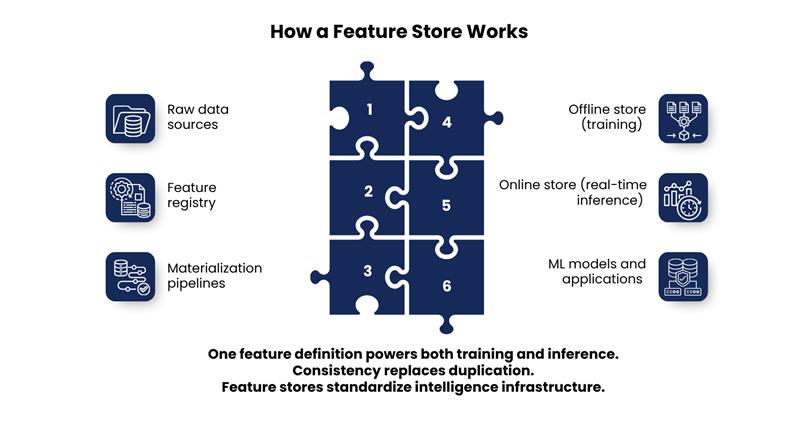
A feature store is a centralized layer designed to own, govern, and serve machine learning features across both training and production environments. It does not run models. It standardizes the inputs those models consume.
A Single Source of Truth for Feature Logic
The feature registry is the core of any feature store. It documents how each feature is defined, which data sources feed it, who owns it, and how it has changed over time. When a business rule changes, such as weighting 30-day intent signals more heavily than 7-day signals, the change is made once. Every downstream model inherits the same updated logic automatically.
Organizations that implemented this approach reduced duplicate feature implementations by 83% and cut time-to-deploy new models by 39%, according to a 2025 RevOps case study, because feature logic was reused rather than rewritten.
Unified Online and Offline Access
Feature stores solve the fundamental storage dichotomy in ML. Offline stores, built on data warehouses or data lakes, hold historical feature data optimized for high-throughput batch training. Online stores, built on low-latency distributed databases like Redis, hold the latest feature values for real-time inference with sub-millisecond retrieval.
The same feature definition governs both. Training pipelines read from the offline store. Serving pipelines read from the online store. The definitions are identical. The storage is optimized separately. One implementation of this architecture reduced training-serving skew to under 2% and improved real-world pipeline lift by 27% compared to the prior ad-hoc setup.
Compounding Returns Through Reuse
Reusability is where feature stores generate compounding value. A single account engagement feature can simultaneously feed a lead-scoring model, a churn prediction model, an upsell forecasting model, and a campaign prioritization engine. Teams build on shared, validated intelligence rather than reconstructing logic from raw data each time. Hyperconnect reduced time-to-serve new features from one to two weeks down to one to two days after adopting this approach. The flywheel effect is direct: the larger the shared feature library, the faster new models reach production.
Core Components and the Data Flow They Enable
Three technical layers make this consistency possible.
The feature registry governs definitions, tracks lineage, and makes features discoverable across the organization. It functions as a versioned catalog that replaces informal knowledge scattered across notebooks, scripts, and ad-hoc documentation.
Materialization pipelines automate the movement of feature values between offline and online stores. They transform raw ingestion data into structured features continuously, pushing historical values to the data lake for training while routing real-time updates to the online store for inference.
Point-in-time correctness prevents data leakage, the most common form of silent model failure in historical training. When constructing a training dataset, the system retrieves feature values exactly as they existed at each training moment, not as they exist today. A churn model inadvertently trained on future behavioral data will appear highly accurate in testing and fail immediately in production. Organizations that enforced point-in-time correctness reduced model-training bias by 19% and improved stakeholder trust in AI recommendations.
A Framework for Evaluating Readiness
Organizations can assess feature store readiness across four dimensions using the Feature Store Maturity Model.
Feature Definition Maturity measures whether features are clearly documented, centrally registered, versioned, and owned. Low maturity means teams reverse-engineer logic by asking colleagues. High maturity means any engineer can look up a feature definition and trust it.
Consistency Maturity measures whether training and online serving use the same computation. Low maturity means ongoing skew disputes between teams. High maturity means no gaps between what a model expects and what it receives.
Reuse and Composability Maturity measures whether features are shared across models and whether teams can compose new features from existing ones. Low maturity means logic fragments with every new initiative. High maturity means feature logic compounds over time.
Governance and Operational Maturity measures whether data quality, freshness, and compliance are monitored centrally, with clear ownership and change-control processes. This is what transforms a feature store from an experiment into operational infrastructure.
Organizations that reached high maturity across all four dimensions within 18 months reduced time-to-deploy new models by 48%, improved real-world pipeline lift by 31%, and reduced data-related incidents by 39%.
Strategic Implications and When to Act
Feature stores are not universally necessary. Adoption makes strategic sense when three conditions are present simultaneously.
Multi-model environments with overlapping feature requirements are the primary trigger. If multiple teams consume the same features with different definitions, a feature store provides the governance layer that prevents divergence.
Real-time inference requirements drive the need for online feature serving. Batch-computed features refreshed nightly cannot support dynamic pricing, real-time next-best-action, or personalization that must respond within seconds. Building real-time feature computation ad-hoc inside each application recreates the fragmentation problem at a higher cost.
Cross-team collaboration needs signal that feature engineering has become the organizational bottleneck. When data scientists spend more time wrangling feature pipelines than designing models, and when new team members must ask around to discover what features exist, a centralized feature layer creates the discoverability and governance that scale requires.
Organizations meeting all three conditions achieved three times ROI from feature store investment within 24 months and reduced AI-related go-to-market friction by 47%.
The cost of inaction accumulates as debugging hours, production incidents, missed feature reuse, and AI systems that underperform without triggering an alert.
Conclusion: Features Are Infrastructure Now
The frontier of enterprise AI has shifted. Algorithmic capability is increasingly commoditized. Any organization can access state-of-the-art models through APIs. The differentiator is infrastructure: how consistently features are defined, how quickly they are reused, how reliably they behave across training and production environments.
Feature stores represent this shift in its most concrete form. They convert feature engineering from a fragmented, team-level task into governed organizational infrastructure. The result is not just faster model deployment. It is a fundamentally more reliable AI system, one where intelligence compounds across teams and initiatives rather than fragmenting with each new project.
The organizations that will lead in AI-driven marketing are not those that build more models. They are the ones that build the infrastructure to make those models consistently right.