
Article
Feature Selection in Large-Scale ML Systems: Why Signal Beats Scale
This blog explains why unconstrained feature growth degrades large-scale ML systems through dimensionality, noise amplification, and compounding operational cost, and why feature selection is an infrastructure decision rather than a preprocessing step. It covers filter, wrapper, and embedded approaches, a four-dimension evaluation framework (predictive contribution, stability, operational viability, governance value), and the monitoring and governance discipline needed to keep feature sets useful after deployment. The core shift is from feature engineering to feature intelligence, where signal beats scale.
- Topic
- Machine Learning
- Published
- 13 Oct 2026

The Strategic Shift Enterprise AI Teams Are Missing
For years, enterprise AI strategy followed a simple rule: more features, better models. Marketing stacks accumulated signals at scale. Feature stores expanded from dozens of variables to tens of thousands.
The logic seemed sound. The results were not.
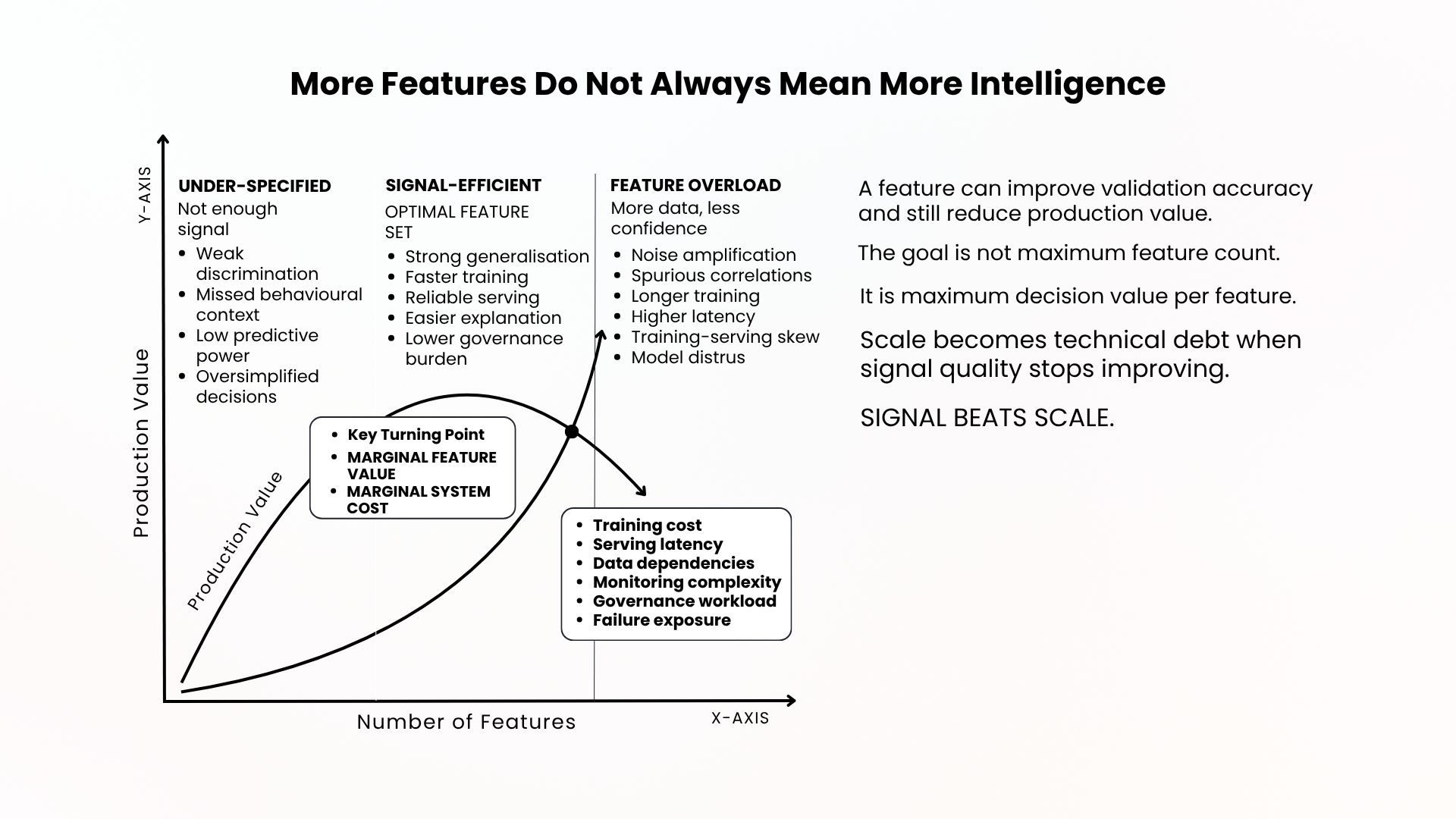
In large-scale machine learning systems, unconstrained feature growth creates the opposite of what teams expect. Performance plateaus. Training costs rise. Inference latency spikes. Models begin learning noise faster than signal. The feature store becomes a feature graveyard.
The real shift in mature ML organizations is not about adding better tools. It is about rebuilding the architecture around a different question: not what data do we have, but which signals deserve to exist in the model at all. Feature selection has moved from preprocessing step to critical infrastructure decision. For marketing leaders and technology strategists, that distinction defines whether AI systems compound in value or quietly accumulate technical debt.
Why More Features Degrade Machine Learning Systems
The curse of dimensionality is well-documented in research but routinely underestimated at the executive level. As feature count grows, the mathematical space the model must search expands exponentially. Training data becomes sparse relative to that space. Distance metrics lose reliability. Pattern-based learning degrades. A model trained on 500 features with 100,000 records is often functionally data-starved, regardless of how large the raw dataset appears.
Noise amplification follows directly. Irrelevant or redundant features do not contribute zero value. They actively harm performance by introducing spurious correlations that models exploit during training but that collapse in production. Enterprise datasets are especially vulnerable. Many fields are proxies, duplicates, or artifacts of process rather than genuine predictors.
Increased training complexity translates to real cost. Every additional feature requires consistent calculation across training and serving, upstream data dependencies, transformation pipelines, refresh schedules, and monitoring rules. A variable that marginally improves validation accuracy may require joining large event tables and processing months of activity. The compounding risks include latency penalties, infrastructure overhead, and training-serving skew.
The downstream impact is asymmetric. A model confident in a spurious correlation will systematically misallocate spend, suppress the wrong segments, and deprioritize the wrong accounts. The error compounds quietly until a business review surfaces degraded performance months later. By then, the cost is not just model accuracy. It is organizational trust in AI-driven decisions.
Feature Selection Approaches: Choosing the Right Architecture
Feature selection methods fall into three primary categories, each with distinct trade-offs that determine their suitability for production systems.
Filter methods score features using statistical relationships with the target, such as mutual information, chi-square tests, or variance thresholds. They are fast and scalable, but evaluate features in isolation. A feature that appears weak alone may be highly valuable in combination with another. Filters work best as an initial screening gate, not a complete strategy.
Wrapper techniques, including recursive feature elimination, assess feature subsets by training models repeatedly and comparing performance. They capture interaction effects that filters miss. The cost is computational. In high-dimensional environments, wrapper approaches can require thousands of model iterations, creating real infrastructure constraints for systems that retrain frequently.
Embedded methods perform selection during model training. L1 regularization drives irrelevant coefficients to exactly zero, producing sparse, interpretable models. Tree-based frameworks calculate feature importance natively through gain and split metrics. These methods balance the accuracy of wrappers with the scalability of filters and are the practical default for most production systems.
Dimensionality reduction, through methods like PCA or learned embeddings, compresses correlated features into a smaller representation. This is architecturally distinct from feature selection. It creates new synthetic features rather than choosing from existing ones, and it sacrifices interpretability. When explainability is a governance or regulatory requirement, reduction alone is insufficient.
A Four-Dimension Framework for Feature Evaluation
Selecting features based on predictive importance alone is not enough. Production systems demand a broader evaluation framework.
Predictive contribution measures whether a feature improves performance on unseen data. This should be assessed as incremental lift across validation folds and time periods, not standalone correlation. A feature that improves training metrics but degrades generalization is not an asset.
Stability measures whether the feature remains useful when the sample changes. A durable feature retains broadly consistent importance across retraining windows, geographies, and business cycles. A feature that ranks first on one data split and fifteenth on another is a liability. That instability often signals that the feature is a proxy for something else, or that its signal is too thin to survive sampling variation.
Operational viability assesses whether the feature can be generated reliably at prediction time. Source availability, latency, missingness rates, transformation cost, and the risk of training-serving inconsistency all factor in. A theoretically powerful feature may be unsuitable if it depends on delayed or fragile data infrastructure.
Governance value asks whether the organization can explain, monitor, and legitimately use the feature. Lineage, ownership, privacy sensitivity, and leakage risk all affect whether a feature should be retained. Some features appear highly predictive precisely because they encode information that would not be available at prediction time. In marketing systems, this happens when post-conversion events or operational status fields leak into training data. Leakage detection requires explicit temporal gating and domain expertise that tooling alone cannot supply.
A feature should be retained only when its predictive contribution justifies its operational and governance burden. That is a system-level decision, not a modeling decision.
Evaluating and Monitoring Feature Importance Over Time
Feature importance is not a static property. It is a property of a model trained on a specific dataset at a specific time, and it must be treated as an empirical claim that requires repeated testing.
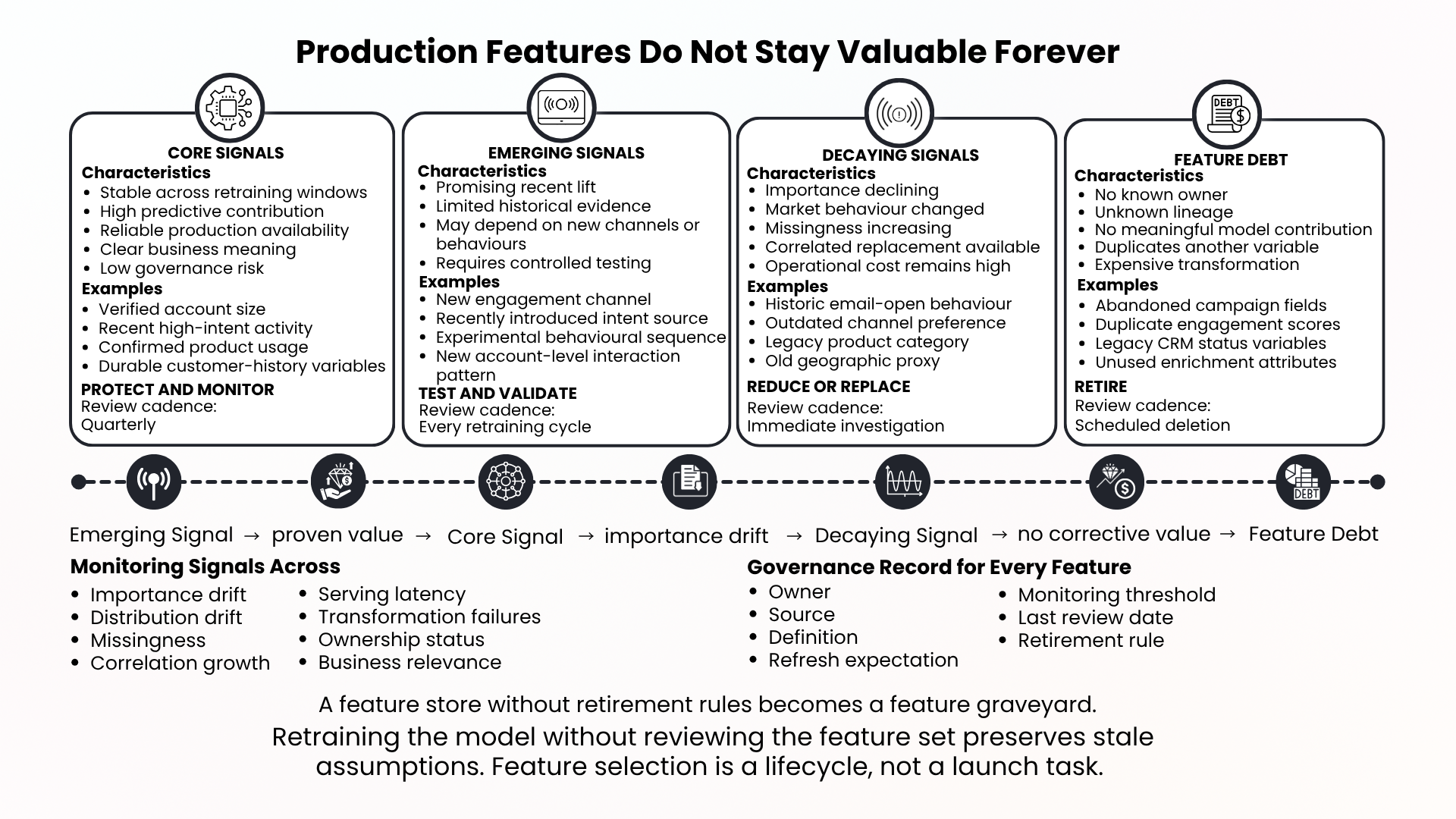
Importance drift is a particularly underestimated failure mode. A variable that predicted well during one market cycle may become structurally different when buying behavior shifts, channel preferences change, or economic conditions evolve. Feature-level drift can cause subtle degradation in model accuracy in streaming environments that standard performance monitors miss entirely. Production ML systems need feature-level drift monitoring, not just model-level tracking.
Managing correlated variables is a compounding problem in enterprise stacks. When behavioral data platforms expose 300 to 800 potential signals per user, redundancy is endemic. Email open rates, click-through rates, and session frequency often move together. Training a scoring model with all three is not just redundant. It can destabilize coefficient estimates, inflate importance scores for correlated clusters, and make model outputs harder to trust. Variance Inflation Factor analysis and hierarchical clustering of feature correlations should precede any selection step in production systems.
Production Governance: The Layer Most Teams Underestimate
The hardest part of feature selection is not the initial model build. It is keeping the feature set useful after deployment.
Each production feature should have a defined owner, source, refresh expectation, and monitoring threshold. Without this structure, feature stores accumulate unused or poorly understood variables. Teams may continue trusting models without understanding which inputs still matter. That hidden fragility is a governance failure before it becomes a performance failure.
Retraining decisions and feature selection decisions are not separable. When a model is retrained on new data, the optimal feature set may have shifted. Retraining without revisiting selection compounds a stale architectural choice. High-performing ML organizations treat feature set review as a recurring governance event, not a one-time engineering step.
The case for simplicity is clearer than most teams acknowledge. A ten-feature model achieving 87 percent of the performance of a 200-feature model is almost always the better business choice. It retrains faster, costs less to serve, explains more cleanly to stakeholders, and holds up better under distribution shift. Complexity is a debt, not an investment.
Strategic Implications: From Feature Engineering to Feature Intelligence
Feature selection is not a data science problem with business implications. It is a business architecture problem that requires data science expertise.
For MarTech teams, scoring, personalization, and orchestration systems need explicit governance rules for which signals shape decisions. Without those rules, every new integration adds features without adding intelligence.
For technology leaders, feature selection is a scalability question. Large-scale AI systems fail not because models are weak, but because the architecture carries too many variables, too much noise, and too many redundant inputs. A disciplined feature set makes the entire system lighter, faster, and more governable.
For strategy leaders, the feature inventory represents institutional judgment about which signals are economically meaningful. That judgment gets scaled into every automated workflow the model touches. If the feature set reflects outdated assumptions, those assumptions compound at machine speed.
The deeper transition is from tools to infrastructure to intelligence. Tools collect data. Infrastructure organizes it. Intelligence decides what data matters. The organizations that win will not have the largest feature stores. They will have the discipline to know the difference between signal and noise, and the architecture to act on it continuously.