
Article
Event-Driven Architecture vs Microservices: How Communication Patterns Shape Marketing Intelligence
This post contrasts event-driven architecture with request-based microservices in marketing tech, showing how communication patterns shape scalability, resilience, and AI integration. It argues that event-driven systems enable compounding intelligence, while synchronous models create hidden debt. The key is choosing the right hybrid approach based on operational maturity and strategic goals.
- Topic
- Technology
- Published
- 16 Apr 2026

The real crisis in marketing technology isn't tool sprawl. It's architectural debt masquerading as integration strategy. As enterprises scale to orchestrate hundreds of touchpoints across dozens of systems, a fundamental question has emerged: how should your marketing systems communicate?
The answer determines not just what you can build today, but what intelligence you can layer in tomorrow. Most marketing leaders are unknowingly choosing between two paradigms that solve fundamentally different problems: request-based microservices and event-driven systems.
From Integration to Infrastructure: The Strategic Shift
Traditional marketing technology operates on explicit requests. When System A needs information from System B, it asks for it. Customer visits website, request profile from CDP, request recommendations, deliver experience. This request-response model mirrors how humans work: sequential, explicit, controlled.
Event-driven architecture inverts this logic. Instead of requesting what they need, systems broadcast what happened. Customer visits website, event published, every subscribed system receives the signal simultaneously and acts independently. No coordination required. No waiting for responses.
This philosophical divergence reflects different problem statements. Microservices decompose application complexity, breaking large systems into smaller services organized around business capabilities. Event-driven patterns solve coordination in dynamic systems where multiple components must react to the same stimulus without tight coupling.
The distinction appears subtle. The implications compound over time.
The Coupling Trap: Why Synchronous Systems Calcify
Consider enterprise personalization workflows. When a high-value prospect visits your pricing page, you need to identify them, retrieve engagement history, score intent, select content, log the interaction, and trigger sales alerts.
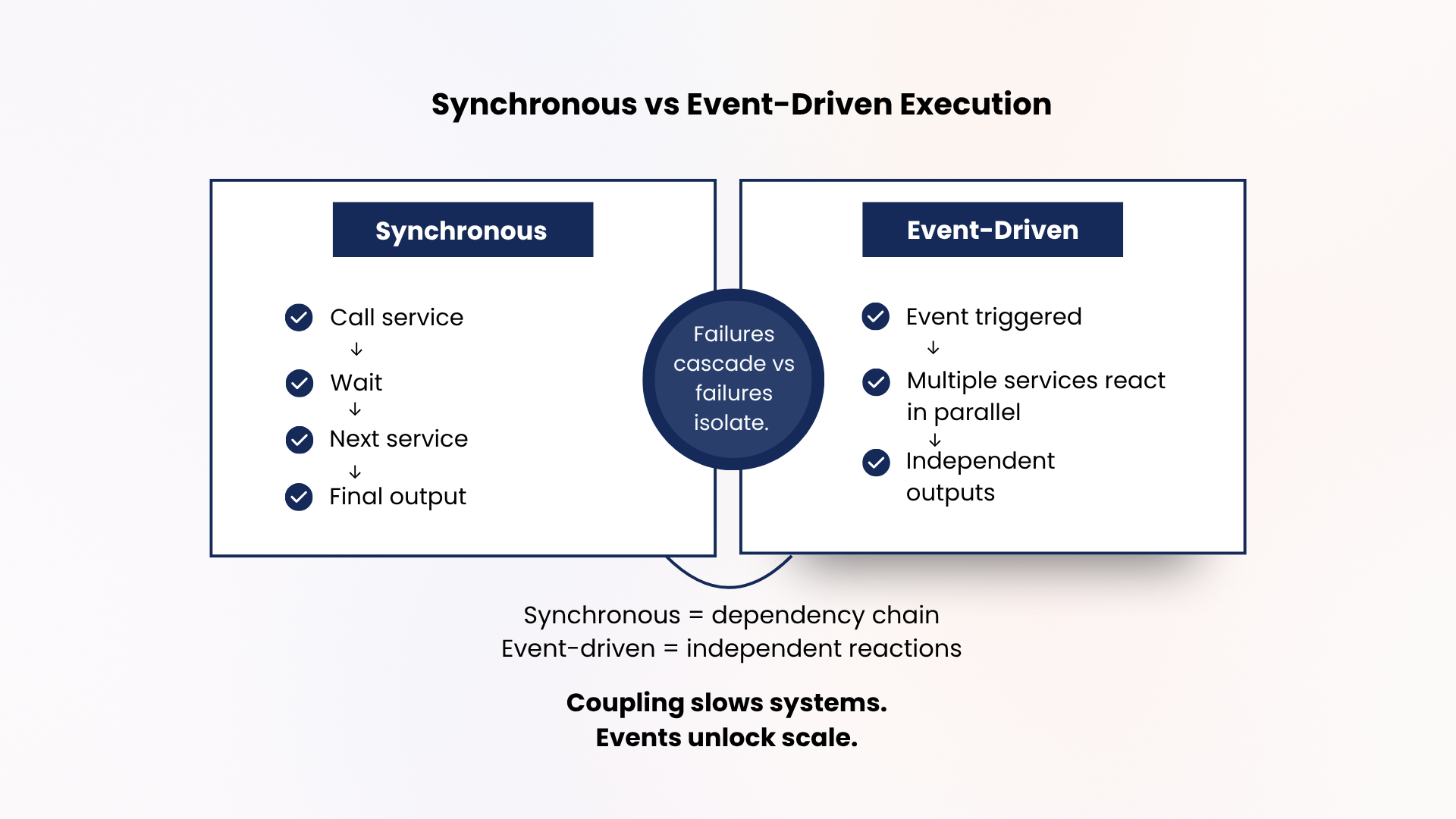
In microservices patterns, this requires choreographed sequences. Each step waits for the previous to complete. The personalization service becomes intimately aware of every dependency: which endpoints to call, in what order, with what fallbacks. This temporal coupling is inherent to request-response communication.
The hidden cost appears when adding new capabilities. Perhaps a new attribution model should factor pricing page visits. In request-based systems, you modify orchestration logic. The personalization service now knows about attribution. Deploy. Hope nothing breaks.
Event-driven systems eliminate this coordination tax. The pricing page visit becomes a domain event. Every system that cares about this signal subscribes independently. Adding attribution changes attribution, not personalization. Systems remain decoupled because they react to facts, not requests.
This architectural choice directly impacts AI deployment. Modern marketing AI generates predictions, scores, and recommendations that other systems should act on. When your lead scoring model identifies a buying signal, should it call every relevant system? Or publish an event and let systems self-organize around the insight?
The request model forces you to predict intelligence flows. The event model lets intelligence flow to wherever it's useful.
Resilience Models That Scale Differently
Marketing operations fail visibly. When personalization crashes during product launches, customers see generic content. When attribution goes down, marketing spend flies blind.
In synchronous microservices, failures cascade. If your recommendation engine times out, the web page hangs. Request-based systems create brittle dependency chains where one service's degradation becomes everyone's emergency.
Event-driven architectures achieve resilience through isolation. When the recommendation engine fails, events persist in queues. The web page serves fallback content. Attribution continues. Analytics continues. The recommendation engine restarts and catches up without coordination.
Research demonstrates this quantitatively. IEEE findings show event-driven data communication achieving 30% faster processing than API-driven approaches, with 70% lower error rates and 4% reduced CPU usage. Financial technology platforms processing high-velocity transactions show event-driven microservices architectures meeting scalability and fault tolerance demands unachievable in monolithic or purely synchronous systems.
Consider traffic spikes. Request-based systems scale by predicting load and provisioning capacity. Event-driven systems scale differently: publish rate remains constant, but processing rate flexes independently. Real-time recommendation might lag seconds during peak load while attribution processes overnight. Different SLAs for different needs, naturally expressed through architecture.
The Operational Complexity Tax
Both patterns impose costs that most organizations underestimate. Microservices increase deployable units, interfaces, and operational surfaces. Event-driven systems add asynchronous flows, broker dependencies, replay logic, and observability challenges.
Debugging differs fundamentally. In request-based systems, trace the request: Service A called B, received response Y, made decision Z. When conversion drops, trace a user journey and pinpoint where the chain broke.
Event-driven debugging requires different thinking. There is no chain, only concurrent reactions to stimuli. When conversion drops, which service's interpretation of which event caused the problem? Causality becomes ambient rather than explicit.
This demands distributed tracing, correlation IDs across asynchronous processes, and schema governance. Without these, teams fly blind. Industry analysis confirms that event-driven architectures require distributed systems fluency most generalist teams haven't acquired.
Yet mature event architectures produce an upside: when every interaction is an immutable event, outcome analytics becomes native. Organizations with sophisticated event systems often discover they've accidentally built real-time decision intelligence platforms.
Decision Framework: Choosing Your Constraint
The question isn't which architecture is better. It's which constraint you prefer.
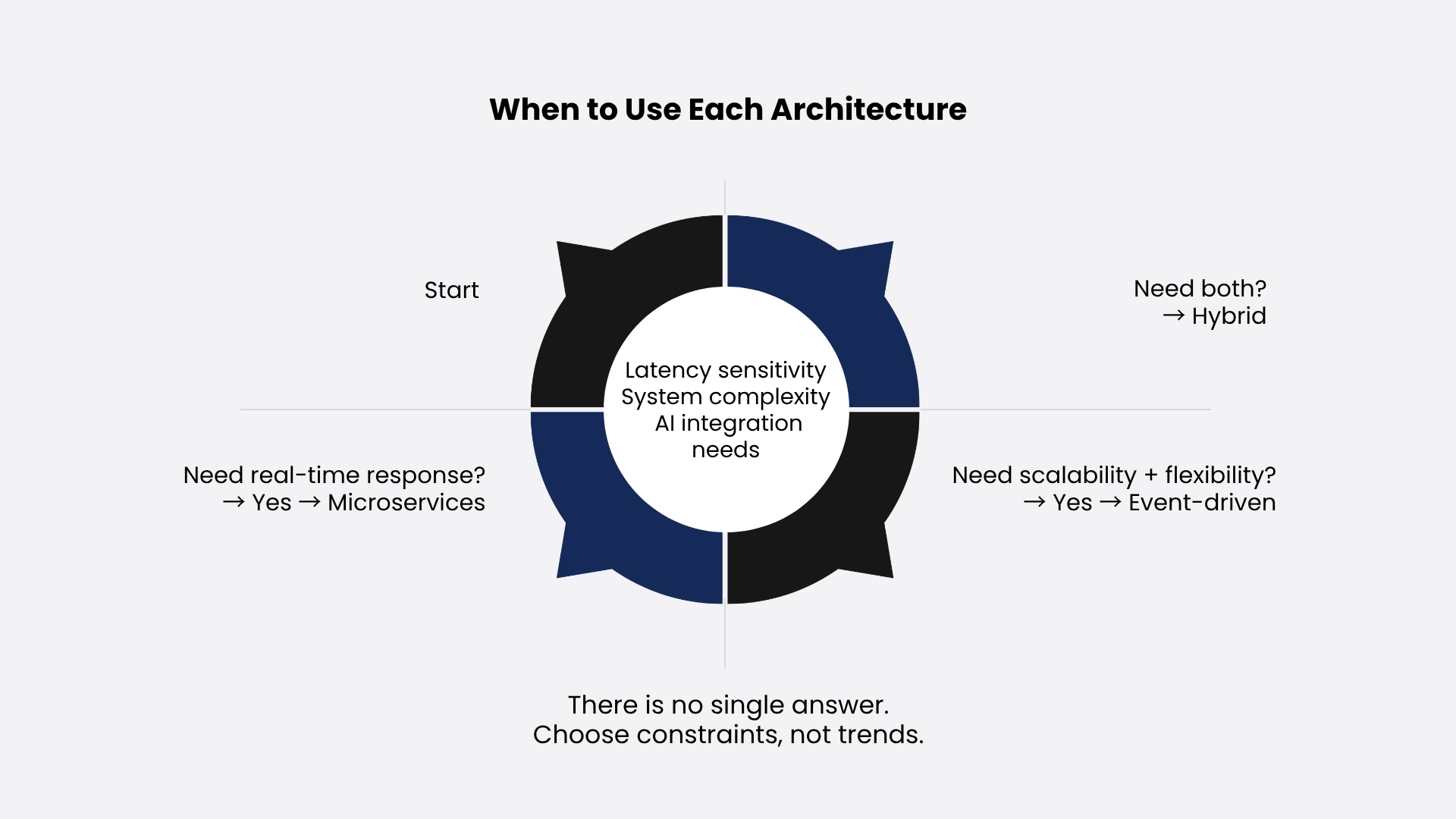
Choose request-based microservices when consistency trumps eventual consistency. Financial transactions, order processing, workflows where stale data creates compliance risks. When bounded contexts are clear and rarely change. When team expertise skews synchronous and decision latency matters more than throughput.
Choose event-driven architecture when intelligence is emergent. When you're building AI capabilities where models continuously retrain and new insights should propagate automatically. When service boundaries evolve frequently. When scale is asymmetric and failure isolation is paramount.
The hybrid reality: sophisticated marketing organizations run both patterns simultaneously. Customer-facing personalization might be request-based for latency reasons while underlying behavioral pipelines are event-driven for scale and flexibility. The art is choosing the boundary.
Expert guidance consistently recommends starting with well-structured monoliths before decomposing. Shopify ran monoliths serving millions of merchants. Almost all successful microservice stories started with monoliths that got too big. Build operational maturity first: one-click deploys with rollback, centralized logging and tracing, circuit breakers and retry logic, documented runbooks.
Without these prerequisites, a well-operated monolith with strong stability beats a poorly operated distributed system every time.
Strategic Implications: Architecture as Competitive Moat
Marketing technology's next phase won't be defined by feature parity. Every vendor will have AI-powered personalization and predictive analytics. Differentiation emerges from architectural sophistication: which organizations built infrastructure that compounds intelligence over time?
Event-driven systems create compounding advantages through accidental capabilities. When you publish prospect behavioral events, you initially subscribe them to lead scoring. Six months later, add content recommendation. A year later, train intent prediction models. Same event, expanding value, zero refactoring.
Request-based systems create compounding costs. Each new capability requires explicit integration. The system becomes more capable but less malleable.
The strategic choice isn't technical. It's temporal. Are you optimizing for shipping the next campaign or building infrastructure that makes future campaigns easier? For tactical execution in stable domains, request-based simplicity wins. For strategic positioning in evolving markets, event-driven flexibility compounds.
As organizations integrate agentic AI, the same architectural lessons apply. The distributed monolith patterns that plagued microservices are emerging in AI systems. Event-driven patterns provide robust solutions by decoupling agents through brokers, avoiding tight coupling that makes systems brittle.
Conclusion: Infrastructure Shapes Intelligence Horizons
The shift from tools to infrastructure to autonomous intelligence requires different thinking about technology investment. Not which personalization platform, but which communication architecture enables personalization you haven't imagined yet.
The answer determines whether your MarTech stack is a curated collection of capabilities or a living system that gets smarter with scale. Microservices sequence requests. Event-driven architectures orchestrate systems. Marketing maturity demands both, not as competing paradigms but complementary intelligence layers.
Hybrid architectures don't compromise. They exploit workload realities. The winning strategy combines synchronous APIs for user-facing interactions requiring immediate response with event-driven patterns for backend processing where resilience and scalability matter more than latency.
Choose the architecture your organization can actually operate while still shipping value. The decision reverberates for years. Architecture precedes intelligence. Systems thinking builds marathons. The choice shapes not just technical capability but revenue velocity and competitive positioning in markets where intelligence compounds faster than features.