
Article
Evaluating ML Models Beyond Accuracy Metrics
This blog explains why accuracy is a dangerously incomplete metric for evaluating machine learning models, particularly in the presence of class imbalances and varying business costs. It advocates for a comprehensive evaluation toolkit, including precision, recall, and cost-weighted analysis, to align model performance with real-world business goals and long-term reliability.
- Topic
- Machine Learning
- Published
- 26 Mar 2026

Your machine learning model just hit 99 percent accuracy. The team celebrates. You deploy to production. Then reality hits: the model misses 80 percent of the critical cases you built it to detect.
A fraud detection model with 99 percent accuracy sounds impressive. Until you realize it achieves this by predicting "not fraud" for every transaction. When only 1 percent of transactions are fraudulent, this useless model looks perfect on paper while failing completely in practice.
For marketing technology leaders deploying ML for lead scoring, churn prediction, or customer intelligence, accuracy alone is dangerously incomplete. Understanding how to properly evaluate models beyond this single metric is no longer optional for organizations deploying AI at scale.
Why Accuracy Fails in Real-World Systems
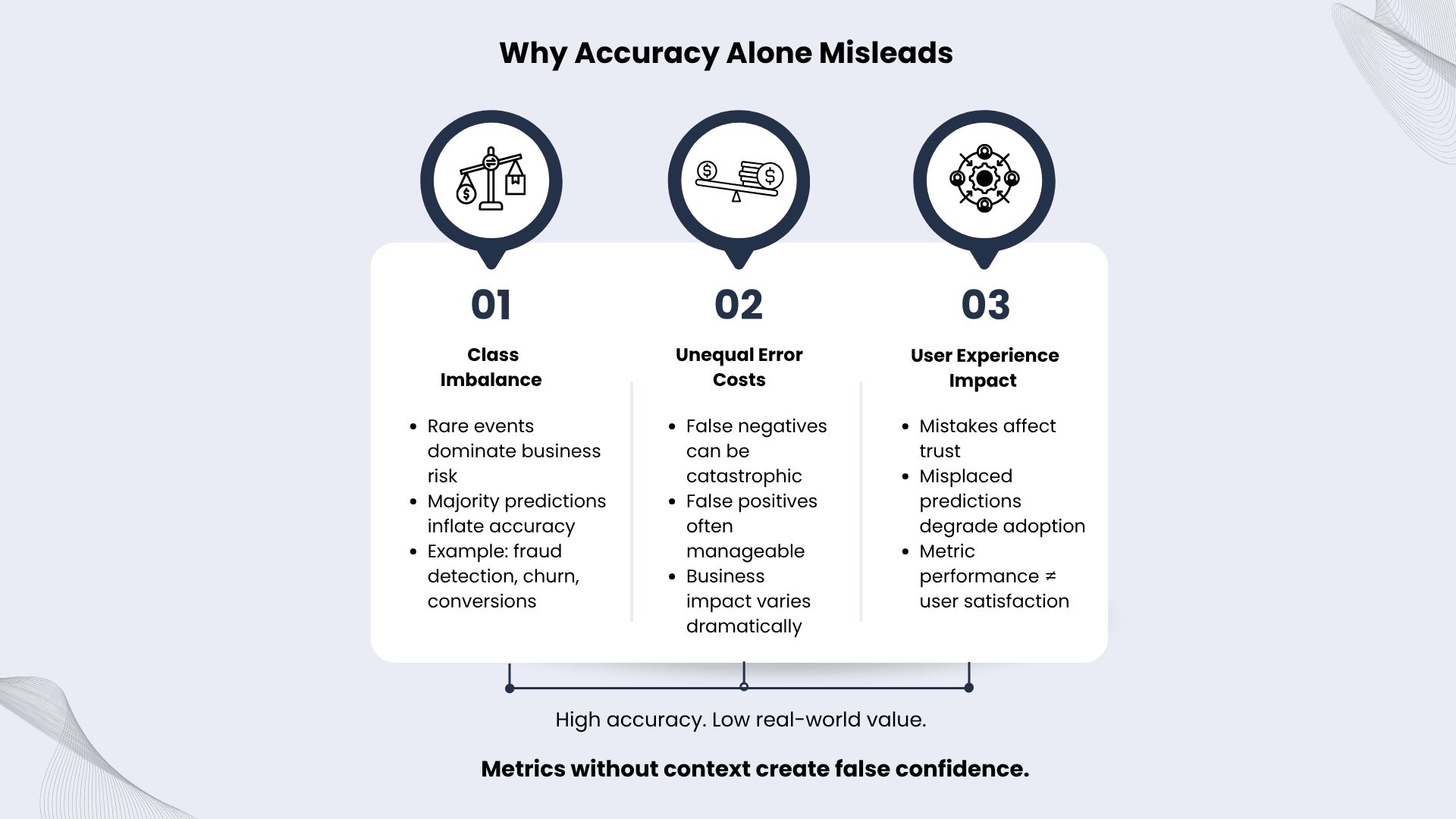
Accuracy measures the percentage of correct predictions. Nothing more. The metric says nothing about which errors are made, when they occur, or what they cost.
Class imbalance effects
In many real-world problems, classes are not evenly distributed. Fraud detection sees 1 percent fraud and 99 percent legitimate transactions. Churn prediction finds small percentages who leave. Lead conversion models face 2 to 5 percent conversion rates against massive non-converting traffic.
In these scenarios, a model predicting the majority class every time achieves high accuracy while being functionally useless. A 99 percent accurate fraud model that never flags fraud is not a success. It's a liability creating false confidence while letting millions slip through.
Cost-sensitive errors
Accuracy treats all errors equally. Businesses do not. A false positive and a false negative rarely carry the same impact. In B2B lead scoring, missing a high-intent prospect (false negative) costs potential revenue of $50,000 or more. Wasting SDR time on a poor lead (false positive) costs $500 in opportunity cost. Accuracy treats these identically. Your P&L does not.
In healthcare, a false negative missing a disease carries catastrophic consequences. A false positive leads to additional testing. Traditional accuracy metrics assign equal weight to both. Recent research on cost-sensitive learning for medical data shows models optimized for accuracy often perform poorly when real-world costs are considered.
User experience impact
From a user's perspective, where and how often mistakes happen matters more than overall correctness. An email spam filter with 95 percent accuracy sounds strong until users realize 5 percent of legitimate emails vanish into spam folders. A recommendation system might achieve high accuracy predicting clicks while recommending content users don't enjoy. The gap between metric performance and user satisfaction dooms products that looked perfect in development.
Alternative Evaluation Metrics That Matter
Real performance becomes clear only when teams look beyond one statistic. Modern ML work calls for a richer and more comprehensive evaluation toolkit.
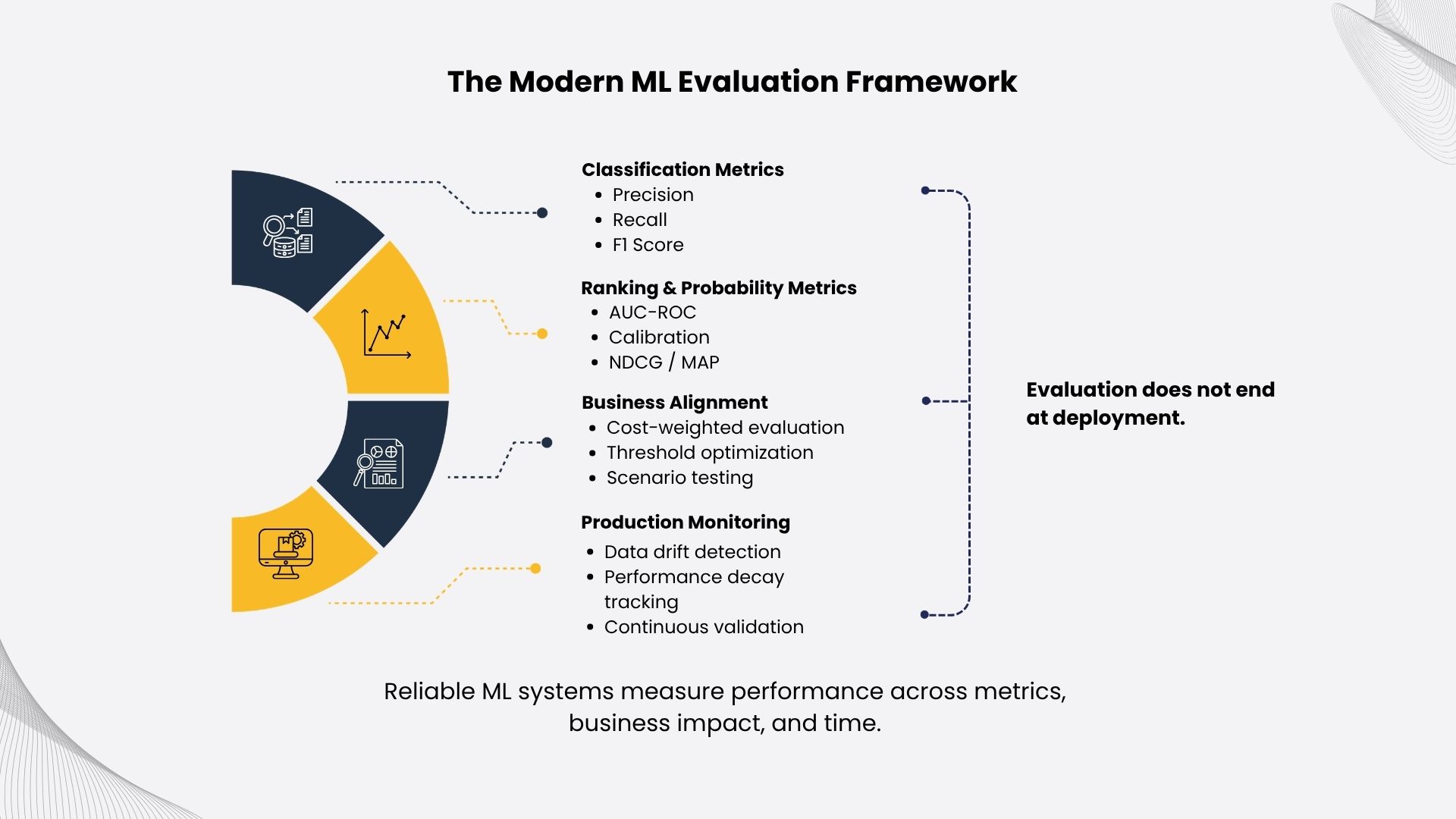
Precision, Recall, and F1 Score
These metrics serve as the core foundation for evaluating classification models.
Precision asks: Of all instances the model predicted as positive, how many were truly positive? This answers "How reliable are our positive alerts?" When your fraud model detects a transaction with high precision, you know it's worth looking into.
Recall asks: Of all actual positive instances, how many did the model correctly identify? This answers "How good are we at finding all positive cases?" High recall means your model catches most fraudulent transactions.
F1 score balances both through harmonic mean. It's useful when you need compromise, but understanding the separate values proves critical. For imbalanced datasets, variants like F-beta allow weighting precision or recall based on business priorities.
Precision matters when false positives are costly. Recall matters when missing positives is dangerous. In fraud detection, it’s more important to catch every possible fraud case, even if it means more false alerts, so recall takes priority. In sales, precision wins because teams want to focus only on leads worth their effort.
AUC-ROC and Calibration
AUC-ROC (Area Under the Receiver Operating Characteristic Curve) looks at model performance over all possible thresholds. When a model hits 0.95, it means it’s really good at ranking the real positives above the negatives. AUC, unlike accuracy, is not affected by imbalance in classes.
Calibration checks whether a model’s predicted probabilities actually match what happens in reality. If a well‑calibrated model says something has a 70% chance of occurring, it should be right about 70% of the time. When a model isn’t calibrated properly, it can become overconfident or too cautious in its predictions. A poorly calibrated credit scoring model misprices loans. A churn model with miscalibrated probabilities causes CS teams to misallocate retention resources.
Ranking and probabilistic measures
In many systems, the purpose is not classification but prioritization. Normalized Discounted Cumulative Gain (NDCG) quantifies the quality of a model's ordering of items, placing more emphasis on the top positions. Mean Average Precision (MAP) is a measure of the proportion of relevant items among the top recommendations.
Lead scoring or content recommendation are examples of situations where these metrics essentially acknowledge that the relative ordering is more important than absolute classification.
Aligning Metrics with Business Goals
Even the smartest evaluation framework is useless if it isn’t tied to real business results. This alignment requires three critical elements.
Cost-weighted evaluation
Instead of treating errors equally, assign explicit costs. A financial institution might determine that a missed fraud case costs $5,000 on average, while investigating a false positive costs $50. By encoding these costs into evaluation, models are optimized for actual business impact rather than statistical abstractions.
Studies on cost-sensitive learning for financial applications demonstrate that models optimized with cost matrices significantly outperform accuracy-optimized models in business value generation. One B2B company applying cost-weighted evaluation to lead scoring saw 21 percent revenue increase and 18 percent less wasted sales effort.
Threshold optimization
Predicted probabilities are of no value on their own without the accompanying decision thresholds. Most classifiers produce probability estimates, rather than definite decisions. The threshold that results in the best accuracy is often very different from the threshold that leads to the highest business value.
For example, a fraud detection system could set its threshold at 0.3 instead of 0.5 and, in this way, it would choose to tolerate more false positives in order to catch more actual fraud cases. When determining the best thresholds, companies should go through the entire performance spectrum and choose based on a cost, benefit analysis that is linked to revenue impact, risk tolerance, and capacity constraints.
Scenario‑driven testing
Instead of measuring overall performance, look at how the tests perform in real-life scenarios. It is when things get busy, rare but significant events occur, or different customer segments behave in their unique ways that these moments show issues, which large- averaged out metrics generally tend to hide.
A model might show excellent overall metrics while failing for critical subpopulations. A loan approval model could demonstrate bias against certain demographics. A demand forecasting model might excel in stable periods but collapse during market disruptions.
Monitoring Evaluation Metrics Over Time
Evaluation doesn't end at deployment. Machine learning models exist in a state of continuous silent degradation as the world changes around them.
Performance decay and distribution shifts
Models degrade as customer behavior changes, markets shift, product features evolve, and data pipelines drift. Research on model degradation found that different models degrade at dramatically different rates on identical data. Some decline gradually and predictably. Other people suffer from what they call "explosive degradation”, which means they work fine for long periods and then suddenly break down.
Data drift describes a situation where the distribution of the input features changes over time. A pandemic changes shopping behavior. A new competitor shakes up the market. Regulatory changes affect the way the business is run.
Concept drift is when the connection between the inputs and outputs changes at a deep level. The behaviors of customers that were once used to predict churn might no longer be relevant after a product change.
Alerting and governance strategies
Efficient setups feature metric thresholds equipped with alerts, segment-level dashboards that track the performance of each subgroup, regular recalibration checks, and retraining triggers linked to business impact. Monitoring should concentrate on the quality of the decision made rather than the statistical drift only.
Warnings must find the right balance between sensitivity and specificity. Too sensitive, and teams drown in false alarms, leading to alert fatigue. Too conservative, and critical degradation goes unnoticed. A typical implementation uses a three-tier system: green indicates normal operation, yellow triggers review, and red demands immediate investigation.
Evaluation in Real-World Systems
The final test of any ML system is performance in production with real users and real consequences.
Offline versus online evaluation
Offline evaluation checks model performance on separate test data before launch. It’s efficient, easy to reproduce, and helps teams improve models quickly. But offline metrics don't capture how models interact with live systems, user behavior, and feedback loops.
Online evaluation assesses performance on actual production traffic. It measures real business impact but carries deployment risk and requires careful experimental design. Both are necessary.
A/B testing and continuous validation
A/B tests reveal whether the model improves outcomes, how users respond to decisions driven by the model, and unintended behavioral effects. Sometimes a statistically "better" model performs worse in practice due to human adaptation.
The control group sees predictions from the current production model. The treatment group receives predictions from the challenger model. By randomizing user assignment, A/B testing isolates model changes from confounding factors. Multi-armed bandit methods are a step beyond traditional A/B testing, in that they continuously modify the proportion of traffic that each model receives based on the growing evidence of which model is better performing.
Continuous validation involves running evaluation continuously within the ML lifecycle itself. Various MLOps platforms currently in use allow a degree of automation in model monitoring such that performance metrics are displayed running in real, time on dashboards, alerts are sent when metrics fall beyond prespecified limits, and retraining pipelines start up automatically when drift is detected.
Organizations that have successfully implemented robust continuous validation keep track of metrics in four different areas: model performance metrics such as precision and recall, data quality metrics which include distribution shifts, system performance metrics like latency and business outcome metrics such as revenue impact and user satisfaction.
Building Systems That Last
The competitive advantage in ML no longer comes from having the best initial model. It comes from building systems that maintain model quality continuously through sophisticated evaluation, rapid problem detection, and disciplined improvement processes.
Accuracy is not wrong. Accuracy is only a part of the story. Actually, in practical ML systems, the victors are those who manage error trade, offs, align with the business, offer great user experience, and ensure long-term reliability. Accordingly, teams that look at model performance metrics beyond accuracy ultimately develop products that are more dependable, more trusted, and more profitable.
When your next ML model scores high in accuracy, don’t stop at the surface, dive into the questions: What kind of errors will have the biggest impact? Will the model's performance degrade over time? Which business metrics are we targeting?
It is these questions and not the accuracy figure that decides whether the model will be able to successfully perform in the real world.