
Article
Ensemble Learning in Production ML Systems: The Architecture of Reliable AI
This blog explains why single models break at scale through data variability, edge case sensitivity, generalization limits, and instability under drift, and why ensemble architectures are becoming the defining pattern of production-grade AI. It covers the four ensemble approaches (bagging, boosting, stacking, voting), their operational trade-offs (latency, cost, debugging complexity, explainability), and a governance framework that treats prediction quality not as a property of any individual model but as a property of a well-designed system.
- Topic
- Machine Learning
- Published
- 2 Jul 2026

The Shift That Defines the Next Era of Enterprise AI
Enterprise AI has crossed a threshold.
For most of the last decade, the dominant challenge was building and deploying individual machine learning models. Organizations invested in data infrastructure, feature engineering, and model selection. Getting a model into production felt like the finish line.
It is not. It is the starting line of a much harder problem.
Modern AI sits at the center of go-to-market decisions. Lead routing, revenue forecasting, churn prediction, real-time personalization, and pipeline allocation all run on predictive models. When those models degrade quietly, the damage is not a missed experiment metric. It is misrouted pipeline, wasted budget, and eroded trust with high-value accounts.
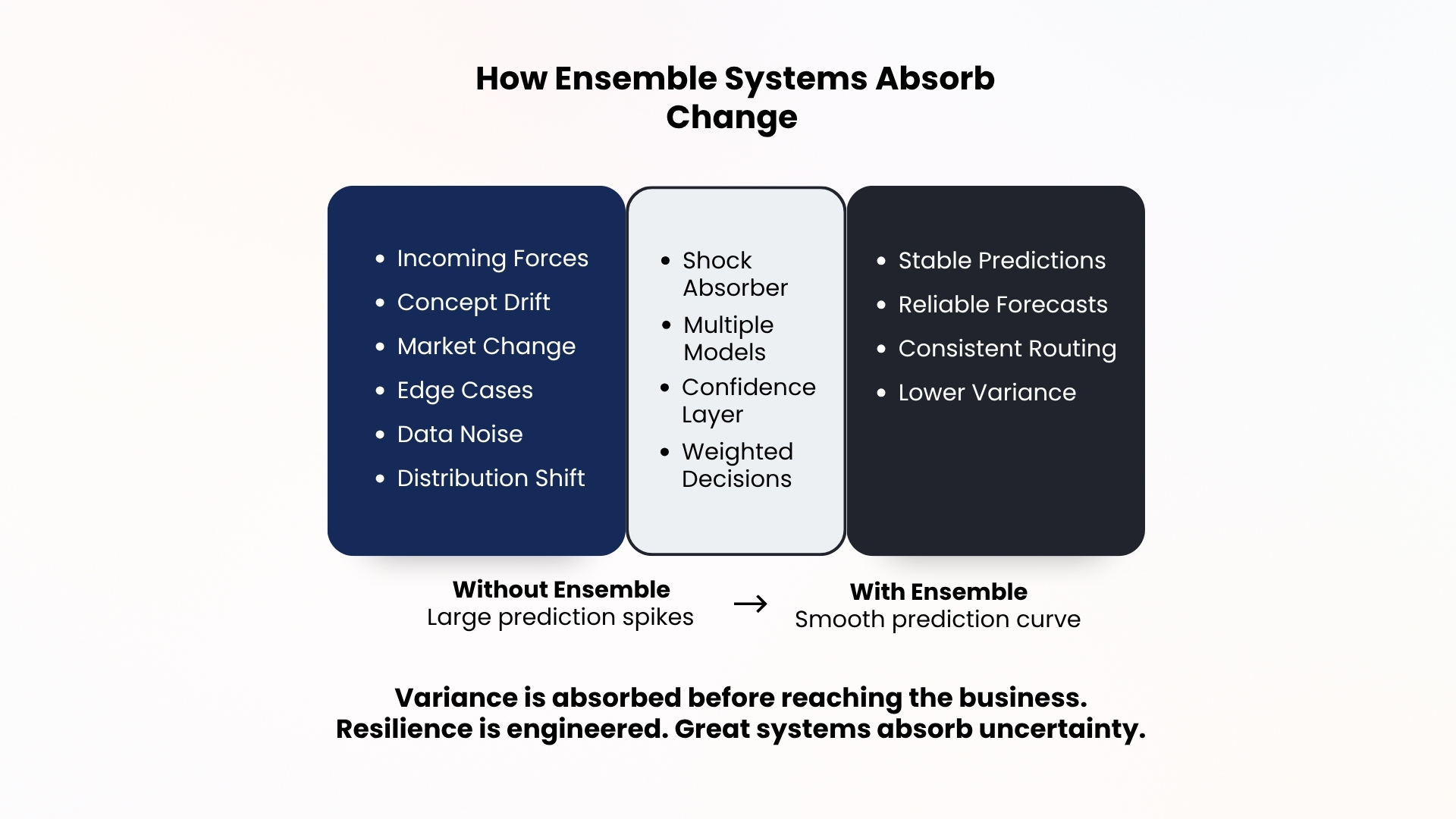
The organizations pulling ahead have redesigned the entire inference layer, moving from isolated models to ensemble architectures that distribute risk, absorb variance, and sustain performance under real-world pressure. This shift mirrors the broader arc of enterprise technology maturity: from tools, to infrastructure, to intelligence architecture. Ensemble learning is what that third stage looks like in practice.
Why Single Models Break at Scale
Single-model failure in production is rarely dramatic. There is no error code, no system alert. The model keeps running and outputting predictions. The accuracy simply decays.
Four structural weaknesses drive this decay.
Data pattern variability is the first. Consumer behavior, campaign dynamics, and market conditions are not static. A model trained on one quarter's data may perform poorly on the next quarter's signals. Without an internal mechanism to recognize distributional shifts, the model continues operating on stale assumptions while the world moves on.
Edge case sensitivity is the second. Any single model optimizes for the dominant patterns in its training data. Rare inputs, unusual account types, or underrepresented regions fall outside that optimization. In high-stakes systems, these are exactly the cases where errors are most expensive. A lead-scoring engine that misclassifies high-value international accounts as low-priority because they were sparse in training data does not produce a minor inaccuracy. It produces a revenue miss.
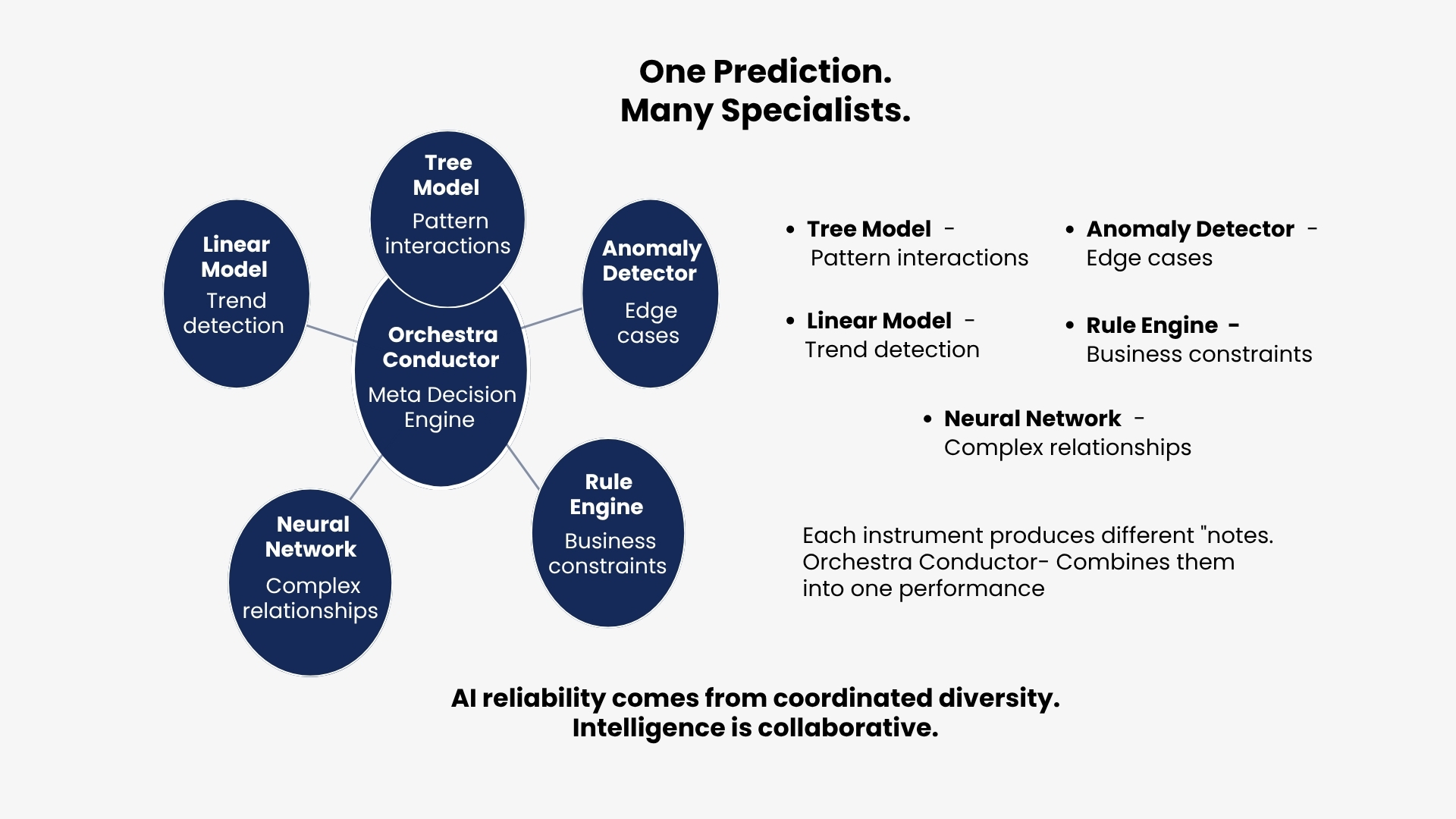
Generalization limits compound the problem. Different model architectures encode different assumptions. A gradient-boosted tree captures feature interactions that a neural network may miss. A linear model captures trends that a tree-based model ignores. Committing to one architecture means systematically discarding the signals the others would surface.
Instability under drift is the most operationally disruptive failure mode. Concept drift, the gradual misalignment between a model's learned patterns and the current data distribution, is invisible in aggregate metrics until the damage is done. By the time degradation appears in dashboards, entire pipeline cycles have run on compromised predictions.
These are not data quality problems. They are system design problems.
The Four Ensemble Approaches and When to Use Each
Ensemble learning addresses these failure modes by redesigning the prediction layer itself. Rather than searching for one perfect model, ensemble systems coordinate multiple models, each contributing a distinct perspective, into a single stable output.
Bagging trains multiple instances of the same model type on different random subsets of training data and aggregates their predictions. The mechanism is variance reduction: individual models differ slightly, so their errors cancel when averaged. Random Forests are the canonical implementation. Bagging is most effective when data is noisy or limited, common in emerging market segments or customer cohorts with sparse historical signal.
Boosting trains models sequentially, with each new model correcting the errors of its predecessors. XGBoost, LightGBM, and CatBoost dominate production implementations on structured tabular data. The key benefit is bias reduction: by systematically concentrating on difficult examples, boosting achieves accuracy a single model cannot. Worth noting: boosting introduces sequential inference dependencies, which requires deliberate latency planning for real-time applications.
Stacking introduces a meta-model that learns how to optimally weight the outputs of diverse base models. A gradient-boosted tree, a neural network, and a linear model can each generate predictions that a second-level model then combines, learning which base model to trust under which conditions. For organizations operating multi-modal data environments, stacking provides the connective architecture that translates heterogeneous inputs into coherent predictions.
Voting systems aggregate predictions through majority vote or weighted averaging. They require no additional training and are the most operationally transparent of the four approaches. For applications where model governance and auditability matter, voting ensembles offer a pragmatic balance between performance and explainability.
Where Ensemble Architectures Deliver Asymmetric Value
Not every prediction task benefits equally from ensembling.
High-risk prediction systems are the clearest case. In fraud detection, churn propensity scoring, revenue forecasting, and credit decisioning, false positives and false negatives carry asymmetric costs. Ensembles reduce variance at the tail of the error distribution, precisely where the most expensive mistakes concentrate.
Noisy datasets are the natural habitat of ensemble methods. Marketing data is structurally noisy: click signals are behaviorally ambiguous, attribution windows are contested, and customer journey data is incomplete. Individual models overfit to the noise. Ensembles average it away.
Multi-modal data environments require ensemble thinking almost by definition. When a prediction depends on transaction history, content engagement, device-level signals, and real-time intent data, no single architecture handles all four modalities optimally. Stacking allows each data type to be processed by the model best suited to it.
The Operational Costs That Cannot Be Ignored
Ensemble architectures are not universally superior. They are contextually superior. The trade-offs are real and must be weighed deliberately.
Increased inference latency is the most immediate constraint. Running multiple models introduces overhead that becomes a hard architectural limit for real-time bidding, conversational AI, or latency-sensitive recommendation engines. Parallel containerization and tight timeout rules help, but the constraint must be planned for, not discovered post-deployment.
Higher infrastructure cost follows directly. More models mean more compute, more storage, and more orchestration. The economics must be evaluated against the value of the accuracy gains. A fraud detection system justifies higher infrastructure spend because accuracy has direct revenue protection value. A content recommendation system requires a tighter cost-benefit case.
Complexity in debugging compounds across ensemble members. When an ensemble prediction is wrong, identifying which component model is responsible requires observability infrastructure most organizations do not have at deployment. Build it before you need it.
Explainability limitations represent the deepest structural challenge. SHAP and LIME can be extended to ensemble contexts, but interpretive complexity grows with each additional model. Organizations in regulated industries should treat explainability as a first-order architectural constraint, not an afterthought.
A Governance Framework for Ensemble Systems at Scale
Organizations that deploy ensembles successfully operate with a consistent four-layer discipline.
Orchestration treats each ensemble member as a discrete microservice with its own versioning, deployment pipeline, and rollback capability. Models are never lifecycle-coupled. Shadow deployments and canary testing validate new ensemble configurations against production data before going live.
Component-level monitoring tracks each base model's prediction distribution independently, not just the ensemble's aggregate output. Drift in one component, even when masked by the ensemble, is a leading indicator of future degradation. Automated alerting on confidence interval divergence catches decay before it propagates into downstream business decisions.
Selective updating recognizes that different ensemble members have different decay curves. A behavioral model may require weekly retraining. A demographic model may be stable for quarters. Conflating these cycles introduces unnecessary risk and cost. Small ensembles of two to three diverse models often achieve near-optimal results at a fraction of the cost of larger configurations.
Accuracy-efficiency arbitrage defines explicit thresholds at which ensemble complexity is reduced in exchange for operational efficiency. Tiered strategies, lightweight models for low-stakes predictions and full ensembles for high-stakes decisions, deliver the optimal accuracy-cost ratio across a heterogeneous workload.
The Strategic Implication: Intelligence is a Property of Systems
Enterprise AI maturity follows a consistent arc. Organizations begin by acquiring tools. They then recognize that tools without infrastructure are fragile, and invest in pipelines, observability, and MLOps. The organizations now pulling ahead are making the third transition: from infrastructure to intelligence architecture, systems that are not just reliable but adaptive.
Ensemble learning defines that third stage. It reflects a core insight: prediction quality is not a property of a model. It is a property of a system. Systems are designed, governed, and evolved, not merely trained.
The competitive advantage in AI-driven revenue operations is no longer having models. It is building AI infrastructure that remains resilient, scalable, and observable under continuous change. Ensemble architectures contribute to this by distributing intelligence, absorbing variance, and sustaining performance where single models would silently degrade.
The organizations that internalize this will build AI systems that compound over time. Those that continue deploying isolated models will keep rediscovering, at real cost, why single points of failure always eventually fail.
The question is not whether your models are good. It is whether your systems are designed to stay that way.