
Article
Distributed Caching Strategies for High-Performance Marketing Systems
This blog explains why distributed caching has become a core architectural commitment in the intelligence era, where speed and reliability of AI-driven decisions determine competitive advantage. It covers caching architectures (in-memory, edge, write-through vs. write-back), the hardest problem of consistency and invalidation, a maturity framework for evaluating cache performance, and operational risks including cache stampedes, memory pressure, and failover handling that separate production-grade systems from fragile ones.
- Topic
- Technology
- Published
- 7 Jul 2026
Shift From Tools to Architecture
Modern marketing organizations have passed through two distinct technological eras. The first was the tools era: adopting CRMs, email platforms, and analytics dashboards. The second was the infrastructure era: centralizing data into cloud warehouses and customer data platforms. Now comes the third shift: the intelligence era.
In this phase, organizations no longer compete on which tools they use. They compete on how fast and reliably they can serve AI-driven decisions, personalized experiences, and real-time analytics at scale. A recommendation engine is only as valuable as the speed at which it delivers its output.
The bottleneck is no longer strategy or algorithms. It is infrastructure.
Distributed caching sits at the center of this shift. It is the architectural layer that allows systems to stop re-fetching what they already know, reduce pressure on primary databases, and serve intelligence at the speed customers expect. For technology leaders and marketing decision-makers, this is not an optimization project. It is a core architectural commitment.
Why Modern Systems Cannot Function Without Caching
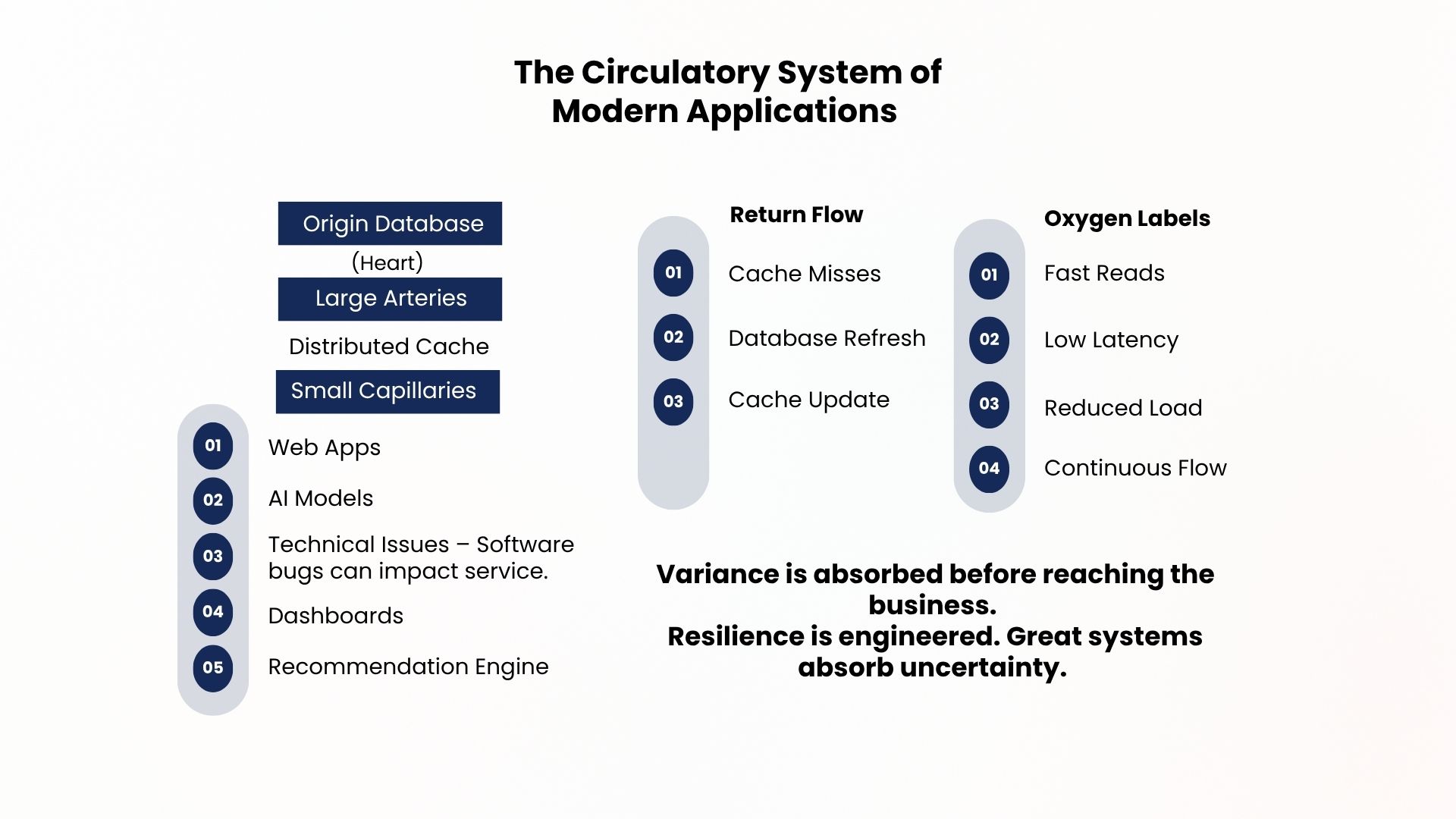
The foundational problem is straightforward. Databases were designed for consistency and durability, not for sub-millisecond response times under concurrent load. When a personalized e-commerce session triggers simultaneous lookups for product recommendations, pricing rules, loyalty tier data, inventory status, and A/B test assignments, every query competes for the same database resources. Latency compounds. At enterprise scale, that compounding effect becomes a system-level crisis.
Without caching, every repeated query hits the origin system directly. That pattern drives up database compute costs, increases query latency, and creates failure risk under traffic spikes. A well-architected cache absorbs the majority of read traffic, reducing database load by 40 to 95 percent depending on workload type.
The business consequences are concrete. Slow enrichment lookups delay AI-driven scoring. Sluggish dashboards delay campaign decisions. These are the operational reality of marketing systems built without a caching layer.
Beyond latency, caching is a cost strategy. Cloud databases bill for compute and read operations. Serving repeated queries from a cache rather than a database reduces both. For large-scale operations running real-time personalization loops and always-on campaign analytics, this reduction translates into significant infrastructure savings.
Caching Architectures: Choosing the Right Layer
Distributed caching is not a single technology. It is a set of architectural patterns, each suited to a different layer of the system.
In-memory caches, led by Redis and Memcached, store data in RAM and deliver sub-millisecond read latency. They handle session storage, precomputed recommendation outputs, feature vectors for AI models, and frequently accessed configuration values. Redis has evolved well beyond a simple key-value store, supporting sorted sets, pub/sub messaging, and stream processing, making it a versatile backbone for complex MarTech data flows. The primary constraint is memory cost: in-memory caches are sized for working sets, so data selection and eviction policy matter significantly.
Edge and CDN caching distributes content to geographically dispersed nodes, serving responses from the location closest to the user. For global marketing operations, this reduces geographic latency substantially. Modern CDN providers now support conditional logic execution at the delivery point, making personalized content at CDN speed achievable. Landing page performance is a direct output of edge cache configuration: pages that load slowly at the edge undermine the campaigns they support, regardless of targeting quality.
Write-through and write-back patterns govern how writes interact with the cache and carry real business consequences. Write-through caching updates both the cache and the underlying database in the same operation, ensuring consistency at the cost of slightly higher write latency. Write-back caching writes to the cache first and persists to the database asynchronously, improving write throughput but creating a window where cache failure can result in data loss. For transactional data, consent records, and subscription changes, write-through is the only defensible choice. For behavioral signals where near-accuracy is acceptable, write-back offers meaningful performance gains.
At scale, single-node caches become bottlenecks. Clustered architectures such as Redis Cluster partition data across nodes using consistent hashing, enabling horizontal scalability and eliminating single points of failure. This allows a caching layer to grow with traffic continuously rather than requiring periodic emergency scaling.
Consistency and Invalidation: The Hardest Problem
Cache invalidation is one of the most demanding challenges in distributed systems, and the reputation is deserved. In marketing systems, the stakes are high. When a customer updates communication preferences and an opted-out record remains cached, the downstream consequence is a regulatory violation. When a product goes out of stock and an in-stock status persists in cache, the consequence is a broken customer experience.
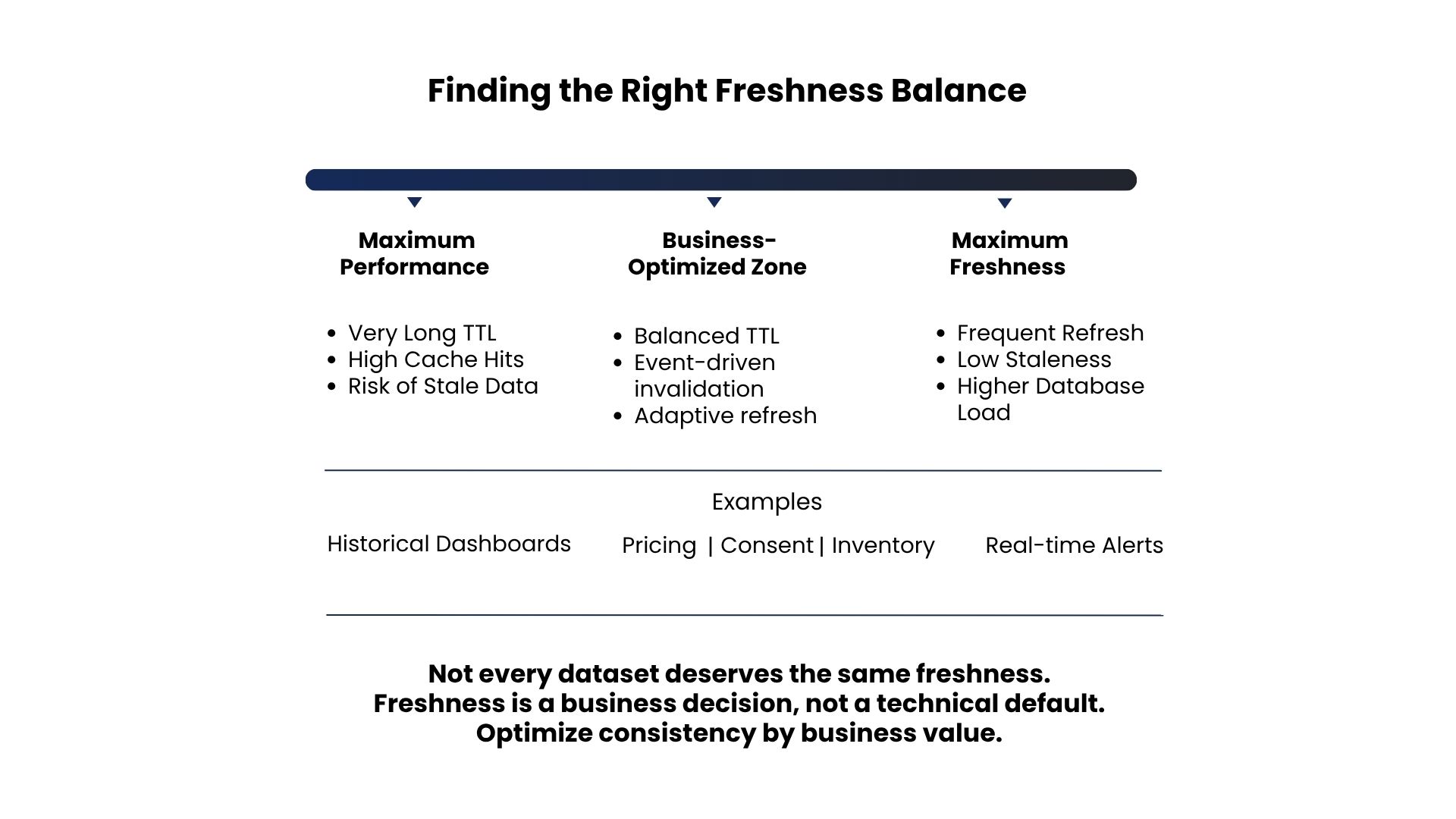
The core trade-off is between freshness and performance. Shorter time-to-live values reduce stale data risk but increase cache miss rates and push more load to the database. Longer TTLs improve hit rates but widen the window in which wrong data influences decisions.
The most important design distinction is between convenience data and control data. Convenience data, such as historical analytics and dashboard aggregates, tolerates eventual consistency. Control data, including consent records, user permissions, pricing, and inventory, requires near-immediate consistency. Applying identical invalidation logic to both categories produces either unnecessary performance constraints or genuine regulatory and business risk.
Event-driven invalidation offers a scalable path forward. When a write operation publishes an invalidation event to a message bus, downstream cache nodes update or evict the affected key without tight coupling between the write path and cache management. This approach also produces a natural audit trail, valuable in regulated marketing environments.
A Framework for Evaluating Cache Maturity
Organizations can assess caching architecture across four dimensions:
Hit rate and latency measures whether the majority of hot reads are served from cache and whether latency targets are being met consistently. Well-tuned caches typically achieve hit rates of 85 to 95 percent for stable workloads.
Consistency and freshness evaluates whether TTLs and invalidation policies are aligned with the business criticality of each data type. High maturity here means stale data is rare and predictable, not a persistent operational hazard.
Cost per request tracks whether caching is delivering net-positive infrastructure value and whether inefficiencies such as over-caching or misaligned partitioning are being identified and corrected.
Operational governance examines whether cache performance is visible, monitored, and shared across marketing, revenue operations, and data infrastructure teams. Without cross-functional accountability, caching becomes a hidden dependency that creates outage risk precisely when traffic is highest.
Operational Risks Worth Naming
Three risks deserve explicit attention. Cache stampedes occur when a popular key expires under peak traffic and concurrent requests simultaneously miss the cache, flooding the origin database. Prevention requires staggered TTL values, mutex locking, and proactive cache warming tied to predictable traffic events.
Memory pressure builds when working sets approach allocated RAM capacity. Eviction rates rise, hit rates fall, and database load spikes in a compounding feedback loop. Automated alerting on memory utilization and adaptive eviction policies allow systems to respond before pressure becomes failure.
Failover handling determines behavior when a cache node goes down. Systems that treat cache availability as a hard dependency are brittle by design. Graceful degradation with circuit breakers is the production-grade standard. The failure path must be designed with the same rigor as the happy path.
Strategic Implications
Three broader conclusions follow from taking caching seriously as an architectural discipline.
Infrastructure is now a marketing asset. The speed and consistency of data delivery directly determine the quality of personalized customer experiences. Organizations that treat infrastructure as a background IT concern cede competitive ground to those that invest in it strategically.
AI investments require a caching foundation. Real-time personalization, propensity scoring, and next-best-action recommendations are computationally expensive. Delivering those outputs at the latency customers expect is only possible when model inference results, feature vectors, and customer context are cached intelligently. AI capabilities built on slow infrastructure underdeliver relative to their potential, regardless of model quality.
Scalability must be designed before it is needed. Organizations that adopt distributed caching architectures early build systems that scale continuously rather than periodically crisis-upgrading under load. The cost of architectural refactoring under live traffic is an order of magnitude higher than proactive design.
Conclusion
The next competitive frontier in marketing technology is not another AI feature or channel integration. It is the foundational work of building systems that can deliver intelligence at scale, without latency and without failure.
Distributed caching is not a technical footnote in that story. It is where performance is won or lost. Organizations that approach caching with the same strategic rigor they apply to campaign execution will build systems that deliver on the promise of real-time, AI-powered customer engagement.
The gap between marketing ambition and marketing capability has always been infrastructure. In the intelligence era, that gap closes here.