
Article
Designing Scalable Data Pipelines for Modern Analytics
This blog explains that data pipelines are the true competitive moat in modern analytics, not the tools themselves; and that most fail when moving from batch to hybrid architectures at scale. It outlines core pipeline components, quantifies the high cost of fragility, and makes the case for reliability, observability, and strategic infrastructure investment over tool-centric thinking.
- Topic
- Data Engineering and Analytics
- Published
- 19 May 2026

Your data pipeline worked perfectly at 100,000 events per day. At one million, it slowed. At ten million, it broke. This is not a technical failure. It is an architectural one.
The strategic tension has shifted. For years, B2B organizations chased the latest CRM, the most sophisticated CDP, or the trendiest AI-driven attribution engine. But elite tools do not create elite GTM motion. They create data silos. Fragmented islands of information that prevent a unified view of the customer.
The competitive moat of the modern enterprise is no longer the software it licenses. It is the architecture of its data pipelines. According to the dbt Labs State of Analytics Engineering 2026 report, 57% of organizations report increased warehouse and compute spend, compared to just 36% reporting team budget growth. This widening gap between infrastructure demand and human capacity reveals a fundamental truth: analytics quality is determined by pipeline quality, not dashboard design.
As organizations move toward real-time personalization, AI-driven prioritization, and cross-channel orchestration, the demand on data pipelines changes from "move data reliably" to "deliver accurate, timely, and contextual data at scale." This is where most systems break.
The Strategic Shift: From Batch to Hybrid Architecture
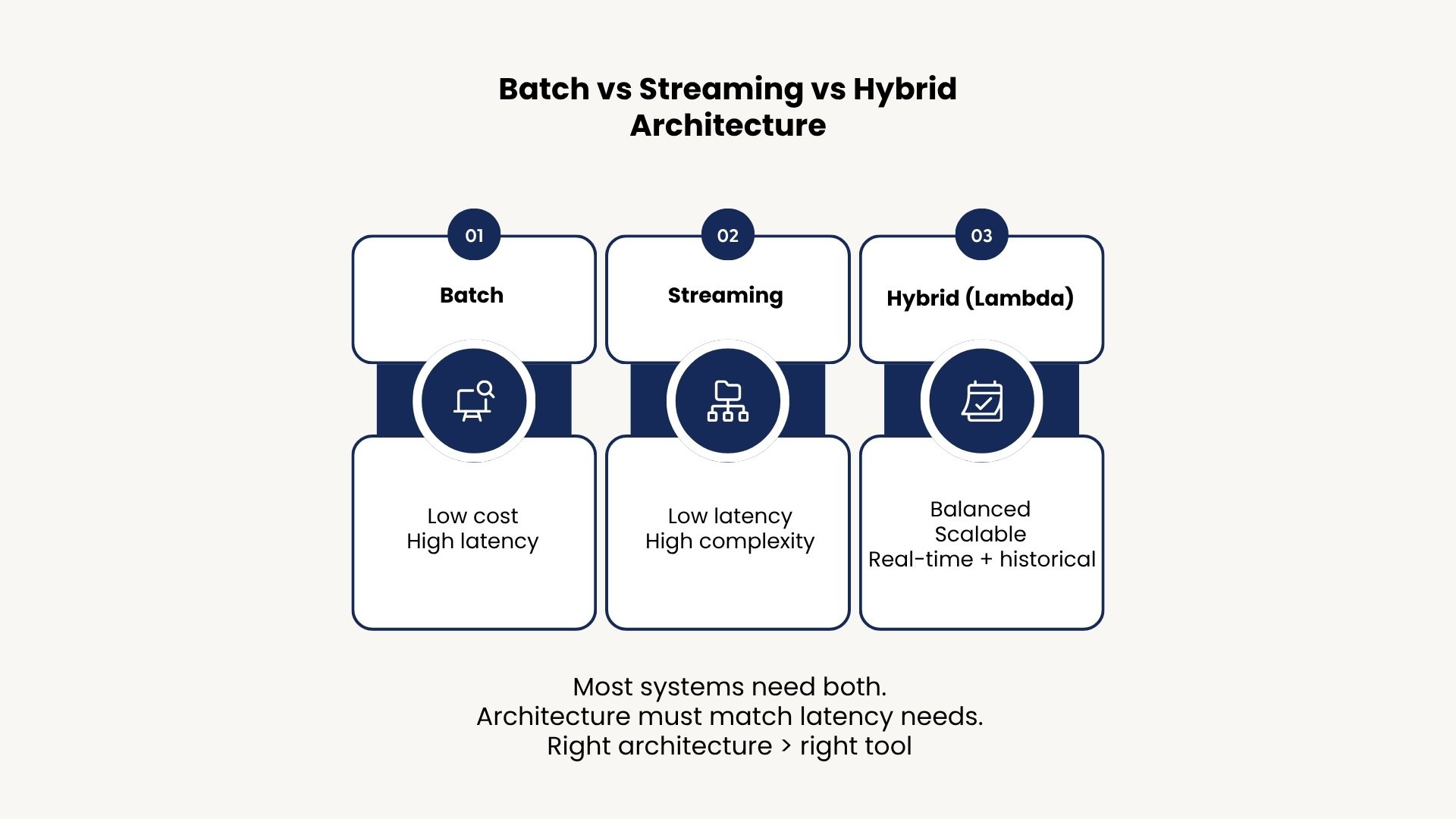
The traditional batch-only architecture is no longer sufficient. Batch processing remains dominant for historical reporting and scheduled workloads where hourly or daily freshness is acceptable. However, streaming ETL is becoming the foundation for fraud detection, real-time personalization, operational dashboards, and AI feature pipelines.
The latency requirement determines the architecture. If your acceptable staleness is hours or days, batch ETL is sufficient and simpler. If the answer is seconds or minutes, streaming ETL is required. Most mature data platforms use both: streaming for the real-time operational layer, batch for the analytical warehouse layer.
This is not about choosing one pattern over another. It is about matching the tool to the problem. The strategic challenge is building a Lambda Architecture: a hybrid system that handles both high-volume batch processing and high-velocity real-time streams without breaking under sustained load.
Core Pipeline Components and Their Trade-Offs
A modern pipeline is a layered system with distinct functional zones. The ingestion layer handles raw data intake from CRM systems, marketing platforms, product analytics, and external providers. It must manage structured and unstructured data at varying frequencies while maintaining durability.
Each ingestion pattern carries specific trade-offs:
Batch ingestion delivers cost efficiency and predictability but introduces delayed insights.
Micro-batch processing offers near-real-time access with predictable intervals but demands careful tuning to avoid small-file and metadata churn.
Streaming ingestion provides sub-second latency with stateful processing and exactly-once delivery, but raises complexity around commit frequency, recovery, and backpressure.
The transformation and enrichment layer converts raw data into actionable intelligence. This involves normalizing data formats, cleaning inconsistencies, and enriching records with firmographic data or intent signals. In scalable pipelines, these stages must be idempotent: repeated execution produces the same result as a single execution.
The storage layer has evolved toward the data lakehouse model, combining the low cost of a data lake with the high-performance querying of a data warehouse. This hybrid approach serves multiple masters: data scientists need raw access for model training, while executives need high-speed dashboards for quarterly reporting.
The serving layer delivers data to dashboards, ML models, and operational systems. Performance here determines whether insights remain theoretical or become actionable.
The Cost of Fragile Pipelines
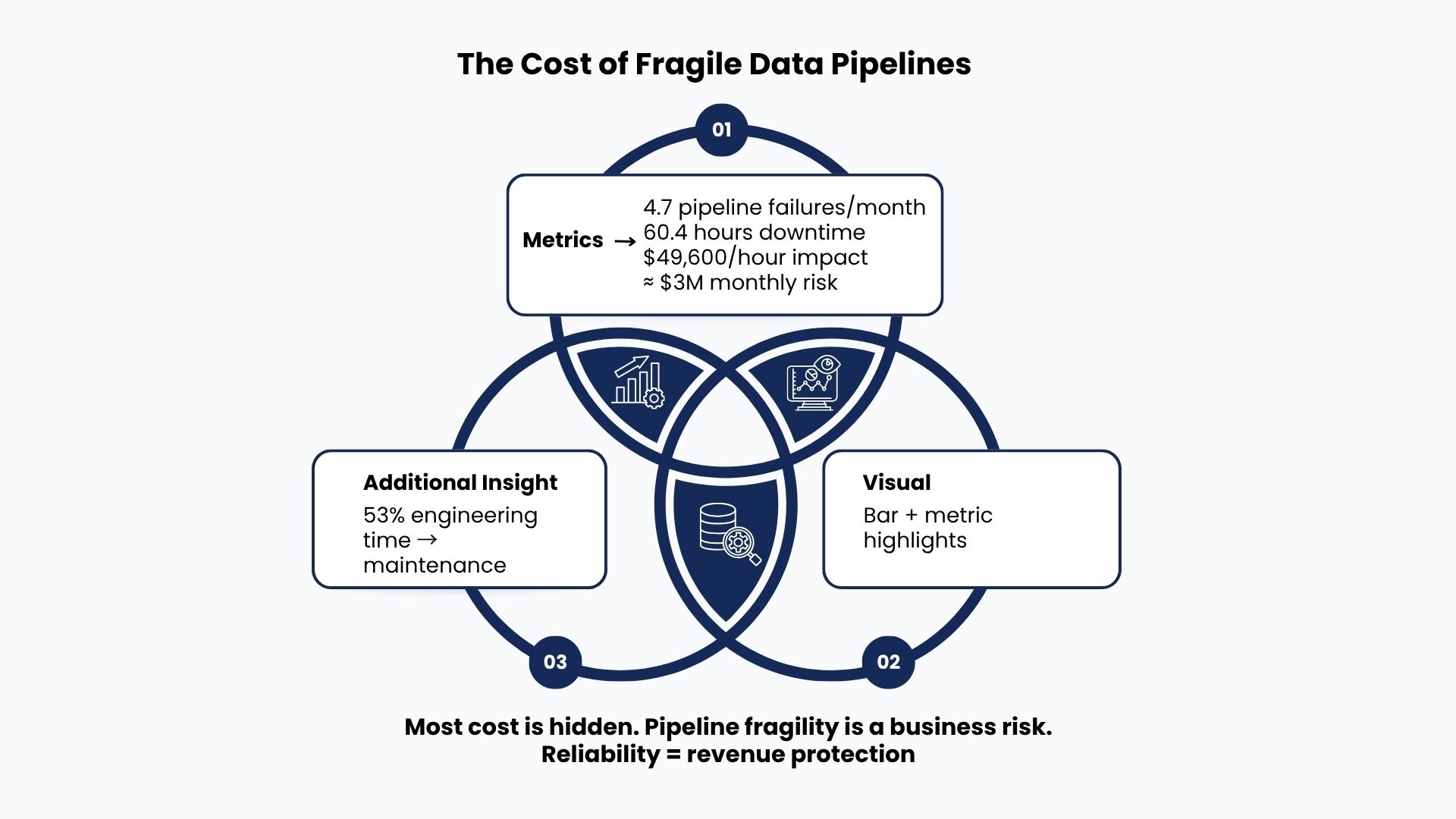
The financial impact of pipeline fragility is staggering. According to Fivetran's enterprise data infrastructure benchmark, organizations experience an average of 4.7 pipeline breaks per month, resulting in 60.4 hours of downtime monthly. Data leaders estimate the business impact of downtime at $49,600 per hour, putting nearly $3 million in potential business value at risk each month.
Perhaps more concerning is the hidden cost of maintenance. Data teams dedicate 53% of engineering time to pipeline maintenance, with $2.2 million per year spent on pipeline upkeep by full-time engineers. Legacy and DIY pipelines break 30-47% more often, requiring 2-4 additional hours for repairs.
The pattern is consistent: as pipelines scale in size, speed, and frequency, the analytics stack begins to take on the characteristics of a distributed compute system. Throughput, reliability, and orchestration matter as much as the data itself.
Reliability and Fault Tolerance: Engineering for Failure
Failures in distributed pipelines are inevitable. The question is how systems handle them.
Achieving reliable event processing requires more than retries. Transactional APIs offer built-in correctness guarantees but have well-defined throughput limits. Exponential backoff helps protect systems from transient failures by routing retried events out of the main processing pipeline, avoiding retry storms.
Stage-aware retry mechanisms ensure that on failure, only incomplete stages are replayed rather than the entire workflow. Idempotent API and protocol design guarantees that repeated execution does not alter shared state beyond its initial application.
For streaming pipelines, key reliability metrics include checkpointing to identify processed data and offsets, backpressure monitoring to identify bottlenecks, and throughput tracking to ensure the system keeps pace with data ingestion. Exactly-once processing demands atomicity across services, a requirement that retries alone cannot satisfy.
One of the greatest silent killers of analytics quality is data duplication. If a pipeline fails and restarts, it might accidentally ingest the same records twice. Scalable pipelines use unique keys to ensure that even if the same data is processed multiple times, it only appears in your warehouse once. This is the foundation of data integrity at scale.
Operational Excellence: Observability as Infrastructure
Observability is not an add-on. It is core infrastructure. You cannot fix what you cannot see.
Key metrics for pipeline observability include backpressure to identify bottlenecks, throughput to track messages per micro-batch, duration to measure average processing time, latency to understand end-to-end delay, cluster utilization to ensure efficient resource allocation, and cost tracking for budget optimization.
The dbt Labs report highlights a structural imbalance: while 72% of teams prioritize AI-assisted coding, only 24% prioritize AI-assisted pipeline management, including testing, observability, and quality controls. This acceleration without stabilization creates systemic risk.
Organizations must balance cost and performance. Real-time data is expensive. Strategic leaders perform a value-to-latency analysis. Does an SDR need a lead in 5 seconds or 5 minutes? Designing for "just enough" speed can save millions in unnecessary compute costs.
Strategic Implications: Infrastructure as Competitive Advantage
Data pipelines are evolving from backend processes into core infrastructure layers. The shift is clear: from data movement to data systems, from pipelines to infrastructure, from reporting to decision enablement.
A scalable pipeline allows you to move from insight to action in minutes. If your competitor is manually uploading CSV files while your pipeline automatically triggers ad spend based on real-time intent, you have a structural advantage that no amount of creative can overcome.
By ensuring data is fresh and accurate, you avoid the irrelevance tax: sending a prospect outreach three hours after they have already signed a contract. You respect the buyer's time economy.
We are moving toward a world of autonomous GTM agents. These agents will only be as effective as the data pipelines they inhabit. If the pipeline is fragmented, the agent will be confused.
Conclusion: Engineering the Future of Analytics
The organizations that scale data pipelines successfully recognize that the analytics stack is evolving into infrastructure. As the dbt Labs report emphasizes, "as we scale, our foundations must be as robust as our ambitions."
Pipeline scalability is not about choosing the right tool once. It is about building systems that can evolve from batch to streaming, from manual to automated, from fragile to resilient without breaking under pressure.
The question is not whether your pipelines will be tested. It is whether they will survive. In the intelligence era, data is only valuable if it flows reliably, at scale, and at the right time. The organizations that master scalable data pipelines turn data into consistent, real-time business advantage.
Is your data pipeline a high-velocity engine of growth, or a leaking pipe of fragmented noise? Stop auditing your tools. Start auditing your architecture.