
Article
Designing Data Architectures for Real-Time Analytics
This blog explains the shift toward real-time analytics architectures as an operational necessity for modern businesses to gain a competitive edge. It details the core technical components such as event ingestion, stream processing, and real-time storage, while highlighting the critical trade-offs between system complexity, cost, and performance.
- Topic
- Data Engineering and Analytics
- Published
- 2 Apr 2026

A financial services company can manage to spot fraudulent transactions in a matter of seconds, whereas it used to take hours earlier, and as a result, they have reduced account takeovers by 60 percent. An e, commerce business has been able to react to changes in demand instantly by adjusting its prices and stock levels accordingly, and this has led to an increase in their conversion rate by 23 percent. A healthcare organization has been able to identify patients at risk of their condition worsening and consequently provide timely care to them, resulting in a decrease of hospital readmissions by 22 percent.
These kinds of results are now becoming a reality thanks to real, time analytics architectures that can turn data velocity into a competitive advantage. However, for each success story, numerous teams encounter difficulties with systems that are supposed to provide real, time insights but, in fact, bring complexity, cost overruns, and poor performance. Back then, a decade ago, it was perfectly fine to have your analytics results the next day.
Nowadays, the value of delayed insights is so low that they are almost equated to no insights at all. People want their dashboards to be updated immediately. The operations team needs to be able to deal with the problem now as it arises instead of after the damage has already been done. Being faster than your competitors in turning data into actionable decisions is now one of the main factors behind gaining a competitive edge.
The Growing Importance of Real‑Time Analytics
The shift to real-time is not a result of technology trend changes. It has more to do with how fundamentally businesses have changed operating and customers have changed their expectations level.
Just like consumers are dealing with recommender systems that change according to their last click, alerts for fraud that are after seconds of suspicious behavior, and shipment tracking that is continuously updated and refreshed, these are just some of the consumer experiences that influence business expectations. A fresh industry poll says 63% of enterprises say that streaming data platforms are their main source of AI development, and real-time analytics becoming indispensable for automated decision-making mechanisms.
Business users now want enterprise analytics to be just as instant. A sales team viewing yesterday's pipeline metrics operates in a different reality than one seeing updates from five minutes ago. Marketing campaigns optimizing hourly outperform those adjusting daily. Supply chain managers need current inventory levels, not last night's snapshot.
Operational intelligence drives the other major force. IoT Analytics forecasts that worldwide IoT devices will hit 21.1 billion in 2025, representing a 14 percent increase over 2024, and will come to 39 billion by 2030. Every device produces ongoing data that must be processed right away. Factory lines figure out when machines are going to break down even, they have not broken yet. The infrastructure of smart cities changes the traffic lights to suit the real conditions.
All these situations have one thing in common: batch processing is of no use. A network intrusion detected through batch processing cannot prevent a breach that has already happened. Discovering equipment failure patterns after the machine breaks doesn't avoid downtime. Real-time analytics has shifted from competitive advantage to operational necessity for entire industries.
Core Architectural Components
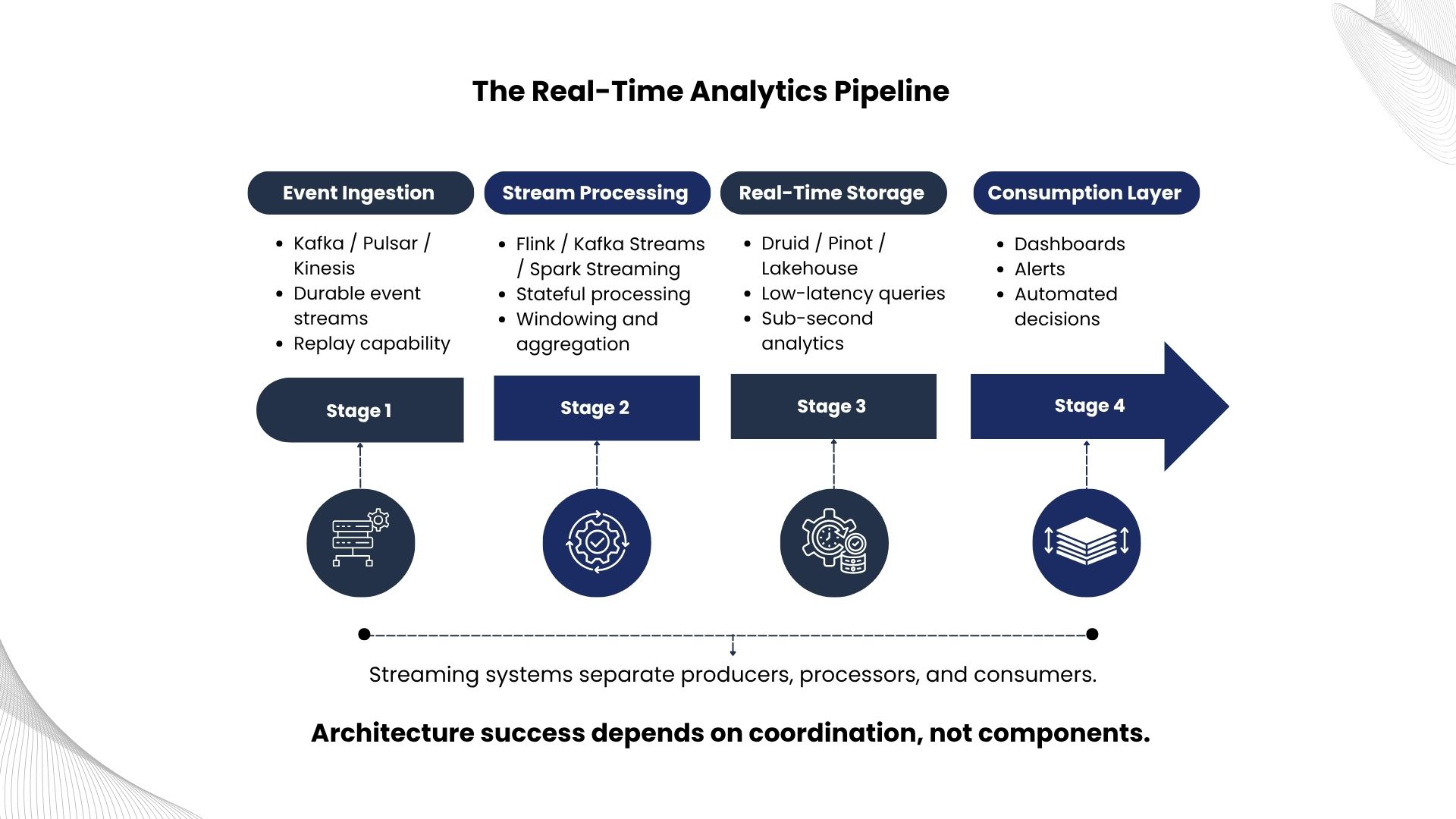
Creating effective real‑time analytics requires coordinating multiple specialized components so they function as a unified system.
Event ingestion platforms
Event ingestion is basically the point where the streaming data enters the system. For this particular aspect, Apache Kafka is the leader, offering a distributed and durable log that effectively separates data producers from consumers. Kafkas publish, subscribe model permits multiple downstream systems to independently access the same event streams. Other lesser, known platforms such as Apache Pulsar and AWS Kinesis provide almost identical features but with a different set of trade, offs in operations. In terms of technical features, Pulsar is great at multi, tenancy and geographic distribution, whereas Kinesis is more AWS, centric with very little operational overhead.
The main thing that these platforms are capable of are buffering and replay. The events are stored in the platform so that the consumers can go back and reprocess the historical data or recover from failures by rolling back to an earlier point in the stream. This level of durability is what makes exactly, once processing semantics possible, a scenario most commonly associated with financial transactions, inventory updates, and other similar use cases where duplicate or missing events would cause significant issues.
Stream processing engines
Stream processing changes raw event streams into insightful decisions. Apache Flink stands out as the leading standard, it is a stateful stream processing engine with very low latency and extremely high throughput. Flink considers streams as tables that are updated incrementally, and thus, one can use the same code for batch processing as well as for real, time processing. Its advanced watermark and event, time processing features flawlessly deal with out, of, order and late, arriving events, which is quite important for real, life situations where events can be delayed by networks and retries due to which events may even arrive after newer events have already been processed.
Other options are Kafka Streams, which is for lightweight processing that is very tightly coupled with Kafka, and Spark Structured Streaming, which is for teams that are already familiar with the Spark ecosystem. By 2025, managed offerings from Confluent, Databricks as well as from cloud providers, made these technologies widely available to everyone by significantly reducing the operational complexity that was one of the main reasons for the low adoption of these technologies in the past.
Stream processors can do the job of selecting, summarizing, and changing the events that are in motion. They can keep track of their state across event streams and instead of batches, they can run business logic continuously. Typical examples of use are windowed aggregations such as metrics per minute, real, time anomaly detection, and sessionization whereby the user behavior is being tracked through patterns.
Real-time storage
Processed data has to be placed in systems that are best suited for low-latency reads. Apache Druid and Apache Pinot are known for OLAP queries on streaming data and they are able to provide sub-second responses for aggregations and filters over billions of events. These databases that are optimized to a high degree internally store data in columns, create indexes efficiently, and perform queries with a distributed architecture, thus enabling the level of performance that traditional databases can hardly dream of.
Another emerging trend is data lakehouse architectures that primarily integrate streaming ingestion with batch analytics features. Delta Lake brings ACID transactions and schema enforcement to data lakes while Iceberg offers table formats features such as time travel and schema evolution. Top-tier platforms such as Databricks and Snowflake currently support near real-time ingestion along with freshness guarantees as low as minutes, thus closing the streaming and traditional analytics gap.
Consistency and Ordering Challenges
Real‑time stream processing brings its own set of distributed‑systems challenges that batch processing never has to deal with.
Late and out-of-order events
In distributed environments, it is common for events to be delayed because of the network. Events may come in different orders in various partitions. For instance, a payment confirmation can come after a fraud check. To correctly handle such scenarios, stream processing engines employ measures such as watermarks, timeliness progress indicators, and allowed lateness windows.
Imagine an e-commerce analytics system that measures the hourly revenue. Using processing time, when events arrive at the system, a delayed order confirmation might fall into the wrong hour's aggregation or be dropped entirely. Event time processing solves this by using timestamps embedded in the events themselves. When a late event arrives, the system places it in the correct time window based on when the transaction occurred.
Watermarks represent a threshold: "I believe all events with timestamps before time T have now arrived." When the watermark advances past a window's end time, the system finalizes that window's aggregation. The watermark strategy balances completeness against latency. Waiting longer captures more late events but delays results.
Exactly-once semantics
Exactly-once processing, which ensures that each event impacts the outcome once and only once, is quite often considered indispensable. However, carrying out exactly-once can make the system more complicated and can even lower the throughput. It involves close coordination between storage and processing.
For end-to-end exactly-once with Kafka sources and sinks, Flink coordinates checkpoints with Kafka transactions. The checkpoint saves Kafka offsets, Flink processing state, and transaction IDs. In case anything goes wrong between checkpoints, Flink will roll back its state while Kafka rewinds to earlier offsets, then the system will retry.
Several teams accomplish more success by posing a simpler question: Which level of duplication or loss is tolerable for this use case? In fact, for many analytics scenarios, exactly-once processing with idempotent operations is not only sufficient but also more resilient.
Performance and Scalability Trade-offs
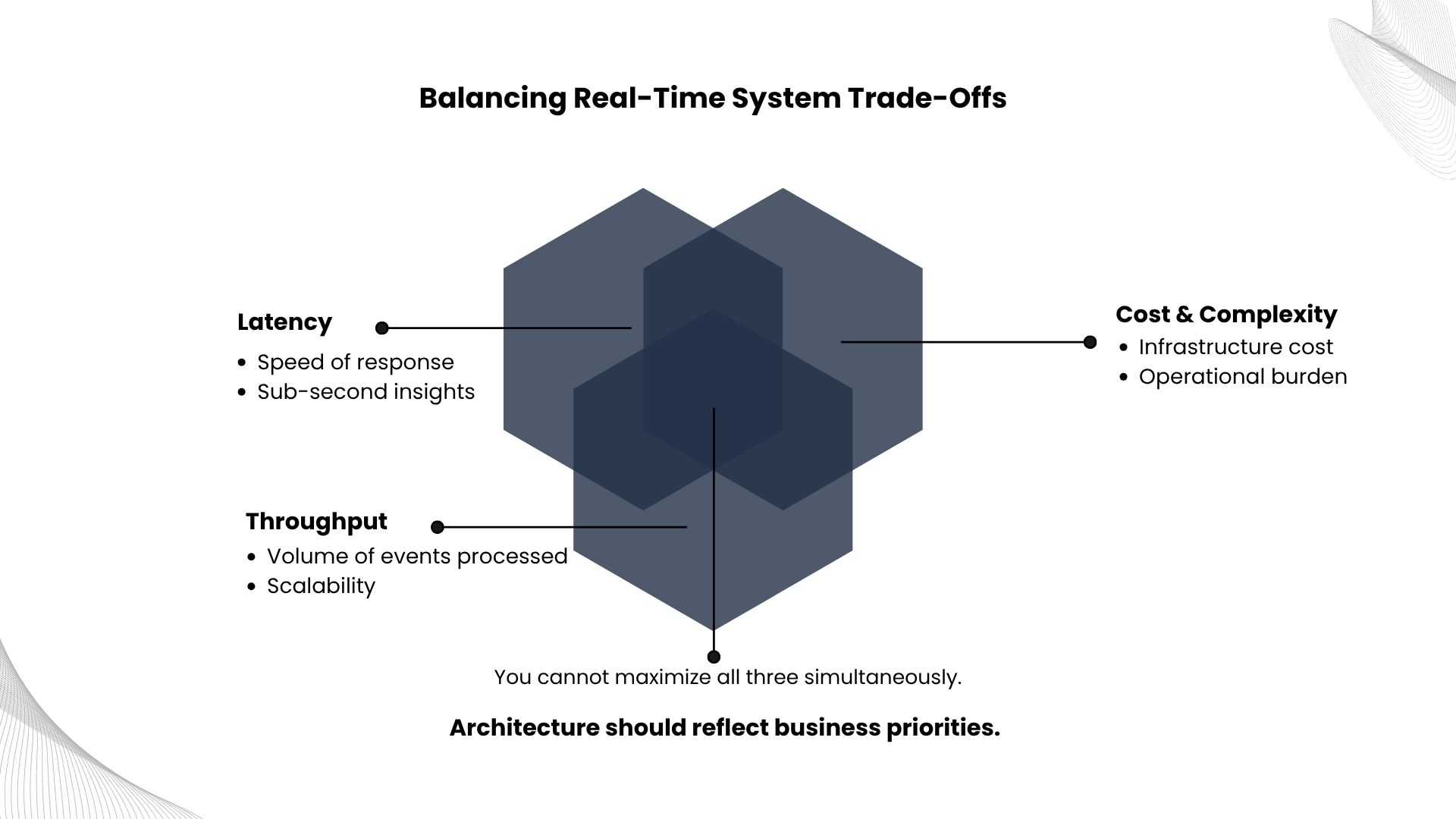
Real‑time analytics requires teams to balance a number of challenging trade‑offs.
Throughput versus latency
You optimize for high throughput, processing massive volumes, or low latency, responding almost instantly. Optimizing both simultaneously is expensive. Throughput indicates the number of events the system can handle in a second. Latency refers to the time it takes for a single event to be processed from the initial stage to the time the query results are obtained.
Batch-oriented approaches try to get the highest throughput by processing large blocks of data at the same time. Processing events one at a time leads to the lowest latency but may lose some throughput. The right choice depends on use cases. Fraud detection requires sub-second latency to block transactions before they complete. Business intelligence dashboards updated every 30 seconds tolerate higher latency for better throughput.
State management
Stateful processing is where complexity compounds. Computing aggregations, joins, or complex event patterns requires storing intermediate results. A session window tracking user behavior might accumulate state for 30 minutes before closing. Focus should be on how many details of the state are held in memory, method of checkpointing and recovery of state, and how state scales when nodes are added.
Apache Flink solves this by having the state backends as interchangeable components. The RocksDB state backend keeps the state on disk by means of an integrated key, value store and thus allows the size of the state to be larger than the available memory.
Bad state management causes issues with performance that is not stable, very long recovery times, and a higher risk of operation failures.
When Real-Time Is Overkill
Not every situation truly needs the added complexity and cost of real‑time analytics, even with all the excitement around it.
Cost versus value analysis
Real‑time systems tend to come with higher infrastructure costs, more moving parts to manage, and a tougher learning curve for teams. Calculate the cost of data latency. If hourly revenue reporting drives decisions adjusting daily pricing, real-time updates provide no benefit. If monthly executive dashboards inform quarterly strategy, daily refreshes suffice.
A revealing question: what action changes if data arrives in one second versus one minute versus one hour? If nothing actually changes by getting data faster, then real‑time analytics is unnecessary overhead. Begin with batch processing and shift to streaming only when the business genuinely needs it.
Simpler alternatives
Before jumping into full real‑time architectures, it’s worth exploring simpler options like micro‑batching updates every few minutes, incremental batch processing, or batch jobs that run whenever specific events occur. These approaches often satisfy business needs without the overhead of full streaming systems.
Micro-batch processing with tools like Spark Structured Streaming or scheduled Airflow jobs provides "near real-time" analytics with dramatically less operational overhead than pure streaming. Snowflake’s Dynamic Tables make it easy to build data pipelines that stay up to date within minutes, without needing separate orchestration tools.
Developing Sustainable Systems
Initially, pinpoint use cases where real-time is genuinely essential: fraud prevention, operational monitoring, personalization engines. For these high value applications create streaming pipelines and at the same time maintain batch processing for other applications. This hybrid approach maximizes return on complexity.
Choose managed services instead of self-hosted infrastructure, whenever possible. The main challenge for most organizations will be the operational effort of running Kafka clusters, Flink jobs, and specialized databases across availability zones that far exceeds the licensing costs. Also, if you go with a fully managed real, time analytics stack from Confluent, Databricks, AWS, or Google Cloud, the operational overhead is greatly reduced, and enterprise, grade reliability is achieved.
Design for evolution. Start with simpler micro-batch processing and migrate to pure streaming only when latency requirements demand it. Architectures built on open formats like Apache Iceberg maintain flexibility to switch platforms without complete rewrites. Separate data ingestion from processing from storage to enable independent evolution of each component.
Competitive advantage does not stem from owning the quickest pipeline; it's found through using analytics to build effective systems to deliver timely insights in a sustainable manner as both the amount of data and the number of use cases increase. Real-time analytics are about aligning the technology with the business needs while managing the complexity and cost of doing so in a sustainable way.