
Article
Data Modeling for Analytics: From Raw Data to Strategic Intelligence
This blog explains why most B2B organizations struggle not with collecting data but with trusting it and how strategic data modeling transforms raw information into reliable, AI-ready intelligence. It offers a practical blueprint for moving from fragmented dashboards to a shared decision architecture that marketing, sales, and finance can actually rely on.
- Topic
- Data Engineering and Analytics
- Published
- 21 Apr 2026

The real marketing advantage isn’t having the most data. It’s turning that data into useful insights the fastest.
Most companies are stuck in a data fog. They run hundreds of tools and generate terabytes of information, but 87% of CMOs lack confidence in their own data driven decisions. The issue isn’t collection. It’s architecture.
When someone asks why sales and finance see different numbers for the same quarter, nobody can answer. The data is there, but the insights aren’t. Only 12% of enterprises have fully integrated business needs with data models. Everyone else just builds dashboards instead of driving real decisions.
Layering AI on shaky data only makes things worse. AI doesn’t understand meaning, it finds patterns. If your definitions are inconsistent, AI will confidently fill the gaps with nonsense. That doesn’t just break dashboards. It breaks trust.
The shift now is from storing data to building shared understanding. Across teams, overtime, and in everyday work.
Why Data Modeling Determines System Intelligence
Data modeling keeps things simple without losing meaning. Raw data is built around transactions and apps: clicks, API calls, CRM updates. But business people think in terms like pipeline, ROI, and customer lifetime value.
Modeling translates between those two worlds. It turns scattered data into a solid foundation for analysis. There are three layers: structural (how data is stored), semantic (what data means), and computational (how results are calculated). If any layer fails, trust breaks.
This becomes even more critical with AI. When someone asks a chatbot, "Why did profit drop last quarter?" the AI needs to know what profit actually includes. Without a clear definition, it will guess confidently and get it wrong.
Google’s Looker docs confirm that conversational AI relies on a strong semantic layer. AI doesn’t remove the need for modeling. It makes modeling more important. Teams that treat modeling as live metadata build analytics they can trust. The rest just keep fighting over numbers.
Architectural Patterns: Star Schemas, Wide Tables, and Strategic Trade-offs
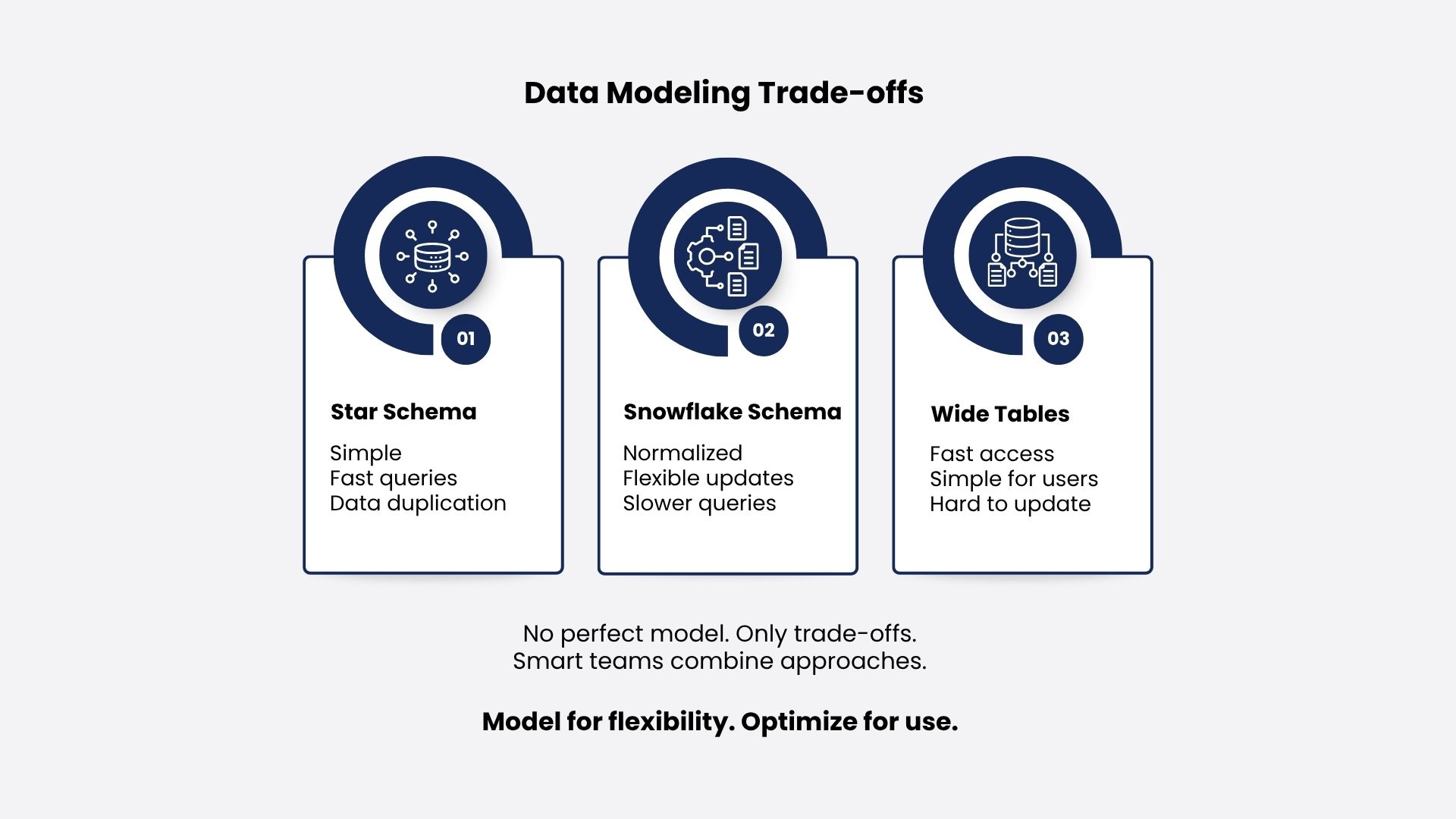
The way you model data shapes what questions you can answer and how fast.
Star schemas stay popular because it keeps things simple. A fact table holds numbers like sales and timestamps, surrounded by dimension tables with context like product names or customer details. Queries run faster with fewer joins, and analysts can understand it quickly. For marketing and RevOps, this means better metric consistency across teams. The tradeoff is data duplication and higher storage costs.
Snowflake schema breaks dimensions into smaller, related tables. Update a tax rate once, and it applies everywhere. But more joins mean slower queries and harder to read reports. It gives you control at the cost of speed.
Wide tables take the opposite route. Everything gets pre-joined into one flat structure. Modern databases like Snowflake or BigQuery make this viable. It is brutally simple for end users, but updating a customer segment means rewriting millions of rows.
The smart middle ground combines both. Keep core data in normalized models for consistency. Then prebuild wide tables or materialized views for heavy queries. Model once, materialize often. You get flexibility without losing speed.
The Scale Challenge: When Business Logic Evolves Faster Than Schema
Data models break down over time. That is the hard truth of working at scale.
Business logic never stays still. Attribution models change. Customer definitions shift. New channels pop up. The winners are not the ones who stop change, but the ones who build for it.
That means moving from rigid schemas to flexible frameworks. When you switch from last touch to multi touch attribution, can you do it without breaking every dashboard and ML model downstream?
Scale makes performance issues worse. A model that flies at 10 million records can die at 100 million. Queries that run fast on last weeks data may time out on last years. These are not just tech problems. They slow down how fast your organization can learn.
The fix is not bigger databases. It is smarter design: partitioning, incremental computation, and pre built summaries. Top teams use tiered setups. Hot data from the last 90 days for real time work. Warm data from the last two years for regular analysis. Cold archives for deep historical pattern finding.
And as more people access modeled data, governance gets harder. Who changed the revenue definition? Which reports broke because of it? Without strong governance baked into your modeling practice, data democracy just turns into data chaos.
Impact on Analytics Consumers: From Gatekeepers to Strategic Velocity
A good model keeps queries simple. A weak one pushes all the complexity onto the business side.
If analysts have to write messy logic every time they want to calculate pipeline or engagement, self service never really works. If RevOps teams spend hours fixing account hierarchies and campaign names before every review, the system is not delivering insights. It is just creating more cleanup work.
The right model wraps complexity into business friendly terms. When your demand gen manager can answer strategic questions without a data engineer, that is real analytical leverage. Tools like dbt or Looker show the way: define a metric once at the model level instead of rewriting it in every report.
When qualified lead means the same thing across every dashboard because it is defined in the model, you get semantic consistency. That has a direct business payoff. Marketing, sales, and finance stop arguing about definitions and start focusing on decisions. Planning speeds up. Forecast debates shrink. Experiments feel trustworthy.
A stable, well documented model lets teams move faster because they spend less time fighting over what numbers mean and more time acting on them.
The Intelligence Layer: AI Readiness and Predictive Outcomes
AI models need clean, consistent historical data. Your data model is the foundation of your marketing intelligence. Predictions for customer lifetime value, churn, and next best actions all depend on how you structure data today. That structure decides what patterns your AI can learn tomorrow.
Real time personalization needs pre computed context. When a high value prospect lands on your site, you have milliseconds to act. Companies that nail AI driven personalization are not doing complex math on the fly. They are querying pre modeled, well indexed data.
The features data scientists build, like engagement scores or channel affinity, are really just pre computed dimensions. Teams that bake feature engineering into their core modeling practice can cut months or years off their path to marketing AI.
Maintaining Models Over Time: The Refactoring Imperative
Great models are not built once. They are maintained.
Refactoring is not failure. It is a sign your business has grown. Treat business logic like code. Attribution rules and metric definitions belong in version control. When something changes, you can see what changed, why, and who approved it. That turns vague data trust issues into clear, auditable processes.
When refactoring core models, run the old and new versions side by side for a while. This shadow mode lets you test new logic before fully switching over. It takes longer but saves you from breaking critical reports.
Documentation is not optional. Every table and transformation should explain what it means, how it is calculated, and who depends on it. Tools like Acryl (DataHub) help with searchable docs and lineage. When people understand the data, they trust it.
A Practical Model: The Three Layer Analytics Architecture
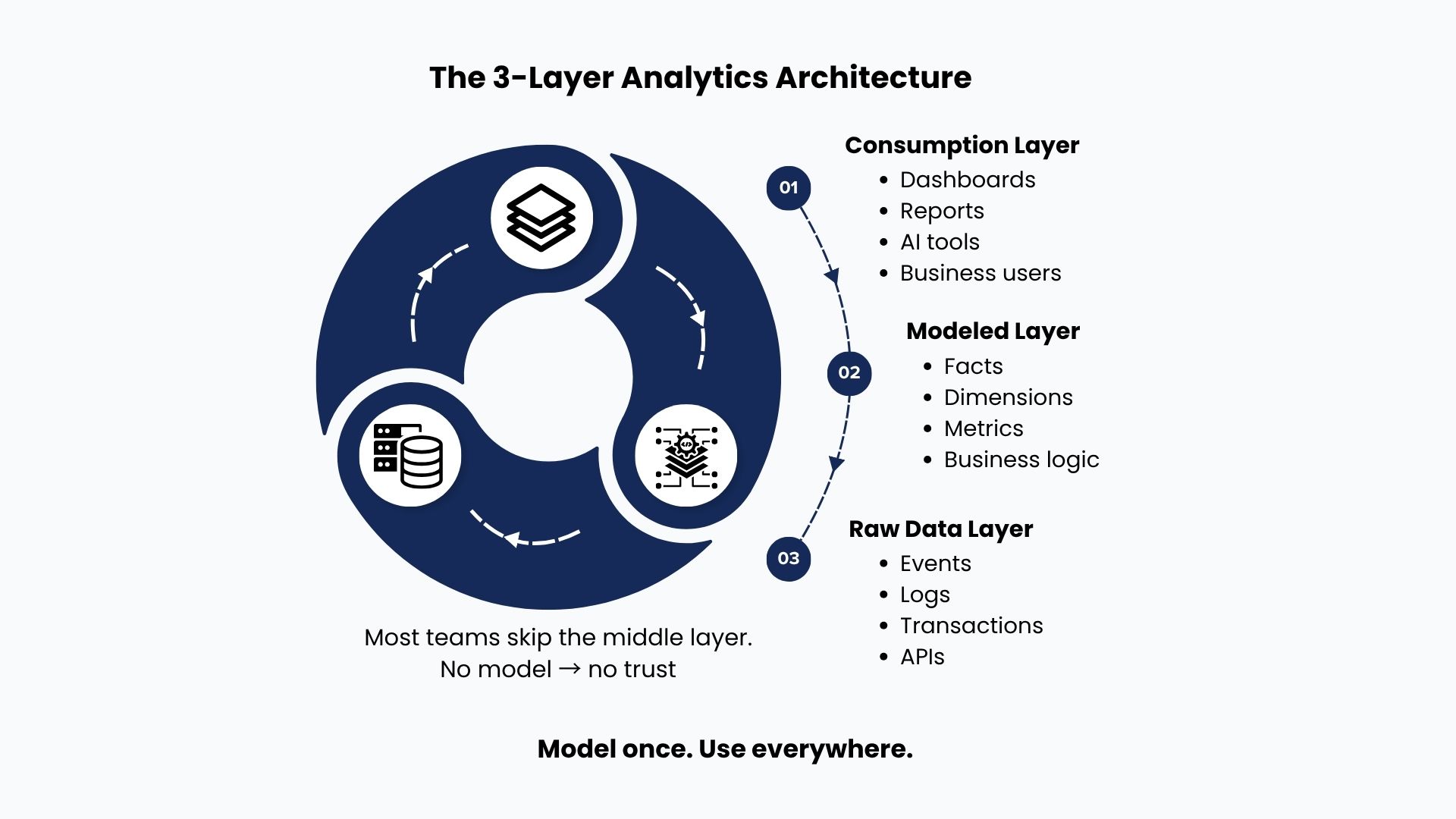
Layer 1: Raw Data Layer. Source data lands here. Noisy and event driven. Preserve fidelity, not readability.
Layer 2: Modeled Data Layer. This is where transformation happens. Facts, dimensions, relationships, and metric rules live here. This layer creates consistency.
Layer 3: Semantic Consumption Layer. Governed metrics and business friendly terms are exposed here for dashboards and self serve tools.
Many companies skip Layer 2 or merge it with Layer 3. That works for speed in the short term but kills scalability later. Using frameworks like dbt, you build staging layers for cleaning, intermediate layers for logic, and mart layers for final tables. Clean models connect to BI tools like Looker or Metabase, so business users can explore without SQL.
Strategic Implications: Modeling as Competitive Moat
Companies that treat data modeling as infrastructure will beat those that treat it as reporting support.
Analytics is moving deeper into execution. AI tools, journey engines, and attribution systems all depend on consistent modeled data. A weak model makes AI spread confusion. A strong model makes AI spread clarity.
Your competitors can buy the same software and data. But they cannot copy your proprietary data model. One that maps your unique buyer journey is a real moat.
According to Forrester, mature data modeling practices deliver 23 percent faster time to insight and 3.5 times higher marketing ROI. Gartner finds poor data quality costs organizations $12.9 million a year on average. The flip side is just as powerful.
So the question for marketing leaders shifts. Not Do we have dashboards? But Do we have a model that supports governed, reusable, scalable decisions for both people and machines?
Conclusion: From Reporting to Strategic Architecture
Data modeling seems like a technical choice. But it is one of the most strategic decisions you can make.
It decides whether teams trust their numbers, whether self serve analytics actually works, whether AI outputs are reliable, and whether raw data becomes insight or just more noise.
The path from raw data to clarity is not about more tools. It is about better structure. Data modeling bridges the chaos of the market and the clarity of the boardroom.
The future belongs to organizations that stop treating modeling as a reporting step and start treating it as decision architecture. The fastest movers will not be the ones with the most data. They will be the ones with the clearest models. They treat their data model as a core product, investing in structural integrity so every touchpoint adds to a growing body of knowledge.
AI does not fix bad models. It makes their flaws louder. The winners will be those who treat data modeling not as a one time design task, but as ongoing operational infrastructure.