
Article
Data Lineage in Complex Analytics Ecosystems
This blog explains why organizations no longer struggle to access data but struggle to explain it, with 68% of teams unable to trace a metric to its source within 15 minutes. It covers what lineage actually tracks (transformations, dependencies, movement, downstream impact), the three architectural approaches (query parsing, event-based, metadata-driven), a four-layer maturity model, and why lineage has become the trust layer for AI governance in complex analytics ecosystems.
- Topic
- Data Engineering and Analytics
- Published
- 28 Jul 2026

Introduction: From Data Access to Data Accountability
For a decade, marketing and revenue organizations optimized for one thing: more data. More platforms, more integrations, more dashboards. That race produced sprawling stacks of CRMs, CDPs, ad platforms, warehouses, and AI models, stitched together by pipelines few people fully understand.
The result is a strategic inversion. Organizations no longer struggle to access data. They struggle to explain it. A 2025 RevOps benchmark of 46 B2B companies found that 68 percent of teams could not trace a single metric back to its source within 15 minutes, and 42% had made a flawed decision because of untraceable data transformations.
This is not a tooling gap. It is an architecture gap. As companies shift from manual reporting to automated orchestration to AI-driven decisioning, the critical question changes. It is no longer "can we access the data." It is "can we explain how this data became the number we are using to decide." That question defines data lineage, and the organizations that answer it well are building a durable competitive advantage.
Why Data Lineage Matters
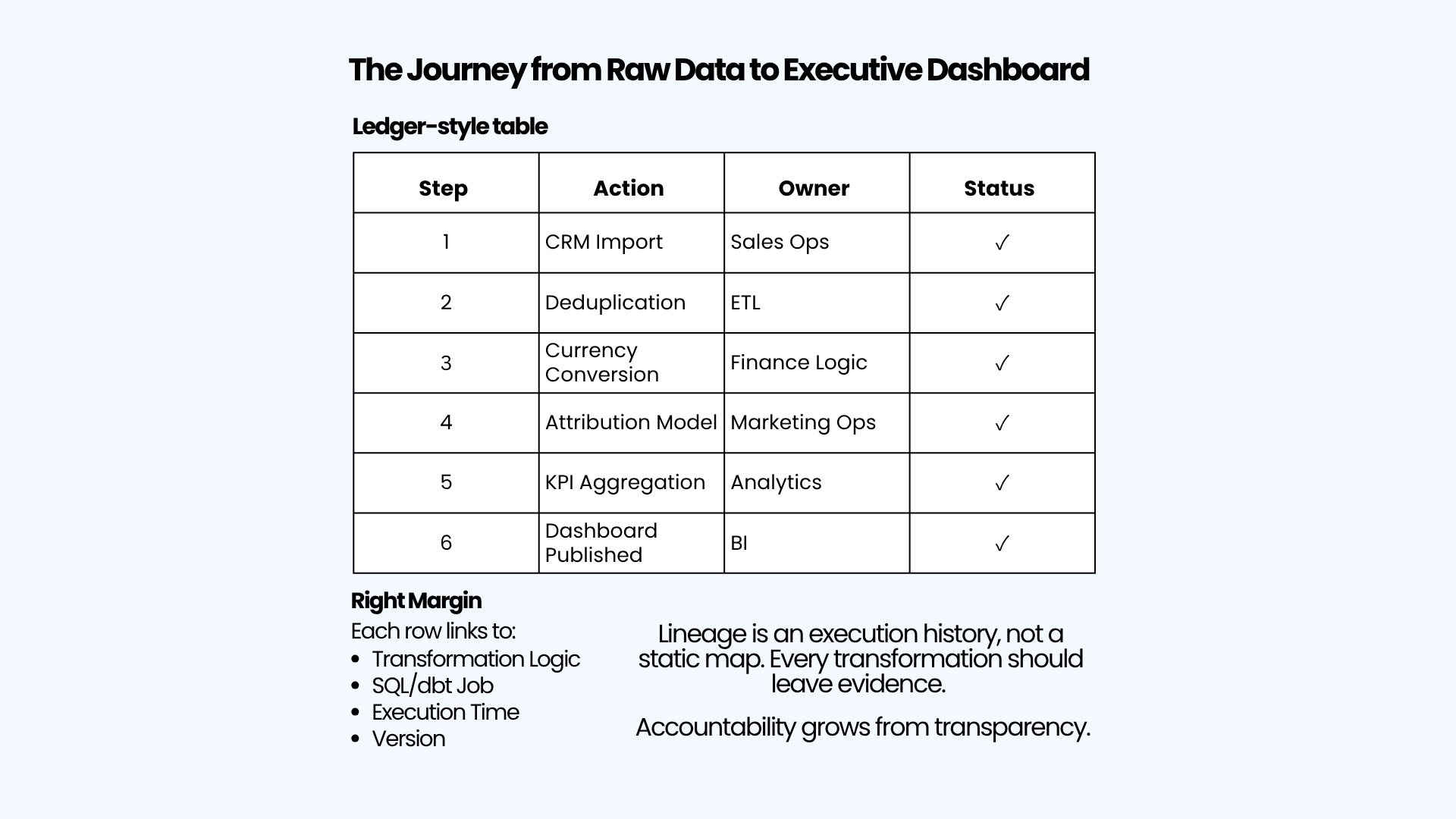
Analytics outputs are only as trustworthy as the journey behind them. A revenue figure, churn score, or attribution model passes through filtering, joins, enrichment, deduplication, and manual correction before it reaches a dashboard. Each step can quietly distort the number, and when a CMO reallocates budget based on attribution data nobody can fully audit, the cost of an untraceable error compounds fast.
Pipeline complexity makes this worse. A 2025 MarTech benchmark found the average GTM pipeline now spans 12 to 18 systems, with complex pipelines running 40 or more transformation steps. A single upstream field can feed dashboards, AI scoring models, and compliance exports simultaneously. Change that field without visibility into its dependencies, and multiple systems break at once, often discovered only after the damage is done.
Regulation has turned this operational risk into a legal one. GDPR, CCPA, and emerging AI governance rules require organizations to prove where data originated, how it changed, and which models consumed it. Lineage converts compliance from a reactive scramble into a repeatable, auditable process, with mature organizations cutting audit preparation time by roughly half.
Underneath all of this sits a trust problem. When sales and finance disagree on pipeline numbers, or marketing and RevOps report different campaign influence, the disagreement is rarely about the data itself. It is about the inability to trace how each team's number was built. Lineage resolves these disputes by making the path from source to output explainable.
What Data Lineage Actually Tracks
Mature lineage systems track four interconnected dimensions, not a single static map.
Source-to-destination transformations record how raw data becomes a business metric: the joins, filters, aggregations, and business logic applied at each step. This is where meaning is created, and where most errors hide.
Pipeline dependencies map the relationships between jobs, datasets, and downstream consumers, answering a question every engineer eventually asks: if this upstream source changes, what breaks downstream.
Data movement across systems tracks information as it crosses warehouses, lakes, SaaS tools, and cloud boundaries. In hybrid and multi-cloud environments, now the majority of enterprise stacks, this is where governance boundaries are most often lost.
Downstream impact relationships let teams run impact analysis before deploying a change, rather than discovering the blast radius after a dashboard fails. This dimension turns lineage from documentation into a working safety system.
Architectural Approaches to Lineage Tracking
Lineage tooling has matured through three distinct generations.
Query parsing, the earliest approach, scans SQL logs and execution history to infer relationships automatically, without instrumenting pipelines. It works well in standard SQL environments but loses fidelity with dynamic SQL, templated dbt macros, and transformations that happen in Python or custom APIs.
Event-based collection embeds tracking directly into execution. Standards like OpenLineage capture job runs, dataset reads, and dataset writes as they happen, producing lineage that reflects what actually occurred rather than what the code implies should occur. This scales better with dynamic logic but requires sustained engineering investment.
Metadata-driven, orchestration-native lineage is the most architecturally mature model. Platforms such as Airflow, Dagster, and Prefect, combined with catalogs like DataHub or Microsoft Purview, treat lineage as a native output of pipeline execution itself. Every run produces a lineage record automatically, and the metadata graph stays synchronized with the real state of the system. This generation also enables cross-system federation, stitching together lineage from a Spark job, a dbt model, and a Python script into one unified graph, where the hardest and most valuable lineage problems live.
Operational Benefits Beyond Compliance
Framing lineage purely as a compliance requirement undersells its return. Faster root cause analysis is the most measurable benefit: teams with column-level lineage trace a broken metric to its source in minutes instead of days, compounding into thousands of saved engineering hours annually at scale.
Safer schema evolution follows closely. Fear of breaking downstream consumers is one of the main reasons teams accumulate technical debt, keeping deprecated fields alive indefinitely. Lineage-based impact analysis makes the consequences of a change visible before deployment, not after.
Governance visibility becomes essential as data teams scale and fragment across functions. Without a lineage-backed metadata layer, governance is policy without enforcement. With it, organizations can show exactly where sensitive data lives, who touches it, and which reports depend on it.
A Framework: The Four-Layer Lineage Maturity Model
Layer one is structural lineage: table-level and job-level dependency graphs, supporting basic documentation and early governance work. Most organizations reach this layer with existing tooling.
Layer two is operational lineage: real-time, execution-driven tracking required for reliable incident response and SLA management.
Layer three is column-level lineage: fine-grained tracking of how individual fields are derived, unlocking safe schema evolution and regulatory traceability.
Layer four is cross-system, federated lineage: a unified graph spanning cloud environments, orchestration platforms, and business units, the layer that makes enterprise-scale governance and AI trust tractable.
Most organizations sit at layer one or early layer two. The widest competitive gap in data maturity today exists between layer two and layer four.
Production Realities That Strategy Often Overlooks
Incomplete coverage is the rule, not the exception. Some tools never emit lineage events, some queries bypass orchestration, and third-party pipelines often hide their internals. Treating partial coverage as failure stalls every lineage program; treating it as a metric to progressively improve keeps the program shipping.
Dynamic transformation logic, generated at runtime by configuration or model outputs, resists static analysis by design. Organizations building LLM-driven transformations should plan for event-based lineage from day one.
Cross-cloud complexity is now the dominant architectural challenge. A single data journey might move from Salesforce through Fivetran into Snowflake, get transformed by dbt, land in a Databricks feature store, and surface in a BI report, crossing five metadata models along the way. Open standards like OpenLineage are closing this gap, but the integration work remains substantial.
Scalability arrives late and hits hard. Column-level lineage graphs at large organizations can contain billions of edges, demanding infrastructure most metadata platforms were not originally built to support.
Strategic Implications: Lineage as the Trust Layer for AI
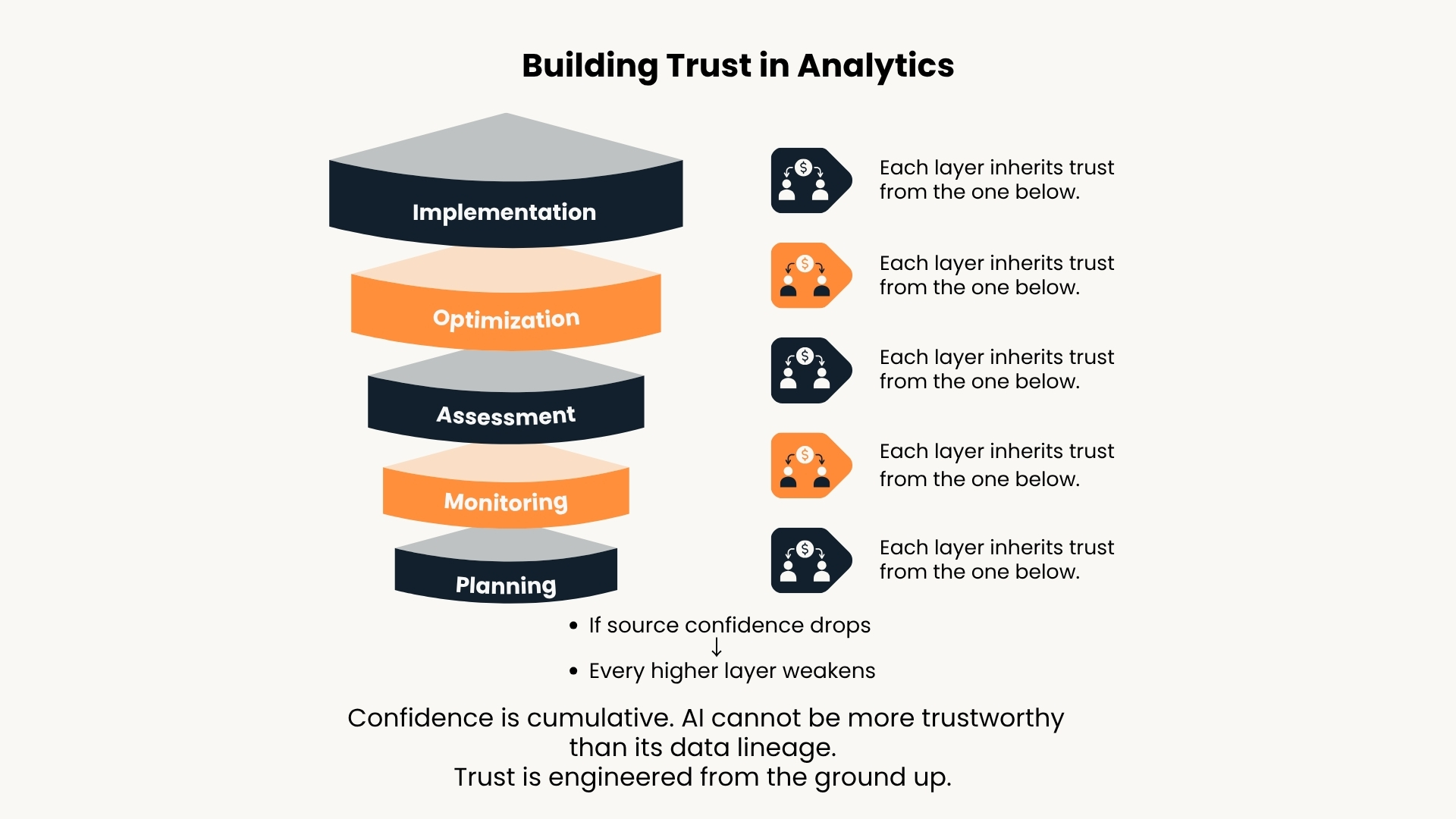
As AI systems increasingly drive marketing and revenue decisions, lineage becomes inseparable from AI governance. Predictive models depend on features, prompts, retrieval sources, and transformation pipelines. If a team cannot trace those inputs, it cannot credibly explain the outputs, no matter how sophisticated the model.
Data-mature organizations have stopped treating lineage as a feature of individual tools and started treating it as a cross-cutting architectural concern. Lineage standards get defined before platforms are selected. Orchestration choices are evaluated partly on lineage emission quality. Lineage coverage becomes a tracked metric, reviewed alongside reliability and data quality, not an afterthought bolted on after an audit failure.
Organizations with strong lineage move faster because they understand their dependencies. Organizations without it move cautiously, because every change carries hidden risk.
Conclusion: You Cannot Trust What You Cannot Trace
The next phase of competitive advantage in analytics will not come from collecting more data or building more dashboards. It will come from the ability to explain, with precision, where any number originated, what happened to it, and what depends on it today.
Data lineage is the infrastructure layer that makes that explanation possible. Organizations that build it in as a first-class architectural concern, rather than retrofitting it after a breach or audit failure, will operate with a level of analytics trust that slower-moving competitors cannot match.
Intelligence without provenance is just confident noise. Lineage is what turns data pipelines into accountable systems, and accountable systems into lasting strategic assets.