
Article
Data Contracts: The Infrastructure Layer Your AI Ambitions Depend On
This blog explains why data pipelines break at organizational boundaries rather than from engineering mistakes, where producers change schemas and semantics without knowing what downstream consumers depend on. It covers the four components of an effective data contract (schema definitions, freshness and quality expectations, versioning policy, compatibility validation), a four-level governance maturity model, and why contracts must be treated as organizational change rather than a tooling rollout. Intelligence built on unreliable infrastructure is fragile intelligence, and contracts are what make the intelligence layer trustworthy.
- Topic
- Data Engineering and Analytics
- Published
- 16 Oct 2026

Organizations are spending more than ever on data infrastructure, yet pipeline failures, silent data corruption, and cross-team breakages are accelerating. This is not a tooling gap. It is an architectural and organizational failure.
Enterprise data has moved through three distinct phases: a tools phase of disconnected SaaS platforms, an infrastructure phase of centralized cloud warehouses, and now an intelligence phase of autonomous AI and real-time prediction engines. Each phase demanded more from the layer beneath it. The intelligence phase requires something the previous two did not: explicit, enforceable agreements about how data is allowed to change.
That is what data contracts deliver. They are versioned, machine-readable operating agreements between data producers and consumers, covering schema, semantics, quality, freshness, ownership, and compatibility. They convert informal assumptions between teams into testable interfaces. For leaders building scalable MarTech ecosystems and AI-driven systems, implementing data contracts may be the highest-leverage infrastructure investment available today.
Why Pipelines Break at Organizational Boundaries
Most pipeline failures do not begin with a catastrophic engineering mistake. They begin at the seam between teams.
A producer renames a field to match internal naming standards. A downstream consumer depends on the old field name. Both decisions are individually reasonable. Together, they create failure. The producer assumes the change is harmless because its own application still works. The consumer assumes the field will remain stable because several models and dashboards depend on it.
Schema changes are the most visible failure mode: removing a column, changing a data type, making a mandatory field nullable, altering enum values. But the more dangerous failures are semantic. A campaign table may still contain a field called "engaged account," but the definition silently shifts from "one interaction in 90 days" to "three interactions in 30 days." The schema remains valid. The business meaning does not. A sales-prioritization model using that field begins ranking accounts differently without producing a technical error.
The most dangerous failure of all is silence. A pipeline may complete successfully while producing structurally correct but semantically broken data. No alert fires. The AI model continues executing on corrupted inputs, leading to misallocated budget and skewed forecasting for weeks before anyone notices. You can build a beautiful data catalog and still have no mechanism to prevent a breaking change from shipping on a Tuesday afternoon.
What Data Contracts Actually Solve
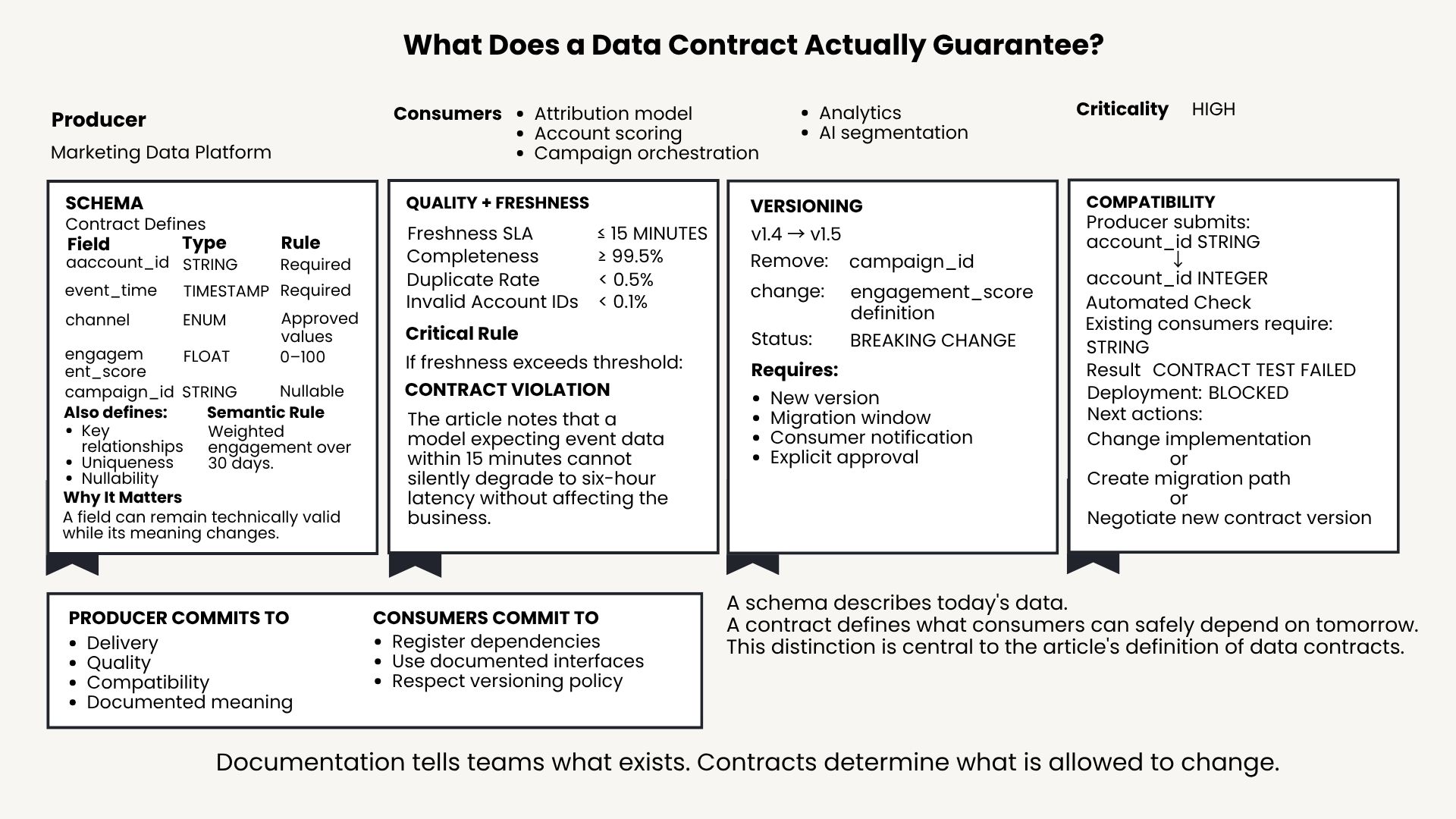
A data contract is a formal agreement between a producer and one or more consumers. It specifies not just what the data looks like today, but what the producer commits to maintaining over time. A schema definition describes current structure. A contract defines what tomorrow's data promises to look like and creates the enforcement mechanism to hold that promise.
The most significant shift contracts enable is moving from passive documentation to active enforcement. When a proposed schema change violates a downstream contract, the CI/CD pipeline fails. The change cannot ship without explicit negotiation with consuming teams or a backward-compatible migration path. This changes the economics of breaking changes. Previously, the cost was externalized and hidden until a dashboard broke. With contracts in place, the cost is immediate and visible to the producing team.
Contracts also clarify accountability. Shared datasets often have many consumers but no clearly responsible owner. When freshness declines or a quality rule fails, no one knows who should investigate or which system is authoritative. A contract assigns explicit ownership: the producer commits to delivery and quality; consumers register dependencies and agree to use the documented interface rather than undocumented implementation details.
The Four Components of an Effective Data Contract
A useful contract should be specific enough to enforce without becoming so complex that teams avoid maintaining it. Four components form the foundation.
Schema definitions establish the structural baseline: field names, data types, nullability, allowed values, key relationships, and uniqueness expectations. These must be machine-readable and version-controlled. Critically, schema definitions must capture semantic intent, not just types. A field called "revenue" that changes from gross to net is a breaking change even if the type remains a float. Contracts must be expressive enough to capture business meaning, not just column structure.
Freshness and quality expectations encode the operational guarantees consumers depend on. A marketing attribution model that expects event data within 15 minutes of occurrence cannot silently degrade to six-hour latency without business impact. Contracts codify these expectations and enable automated alerting when they are violated. Quality rules should reflect the actual use case: a customer-identity dataset requires different guarantees from an exploratory research table.
Versioning policy governs how change happens over time. Borrowing from software engineering, data contracts benefit from semantic versioning. Additive changes such as adding optional fields are backward-compatible. Breaking changes such as removing fields or altering types require a new version and a defined migration window. This gives consuming teams predictability and lead time rather than forcing every downstream system to change simultaneously.
Compatibility validation is the enforcement layer. Integrated into CI/CD pipelines, it prevents breaking changes from reaching production without detection. When a producer submits a change, automated checks evaluate whether the new version is compatible with existing consumers. A breaking change is blocked before deployment or routed for explicit approval. The goal is not to prevent change. It is to prevent surprise.
A Data Governance Maturity Model
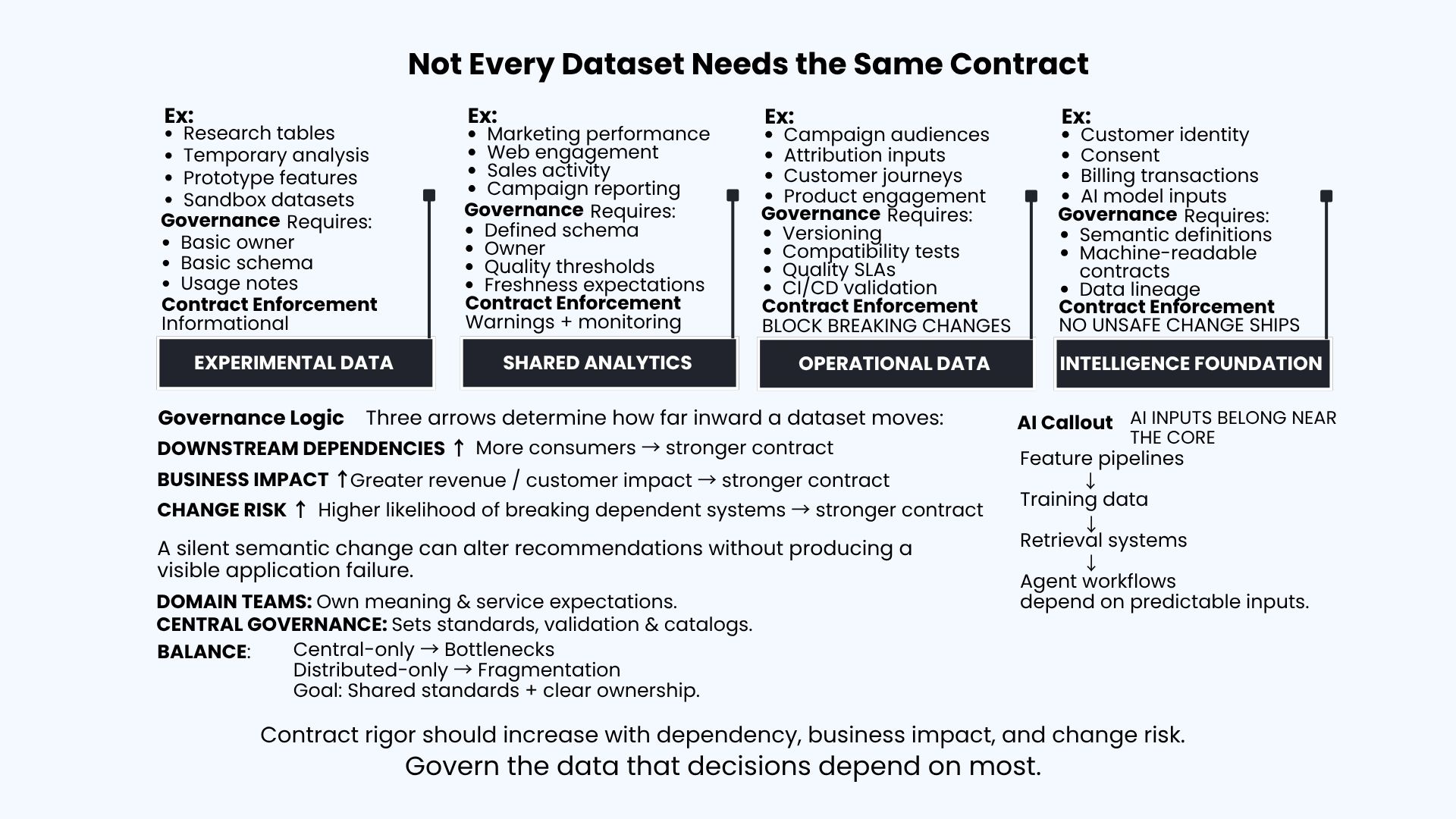
Organizations can evaluate their current position across four levels.
At Level 1, teams depend on documentation, messages, and personal knowledge. Changes are coordinated manually and failures are discovered downstream after the fact.
At Level 2, schemas, owners, and basic quality expectations are recorded, but enforcement remains manual. Post-hoc alerting tools may detect outages after data is already corrupted.
At Level 3, contracts are version-controlled and tested in delivery pipelines. Breaking changes fail before deployment. Engineering and data teams share clear, enforceable service agreements.
At Level 4, contracts include technical, semantic, quality, and governance expectations. They integrate with catalogs, lineage systems, and observability tools. Self-healing migration and dynamic routing minimize downtime during schema evolution.
The objective is not to move every dataset to Level 4. Higher maturity should be reserved for data products with broad downstream use, significant revenue impact, or high change risk. A tiered approach applies strict, blocking contracts to core entity data such as customer identity, billing transactions, and AI model inputs, while allowing lighter governance for experimental or exploratory datasets.
Implementation as Organizational Change
The most common failure in data contract adoption is treating it as a purely technical initiative. Teams deploy tooling, write schema definitions, and then encounter the harder problem: the human system.
Producing teams often experience contracts as bureaucratic overhead. This resistance is legitimate when contracts are poorly designed or rigidly enforced. The antidote is positioning contracts not as constraints on producers but as protection for them. A clear contract reduces the burden on producing teams by eliminating constant reactive work: diagnosing downstream breakages, fielding complaints from consumers, and investigating failures no one owns. Producers who understand this shift become advocates.
Static contracts become liabilities. Business logic evolves, new fields become necessary, and better source systems emerge. Governance must account for contract lifecycle management through regular review cycles, expiration policies for deprecated fields, and clear escalation paths when producers and consumers cannot reach agreement on a revision. The purpose of a contract is controlled change, not permanent immobility.
Ownership must remain distributed. Domain teams should define the meaning and service expectations of the data they produce. Central platform or governance teams provide standards, validation tooling, catalogs, and escalation mechanisms. Centralized data control without domain ownership creates bottlenecks. Distributed ownership without shared standards creates fragmentation.
Strategic Implications for AI and MarTech Leaders
As organizations shift toward AI-driven decision-making, the reliability of data infrastructure becomes a competitive differentiator rather than an operational detail.
A MarTech workflow may use CRM data, consent status, campaign history, customer identity, product engagement, and intent signals to decide who receives a message. If one producer changes a field without coordination, the workflow may continue running while targeting the wrong audience. AI systems raise the stakes further. Feature pipelines, retrieval systems, model training datasets, and agent workflows depend on predictable inputs. A silent semantic change can alter recommendations without producing a visible application failure.
Intelligence built on unreliable infrastructure is fragile intelligence. An AI-powered segmentation model trained on data with no freshness guarantees, no schema enforcement, and no accountability structure is not a competitive advantage. It is a liability dressed as innovation. Data contracts are the mechanism that makes the intelligence layer trustworthy.
The organizations that get this right will move faster. Their AI models will be more reliable because their training data is governed. Their analytics will be more accurate because their event pipelines are contract-enforced. Their cross-functional teams will collaborate more effectively because the interface between them is explicit, not assumed.
Conclusion
Data pipelines break between teams because organizational boundaries are also information boundaries. Producers understand how data is generated. Consumers understand how it is used. Without a formal mechanism connecting those perspectives, each side relies on assumptions the other may not know exist.
Data contracts replace those assumptions with declared expectations. When integrated with CI/CD, contract testing, monitoring, and migration workflows, they prevent failures before they propagate into dashboards, campaigns, models, and operational systems.
The goal is not to make data immutable. It is to make change understandable and safe.
The organizations that scale their data and AI systems successfully will not be the ones with the most pipelines. They will be the ones that make those pipelines dependable across teams. Data contracts provide the shared language and technical enforcement needed to turn fragmented data exchanges into reliable infrastructure.
Build the foundation first. The intelligence follows.