
Article
Data Architecture for Real-Time Analytics: From Reporting Systems to Decision Infrastructure
This blog explains why batch analytics creates structural disadvantages in environments where decisions depend on live signals rather than delayed summaries; shifting analytics from a reporting layer to an execution layer. It covers the core components of real-time architecture (streaming platforms, processing engines, and serving layers), the reliability challenges of consistency at velocity, strategic use cases that unlock new value, and a readiness framework for determining when real-time is worth the cost.
- Topic
- Technology
- Published
- 2 Jun 2026

The Strategic Shift From Hindsight to Reflex
The core tension in modern analytics is no longer about whether organizations have enough data. It is whether their systems can turn data into action before the moment of value passes.
Batch analytics helped teams answer retrospective questions. What happened yesterday? Which campaign performed best last week? How did conversion change last month? That model still matters. But it increasingly falls short in environments where user behavior changes continuously, operational decisions are time-sensitive, and AI systems depend on live signals rather than delayed summaries.
For marketing leaders and tech decision-makers, this matters because analytics is shifting from a reporting layer to an execution layer. A delayed dashboard is inconvenient. A delayed signal in a personalization engine, fraud detector, or lead-routing model is a business failure. Real-time data architecture is therefore not just a technical upgrade. It is a structural move from tools to infrastructure, and from infrastructure to intelligence.
The organizations that lead in the next phase of analytics will not simply collect more data. They will build systems capable of turning live events into live decisions, reliably and at scale.
Why Batch Analytics Creates Structural Disadvantages
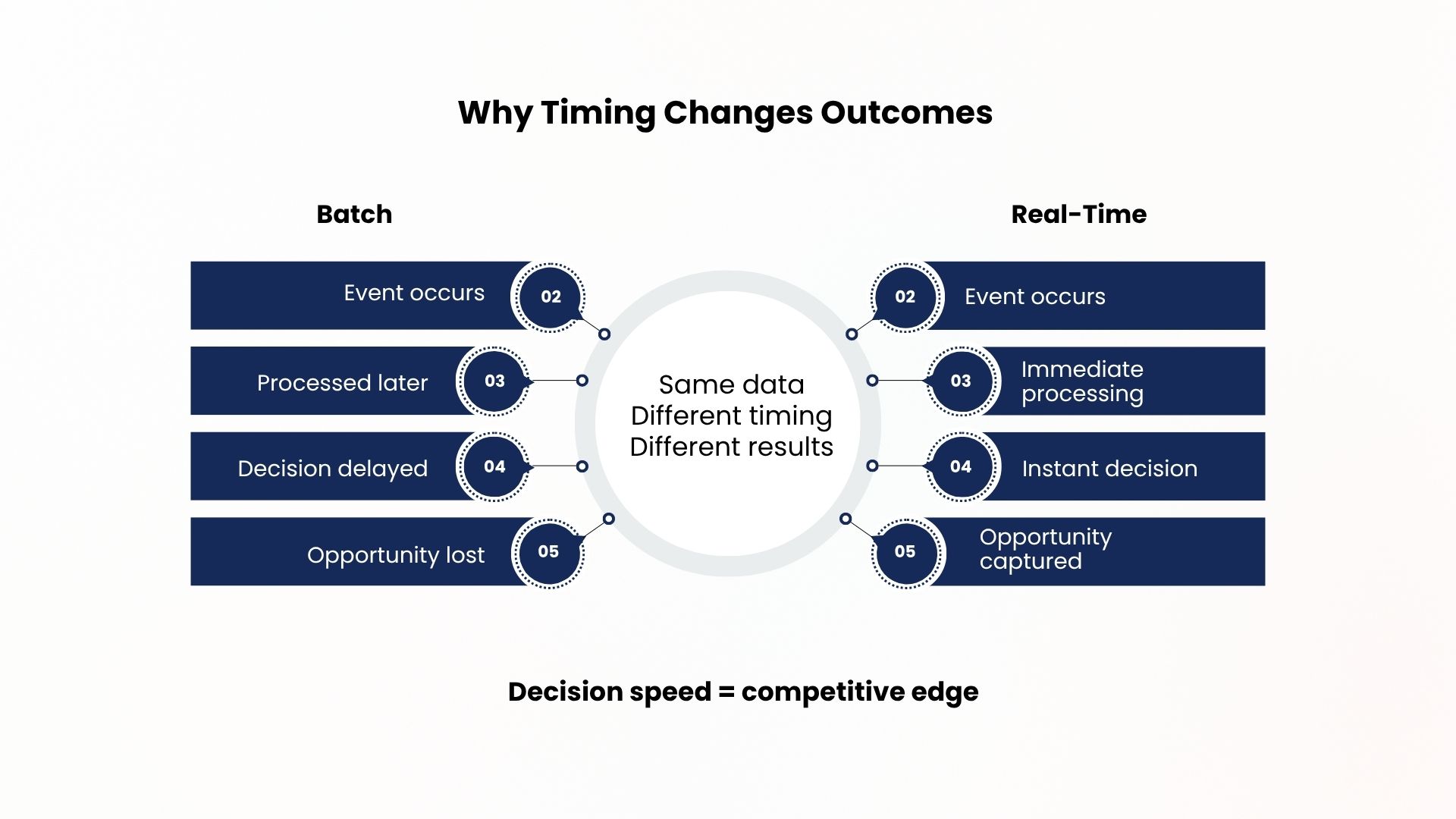
Batch processing accumulates records over a set period and processes them as a single unit. This makes it cost-efficient and predictable. But it also introduces delay by design. In high-velocity systems, delay is not just a reporting issue. It changes outcomes.
When a customer abandons a checkout flow, when an ad click indicates buying intent, or when a system anomaly emerges, the useful response window may be measured in seconds or minutes, not the next ETL cycle. Modern digital systems have trained users and teams to expect immediacy: live personalization, instant fraud checks, real-time notifications, dynamic recommendations, rapid operational alerts.
The distinction between network latency and data latency is critical and often misunderstood. A B2B data API might respond in milliseconds while serving information that is 30 days old. Fast delivery of stale intelligence does not solve the business problem.
The practical question is not "batch or real-time?" but "which decisions require freshness, and which can tolerate delay?" Batch still has a clear role. But assuming that batch systems alone can support modern decision environments creates a ceiling that no amount of creative excellence can overcome. Your competitors are not just faster. They are playing a different game entirely, one where the infrastructure itself enables strategies that were previously impossible.
Core Components of Real-Time Architecture
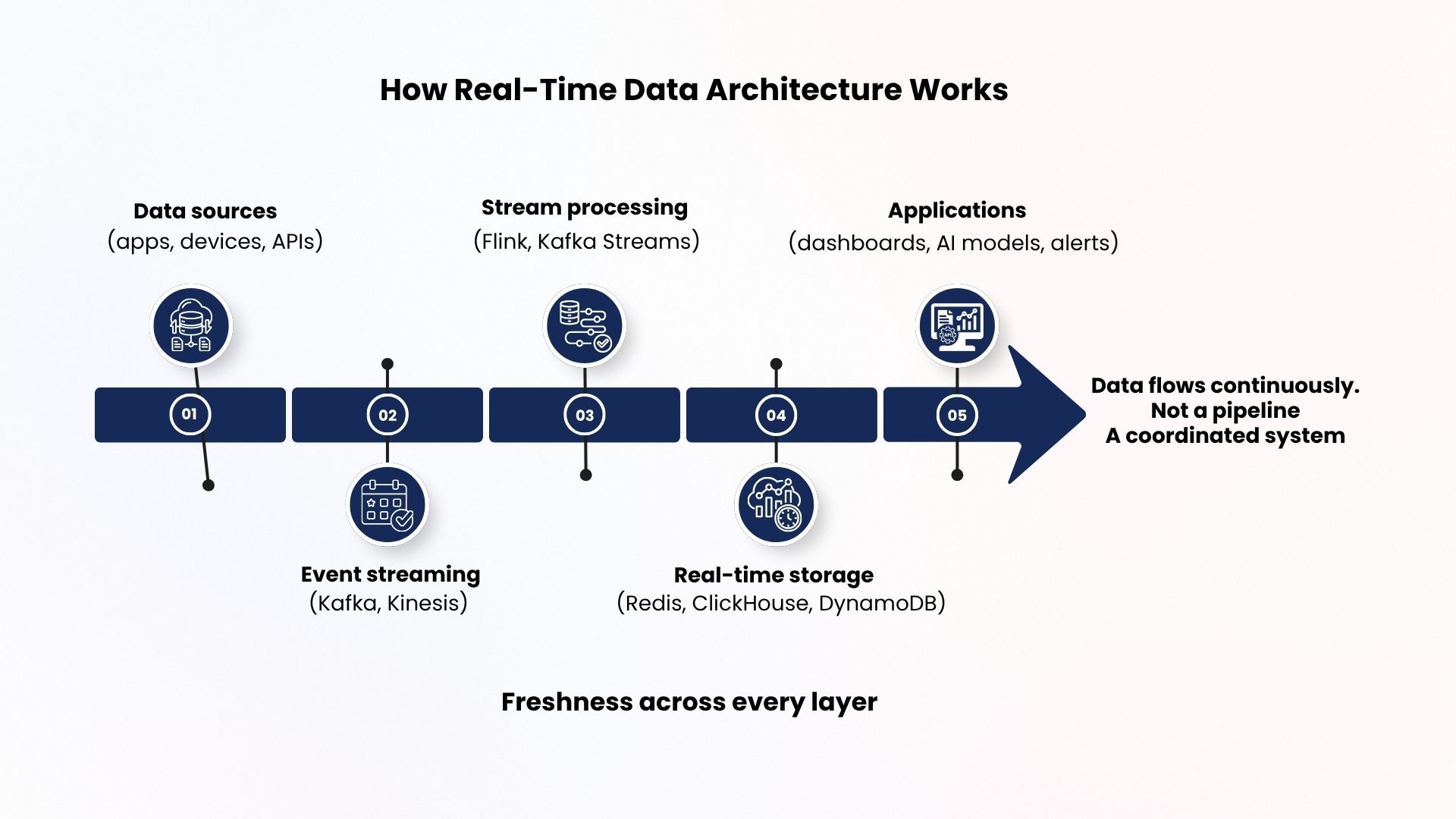
A scalable real-time analytics architecture is built from three coordinated layers, each optimized for freshness.
Event Streaming Platforms
The ingestion layer captures continuous events from applications, devices, databases, and external systems. Technologies like Apache Kafka and Amazon Kinesis provide durable event storage and support multiple downstream consumers. The architectural role of this layer is not just transport. It creates a persistent, replayable stream of system activity that feeds multiple use cases simultaneously.
Production deployments have been validated at over 1 million messages per second, with infrastructure costs scaling from $200 per month for 50,000 messages per second to approximately $25,000 per month at peak throughput. The key is matching capacity to use case, not overbuilding for theoretical peak load.
Stream Processing Engines
Once events are ingested, they need to be filtered, joined, aggregated, enriched, and transformed in motion. Stream processors like Apache Flink and Kafka Streams enable marketing systems to maintain stateful computations across millions of customer journeys simultaneously.
This layer is where data becomes operationally useful. It is also where architecture choices become critical, because stateful processing, time windows, and event ordering are fundamentally harder in streaming environments than in periodic batch transformations. Unlike traditional analytics that query static databases, stream processors evaluate patterns across flowing events while they are still fresh.
Real-Time Data Stores and Serving Layers
Real-time systems need destinations optimized for low-latency querying, alerting, dashboards, or downstream applications. Technologies like Redis, ClickHouse, and DynamoDB enable marketing applications to retrieve customer profiles, segment memberships, and predictive scores fast enough to influence live experiences. A recommendation engine that takes three seconds to load is effectively useless in a mobile app experience.
The strategic point is that a real-time architecture is not just a pipeline. It is a coordinated system of ingestion, processing, and serving optimized for freshness across the entire stack.
The Reliability Challenge: Consistency at Velocity
Real-time architecture introduces complexity that batch systems never had to address. When data moves continuously rather than in discrete batches, ensuring consistency becomes exponentially more challenging.
Exactly-Once vs At-Least-Once Processing
One of the hardest design questions in streaming systems is delivery semantics. Apache Flink achieves exactly-once processing through distributed snapshots and two-phase commit protocols. This ensures each event affects output exactly once, even during failures. But it comes with real costs: checkpointing creates periodic latency spikes, output is not visible until checkpoints complete, and throughput can be reduced by 10 to 30 percent.
At-least-once processing guarantees events are never lost but may be processed more than once on failure recovery. This works well with idempotent sinks like database writes with primary keys or key-value stores. Many use cases do not require exactly-once. If your sink supports upserts or is naturally idempotent, at-least-once with idempotent writes delivers correct results without the coordination overhead.
From a business perspective, this matters because duplicates in event processing can distort revenue calculations, engagement counts, attribution logic, and trigger-based workflows. The right choice depends on how costly duplicates are in your target system.
Late and Out-of-Order Events
Real-time systems do not receive events in perfect sequence. A mobile app might batch events while offline, then upload them hours later. Cross-device journeys fragment across different data collection pipelines with varying latencies. Research indicates that 8 to 12 percent of marketing events arrive out of sequence in typical enterprise environments.
In batch systems, time is mostly an ordering property in stored data. In streaming systems, time becomes a design challenge. Teams need to decide how long to wait for late events, how to correct prior aggregates, and how much disorder the system can tolerate without compromising output quality. Architectures must be designed with time-based windowing and retroactive correction mechanisms. Your attribution model's accuracy depends as much on these architectural choices as on your attribution logic itself.
Fault Tolerance as a Foundation
Real-time systems must keep operating under partial failure. Batch jobs can simply restart if they fail. Stream processing systems must maintain state across failures, ensuring that a server crash does not corrupt ongoing computations or lose customer context. This requires checkpoint mechanisms, state backup strategies, and recovery procedures that happen automatically and transparently.
For marketing leaders, this translates into a fundamental question: what happens to your personalization engine when a component fails during peak traffic? Do customers see generic experiences? Do recommendations become stale? Does the system degrade gracefully or fail catastrophically? Real-time architectures are not valuable because they are fast. They are valuable because they are fast and reliable enough to support decisions continuously.
Strategic Use Cases: Where Real-Time Unlocks New Value
The true value of real-time architecture is not in making existing processes faster. It is in enabling strategies that were previously impossible.
Operational Monitoring and Intelligent Intervention
Real-time systems can detect anomalies in campaign performance, website behavior, or conversion funnels as they develop, triggering automated responses or alerts. When ad fraud systems identify suspicious traffic patterns, they can block those sources within seconds rather than days. When a product page's conversion rate drops unexpectedly, marketing and product teams can investigate while the issue is still active rather than discovering it in tomorrow's reports.
More sophisticated implementations use real-time pattern detection to identify high-value moments. If a customer exhibits browsing behavior that historically correlates with near-term purchase intent, the system can trigger priority handling, adjust bidding strategies, or surface targeted incentives. The window of opportunity might only last minutes. Batch systems would miss it entirely.
Dynamic User Behavior Analysis
Real-time clickstream analysis enables adaptive experiences that respond to customer context. E-commerce platforms adjust product recommendations, search rankings, and promotional content based on immediate browsing patterns. Media companies optimize content feeds by analyzing engagement signals across their user base in real time, surfacing trending content while it is still novel.
This creates a competitive moat that is difficult to replicate. Once your system learns to respond intelligently to behavioral signals in real time, the customer experience improves in ways that static, rule-based systems cannot match. The feedback loops get tighter, the personalization gets better, and the customer data advantage compounds.
Operational Intelligence Beyond Customer Journeys
Marketing organizations can track customer acquisition costs, lifetime value trajectories, and channel performance with intra-day granularity. This enables budget reallocation decisions during active campaigns rather than post-mortems afterward. When performance deteriorates, you can investigate and respond while the campaign is still running, not after you have exhausted your monthly budget.
The Real-Time Readiness Framework
A useful way to evaluate whether a use case deserves real-time architecture is through four questions:
Decision urgency: How quickly must the system respond for the insight to retain value?
Data volatility: How fast do the underlying signals change?
Error tolerance: How costly are duplicates, missed events, or delayed correction?
Operational maturity: Does the organization have the monitoring, ownership, and engineering discipline to run streaming systems well?
If urgency and volatility are high, and the organization can support the operational burden, real-time architecture is likely justified. If not, batch may be the better answer.
Real-time architecture carries substantial cost and complexity overhead. The infrastructure is more expensive to operate. Streaming platforms, distributed processing engines, and high-performance databases require more resources than batch systems. The operational overhead is higher because you are running systems that never stop, which demands robust monitoring, alerting, and on-call support.
Skill requirements shift dramatically. Building and maintaining real-time data systems requires expertise in distributed systems, stream processing, and event-driven architecture. This is not a gap you can close with a weekend training course. It requires either significant internal capability development or strategic partnerships with engineering organizations.
The most sophisticated organizations implement hybrid architectures: batch for baseline coverage and historical analysis, real-time for high-priority use cases where freshness creates genuine strategic value. Start with use cases where real-time capability unlocks new strategies. Build competencies incrementally. Invest in the architecture and skills that will compound over years, not quarters.
Strategic Implications: Infrastructure as Intelligence
The deeper shift here is architectural. Real-time analytics is not just about reducing latency. It is about changing the role of analytics in the enterprise.
In older models, analytics informed decisions after operations occurred. In modern systems, analytics increasingly shapes operations while they are happening. That changes the strategic role of data architecture from storage-first to event-first, from reporting-first to action-first, from tools to infrastructure to intelligence.
For marketing technology, AI systems, and operational workflows, this means the real advantage will not come from having more dashboards. It will come from having architectures that can sense, interpret, and respond to events continuously.
When every marketing organization has access to similar tools and channels, the differentiator becomes the underlying system architecture that determines what strategies you can actually execute. This creates a structural advantage that compounds over time.
Conclusion: Real-Time Architecture Is a Decision About Business Tempo
Batch analytics still has a clear role. But as customer experience, AI systems, and operational workflows become more time-sensitive, organizations need architectures that match the tempo of the decisions they want to make.
Real-time data architecture is not a universal requirement. It is a strategic choice. But when the business requires responsiveness, delayed insight is often functionally equivalent to no insight at all.
The future of marketing is not just real-time. It is adaptive, intelligent, and infrastructure-dependent. The question is not whether to make this transition, but whether you will lead it or be forced into it by competitive pressure. The organizations winning over the next decade will be those whose infrastructure enables types of intelligence and responsiveness that competitors cannot match.