
Article
Continual Learning in Machine Learning Systems
This blog explains why static AI systems degrade 18 to 33 percent within six to twelve months of deployment as the world shifts around them, creating intelligence debt that compounds silently. It covers the shift from periodic retraining to continual learning, the engineering tensions of catastrophic forgetting and stability-plasticity tradeoffs, architectural approaches (replay, parameter isolation, dynamic expansion), and a four-stage maturity model that distinguishes organizations treating intelligence as a one-time asset from those building it as living infrastructure.
- Topic
- Machine Learning
- Published
- 21 Jul 2026

Enterprise AI has crossed a threshold. Machine learning models no longer sit at the edge of marketing operations as experimental tools. They now sit at the center as core infrastructure: driving lead scoring, audience segmentation, campaign optimization, personalization, and revenue forecasting.
And yet, most of these systems are built on a fundamentally flawed assumption: that the world stays stable after deployment. It does not.
A 2024 RevOps-AI benchmark found that static-model systems dropped 18 to 33% in pipeline performance within six to twelve months of deployment, even when offline accuracy metrics looked healthy. By the time the degradation surfaces in business outcomes, the cost of recovery far outweighs what proactive architecture would have required.
This gap between what your AI knows and what is currently true is intelligence debt. It compounds silently. And it is the defining AI risk most organizations are not actively managing.
The strategic response is continual learning: machine learning systems designed to adapt incrementally from new data while retaining prior knowledge. This is not a model training technique. It is an operating model for AI systems that must remain useful in changing environments.
Why Static Models Are a Structural Liability
Static ML models are trained on historical data, validated, and released. That snapshot approach made sense when data was scarce and compute was expensive. Neither condition holds today.
The technical term for what happens next is data distribution shift: the statistical properties of incoming data diverge from what the model was trained on. A 2025 GTM-AI case study found that a lead-scoring model trained on 2023 buyer behavior misclassified 38 percent of high-value 2024-era prospects, despite no change in the underlying data schema. The model was not broken. It was simply no longer aligned with reality.
Periodic retraining is the most common mitigation, but it is a tactical patch on a structural problem. It introduces batch latency: the model is always behind by at least one retraining cycle. It requires labeled data that may not yet be available. And it creates discontinuous knowledge: a model that lurches between states rather than adapting fluidly. Most critically, it treats intelligence as a product release rather than a living system.
What Continual Learning Actually Means
Continual learning enables ML systems to update incrementally from streaming data without discarding what they already know. This distinction matters in practice.
Basic online learning simply updates model weights as new data arrives, with no architectural provision for preserving prior knowledge. Continual learning goes further. It manages the tension between absorbing new patterns and retaining established ones. A system that updates continuously is not automatically a good continual learning system. It must also protect useful prior knowledge from being overwritten.
In marketing systems, this translates directly to business value. A recommendation engine can update its understanding of an emerging user segment without degrading performance on established ones. A predictive attribution model absorbs new channel behaviors without losing the long-tail patterns built from years of campaign data. The knowledge encoded cannot be acquired in a single training run. It has to be earned, incrementally, from experience. That is not just a performance advantage. Over time, it becomes a structural competitive asset.
Three Engineering Tensions That Are Actually Strategic Decisions
The core challenges of continual learning are technical in nature but strategic in consequence.
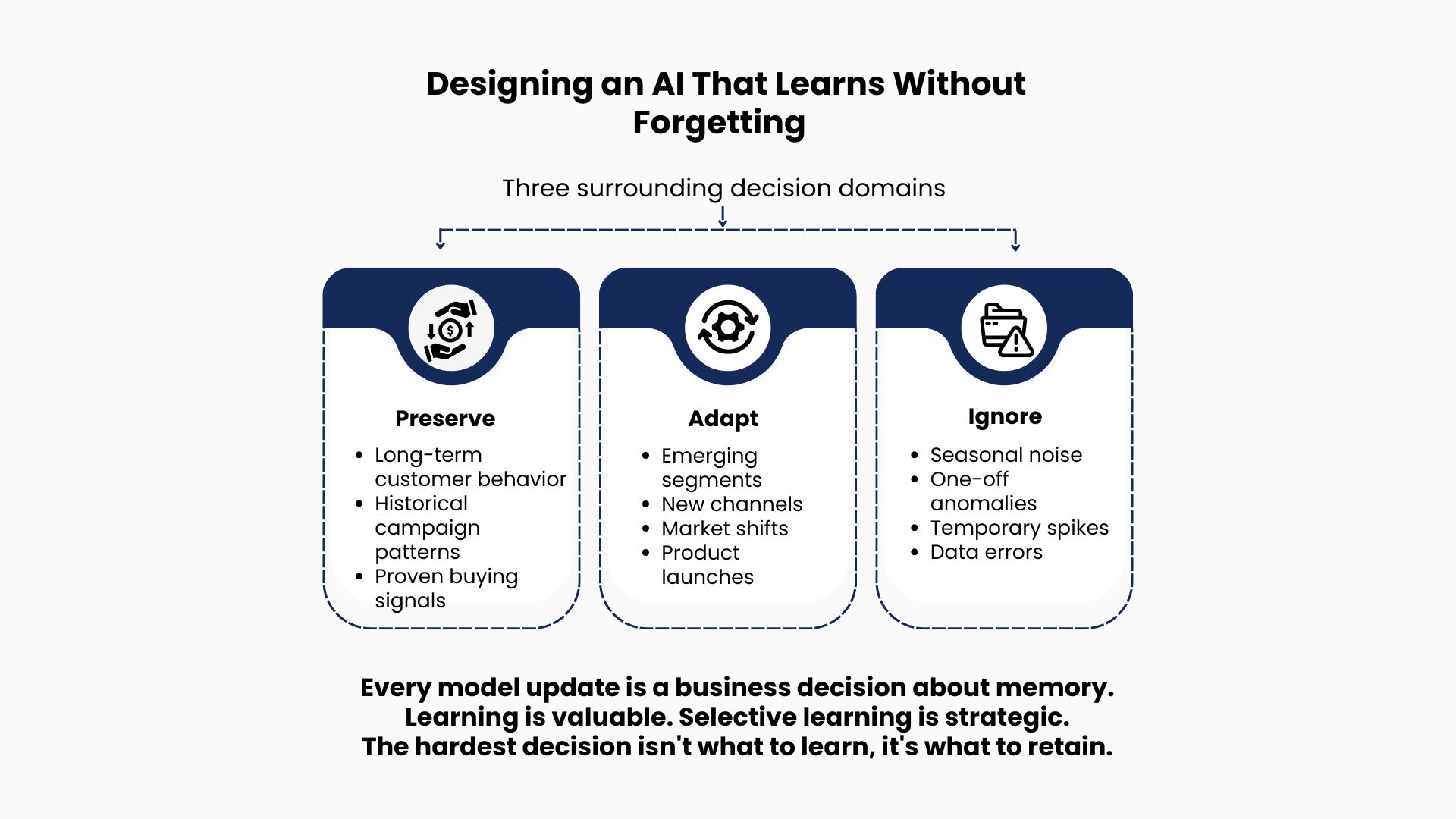
Catastrophic Forgetting
When a neural network updates on new data without structural constraints, it overwrites the weights that encoded prior knowledge. A customer intent model updated during a holiday campaign may lose its sensitivity to standard buying signals once the campaign ends.
Every significant model update is effectively a knowledge governance decision. What does this system need to remember? What can it safely overwrite? These are business questions with business consequences, and they cannot be delegated entirely to engineering teams.
The Stability-Plasticity Tradeoff
A highly stable model preserves existing knowledge but adapts slowly, potentially missing emerging signals entirely. A highly plastic model absorbs new patterns quickly but forgets easily, making it vulnerable to noise and short-term anomalies masquerading as genuine trends.
Getting the calibration right requires business context: understanding which signals are structural versus ephemeral. In campaign targeting, dynamic pricing, and content personalization, this judgment determines whether your AI is responding to real behavioral shifts or chasing anomalies that will reverse within weeks.
Feedback Delay
Many marketing systems suffer from delayed ground truth. A lead scored today may not convert for 90 days. Acting on weak proxy signals too early teaches models noise. Waiting too long misses genuine shifts. Managing this tension requires hybrid strategies: proxy signal frameworks, human review loops, and delayed evaluation pipelines built as first-class architectural components, not afterthoughts.
Architectural Approaches: A Decision Framework
There is no single architecture for continual learning. The right choice depends on update frequency, label availability, forgetting tolerance, and compute budget.
Replay-based methods store representative samples of past data and mix them into new training updates. They are effective at preventing catastrophic forgetting, but introduce storage overhead and privacy considerations.
Parameter isolation techniques dedicate separate model components to different tasks or time periods, preventing new learning from overwriting established knowledge. They work well in modular systems but introduce complexity that grows over time.
Dynamic network expansion grows model capacity when genuinely new domains or behaviors emerge. It is powerful but demands intelligent governance to avoid unbounded compute growth.
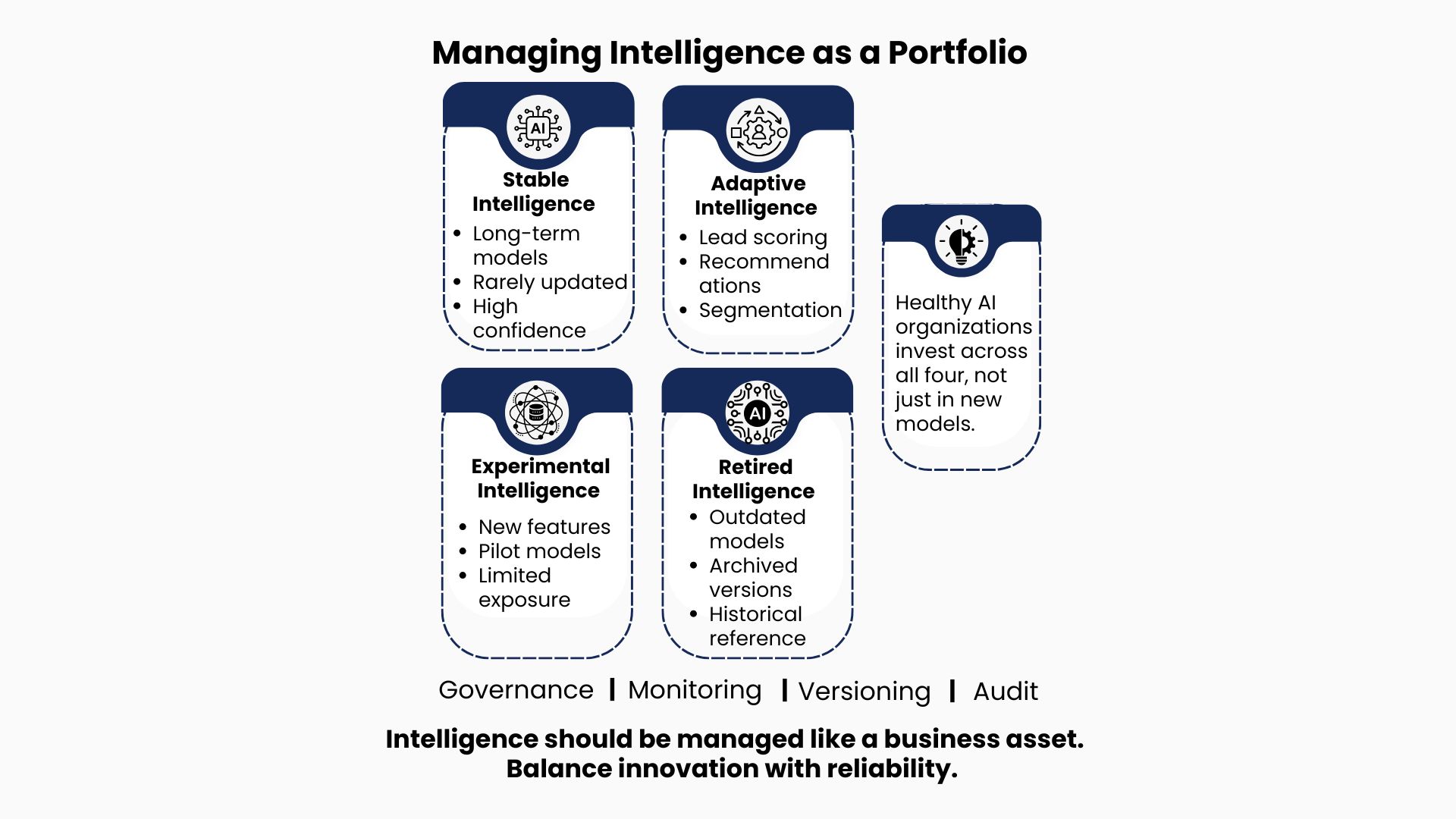
In practice, production systems at scale use hybrid strategies: a stable core model that anchors institutional knowledge combined with lightweight adapter layers that update frequently. The core encodes durable signal. The periphery absorbs emerging patterns. Governed processes manage the flow between them.
The Intelligence Maturity Curve
Organizations can assess their continual learning readiness across four stages:
Stage 1- Static Intelligence: Models trained once, deployed until performance breaks. Intelligence decays silently. This is the dominant enterprise posture today.
Stage 2- Periodic Adaptation: Scheduled retraining cycles, monthly or quarterly. Better than Stage 1, but still reactive and discontinuous. Models lag behind reality by design.
Stage 3- Monitored Continuous Learning: Real-time monitoring with triggered adaptation and governance controls. Organizations can distinguish beneficial learning from harmful drift before business metrics are affected.
Stage 4- Autonomous Intelligence Infrastructure: Fully integrated systems that adapt continuously, governed by automated policy, and auditable at every step. Intelligence functions as infrastructure.
Most enterprises sit between Stage 1 and Stage 2. The competitive gap between those organizations and those operating at Stage 3 is widening, not because of model quality, but because of organizational commitment to treating intelligence as a living system.
Running Continual Learning Systems in Production
Building a continual learning system is a technical challenge. Operating one is an organizational one.
The most consequential skill is differentiating genuine distribution shift from noise. Acting on noise as if it were signal produces models that chase ghosts. Missing genuine drift produces models that ignore reality. Both failures are expensive.
This requires monitoring that tracks not just model performance metrics but the statistical properties of incoming data: feature distributions, prediction confidence, and outcome rates over time. When these diverge from baseline, the system should surface an alert before downstream business metrics are affected. This shifts posture from reactive to anticipatory.
Governance is equally critical. Continual learning systems update autonomously. Without explicit governance, a system can drift into states that are difficult to diagnose and expensive to reverse. Every enterprise deployment needs versioned model states that enable precise rollback, audit trails that record what data triggered each adaptation, canary deployments that test updated models on a portion of traffic before full rollout, and concept drift alerts that distinguish healthy adaptation from problematic degradation.
This is not overhead. It is the infrastructure that makes autonomous learning trustworthy and deployable at scale. Organizations also need to shift their data infrastructure from batch processing toward streaming-native architectures. Those still operating on periodic ETL pipelines face a harder transition: structural investment must precede learning benefits.
The Strategic Imperative: From Models to Intelligence Infrastructure
The shift underway in enterprise AI is architectural. The progression from tools to infrastructure to intelligence is not linear improvement on the same path. Each transition requires a fundamentally different organizational commitment.
Buying an AI tool requires a procurement decision. Building AI infrastructure requires data engineering investment. Building intelligence infrastructure requires something more: streaming data pipelines, model lifecycle management, and governance practices that make autonomous learning trustworthy enough to operate at scale.
The organizations that will lead in AI-driven marketing are not those with the best point-in-time models. They are those that have built systems designed from the ground up to learn, adapt, govern, and compound knowledge over time.
Static models can be purchased. Accumulated intelligence must be earned. The question for marketing and technology leaders is not whether continual learning is technically feasible. It is. The question is whether your organization is structured to capture its compounding value, or whether you are building intelligence debt, one static model at a time.