
Article
Context Window Management: The Infrastructure Problem Shaping Enterprise AI
This blog explains why treating context windows as limitless buckets creates information dilution, cost escalation, and degraded model performance; making context management an architectural discipline rather than a prompt-engineering afterthought. It covers production patterns (sliding windows, summarization, retrieval prioritization, dynamic assembly), common failure modes, a maturity model, and operational governance practices (token budgeting, caching, observability) that transform context from a resource to maximize into a resource to optimize for sustainable competitive advantage.
- Topic
- Artificial Intelligence
- Published
- 30 Jun 2026

The Strategic Shift From Prompts to Architecture
Enterprise AI has moved through three distinct phases. First came the tool era: subject-line generators, lead-scoring widgets, single-call API interactions. Then came infrastructure: CDPs, data lakes, unified platforms. Now organizations are in the intelligence era, where AI underpins long-running workflows such as multi-stage customer onboarding, churn intervention programs, negotiation support systems, and compliance-driven account management.
This shift changes what AI demands from the systems beneath it. A prompt is no longer a short, self-contained request. It is a curated history of a customer journey, expected to carry forward pricing objections, prior commitments, and regulatory constraints across dozens of interactions. When context is treated as a limitless bucket, that richness becomes a liability. The organizations that will scale AI safely and economically are those that treat context window management as a core architectural discipline, not a prompt-engineering afterthought.
Why Context Windows Become a Bottleneck
The problem has three compounding dimensions.
The first is information dilution. LLMs operate with a fixed attention budget. When 90% of a prompt consists of historical noise and only 10% contains the actual instruction and critical details, model performance collapses. A benchmark comparing two variants of the same lead-response system found that the curated version, which included only key constraints, objections, and recent decisions, improved response accuracy by 29% and reduced hallucinations about prior commitments by 41%. The model was identical in both cases. The architecture was not.
The second dimension is cost escalation. Token pricing is linear, but inefficiency compounds. Systems that send unfiltered conversation history into every model call consume roughly 3.4 times more tokens per interaction than systems that filter and compress context. For a workflow processing 50,000 customer interactions per month, that discrepancy translates into tens of thousands of dollars in unnecessary spend. Every redundant paragraph, every re-injected system instruction, every unfiltered data dump is a direct cost multiplier with no return on relevance.
The third is the completeness-versus-relevance trade-off. Including everything feels safe. Including only what matters requires architectural discipline. A case study of a churn-intervention engine showed that when the system included every interaction from the prior 90 days, the model frequently invented past concessions that never occurred. When context was limited to the last 7 to 14 days plus key decision points, hallucination rates dropped by 38% and time to resolution improved by 24%. More context did not produce better decisions. It produced more noise.
How Modern Systems Manage Context
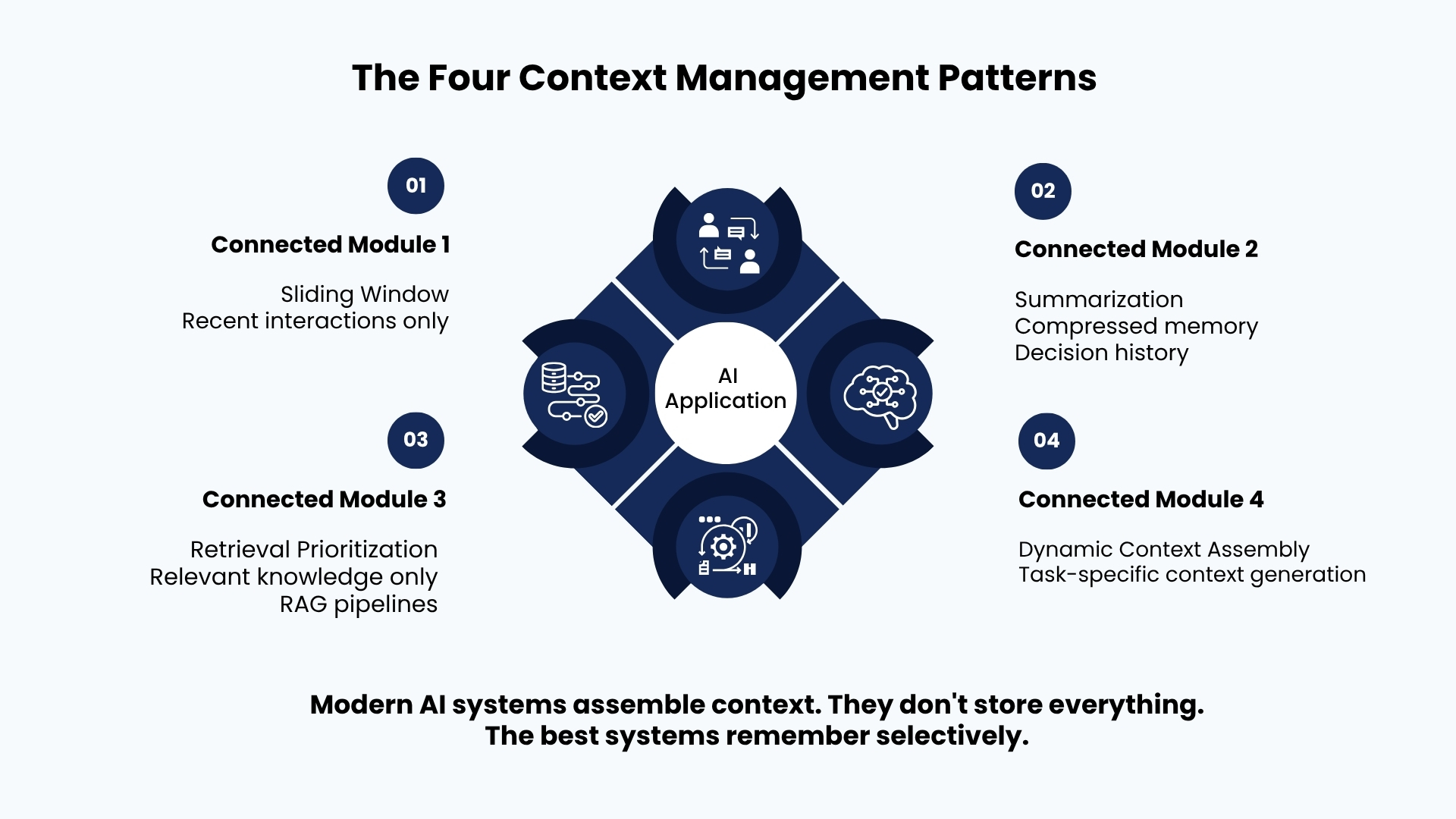
Production AI systems have converged on four patterns for managing context at scale.
Sliding window approaches keep only the most recent exchanges in active context while replacing older history with compressed summaries. This transforms an unbounded context problem into a bounded-buffer problem, which is far easier to govern and optimize. Benchmarks show that well-tuned sliding windows can reduce token consumption per call by roughly 39% while retaining 86% of response quality compared to naive append-all approaches.
Context summarization pipelines compress long histories into compact, decision-relevant representations. Rather than feeding a model thousands of words of prior interaction, a summarization layer distills that history into structured summaries: what was objected to, what was agreed, what constraints remain open. The model receives meaning without mass. The risk is fidelity loss. A lossy summary that discards a critical detail creates downstream hallucinations that look like model error but are, in fact, infrastructure error.
Retrieval prioritization strategies take a different approach: instead of compressing context, they select only the relevant chunks for each specific query. A multi-stage RAG pipeline retrieves candidate documents using fast vector matching, reranks them by contextual relevance, and injects only the highest-signal items into the prompt. This approach requires serious investment in embedding quality and relevance tuning, but it is the architecture that powers genuinely precise AI experiences at scale.
Dynamic context assembly treats the context window as a composable resource, not a fixed payload. Based on query type, user state, workflow stage, and available token budget, the system assembles context from modular components: a system instruction block, a retrieved knowledge chunk, a compressed history summary, a current task specification. A troubleshooting query draws on logs and error documentation. A compliance query draws on policy, regulatory references, and audit history. One benchmark found that dynamic assembly reduced hallucinations about prior commitments by 44% and increased response-relevance scores by 31%.
Four Failure Modes to Architect Against
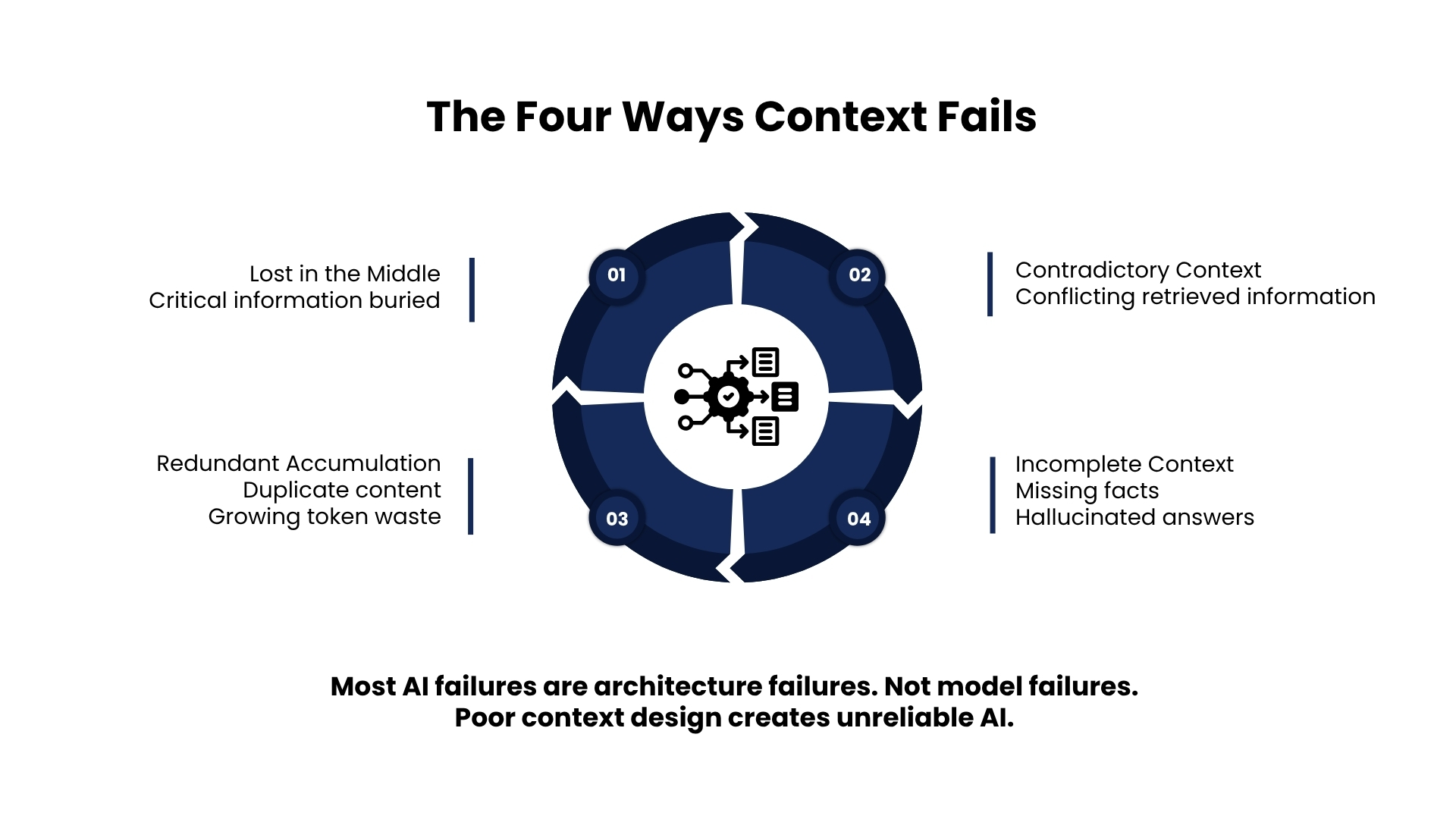
Understanding how large-context systems fail is as important as understanding how to build them.
The lost-in-the-middle problem is empirically documented across multiple model architectures. Models consistently attend more strongly to information at the beginning and end of a context window. A critical constraint buried in the middle of a 100,000-token prompt will perform measurably worse than the same constraint placed near the top. This is not a model bug. It is an attention distribution property. System design must account for it by placing high-priority context at deliberate positions, not wherever it naturally accumulates.
Contradictory context injection occurs when retrieval sources introduce conflicting information. A customer expresses frustration in a support ticket while a sales note flags them as open to an upsell. A system instruction conflicts with a retrieved policy document. Without source authority ranking, recency weighting, or conflict resolution logic, the model will resolve these contradictions probabilistically and without surfacing any indication that a conflict existed.
Redundant information accumulation is the entropy problem of ungoverned context pipelines. Over time, the same information appears in original form, summarized form, and retrieved form simultaneously. The context window fills with redundancy, costs climb, and quality degrades. Without active pruning, context pipelines accumulate waste the same way data warehouses accumulate stale tables.
Hallucinations from incomplete context are the most operationally damaging failure mode. When a model is asked about something that should be in its context but has been compressed away or dropped by the retrieval algorithm, it does not signal uncertainty. It fills the gap with plausible-sounding inference. In legal research, compliance support, or customer-facing automation, this produces confidently wrong outputs that erode trust organization-wide.
A Maturity Model for Context Architecture
Most enterprise AI teams sit between reactive and governed approaches to context. The following four-stage model identifies where organizations are and where the most resilient systems operate.
Stage 1 is static prompting: fixed templates, manual context insertion, no retrieval. The risk is inconsistency and poor scalability.
Stage 2 is retrieval-enhanced context: RAG pipelines, knowledge base search, document retrieval. The risk is irrelevant or conflicting context entering the prompt without governance.
Stage 3 is governed context assembly: source ranking, freshness filters, summarization pipelines, and structured memory layers. Context is treated as a managed resource with defined rules for what enters, in what form, and at what priority.
Stage 4 is adaptive context architecture: dynamic retrieval, context caching, hierarchical memory, explicit token budgeting, and continuous monitoring of context effectiveness.
The shift from Stage 2 to Stage 3 is the maturity marker that separates teams running AI experiments from teams running AI infrastructure.
Operational Governance: Budgets, Caching, and Observability
Three operational practices distinguish production-grade context management from aspirational architecture.
Token budgeting should be explicit and enforced programmatically. Define maximum token allocations across each context layer: system instructions, retrieved knowledge, conversation history, response space. When a pipeline exceeds its budget, the system should route the payload through a compression or summarization loop, not silently truncate it. Teams that set explicit budgets and auto-apply summarization at thresholds reduce unexpected cost spikes by roughly 40% without sacrificing output quality.
Context caching reduces repeated processing of stable content. System prompts, product documentation, brand guidelines, and policy documents are constant across many queries. Caching these static segments at the API level eliminates redundant token consumption and cuts latency substantially. For high-volume deployments running large-scale content or support operations, caching alone can reduce operational AI costs by 60 to 80%.
Monitoring context effectiveness requires going beyond token count. Track whether retrieved context actually influenced model responses. Track hallucination rates, contradiction frequency, and cost per business outcome rather than cost per call. Organizations that build this observability layer and use feedback loops to tune summarization logic see sustained improvements in prompt effectiveness and meaningful reductions in AI-caused rework.
The Strategic Frame: Context as Competitive Infrastructure
The organizations that will lead enterprise AI are not those with access to the largest models. Model capability is commoditizing. The differentiation will be determined by which organizations have built the deepest context infrastructure beneath their AI applications.
Context is not a resource to maximize. It is a resource to optimize. Systems that remember the right things, in the right form, at the right time, within sensible economic bounds, will outperform systems that accumulate everything and hope for coherence.
Building that infrastructure requires treating context as a first-class system resource: hierarchical, compressible, governed, and continuously measured. It requires the same engineering discipline applied to data pipelines and orchestration logic.
The advantage this creates is architectural, not algorithmic. It accrues over time as the system learns organizational context, customer history, and domain knowledge. It is not quickly replicated by competitors still asking how much context they can fit rather than what context they should include.
That question marks the boundary between tool adoption and intelligence infrastructure.