
Article
Cloud Cost Optimization Techniques at Scale
Cloud cost optimization at scale is about turning uncontrolled infrastructure spending into strategic business advantage. By improving visibility, rightsizing resources, automating usage, and embedding FinOps practices, organizations can eliminate waste without sacrificing performance or agility. Every dollar saved from idle or misconfigured cloud resources becomes capital for innovation, customer acquisition, and market expansion.
- Topic
- Technology
- Published
- 25 Feb 2026
Global cloud spending hit $723 billion in 2025. Organizations waste 32 percent of this budget on unused or misconfigured resources. For demand generation heads and CMOs managing B2B technology investments, this isn't a technical problem. Every dollar wasted on idle infrastructure is capital not invested in customer acquisition, product development, or market expansion.
The challenge isn't cloud adoption. The challenge is controlling costs at scale while maintaining performance and agility.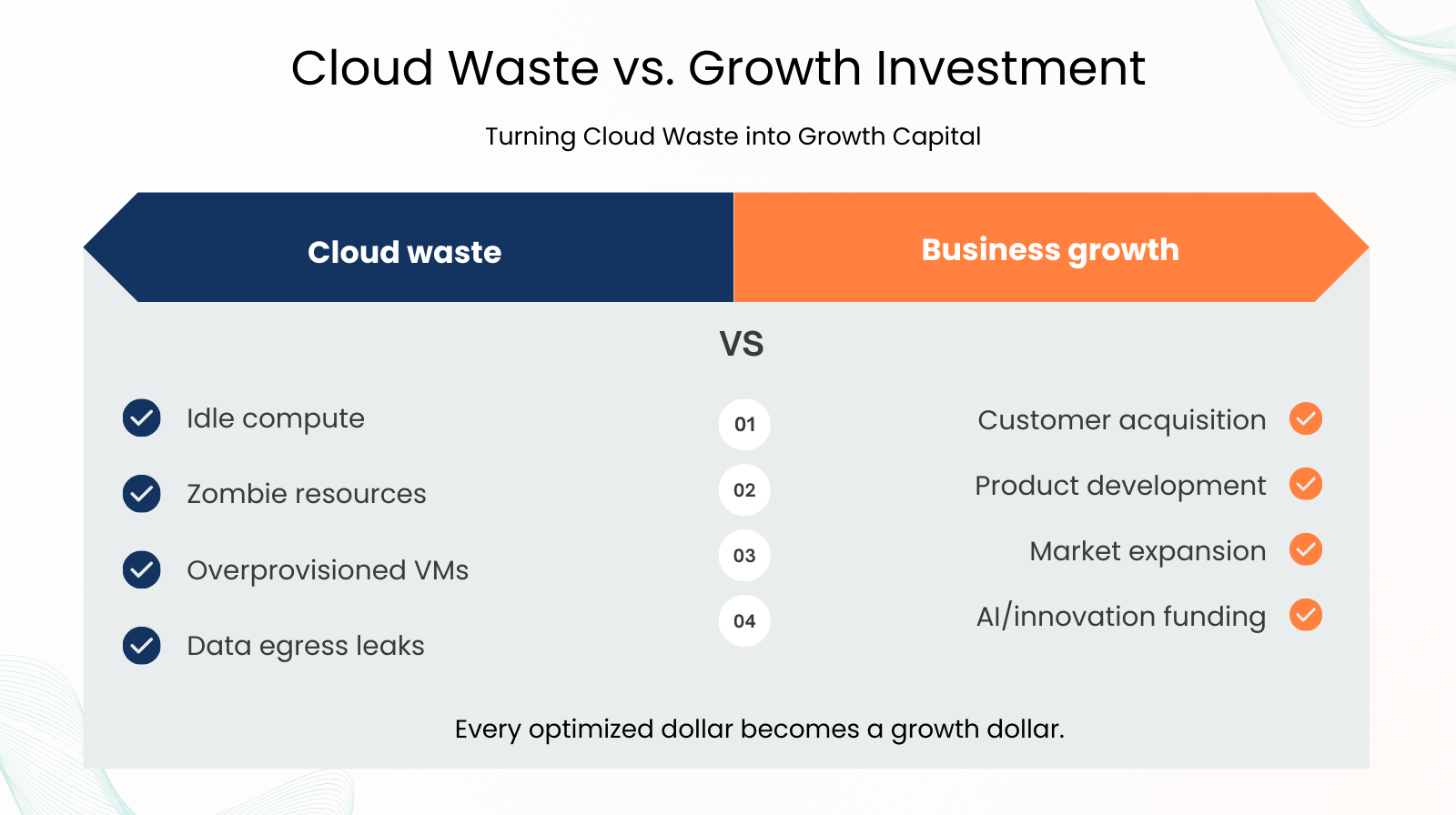
Why Cloud Costs Spiral Unexpectedly
Cloud providers sell simplicity: pay only for what you use. The reality is more complex. 94 percent of IT leaders report rising cloud storage costs, with 59 percent indicating significant increases in service billing.
Pay-as-you-go misconceptions
The variable cost model appears straightforward until you examine the details. Teams approach cloud infrastructure with on-premise thinking. They provision for peak capacity, leave resources running continuously, and treat cloud spending as a fixed cost. Development instances left running over weekends, or marketing microsites from past campaigns still provisioned "for backup," incur charges similar to those of production systems.
The VMware Private Cloud Outlook 2025 states that 94% of businesses think some of their public cloud expenditures are wasted. Approximately 31% believe that more than 50% of cloud spending is worthless. This waste does not exhibit the typical characteristics of an IT failure. Productivity ceases when a server malfunctions. Everything continues to function even as cloud spending rises. There is no emergency ticket, no outage, and no obvious point of failure. Teams take longer to respond since the impact is financial rather than operational.
Overprovisioning and idle resources
To avoid performance issues, teams allocate more resources than necessary. Average CPU utilization across Kubernetes clusters sits at 10 percent, according to Cast AI's 2025 Kubernetes Cost Benchmark Report. Studies show organizations squander 30 to 35 percent of budgets on oversized VMs, with 83 percent of Kubernetes container costs linked to idle capacity.
Engineers want performance buffers. Business teams fear service disruptions. Development environments remain active long after projects end. Test workloads quietly become permanent. Old storage volumes stay attached "in case." These zombie resources continue to rack up charges 24/7. A Gartner study highlights that up to 70 percent of cloud costs are driven by overprovisioning.
Hidden costs in data transfer and storage
Data egress fees for moving data out of cloud providers' networks or between regions are substantial and often overlooked in architectural decisions. Egress charges represent 30 to 50 percent of total egress expenses for organizations in many cases. Research from IDC shows planned and unplanned egress charges account for an average of 6 percent of organizations' cloud storage costs.
Common scenarios include disaster recovery testing, cross-region data synchronization for high-availability applications, and API integration proliferation as businesses grow. Organizations frequently discover API integrations represent 30 to 50 percent of total egress expenses. One mid-market B2B company discovered data transfers between regions for global SDR dashboards consumed 15 percent of their annual cloud spend, all invisible until audited.
Gaining Visibility Into Cloud Spending
Before you optimize costs, you need complete visibility into where money goes. In 54 percent of cases, cloud waste stems from a lack of visibility into cloud costs.
Cost allocation and tagging
Implement a consistent and mandatory tagging strategy. Tag resources by department, project, application, environment, and cost center. Examples include team: sales, campaign: Q1-leads, envisaging. This transforms a monolithic bill into a clear map of who and what drives costs.
Utilize IAM policies to strictly enforce tagging by denying any non, tagged launches. Compliance rate goes up to 95%.
Cost allocation is measured by three metrics: the percentage of costs directly allocated to organizational units (target 90 percent or higher), the percentage of costs with allocation metadata (target 80 percent or higher), and the percentage of unallocated costs (below 10 percent).
Usage pattern monitoring
Thanks to real-time monitoring tools, teams can see usage trends, detect aberrations, and spot idle or wasteful resources before they affect budgets. Because of continuous cost monitoring with FinOps dashboards, the forecast accuracy increased by 35% in 2025.
Track not only what resources are running but how they're used. CPU and memory utilization patterns reveal overprovisioning. Network traffic patterns expose unexpected data transfer costs. Storage access patterns identify opportunities for tiering. Modern cost monitoring extends beyond basic metrics. Track spending velocity, the rate at which costs accumulate over time. Monitor cost per business outcome, such as cost per customer, transaction, or feature.
Identifying high-cost workloads
Not all workload contributes equally to your cloud bill. According to the Pareto principle, 80% of expenses are driven by 20% of workloads. Look through reports to identify databases with high IOPS, idle ML training pods after an experiment, or Lambda functions that aren't optimized. AI and machine learning workloads deserve special attention. GPU instances cost 10 to 50 times standard compute, yet only 51 percent of organizations effectively track AI ROI.
Optimization Strategies for Compute and Storage
Once you have visibility, implement specific optimization strategies for compute and storage resources.
Rightsizing resources
Analyze 14 to 30 days of metrics to match instance types precisely. AWS Compute Optimizer recommends swaps (for example, m5.xlarge to t3.medium), delivering 20 to 40 percent savings without refactoring. According to the 2025 State of Cloud Costs by Datadog, over 80 percent of container spend goes to waste. Prioritize by cost-to-utilization ratio and automate via Terraform.
Autoscaling and scheduling
Horizontal pod autoscalers in Kubernetes add nodes at 70 percent CPU. Vertical scaling adjusts memory dynamically. Non-production environments auto-shutdown outside core working hours via AWS Instance Scheduler. For non-production environments, automated scheduling reduces costs by 70%. For even more savings, combine spot instances with autoscaling. When compared to on-demand pricing, spot instances can offer savings of up to 90%.
Storage Tiering
Storage costs vary dramatically based on access frequency. Hot storage provides immediate access for frequently accessed data. Cool storage offers lower costs for infrequently accessed data. For data that is rarely accessed, archive storage offers the lowest prices; retrieval times are measured in hours rather than seconds.
Put in place lifecycle policies that automatically transfer data between storage tiers according to access patterns and age. Data is automatically moved by S3 Intelligent-Tiering or Azure Cool Blob based on access patterns, which results in 28–40% savings over manual hot storage. Hunt idle EBS volumes (average waste of 50%), and lifecycle policies remove snapshots that are more than 90 days old.
Architectural Decisions That Affect Cost
Architecture choices made during the design phase have lasting cost implications.
Stateless vs stateful design
Stateless applications have higher scalability efficiency as new instances can be added or removed without keeping an internal state. Autoscaling thus becomes much more effective, and one doesn't have to pay for persistent, low, utilization resources.
Stateless architectures such as API gateways on Lambda scale horizontally without session storage and cost only a few cents per million requests as compared to stateful apps that require Redis replication.
Multi-region deployments
Deploying multi- region can elevate the level of availability and mitigate the delay of users worldwide. However, these advantages come at the expense of higher costs due to cross, regional data transfer fees and duplicated infrastructure. Check if all workloads truly need to be deployed in multi-region. Use CDNs (CloudFront caches assets at the edge), data residency (process in, region), and secondary regions for disaster recovery to achieve efficiency.
Managed services vs self-hosted
Although self-hosted, open-source databases may appear to be less expensive, the comprehensive ownership expenses related to patching, scaling, and securing them usually run way beyond the expenses of managed services such as RDS or Cloud SQL. Managed services change the variable operational labor into a predictable, frequently lower, operational expense.
A headless CMS was moved to managed Kubernetes, so the total cost of ownership was cut in half while at the same time the uptime increased to 99.99 percent.
Organizational Practices to Achieve Long, Lasting Cost Control
Technology cannot be the only factor to drive cost optimization. In order to achieve cost control which is sustainable, you will need to develop organizational practices that make cost awareness a natural part of everyday workflows.
Cost ownership models
Adopt cost ownership models (showback or chargeback) whereby a team is responsible for its cloud spend. Once developers and product teams understand the cost implications of their decisions, they tend to design and run more efficiently without any further prompting. Define clear cost ownership by team, service, or application.
Cost-aware engineering hackathons at Skyscanner revealed a year's worth savings in just a few weeks.
Budgeting and alerts
Budgets should be set up for the project, department, and whole organization. You can set automated alerts that will send notification at the time when the budget is at 50 percent, 80 percent, and 100 percent, so that the stakeholders are informed before the overspend happens.
Conventional optimization is based on the idea that cost problems arise gradually and predictably, however, modern cloud environments such as AI workloads can spike sharply in a matter of minutes. An alert system that is based on real-time information can help you to detect unbounded charges early instead of finding them in your month-end bills.
Continuous optimization culture
Based on the findings of enterprises that have implemented structured cost optimization programs, they are able to reduce their monthly cloud spend by an average of 25 to 30 percent. It is recommended to incorporate continuous optimization into your regular workflows rather than treating it as a one-off exercise. Since updates, projects, and spikes in consumption cause cloud infrastructures to be constantly changing, quarterly reviews are way too slow to spot waste in time. At the very least, monthly optimization opportunity assessments are necessary.
One of the main pillars of FinOps is mutual collaboration. The ideal FinOps team includes members from Finance, Cloud Engineering, Procurement, and Product Management, etc., this can lead to fast decision, making and shared cloud cost ownership.
Celebrate optimization gains. Share stories of teams that reduced costs while maintaining or even improving the performance.
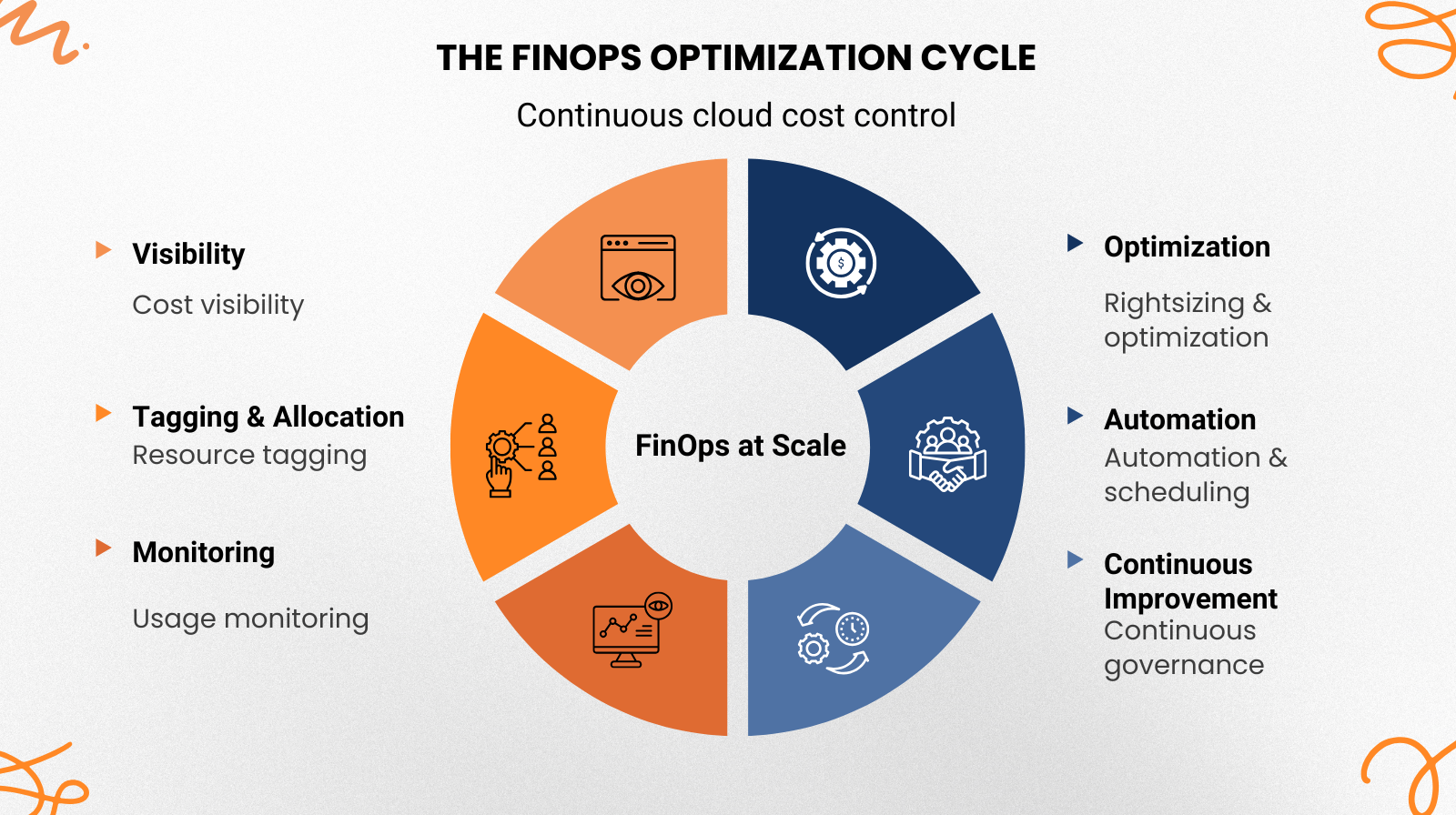
Cloud cost optimization at scale requires commitment across three dimensions: technical implementation, organizational change, and continuous improvement. A Deloitte analysis has revealed a $21 billion saving will be achieved by companies through the adoption of FinOps tools and practices in 2025 only, with a few organizations realizing cloud cost reductions as high as 40 percent.
Initiate with awareness. Utilize cost monitoring tools. Execute detailed tagging. Configure automated alerts. Next go to optimization techniques: right, sizing, auto, scaling, storage tiering, and architectural modifications that lead to less wastage. Every dollar saved on waste is a dollar available for innovation, customer acquisition, and market growth.