
Article
Batch ML vs Real-Time ML: The Infrastructure Decision That Shapes Marketing Intelligence
This blog explores how the choice between batch and real-time ML architecture is a strategic decision that shapes your marketing intelligence. It breaks down when to use batch for scale and efficiency, when real-time is worth the higher cost, and why most mature organizations need a hybrid approach. Ultimately, it argues that competitive advantage no longer comes from having more data, but from how quickly and intelligently you turn that data into action.
- Topic
- Machine Learning
- Published
- 14 Apr 2026

From Tools to Intelligence Systems
Marketing is no longer driven by tools. It is driven by decision systems.
In the past decade, businesses have transitioned from being on individual platforms to ecosystems enabled by machine learning. Marketing technologies have evolved from focusing solely on executing campaigns to continuously optimizing them. They have transitioned from being automated to being intelligent, from mere software solutions to infrastructures.
The key challenge at this juncture is to decide whether intelligence is to be run in batches or real-time.
It is no longer merely an implementation choice but a strategic constraint that governs your speed, scalability, and visibility into opportunities.
Defining the Architectural Divide
Batch ML operates on scheduled intervals. Data is collected over time, processed in bulk, and predictions are generated periodically. These systems snapshot reality, analyze it deeply, then wait.
Real-time machine learning is a continuous process. The predictions are made as the data becomes available, allowing instant action. The systems work in conjunction with moving reality.
Value propositions vary in each architecture depending on the assumptions about value. Batch systems are under the assumption that value accumulates with time and decisions can be delayed. Real-time systems rely on the idea that the competitive edge exists in the difference between now and then.
The batch recommender considers past customer engagements to maximize the performance of future content. A real-time system would use the customer's last click to personalize their experience.
Where Batch ML Creates Strategic Value
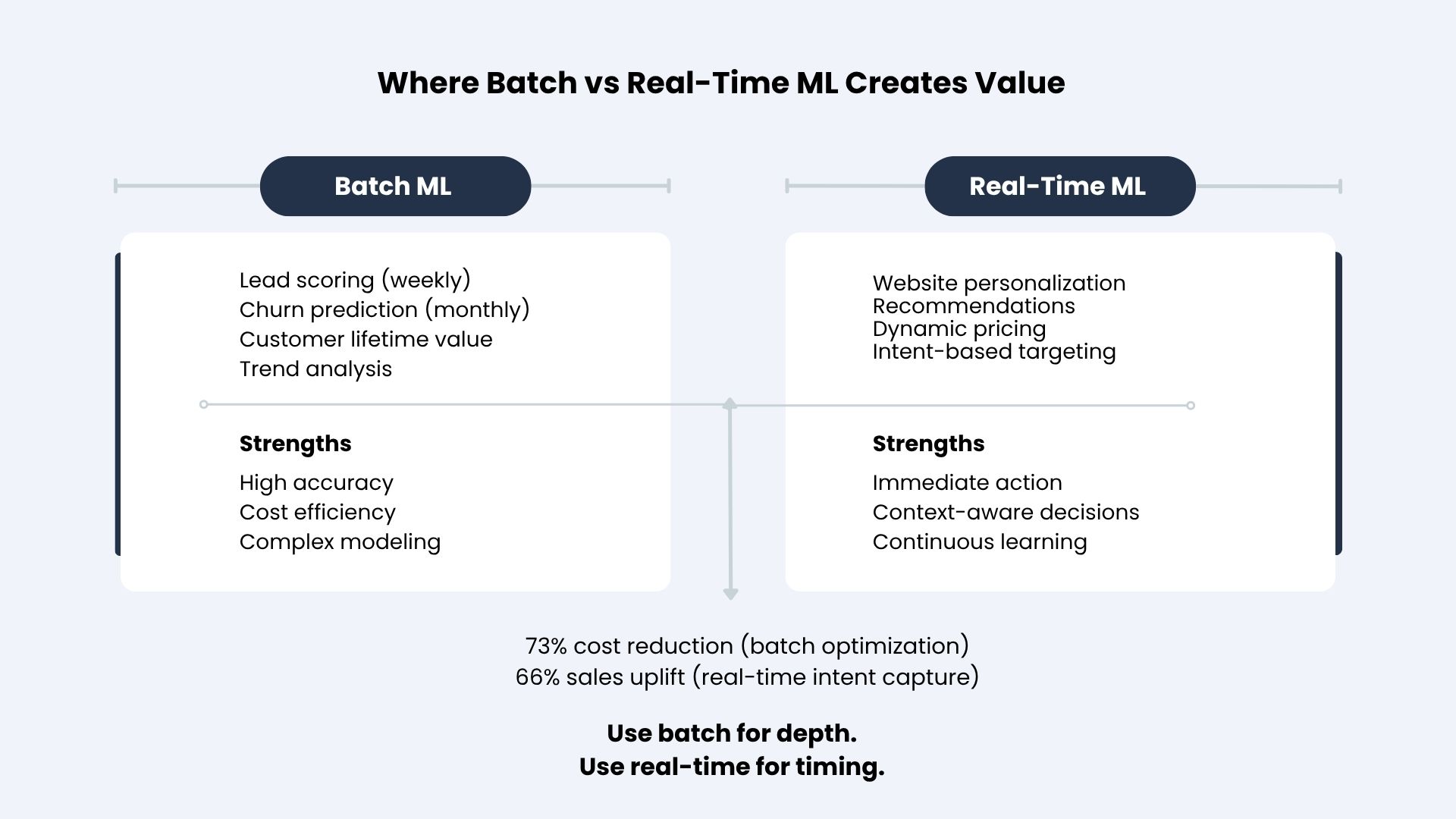
Batch processing systems work well in situations where periodic predictions are made that don’t need an instant reaction. Lead scoring every week, predicting churn every month, or determining lifetime customer value once per quarter are good examples that need full data processing and not speed.
The economic advantage is substantial. Batch systems process ten million records as efficiently as one million. Cloud infrastructure costs drop dramatically when compute resources run during off-peak hours. One financial services company reduced ML infrastructure costs by 73% by shifting non-time-sensitive models from real-time to batch without sacrificing analytical quality.
Batch architecture also enables greater model complexity. Without racing against response-time requirements, organizations can deploy ensemble methods and extensive feature engineering. This creates a counterintuitive advantage: batch systems often produce more accurate predictions because they can afford deeper computation.
For strategic insight generation, batch ML identifies which channels drive sustainable pipeline, detects shifts in market segments, and understands long-term customer behavior trends.
The limitation emerges when batch intervals create blind spots. If customer intent shifts between processing cycles, predictions optimize for a reality that no longer exists.
When Real-Time ML Becomes Strategically Necessary
Real-time ML systems are needed when the usefulness of a decision deteriorates quickly over time. There are three circumstances that call for real-time ML systems: systems used by humans where the delay is critical; predictions that rely on current data because old predictions may pose risks; and learning processes driven by feedback.
For user-facing decision systems, delays reduce effectiveness. Website personalization engines, recommendation systems, and dynamic pricing must respond while the customer is still engaged. A recommendation delivered minutes later is no longer relevant. When a visitor lands on your pricing page, personalization must happen immediately, not hours later when batch processing completes.
Some signals lose value within seconds. Intent spikes indicating active research, real-time engagement patterns, and live campaign interactions create opportunity windows that close before batch systems can act. The BBVA cross-sell initiative using real-time intent delivered a 66% increase in sales because the intent was immediately capitalized upon instead of waiting to send emails after a batch process.
AI today operates through a feedback loop. Click-through rates, conversions, and other engagement statistics should feed back into the prediction algorithm during the user’s interaction. This builds the concept of what Microsoft AI CEO Mustafa Suleyman calls an “AI flywheel,” where high-margin businesses create cash flow that can be reinvested to build the architecture further and attract more users.
The strategic unlock happens when real-time systems enable closed-loop optimization. The traditional way of marketing is to plan, execute, and measure through cycles of time frames ranging from days to weeks for feedback and correction. Real-time machine learning reduces the process to minutes or even seconds, making the infrastructure learn as it deploys.
Infrastructure Realities and Cost Trade-Offs
According to Deloitte's TMT Predictions 2026, inference workloads now account for two-thirds of total AI compute spending. Running AI systems at scale has become harder than building them.
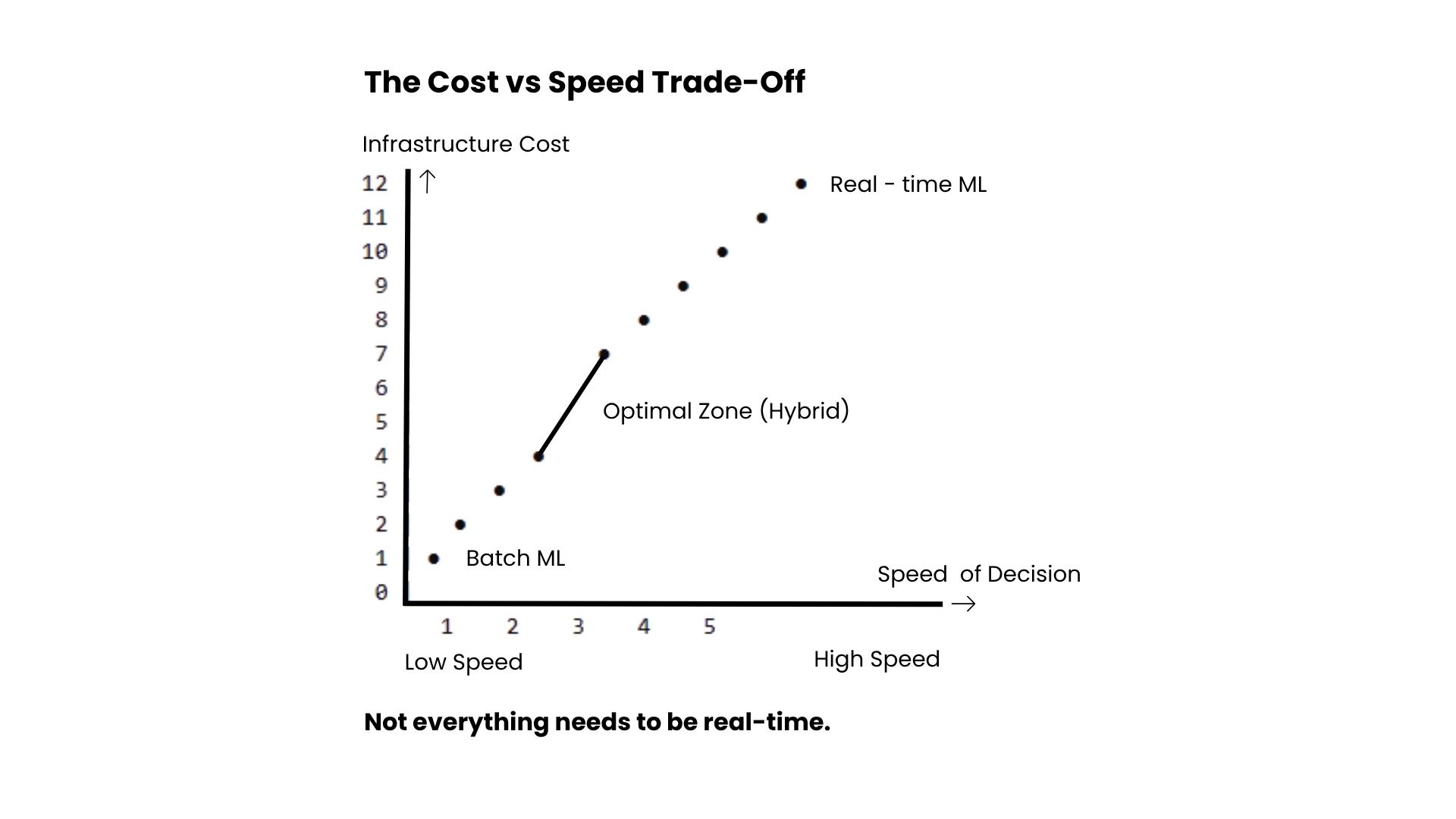
The cost differential is substantial. Batch processing runs compute only during scheduled windows using spot instances. Real-time processing requires always-on inference servers and complex architectures. Real-time inference typically costs 4-5x more than batch for equivalent workloads.
Scalability challenges differ fundamentally. Batch systems have predictable scalability due to the predefined nature of their load. Real-time systems need to deal with unexpected peaks in activity, unpredictable data streams, and continuous processing, demanding streaming architectures.
Reliability trade-offs favor batch processing. Failed batch jobs can be rerun. Real-time errors affect individual requests, requiring circuit breakers and fallback mechanisms. The p99 latency requirement leaves little margin for error recovery.
Microsoft is committing over $80 billion annually to AI infrastructure. As Microsoft AI CEO Mustafa Suleyman predicts, access to inference computing will determine success more than model intelligence.
The Hybrid Architecture Imperative
The most sophisticated marketing organizations combine both approaches, optimizing each workload for its appropriate latency tier.
The emerging pattern uses batch pipelines for model training and large-scale analysis while real-time pipelines handle inference and immediate decision-making. A lead scoring model trains in batch on comprehensive historical data, then real-time signals adjust scores dynamically. This balances accuracy and responsiveness.
Managing consistency is the critical challenge. Feature stores serve the same definitions for both training and inference. When batch and streaming pipelines process data differently, predictions diverge and performance degrades.
The operational complexity is significant. Teams must maintain multiple pipelines, feature stores, and model serving infrastructure. This explains why many organizations default to single approaches.
The strategic recommendation: start with batches, validate business impact, and then incrementally migrate specific predictions to real-time. Batch-compute wherever possible; use real time only where necessary.
Strategic Implications for Marketing Systems
The batch versus real-time decision maps onto a deeper question: what kind of intelligence does your marketing organization need to build?
If your competitive advantage comes from discovering invisible patterns through better segmentation or superior attribution, batch architectures provide computational depth at sustainable cost.
If your advantage comes from responding to customer context faster through relevant recommendations or dynamic optimization, real-time architectures create the responsiveness that batch intervals prevent.
Most organizations need both capabilities but should sequence them deliberately. Treat ML architecture as capability infrastructure, not project tooling. The question is not which ML approach to use for a campaign but which cognitive capabilities your organization should possess and what infrastructure enables them.
Stop asking which AI tool to buy. Start asking how your data infrastructure supports intelligence delivery. If your infrastructure is batch-oriented, you cannot deliver true real-time personalization regardless of which AI tools you purchase.
Conclusion: Architecture as Strategic Foundation
The choice between batch and real-time ML architecture is really a choice about organizational cognition. Batch systems create periodic intelligence that compounds over time. Real-time systems create continuous adaptation that responds to emergence.
Neither one is inherently better than the other. The correct approach matches your organization’s business model, decision-making cycles, and sources of competitive intelligence.
As marketing becomes more algorithmic, these infrastructure decisions increasingly determine strategic possibilities. The tools you can deploy, the speed at which you can adapt, and the complexity of intelligence you can sustain are all downstream of architectural choices often made without recognizing their strategic weight.
Batch ML provides scale, efficiency, and strategic insight. Real-Time ML offers speed, adaptability, and precise execution. Both lay the groundwork for contemporary artificial intelligence-powered marketing platforms.
In the era of intelligence, advantage will not come from having more data. It will depend on how quickly and intelligently that data is turned into action.