
Article
Autonomous AI Agents: The Architecture of Intelligence Infrastructure
AI is shifting from passive chatbots to autonomous agents that plan, execute, and learn across systems without step-by-step human instruction. This blog breaks down the core architecture of agent systems; planning, memory, execution, and adaptation, while tackling the real constraints of error compounding, security risks, and token economics. The key takeaway: the question is no longer what AI can tell you, but what you'll empower your agents to do for you.
- Topic
- Artificial Intelligence
- Published
- 7 May 2026

The Shift From Assistance to Execution
For three years, enterprise AI meant chatbots. Large language models helped humans write faster, summarize meetings, and generate code. AI acted as a turbocharger while humans remained the engine.
That paradigm is ending. The shift now underway is from response generation to goal execution. Traditional AI systems answer questions or produce content on demand. Agent-based systems interpret goals, plan work, use tools, track state, and keep operating until a task is complete. This moves AI from a productivity feature into an infrastructure layer for execution.
The strategic tension lies in the "execution gap." Operations teams have more data and more tools than ever, yet they remain constrained by human orchestration. Every workflow requires someone to monitor, decide, and execute. Every system boundary demands manual integration. Autonomous agents close that gap by operating across systems without constant human intervention.
What Distinguishes an Agent From an AI Tool
The critical distinction is architectural, not semantic. A chatbot responds. An agent acts.
Response-based AI waits for input, processes a request, and returns output. An autonomous agent operates from objectives rather than prompts. Given the goal "optimize email engagement for dormant enterprise accounts," an agent would segment audiences by inactivity patterns, analyze historical engagement data, generate variant messaging, schedule delivery optimized by timezone, monitor early performance signals, and iterate based on results. All without step-by-step human instruction.
This shift from reactive to goal-driven operation requires three architectural components that distinguish agents from conventional AI systems.
Planning and decomposition logic breaks high-level objectives into executable subtasks. The agent constructs its own task graph based on the goal state and available capabilities, understanding not just what to do, but in what sequence, with what dependencies, and with what contingencies.
Memory as a foundational system layer enables agents to maintain context across interactions, build knowledge over time, and learn from outcomes. Unlike stateless API calls that forget everything when the session ends, agents accumulate operational intelligence. They understand which approaches succeeded, which failed, and why. Production memory systems implement a two-layer architecture: working memory for active processing and vector storage for long-term knowledge. Memory is not a feature enhancement. It is the infrastructure of agentic intelligence.
Iterative reasoning loops create the capacity for self-correction and adaptation. An agent operates in a sense-think-act cycle: it plans a step, executes it, observes the result, and adjusts its next move based on feedback. When an action produces unexpected results, the agent evaluates the discrepancy, adjusts its approach, and retries. This is what separates automation from autonomy.
The Core Architecture of Agent Systems
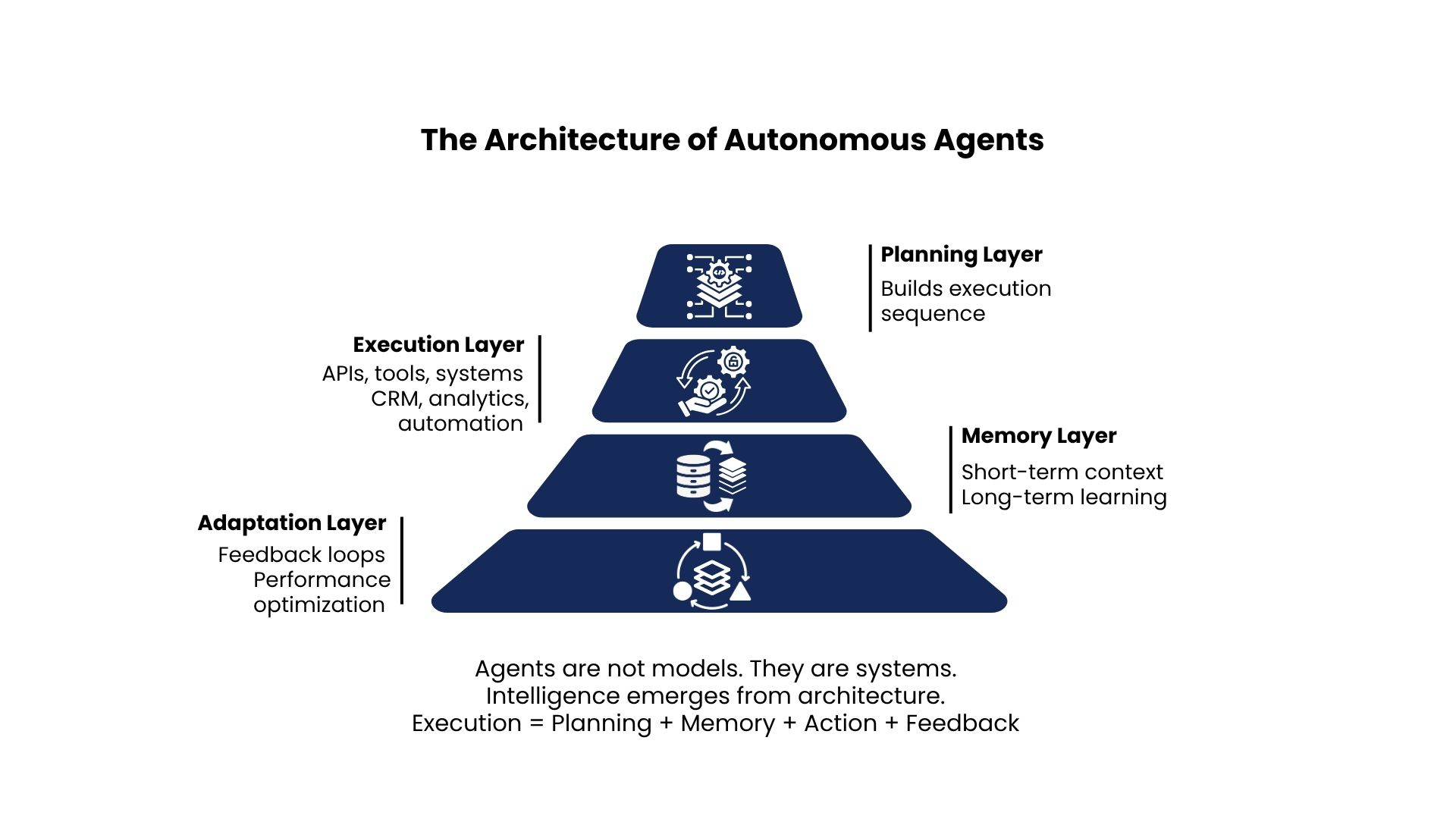
Building effective agent systems requires integrating four operational layers, each serving a distinct function in the execution pipeline.
The planning layer translates objectives into executable workflows through dependency mapping. Advanced implementations construct directed acyclic graphs of subtasks, identify parallel execution opportunities, and dynamically adjust plans when conditions change. When a planned integration fails, the system explores alternative paths rather than simply erroring out.
The execution layer provides operational capabilities through tool access: API connections to CRM systems, marketing automation platforms, analytics systems, and customer data platforms. The architectural challenge is abstraction. Effective agent systems need a unified interface layer that normalizes interactions across disparate platforms, handles authentication and rate limiting, and provides consistent error handling.
The memory layer operates at two timescales. Short-term memory maintains context within a single workflow, preventing redundant work and enabling coherent execution. Long-term memory captures patterns across workflows: which segmentation approaches yield the highest conversion, what messaging themes resonate during different buying cycles. This accumulated intelligence transforms agent performance over time. Unlike static automation rules, agent systems improve through operation.
The adaptation layer enables agents to evaluate outcomes against objectives and adjust execution strategies. When a campaign underperforms, the agent analyzes performance dimensions, forms hypotheses, and tests adjustments. This creates operational learning distinct from model training. The agent accumulates strategic knowledge about how systems behave in specific contexts.
Capabilities That Emerge From Agent Architectures
When these architectural layers work together, several capabilities become possible that were previously constrained by human bandwidth.
Multi-step task execution can operate without manual checkpoints. An agent managing paid media continuously monitors performance signals, tests variants, and reallocates budget toward better-performing segments within defined bounds.
Cross-system orchestration becomes fluid. When a high-value account exhibits buying signals across multiple touchpoints, an agent can coordinate response across email, advertising, and sales outreach without requiring a human to manually trigger each system.
Long-running research workflows can operate asynchronously. An agent tasked with competitive intelligence continuously monitors sources, synthesizes findings, and surfaces insights when they cross relevance thresholds, accumulating understanding over weeks.
Dynamic decision-making adapts based on intermediate results. If a database query returns no results, the agent broadens search parameters. If an API call fails, the agent retries with exponential backoff or selects an alternative endpoint.
The Constraints That Define Production Viability
Despite these capabilities, autonomous agents introduce failure modes that require explicit architectural consideration.
Error compounding represents the primary risk. When an agent makes an incorrect decision early in a multi-step workflow, subsequent steps can amplify the error. As one production engineer explains: if each step in an agent workflow has 95 percent reliability, five steps yield 77 percent success, ten steps 59 percent, and twenty steps only 36 percent. Even improved per-step reliability of 99 percent yields only 82 percent success for twenty steps. This is not a prompt engineering problem. This is mathematical reality.
The practical solution is breaking workflows into three to five discrete, independently verifiable steps, each with explicit rollback points and human confirmation gates.
Security risks from tool access expand the attack surface. Giving an agent API access to your CRM creates massive security responsibility. If an agent is influenced by a malicious external signal, it could be coerced into exfiltrating data or deleting records. Permission boundaries are non-negotiable. Runtime policy enforcement, cryptographic identity, and behavioral trust scoring are emerging as the governance standard.
Cost of continuous execution can escalate unexpectedly. Reasoning loops are expensive. Unlike a single chat response, an agent might make twenty to thirty LLM calls to solve one task. In one documented case, a hundred-turn exchange cost between fifty and one hundred dollars in tokens alone. Leaders must calculate the ROI of autonomy. Does the labor saved outweigh the compute cost?
Human supervision remains fundamental. The most successful production agents share a common pattern: AI manages complexity within clear boundaries while humans ensure control and reliability. UI generation agents create components but require human review before deployment. DevOps automation produces code that undergoes review, version control, and rollback.
The Agent Maturity Framework
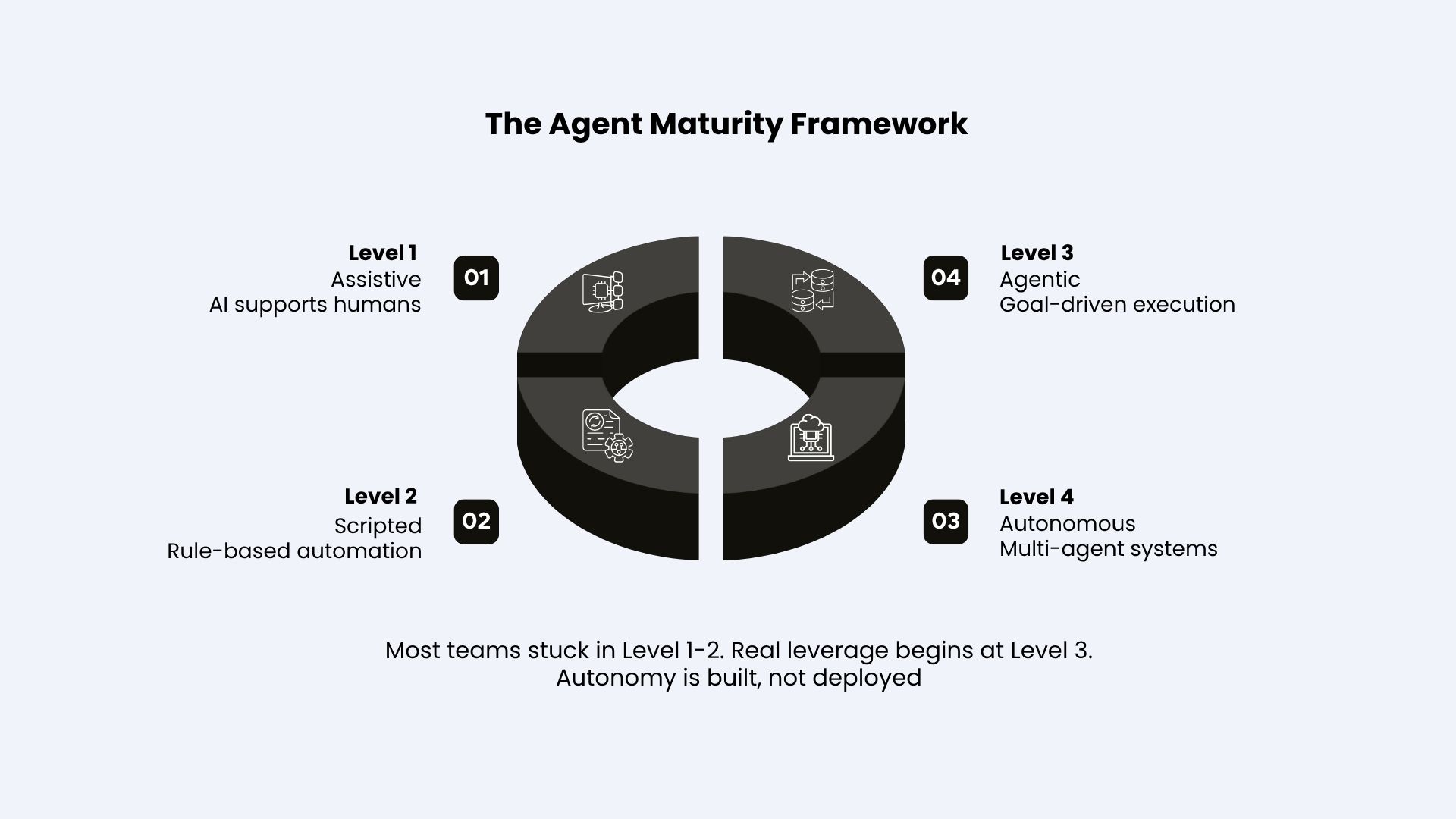
Organizations building toward agent-based operations should follow a deliberate progression.
Level 1: Assistive. Humans use AI to write and code. Impact is individual productivity.
Level 2: Scripted. AI follows rigid if-then workflows. Impact is basic automation.
Level 3: Agentic. AI plans and executes multi-step goals within bounded domains. Impact is systemic efficiency.
Level 4: Autonomous. Multiple agents collaborate on complex workflows with human oversight at critical junctures. Impact is predictive, scalable growth.
Organizations extracting maximum value are not those with the most sophisticated AI capabilities. They are those with the clearest operational objectives, the most reliable system integration, and the best observability infrastructure.
Strategic Implications: Architecture as the Moat
The rise of autonomous agents means your competitive advantage is no longer your data. It is your agentic logic.
The role of the operations professional shifts from doing the task to managing the agent that does the task. Agents require a unified data layer and centralized identity resolution to act accurately. You cannot run them on a fragmented data foundation.
Infrastructure becomes strategy. We will stop building dashboards for humans and start building APIs for agents. The interface of the future is an agent-to-agent protocol.
As capabilities mature, competitive differentiation shifts from tool access to system design. Every organization will have access to powerful language models. The advantage emerges in how those models are integrated: what objectives they pursue, what tools they access, what knowledge they accumulate, and how effectively humans and agents collaborate.
Conclusion: Bounded Autonomy as the Path to Production
Autonomous AI agents represent the moment where intelligence becomes an active, scalable infrastructure rather than a passive tool. They are being deployed today in DevOps, research automation, and workflow orchestration.
But they are not magic. They are systems with known constraints: error compounding, token economics, security surfaces, and the need for human supervision at critical junctures.
The winning strategy is not chasing autonomy for its own sake. It is architecting agents that are autonomous where reliable, supervised where risky, and bounded everywhere. The organizations that will lead are those who recognize that the execution gap can finally be closed by delegating orchestration to agents while reserving strategic empathy, creative narrative, and high-stakes relationship building for humans.
The question is no longer what AI can tell you. The question is what you will empower your agents to do for you.