
Article
AI System Evaluation in Open-Ended Environments
This blog explains why traditional benchmarks fail in production environments where data shifts, ground truth is uncertain, and outputs are non-deterministic, and why evaluation has become a strategic capability rather than a technical checkbox. It covers a layered evaluation architecture (automated regression, LLM-as-judge, scenario simulation, production monitoring), a four-dimensional framework (consistency, quality, reliability, business impact), and the organizational governance required to turn AI evaluation from a pre-deployment gate into continuous operating infrastructure.
- Topic
- Artificial Intelligence
- Published
- 16 Jul 2026

The Measurement Problem Enterprise AI Cannot Ignore
Enterprise AI has crossed a threshold. For most organizations, it is no longer a discrete feature or an experimental tool. It is infrastructure: powering customer journeys, content pipelines, sales workflows, and decision-support systems that run continuously in conditions no laboratory anticipated.
That shift has exposed a structural flaw at the center of AI programs. Evaluation practices have not kept pace. Organizations deploy open-ended AI systems while still measuring them with frameworks built for closed, deterministic tasks. The result is a dangerous illusion: models that score well in evaluation and fail in production, not because they are bad models, but because the measurement apparatus was asking the wrong questions.
This is not a technical problem with a technical fix. It is an architectural problem.
Why Benchmarks Break in Production
Traditional benchmarks assume three things that production environments routinely violate: static data, fixed ground truth, and deterministic outputs.
Static datasets capture a snapshot of the world as it existed when the data was curated. Production environments are not snapshots. User intent shifts, language evolves, edge cases multiply, and the context that shaped a benchmark becomes stale from the moment the system deploys. A B2B marketing AI evaluated on last quarter's customer inquiries has never seen the product features launched since, the competitors who entered the market, or the phrasing patterns that users have adopted in the interim. The benchmark score tells you almost nothing about live performance.
Benchmark saturation compounds the problem. As models optimize against known test sets, leaderboard scores rise while operational generalization stagnates. Models learn to pass tests they were never taught to reason through. Research has consistently found that as models approach ceiling performance on widely used benchmarks, the correlation between those scores and real-world task completion weakens. The benchmark stops measuring capability and starts measuring familiarity with the benchmark itself.
The gap between lab performance and operational reliability is widest in systems that handle variability: conversational AI, generative content tools, multi-step reasoning agents. These are also the systems marketing and revenue operations teams are deploying most aggressively. A model with a 5% lab error rate, operating at scale, can generate tens of thousands of problematic responses per month. The aggregate number is small; the downstream impact on churn risk, brand trust, and customer confidence is not.
The Evaluation Challenges That Benchmarks Cannot Reach
Open-ended AI systems present challenges that closed-domain benchmarks were never designed to address.
The first is non-determinism. An LLM responding to the same customer query may produce multiple valid, meaningfully different outputs. Traditional evaluation assumes deterministic ground truth. Open-ended evaluation cannot. Teams must move from asking whether the answer was correct to asking how often the system deviates in harmful directions and how much variation is acceptable given business context.
The second is subjective quality. What makes a piece of marketing copy good depends on brand voice, audience segment, competitive positioning, and channel format. There is no universal rubric. An AI system can produce outputs that are technically accurate and still erode customer trust by drifting off-brand, over-promising, or misjudging tone. Quantitative metrics do not surface this; only contextually grounded evaluation can.
The third is compounding error in multi-step systems. AI agents in production chain reasoning steps, call external tools, and make sequential decisions. A failure at any step can degrade the final output without triggering a measurable error in the component evaluation. Research into multi-step consistency has found that single-step accuracy may exceed 85% while logical coherence across a five-message sequence falls below 63%. Evaluating components in isolation while ignoring system-level behavior creates a blind spot that only surfaces in production.
A Layered Evaluation Architecture
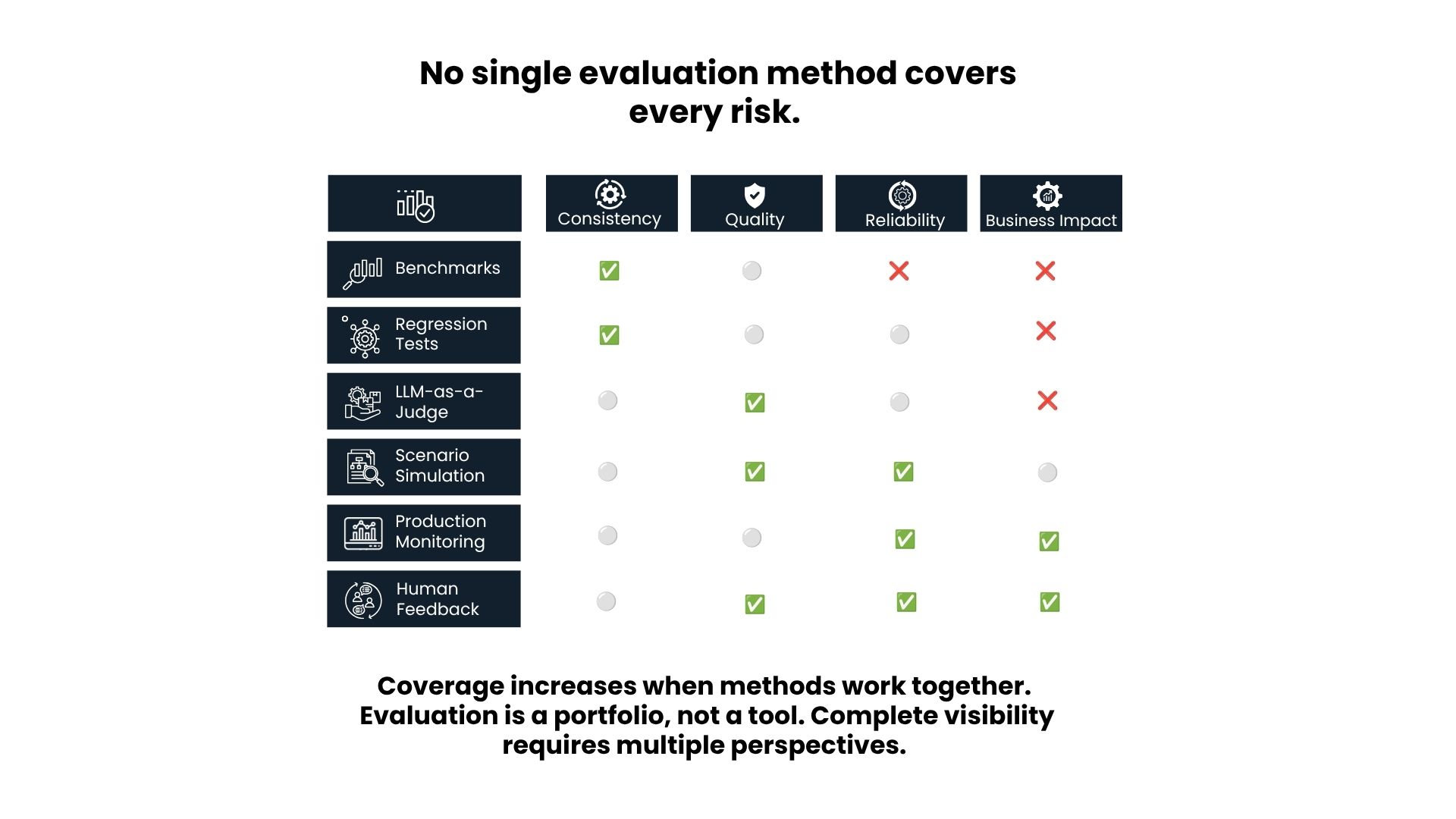
The industry is converging on a multi-layered evaluation model that pairs automated scale with human judgment. No single method is sufficient. The strongest programs combine several.
Automated regression testing forms the foundation. Run continuously against a controlled reference set, this layer catches behavioral drift introduced by model updates, prompt changes, or system modifications before they reach users. Adversarial evaluation belongs here as well: systematically probing models with edge cases and deliberately ambiguous prompts surfaces failure modes that curated benchmarks miss. The goal is not to find cases where the model fails; it will. The goal is to understand the shape of the failure space and ensure it stays bounded.
LLM-as-a-judge frameworks provide scalable qualitative assessment. A separate model evaluates outputs against defined criteria: relevance, factual grounding, brand alignment, tone consistency. This scales human-level judgment without the cost and latency of reviewing every output. However, these frameworks carry real vulnerabilities. Research has found that AI judges are susceptible to evaluation faking, where awareness of the downstream consequences of their scores systematically corrupts assessments. LLM judges should support evaluation, not replace human governance.
Scenario simulation and production monitoring operate at the system level. Simulation testing runs AI through realistic workflows before deployment: complete customer journeys, multi-turn conversations, sequential decision chains. Production monitoring captures live behavioral data and flags anomalies in real time. Together, they transform evaluation from a pre-deployment gate into a continuous operating discipline.
Human feedback closes the loop. Every override, escalation, and correction is a signal. The people who live with AI decisions daily are the most valuable evaluation source in the organization. Their corrections teach the system what good actually means in context.
An Evaluation Framework for Production AI
Effective evaluation operates across four dimensions:
|
Dimension |
What It Measures |
Primary Method |
|
Consistency |
Output stability across similar inputs |
Automated regression testing |
|
Quality |
Alignment with defined standards |
LLM-judge with human calibration |
|
Reliability |
Performance under real-world variability |
Scenario simulation and production monitoring |
|
Business Impact |
Correspondence to operational outcomes |
Feedback loops and outcome tracking |
Most organizations currently evaluate only on consistency and quality. Reliability and business impact are harder to measure but are where AI programs succeed or fail at scale. The full four-dimension framework is the baseline for production-grade deployment.
The Organizational Dimension
Technical frameworks are necessary but not sufficient. The organizational architecture around evaluation is equally critical and harder to build.
Defining what "good enough" means is a governance decision, not a technical one. Different stakeholders hold different definitions of acceptable performance. Marketing wants brand consistency and engagement. Legal wants compliance and accuracy. Engineering wants reliability and latency. Without a cross-functional standard, evaluation becomes a political negotiation. Threshold-setting must be deliberate and tied to the risk profile of each workflow. A compliance assistant and an internal brainstorming tool do not require the same standard.
Evaluation standards also drift. The criteria appropriate at initial deployment will not be right eighteen months later. User expectations shift. Competitive norms evolve. Regulatory requirements change. Organizations need a governance process that periodically re-anchors evaluation criteria to current business reality.
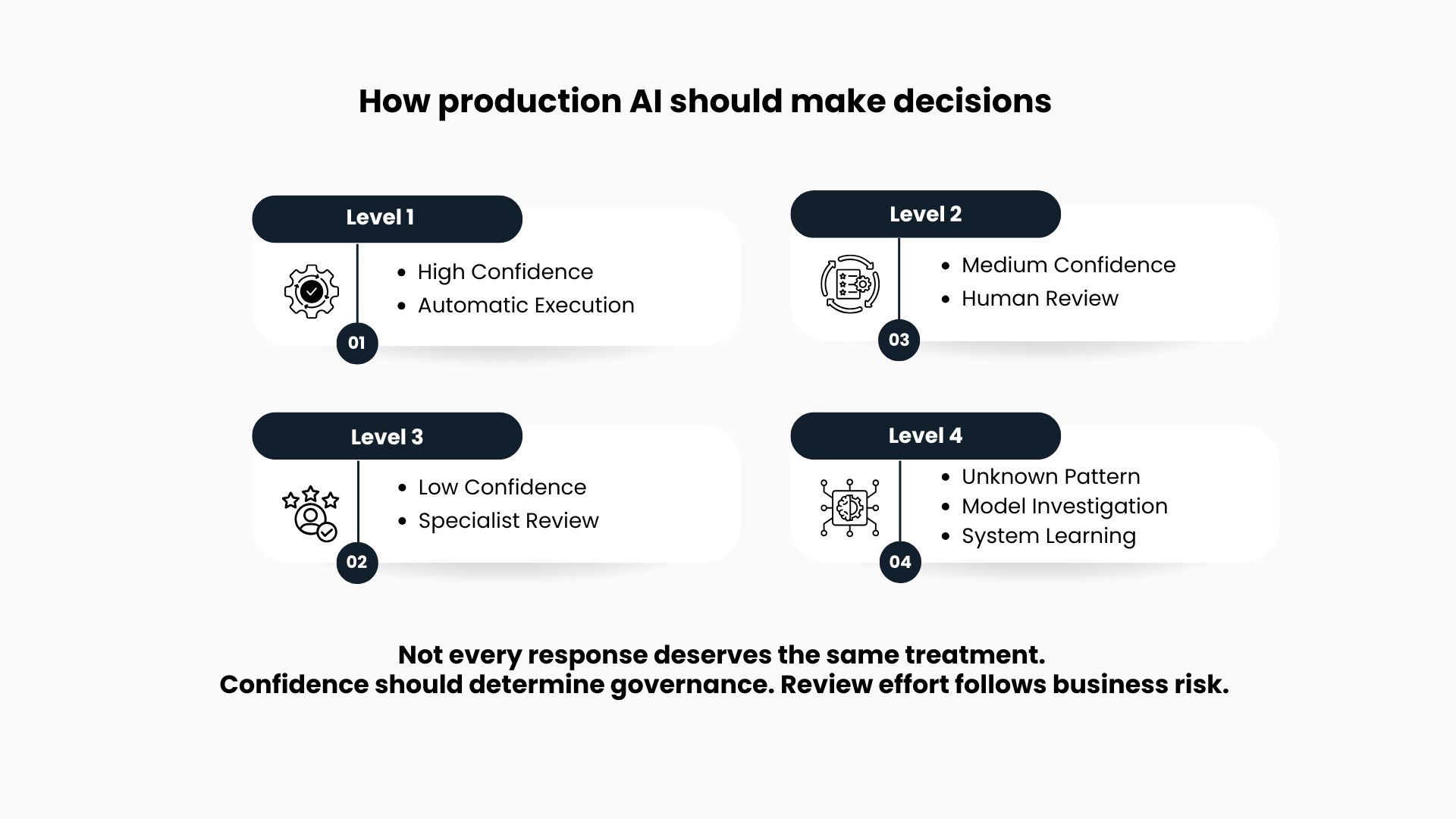
Scaling human review requires systems design. The strongest programs route ambiguous, high-risk, and low-confidence outputs to specialist review while using automated methods for routine outputs. This is not an ad hoc quality check. It is infrastructure.
Evaluation as Competitive Infrastructure
The organizations that will lead in enterprise AI are not necessarily those with access to the best models. Model capability is increasingly commoditized. The differentiator is operational excellence: the ability to deploy AI reliably, improve it continuously, and maintain confidence in its outputs as conditions change.
Evaluation infrastructure is the enabling layer. Without it, AI is a liability: capable in controlled conditions, unpredictable in production, and impossible to improve systematically. With it, AI becomes a compounding asset. Each deployment teaches the system something. Each failure generates a signal.
For marketing and revenue leaders, this reframes the investment decision. The question is not which AI tool to buy. The question is what evaluation infrastructure is needed to make any AI tool work reliably at scale. Organizations that answer that question well build durable advantage. Those that chase benchmark improvements while leaving evaluation architecture underdeveloped will optimize for metrics that bear no relationship to business outcomes.
Confidence in AI cannot come from a score. It must be earned through systems that match the complexity of the environments where AI operates: continuous, multi-layered, cross-functional, and built for the open-ended reality of production rather than the controlled convenience of the lab.