
Article
AI Model Observability: The Infrastructure Behind Reliable Intelligence
This blog explains why AI failures evade traditional monitoring; degradation is gradual, outputs are non-deterministic, and offline metrics don't predict live performance, creating an observability gap that most marketing teams cannot close. It covers the four essential signals (prediction quality, input distribution, business-outcome alignment, and tail latency), operational architecture like shadow deployments, and a maturity framework for turning model monitoring from a data science consideration into a business imperative.
- Topic
- Artificial Intelligence
- Published
- 11 Jun 2026

The Shift That Changed the Risk Profile
In 2020, AI in marketing meant bolt-on intelligence: a vendor-built model sitting inside a platform, scoring leads or recommending the next best action. By 2026, AI is embedded infrastructure. Custom and fine-tuned models now sit between data sources and execution layers, dynamically routing accounts, personalizing journeys, and determining how campaign spend gets allocated.
This architectural shift changes the nature of risk entirely. A poorly tuned lead-scoring model in 2020 was a missed opportunity. Today, the same model might govern GTM allocation across millions of accounts. When it degrades, the consequences are misallocated budget, misprioritized pipeline, and eroding customer experience.
Yet most organizations still treat AI models as one-off experiments. They measure success in offline tests, ship to production, and assume the model will keep working. A 2025 benchmark of 54 AI-driven MarTech stacks found that 71% of marketing teams could not confidently say whether their scoring or sequencing models were performing worse than they were six months earlier. That is the AI observability gap: the difference between deploying intelligence and actually understanding it in production.
Why AI Failures Evade Detection
AI systems fail in a structurally different way than traditional software. A crashed server triggers an immediate alert. A model that drifts over three months triggers nothing. Understanding why requires looking at four root causes.
Non-deterministic outputs create moving targets. Traditional software is deterministic: the same input produces the same output. AI systems are probabilistic. A model might assign a 0.72 intent score to an account today and 0.68 tomorrow with no underlying code change. This makes it genuinely difficult to distinguish normal variability from early-stage degradation.
Degradation is gradual, not sudden. A 2024 MLOps benchmark found that 88% of AI model failures in production were gradual. Pipeline or conversion slowly declined over months, and teams only noticed when they looked back at historical data. By then, the damage was already baked into the quarter. This slow decay is the silent killer of AI-driven systems.
Offline metrics do not predict live performance. Data science teams validate models on historical data using metrics like AUC-ROC, precision, and recall. One 2024 RevOps case study found that a lead-scoring model with a 0.92 AUC-ROC in offline tests showed no conversion lift in production. The model had overfit to training biases and failed to capture real-world buyer behavior. High offline metrics provide false confidence.
Input opacity hides the root cause. When an ad platform changes its pixel tracking format, or an intent vendor alters signal coverage, the model continues processing the distorted data without throwing an error. Only 29% of organizations logged model inputs in production, according to a 2025 RevOps benchmark. Without input visibility, teams cannot determine whether a drop in performance is caused by a bad model, bad data, or a changed market.
What Production AI Observability Actually Measures
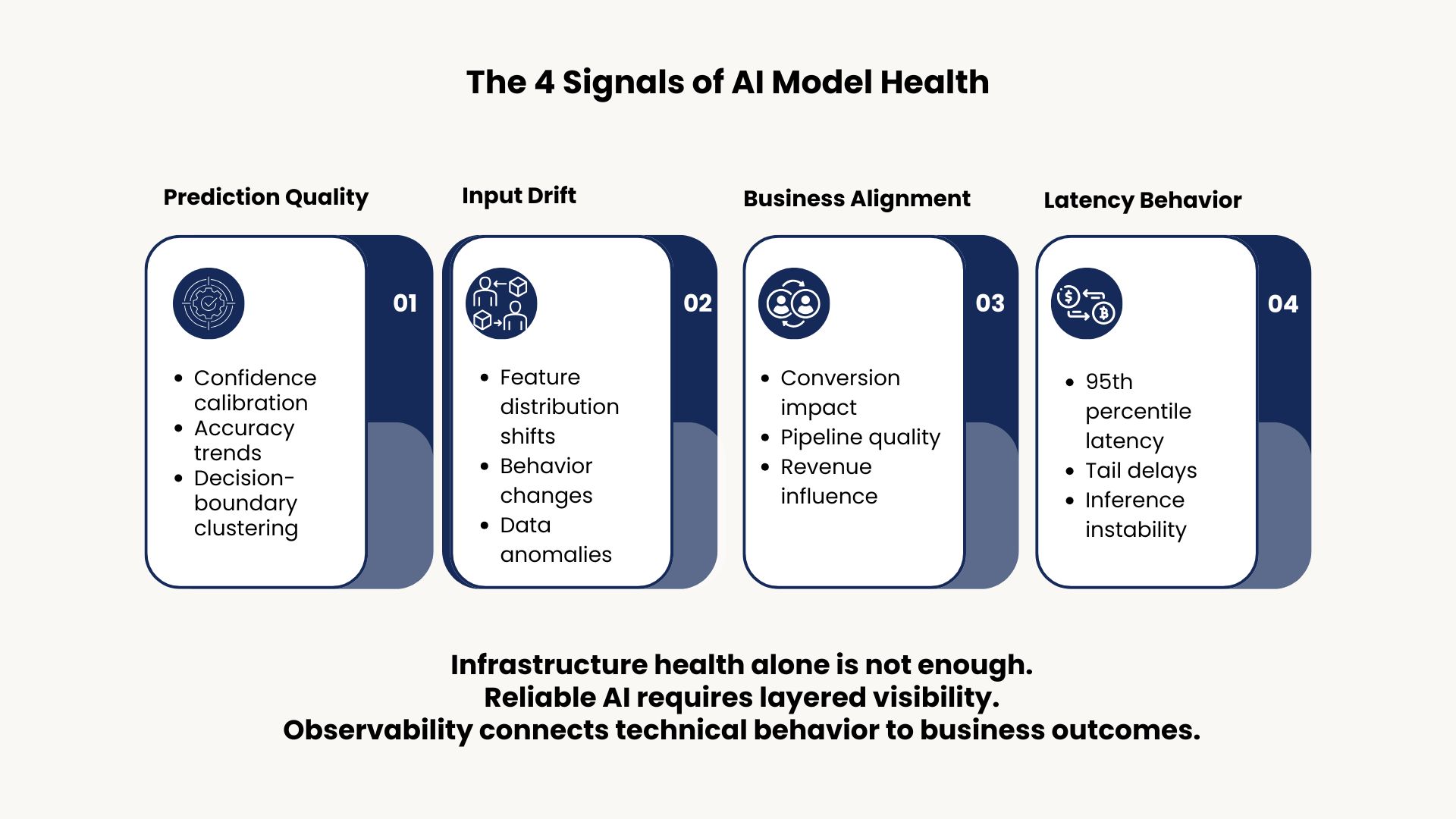
Closing the observability gap requires instrumentation built for non-deterministic systems. Four signal categories form the core.
Prediction quality and confidence track not just accuracy but calibration. A model predicting 0.80 probability for high-intent accounts should see roughly 80% of those accounts convert. When confidence scores cluster near the decision boundary across the board, the model is signaling drift in real time, often before accuracy metrics move.
Input distribution changes are the most valuable and least monitored signal. Statistical distance metrics comparing this week's feature distributions to training baselines reveal when a model is operating outside its comfort zone. Organizations that monitored input drift detected model degradation 52% faster and reduced retraining latency by 33%, according to a 2025 RevOps case study.
Business-outcome alignment connects model behavior to revenue. Pipeline-to-revenue ratios for AI-driven segments, conversion rates by model score, and churn rates for AI-prioritized accounts should all be tracked alongside technical drift signals. When combined, organizations in a 2024 RevOps benchmark achieved 41% higher accuracy in detecting failures and reduced false-positive alerts by 27%.
Latency at the tail, not the median. A median inference time of 200ms can look stable while the 95th percentile climbs from 400ms to 800ms. That tail behavior is a proxy for model confusion: the system is extrapolating rather than interpolating, spending more compute on inputs outside its training distribution. Monitoring latency distribution rather than averages surfaced bottlenecks that helped organizations reduce pipeline delay by 24%.
The Operational Architecture
Observability is not a dashboard problem. It is a systems design problem. The organizations that get this right embed monitoring into the architecture before models reach production.
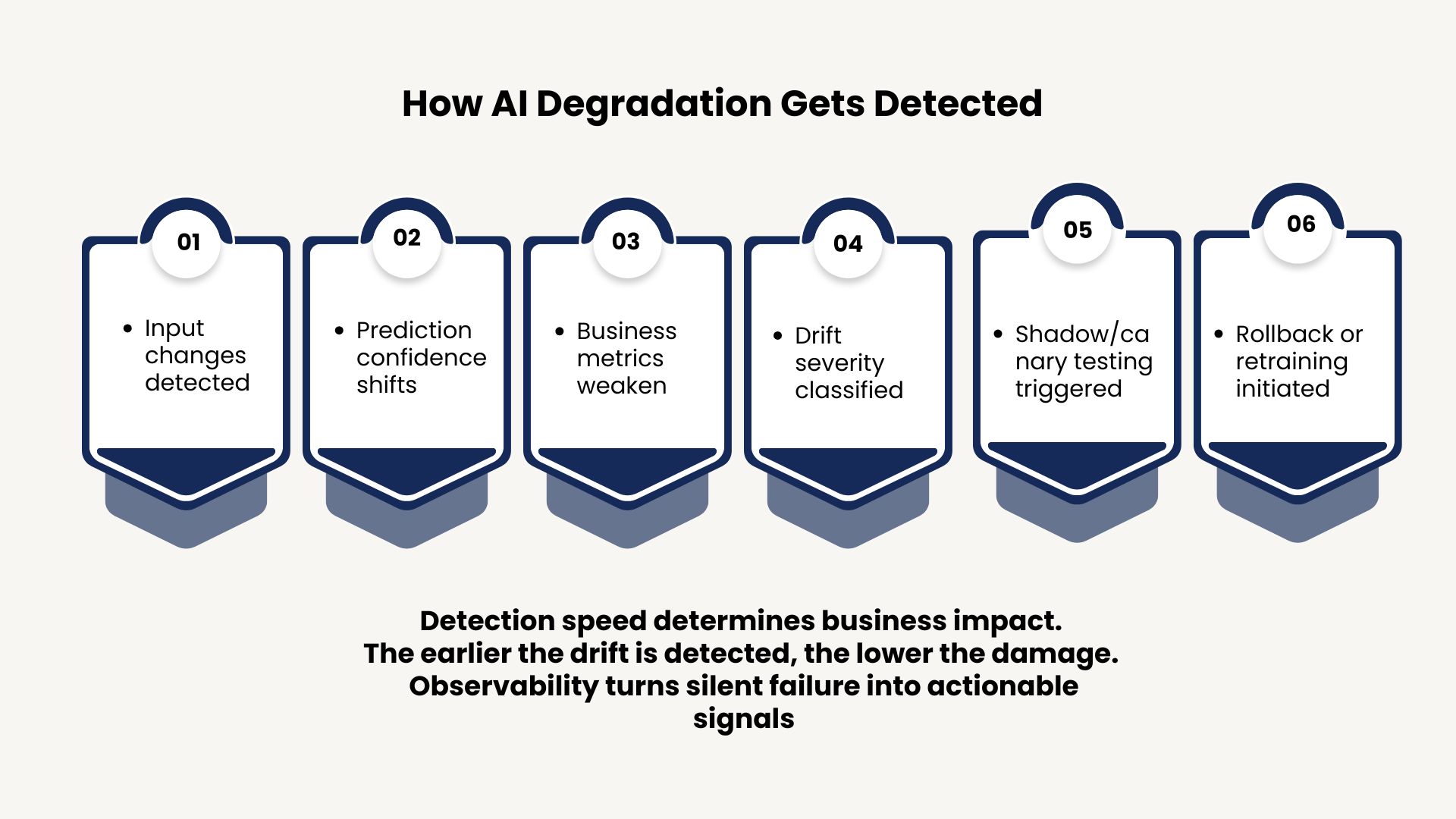
Shadow and canary deployments are the standard for safe rollout. Shadow mode runs a new model against live traffic without affecting decisions, exposing how it behaves on real-world distributions before any user sees its outputs. Canary mode follows, routing a small percentage of live traffic to the new version with automated rollback triggers tied to model-specific metrics, not just aggregate conversion rates that take days to move.
Structured logging with privacy architecture captures enough signal to diagnose failures without storing raw user data. Logging input features, model outputs, confidence scores, latency, and business context creates the foundation for root-cause analysis. Organizations that logged inputs and outputs reduced model-debugging time by 47%.
Automated alerting on business risk, not statistical noise. A 10% shift in input distribution for a send-time optimizer warrants investigation. The same shift in a fraud model warrants immediate escalation. Alerts need to encode business criticality. The goal is catching structural errors early enough to route traffic to safe fallback systems before accuracy loss translates into revenue loss.
A Framework for Measuring Maturity
Production AI reliability is an organizational capability, not a tooling purchase. The AI Observability Maturity Model (AOMM) assesses four dimensions, each scored 0 to 5.
Logging and data maturity asks whether inputs and outputs are captured in production, governed properly, and accessible for retraining pipelines.
Monitoring and alerting maturity asks whether prediction quality, drift, and business-outcome metrics trigger alerts when they deviate from baselines.
Deployment and experimentation maturity asks whether shadow and canary releases are standard practice and whether retraining is triggered by data signals rather than scheduled intervals.
Organizational maturity asks whether every production model has a clear owner accountable for its performance, freshness, and escalation path.
Organizations that reached an average score of 4.0 or above within 18 months reduced model-failure incidents by 59% and saw 23% higher conversion rates from AI-driven segments.
The Strategic Imperative
Most organizations monitor Layer 1: infrastructure uptime, latency, and error rates. The returns are inverted. The higher layers, data health, model health, and business-outcome alignment, provide exponentially more strategic value and remain the least implemented.
The organizations leading in AI-driven marketing are not necessarily those with the most sophisticated models. They are the ones who built operational infrastructure to keep those models healthy, aligned, and improving over time. They understand a distinction that still escapes most teams: traditional monitoring tells you a system is running. Observability tells you it is working.
The question is not whether your models will drift, degrade, or eventually diverge from business reality. They will. The question is whether your organization will detect it in hours or discover it in a revenue report three months too late.
AI-driven intelligence is now core infrastructure. The discipline that makes it reliable is observability. Building it into the architecture is no longer a data science consideration. It is a business imperative.