
Article
AI Memory Systems: Architectures for Persistent and Adaptive Intelligence
This blog explains why stateless AI breaks down at scale in enterprise workflows that span weeks and months, forcing users to rebuild context every session and negating the efficiency gains of AI investment. It covers the four-layer memory architecture (short-term conversational, long-term persistent, episodic and semantic memory, storage formats), the core engineering decisions that determine memory performance, a four-stage maturity model, and the governance risks of context poisoning and privacy that must be addressed before deployment.
- Topic
- Artificial Intelligence
- Published
- 1 Sept 2026

The strategic shift in enterprise AI is not from models to bigger models. It is from stateless tools to persistent systems.
Most enterprise AI today operates on a simple, flawed premise: each interaction begins from scratch. A customer support assistant forgets everything once the session closes. A marketing copilot has no recollection of last quarter's campaign decisions. An autonomous agent loses context between workflows. These are not model failures. They are architecture failures.
As AI moves from experimental tooling to operational infrastructure, persistent memory has become the defining gap between what AI can do in a demo and what it sustains in production. The organizations pulling ahead are not just choosing better models. They are building the memory infrastructure that makes those models contextually aware, continuously adaptive, and genuinely useful over time. Competitive differentiation is shifting from model selection to memory architecture.
Why Stateless AI Breaks Down at Scale
Stateless AI is adequate for isolated tasks. Enterprise work is rarely isolated.
Campaign planning, account management, compliance reviews, customer onboarding: these workflows extend across weeks and months, involving multiple users, systems, and decision points. When AI forgets prior interactions, users are forced to rebuild context manually every session, turning each interaction into a briefing exercise and negating the efficiency gains that justified the investment.
Three failure modes define stateless AI at scale. Repeated context loss forces constant reconstruction: every session starts from zero regardless of how much relevant history exists. Personalization stays shallow because it is based on the current prompt rather than accumulated experience. And session-based reasoning cannot support long-running workflows where the right answer in March depends on what happened in January.
The core problem is structural. Expanding context windows delays the failure but does not solve it. Research shows that as context windows grow, retrieval accuracy degrades for information buried in the middle of the window. More context is not the same as better memory.
The Memory Stack: Four Architectural Layers
Understanding AI memory architecture is prerequisite to evaluating vendor claims and making sound infrastructure decisions. There are four distinct memory types, each serving a different function.
Short-term conversational memory holds the active context of the current session. It is temporary, token-limited, and session-scoped. Most enterprise AI today operates entirely within this layer. It enables coherence within a conversation but disappears the moment the session ends.
Long-term persistent memory is where enterprise AI differentiation begins. It stores durable information across sessions: user preferences, prior decisions, organizational rules, and recurring workflows. Rather than rebuilding knowledge continuously, the system accumulates experience. This is what makes an AI system feel consistent over time.
Episodic and semantic memory represent two distinct modes of long-term retention. Episodic memory captures specific events and context: what happened, when, and under what circumstances. Semantic memory abstracts patterns from those events into reusable knowledge: "This stakeholder prefers concise summaries," or "This account prioritizes compliance over speed." The most capable systems maintain both: episodic records that can be queried and semantic abstractions that inform real-time reasoning.
Storage format matters as much as memory type. Structured memory, including databases, knowledge graphs, and entity stores, offers precision and auditability. Unstructured memory, using vector embeddings and document stores, handles nuance more flexibly. Enterprise architectures require both. Pure vector search lacks the precision for enterprise relationship mapping. Graph-augmented retrieval, which grounds semantic search in deterministic relational logic, significantly reduces retrieval noise and hallucination risk.
Core Engineering Decisions That Determine Memory Performance
Three architectural choices determine whether a memory system scales gracefully or becomes a liability.
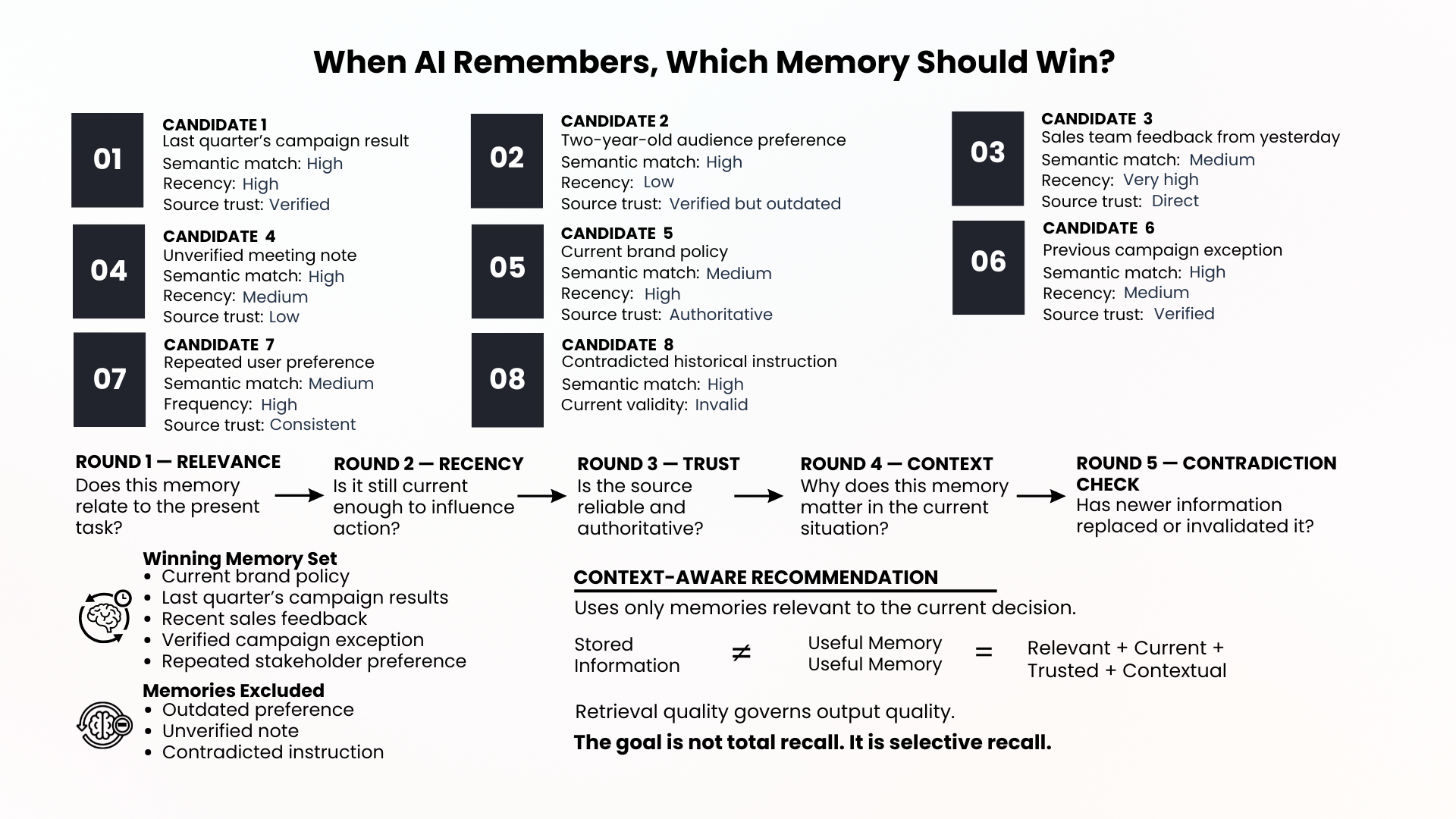
Retrieval mechanism design is the most consequential. The goal is not to recall everything stored. It is to surface the most relevant pieces with enough context to improve the current action. This requires semantic similarity scoring, recency weighting, and contextual inference about why a prior interaction matters now. Retrieval quality governs output quality directly. A model with access to poorly retrieved memories performs worse than one with no memory at all.
Relevance ranking at recall time determines which memory candidates actually surface. The best systems apply multi-factor scoring that combines semantic similarity, recency, frequency of access, and source trustworthiness. This prevents an outdated preference from two years ago from outranking a direct instruction given yesterday, simply because it matched a keyword.
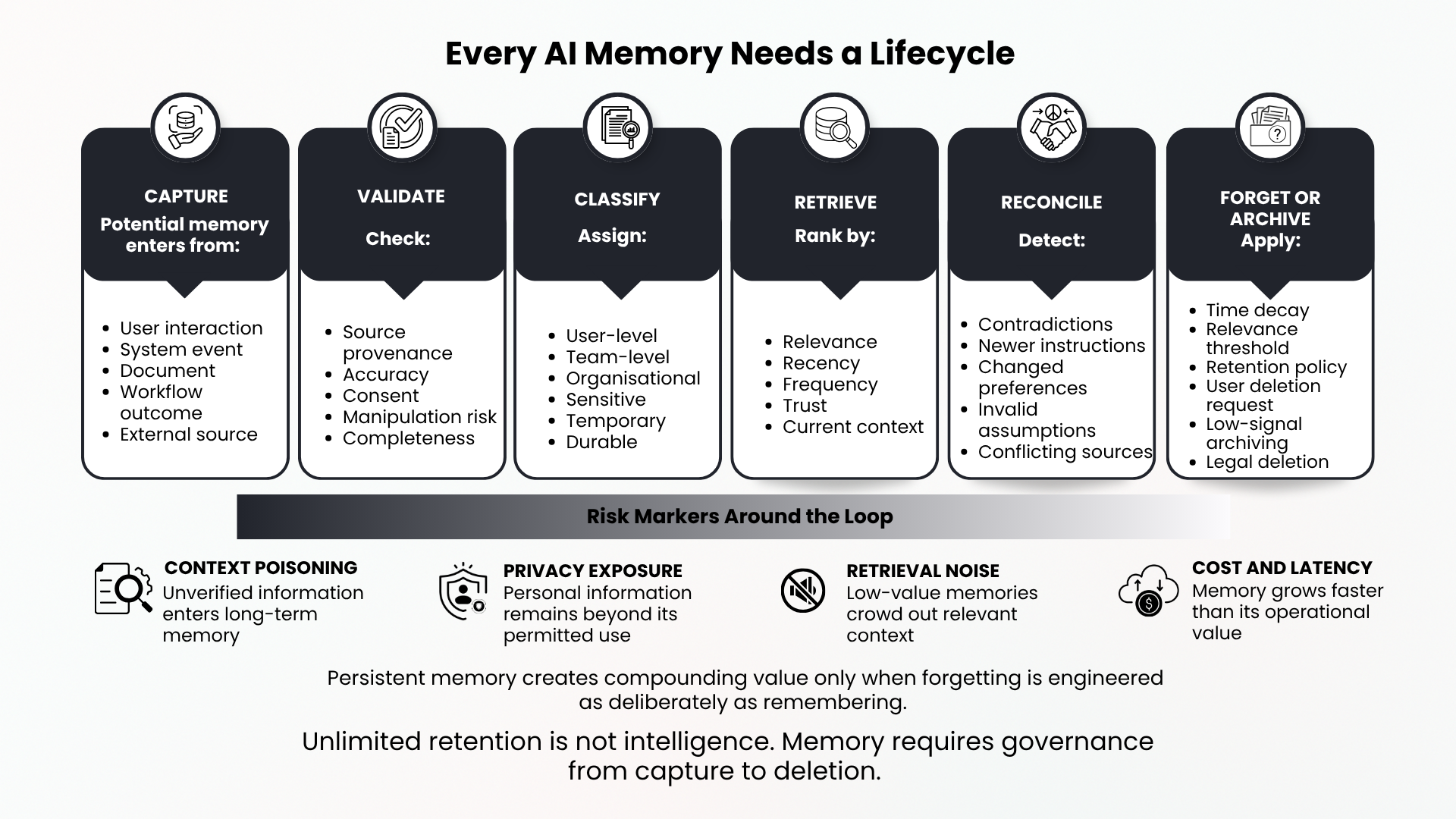
Forgetting and pruning logic is underappreciated but essential. Unbounded memory accumulation creates retrieval noise, storage cost, and the risk of surfacing outdated information with misplaced confidence. Effective systems implement principled forgetting: time-decay functions, contradiction detection, and relevance thresholds that archive low-signal information rather than deleting it outright. Memory is not a warehouse. It is a managed system of retention and loss.
A Framework for Evaluating AI Memory Maturity
Before selecting or building AI memory infrastructure, organizations benefit from a structured maturity model. Four stages define the landscape.
Level 1, Session Memory: context exists only within a single conversation. Sufficient for transactional tasks; cannot support continuity or learning.
Level 2, User Memory: preferences and history persist per user across sessions. Personalization becomes possible, but knowledge stays siloed and does not compound across teams.
Level 3, Organizational Memory: a shared knowledge base spans teams and systems. Agents access institutional context without it being manually re-injected into each prompt. The system functions as infrastructure, not individual tooling.
Level 4, Adaptive Memory: the system learns from outcomes, updates dynamically, and resolves conflicting information autonomously. AI stops being a reactive assistant and becomes an adaptive organizational asset. This requires robust governance and deliberate lifecycle management.
Most enterprise deployments sit at Level 1 or early Level 2. The competitive window is the transition to Level 3 and 4, where memory becomes a durable strategic asset rather than a user convenience.
Risks That Demand Governance Before Deployment
Memory capability introduces risks proportional to the value it creates.
Context poisoning is the most operationally dangerous. If incorrect or manipulated information enters the memory store, it propagates forward, contaminating future reasoning with the confidence of established knowledge. Systems need validation gates, source provenance tracking, and contradiction detection before committing information to long-term storage. Memory should never become self-authoritative.
Privacy and data retention are the most legally exposed. Persistent memory systems storing customer interactions, behavioral patterns, or decision history are subject to GDPR, CCPA, and sector-specific regulations. Deleting an individual's data from vector databases and knowledge graphs requires un-indexing high-dimensional embeddings and re-clustering semantic graphs: far more complex than a row deletion in SQL. Memory architecture decisions are privacy architecture decisions, and legal teams must be in the design conversation, not the post-deployment review.
Cost and latency scale with memory sophistication. Retrieval adds latency. Vector storage maintenance adds cost. These economics must be modeled explicitly against the value created. Intelligent retention, not unlimited accumulation, is the design goal.
Strategic Implications for Marketing and Technology Leaders
The framing that matters most is this: AI memory systems are not a feature. They are infrastructure, analogous to a CRM, a data warehouse, or a customer data platform. Like those systems, they accumulate value over time. Like those systems, they require governance, maintenance, and deliberate design.
For marketing leaders, persistent memory will reshape personalization at scale. The next generation of campaigns and orchestration tools will incorporate longitudinal context: prior interactions, content resonance, account history, and evolving preferences. That precision comes with proportional governance obligations.
For technology decision-makers, persistent memory cannot live as an afterthought inside a single prompt chain. It requires a managed data layer with retrieval logic, lifecycle policies, and access controls. The strategic imperative is to build a vendor-agnostic memory layer that survives model upgrades and platform changes, rather than locking organizational knowledge inside proprietary fine-tuned weights.
For strategy leaders, the biggest shift is organizational. When knowledge survives sessions and compounds across interactions, teams stop restarting from zero. They build on prior context and reduce repetition. That compounds in value especially for multi-stakeholder workflows where institutional knowledge, not isolated task execution, is the real output.
Models will continue to commoditize. An organization's proprietary memory infrastructure, capturing years of buyer context, campaign outcomes, and operational learnings, forms an advantage that is difficult to replicate quickly.
Conclusion
The next phase of enterprise AI adoption will be defined not by which models organizations choose, but by the memory architectures they build around those models.
The intelligence of an AI system is bounded by what it can remember and retrieve. A model with superior reasoning but no memory will be outcompeted, over time, by a model with good reasoning and excellent memory. The lesson from enterprise software history is consistent: infrastructure outlasts tools, and context outlasts raw capability.
Stateless AI can respond. Memory-enabled AI can participate in work, learn from it, and carry that learning forward. The question is no longer whether your AI can perform a task in isolation. The question is whether your AI infrastructure can accumulate understanding and build on it with every interaction.
That is the architecture of persistent intelligence. And the time to design for it is before the limitations of stateless systems show up in your results.