
Article
AI Governance: Mitigating Risks, Addressing Bias, and Ensuring Compliance
In an era where AI drives critical business decisions, neglecting governance invites regulatory fines, biased outcomes, and irreversible brand damage. This blog explores the urgent need for robust AI governance, from addressing algorithmic bias and ensuring explainability to navigating global compliance, so organizations can build trust, mitigate risk, and deploy AI responsibly.
- Topic
- Artificial Intelligence
- Published
- 12 Mar 2026

Your AI lead-scoring model is responsible for lead generation. Your automated customer service chatbot is a great badge to show the cost reduction. Everything is fine on the dashboard. But what happens if the scoring model snares an entire demographic of high-potential clients? What happens if the chatbot encourages out-of-date and non-compliant product promises after being trained on previous data?
This isn't a hypothetical scenario. AI systems used without proper governance frameworks have caused real harm. Facial recognition systems have a 35% error rate for dark, skinned women compared to less than 1% for light, skinned men. It was found that Amazon's recruiting tool devalued resumes that contained the word "women's," indicating that the system was sexist.
The first complete legislative framework for AI in the world is the AI Act of the European Union, which went into effect in August 2024. Businesses that violate these regulations risk fines of up to 7% of their worldwide revenue. Governance is no longer an option for B2B enterprises that deploy AI systems for decision-making.
The New Imperative for AI Governance
The time of AI experimentation is behind us. We are now dealing with agentic AI systems that do not merely suggest but instead perform actions. Organizations currently depend on AI for about 40% of their main operations, which is double the figure in 2023.
McKinsey reports that more than 55% of organizations have AI integrated into at least one function of their business. AI influences a broad range of aspects such as customer segmentation and pricing, hiring and talent screening, fraud detection and risk scoring, as well as lead prioritization and pipeline forecasting. When decisions are automated at such a large scale, even minor errors can cause huge damage.
Besides, the issues of trust and accountability have led to the involvement of the board in AI governance, which was previously a matter of technical teams only. In a 2023 research conducted by IBM, it was revealed that less than 20% of CEOs have already established a solid governance system while around 79% of them are currently integrating AI into their business.
In 2024, a PwC survey demonstrated that merely 58% of companies have done their first AI risk assessment. According to KPMG survey data, 71% of the people are afraid of AI due to a lack of trust. Nowadays B2B customers are performing more checks on the AI governance policies of vendors before they decide to sign contracts.
Regulatory momentum has accelerated dramatically. The new EU AI Act divides AI into different categories in terms of risk, such as those with an unacceptable risk (which would be completely banned), high risk (which would be subject to strict compliance requirements), limited and minimal risk.
By 2024, 45 states in the United States had already proposed AI, related bills, and 31 states had passed laws or resolutions regarding AI. In May 2025 Japan became the first in the world to have an AI, specific Basic Act. The requirement for mandatory labeling in China became effective in September 2025. Given that the EU AI Act will be fully applicable from August 2026 and the various U.S. state, level laws are entering into force, the cost of being "ungoverned" is now legally prohibitive.
There is more to an ungoverned AI failure than simply, a missed opportunity. Regulatory fines of millions of dollars, irreversible brand harm, and irreversible loss of customer trust are all possible.
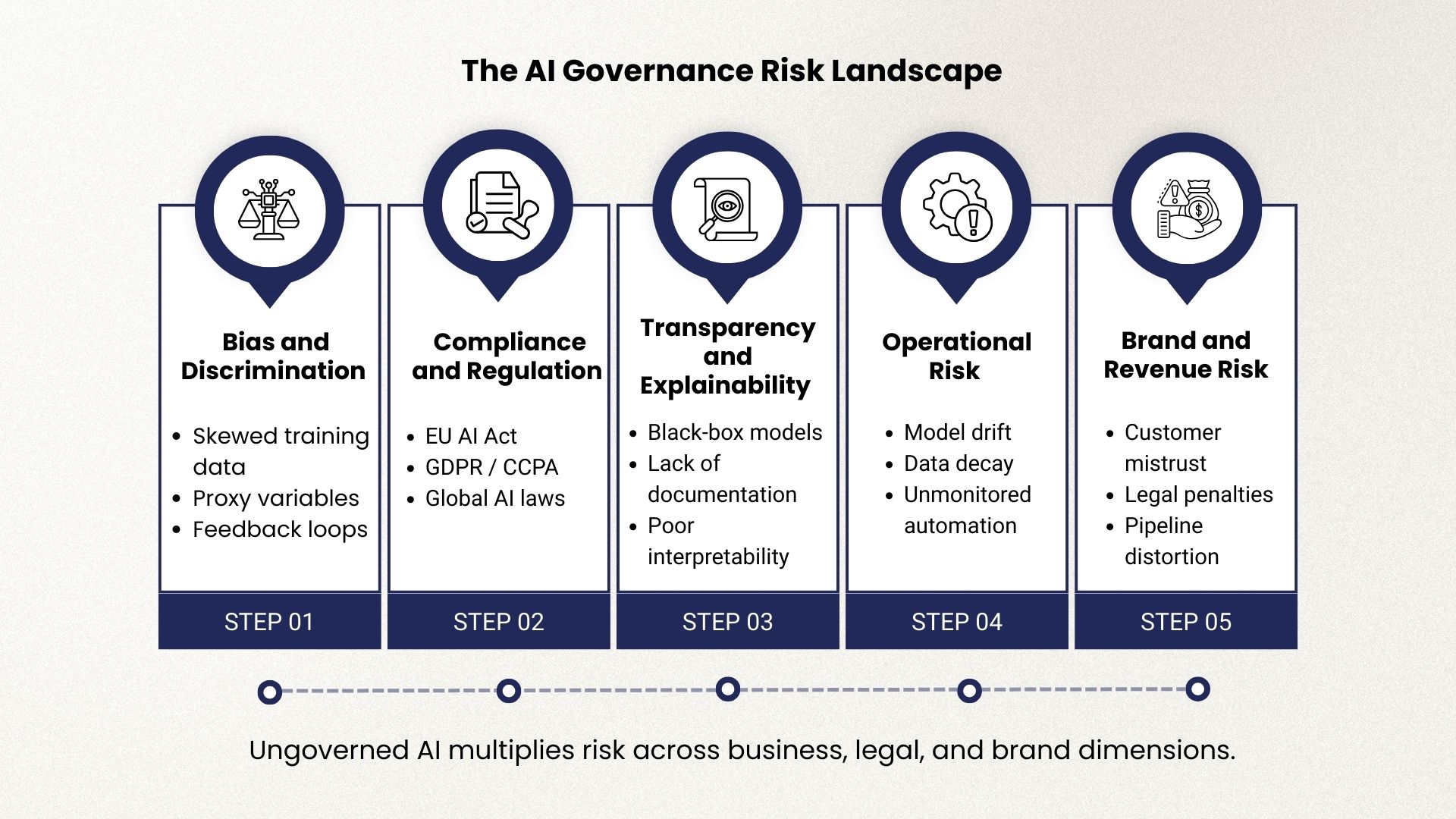
Addressing Bias and Ensuring Fairness
Bias isn't an ethical issue alone. This is a performance and legal flaw.
Historical data reflecting societal inequities creates the most common source. If your past "successful" customers were all from a specific geographic region, the AI naturally deprioritizes innovators who don't fit the mold, effectively locking your growth in the past.
Studies conducted by MIT and Stanford suggest that facial recognition algorithms can even have 34% higher error rates for certain demographic groups. If an AI model is trained on healthcare records where doctors spent less time with female patients, the model will learn to perpetuate this unequal treatment.
Proxy variables encode sensitive attributes. A loan approval model using "zip code" as a feature inadvertently discriminates based on race, a practice known as redlining.
In a 2024 University of Washington study, resume-screening AI systems were tested using identical resumes that differed only in name. Resumes with Black male names were never ranked top by the AI, which preferred names associated with white men.
Interaction bias arises when deployed systems create a feedback loop that exaggerates initial inequalities. For example, if the lending algorithm refuses to lend loans to a certain neighborhood, the residents there will not be able to build their credit history, which leads to further lowering of their loan approval rates in the future. To deal with this issue, researchers at Carnegie Mellon came up with FairSense, which can tell how tiny initial prejudices can get magnified through feedback loops leading to long, term system deployment.
One of the biggest challenges when it comes to measuring fairness is that fairness itself is not defined in one particular way. Companies have to check whether they have demographic parity, equal opportunity, predictive parity, and a low disparate impact. Each of these indicators is reflective of a quite different ethical and operational trade, off. It is a mathematical impossibility in most situations to achieve all of them at the same time. Move beyond vague intentions. Turn to quantitative fairness metrics to verify if model results are unjustly biased towards protected groups. For example, IBM's AI Fairness 360 and Google's Fairness Indicators are two tools that make this process very easy, and they even send a warning when inequalities are found.
Apart from mitigation, actions should come from multiple perspectives. The range of methods includes pre- processing (removing bias from the data used for training), in, processing (utilizing algorithms that impose bias penalties), and post, processing (modifying model outputs). Data audits uncover the groups that are underrepresented. Regular bias audits along with diversified training datasets can decrease unawareness by 30%. Fairness, aware algorithms and human intervention at highly sensitive decision, making stages are two other ways for additional controls.
There are trade-offs between having a perfectly accurate model and a perfectly fair model. Debiasing a churn model might drop accuracy by 5-10%. Governance requires a conscious, documented business decision on where the balance lies, approved by legal and leadership. A 95% accurate model being fair is infinitely more valuable than a 99% accurate model creating a PR nightmare.
For B2B organizations using AI in lead prioritization or customer scoring, biased models distort revenue forecasts and misallocate sales resources.
Opening the Black Box
You simply cannot manage what you don’t comprehend. Being able to explain is fundamental not only to trust but also to compliance.
Impose a "Model Card" for each production AI, a universally recognized document that describes the purpose, performance, training data, known limitations, and fairness assessments. It is a living document, rather than a one, off report. The EU AI Act demands extremely comprehensive documentation to accompany high, risk systems, including risk assessments, data governance measures, and human oversight procedures.
Different types of stakeholders require different explanations. One is a data scientist who needs technical feature importance. A loan applicant is entitled to receive a simple and clear explanation of the reason for the denial ("lack of credit history" not "the algorithm said no"). The EU AI Act obliges high, risk AI systems to be developed in a way that enables users to understand the outputs properly.
Particularly in regulated businesses, explainable AI technologies like SHAP and LIME help comprehend model behavior. From $8.1 billion in 2024 to $9.77 billion in 2025, the explainable AI market expanded at a compound annual growth rate of 20.6%.
Every AI-based decision must be registered along with input data, model version, and output. This audit trail is essential to enable debugging errors, customer dispute resolution, and compliance evidence during regulatory audits. Production systems are required by the regulator to keep logs for 6-24 months.
Limitations exist. A 2017 review of explainable AI workshop papers found not a single paper performed human evaluations demonstrating interpretability. Broader examination of over 18,000 XAI papers showed only 0.7% mention any kind of human evaluation. Studies demonstrate humans consistently over-rely on AI suggestions even when incorrect and even when provided explanations.
Navigating Compliance
Data privacy restrictions set the basis for fundamental requirements. GDPR requires an explicit opt-in for the processing of EU data. CCPA provides the right to opt-out of sales. Using customer logs for AI training is subject to both regulations. If a company fails to comply, it can be fined up to 4% of its global annual turnover according to GDPR.
Different regional laws and regulations bring about difficulties in compliance. The EU AI Act is prescriptive, categorizing specific use cases and mandating detailed requirements. The UK emphasizes flexibility and context-driven application of principles. The US emphasizes sector-specific regulation. A model deployed globally must comply with a patchwork of rules. Governance requires a geofenced deployment strategy.
Audit readiness means treating your AI portfolio like your financial statements. Colorado's AI Act necessitates that implementers of high, risk AI systems keep risk management programs that are reasonable considering the use of established frameworks such as NIST AI Risk Management Framework or ISO 42001.
Get ready for the auditors to investigate your model development processes, data pipelines, and decision logs. If you are proactive in your governance, what could have been a chaotic audit will simply become a standard procedure.
Building Practical Systems
Define clear roles. Set up a cross, functional AI council. Planning shouldn't be left to just IT. You also need your CMO (to look at brand and bias issues), your Legal Counsel (to ensure compliance), and your CFO (to evaluate risk). AI ethics committees offer a broad strategic oversight and are responsible for giving the green light to high, risk AI initiatives. Model owners are the ones who should be held accountable for the results of the model. ML engineers are those who carry out technical controls. Without clearly defined responsibility, governance efforts will be unsuccessful.
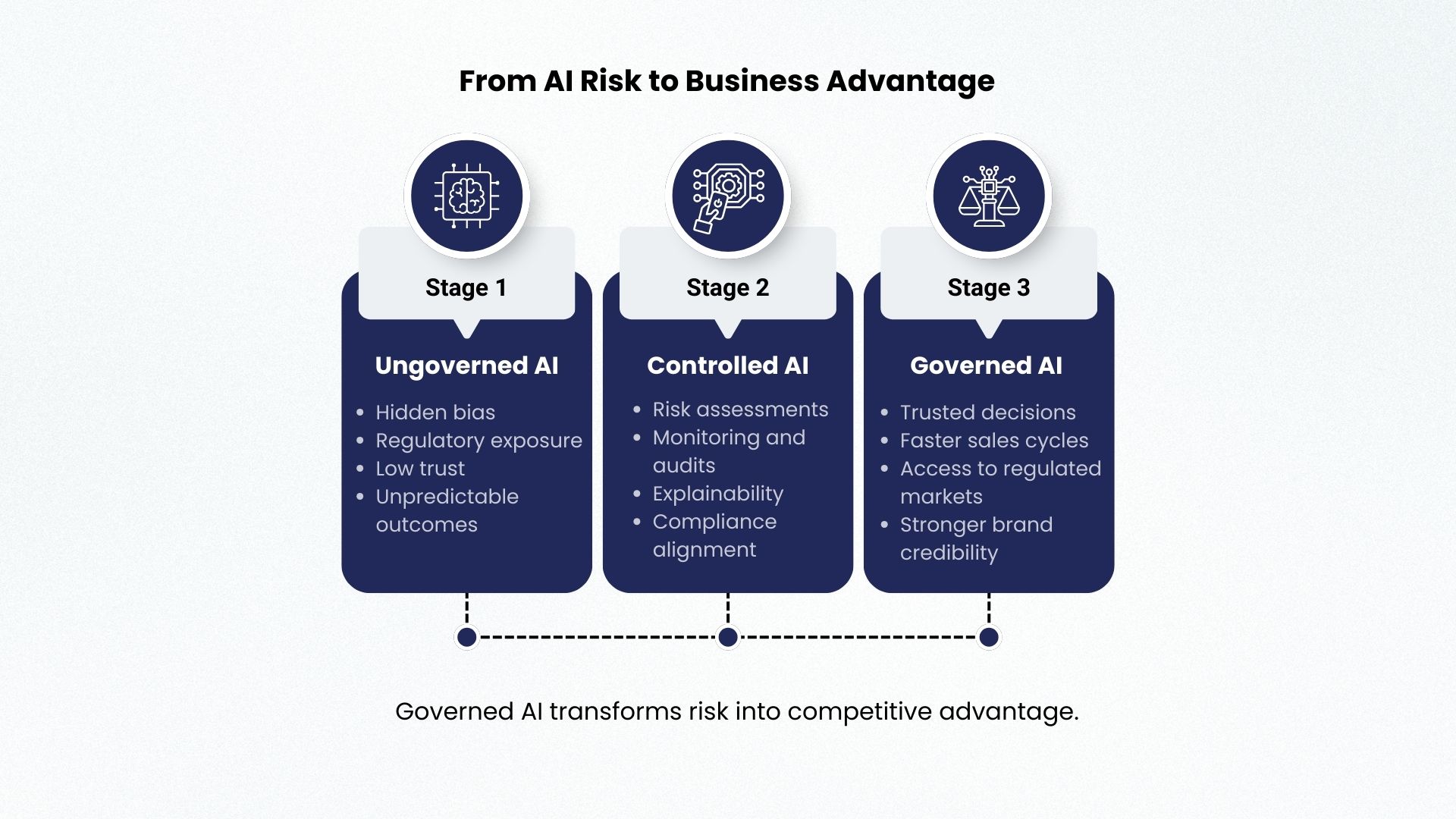
Don't write a policy document sitting on a shelf. Embed governance into the ML-Ops pipeline. Use automated tools to scan for bias, check for data drift, and require model cards before deployment. Policy sets the rules. Technology enforces them on a scale. Automated checks prevent deployment of models failing fairness tests. CI/CD pipelines include bias detection steps.
Adopt a risk-tiered approach. A generative AI creating marketing copy requires different governance rigor than an AI diagnosing diseases. AI models "decay" over time as the world changes. Implement continuous assurance where systems are audited in real-time, not once annually. Quarterly reviews should examine performance metrics across demographic groups, audit logs for unusual patterns, incident reports and resolutions.
Balance innovation and control. Over-regulation kills innovation and under, regulation opens to risk. Top companies decide on their regulation as "guardrails, not gates": they allow experiments in the frameworks of structured governance.
Governance frameworks for safe deployment are the ones that are most clearly laid out because they provide both guardrails and clarity, hence, granting teams freedom leading to innovative work at a high level of confidence.
Organizations succeeding at AI governance treat this as enablement rather than constraint. Robust governance builds customer trust, accelerating sales cycles. Documented fairness practices differentiate vendors in competitive evaluations. Compliance frameworks open regulated markets.
B2B leaders should start building their governance frameworks right away if they plan to employ AI in 2025.
Finding the AI applications that will have the biggest effects requires a risk assessment. Establish a framework for ongoing monitoring as well as initial fairness metrics. Examine and document the current configurations. Establish cross-departmental governance groups and grant them explicit authority. The businesses who choose to start building trust, transparency, and accountability in their systems at the basic level will be the most successful in the future, where AI is the primary driver.
Individuals who manage AI the best will prevail, not the ones who employ it the fastest.